NEW - download 'Seoul VillageS (서울 마을들)', my collection of 12 short fictions now adapted into short films! Get your free copy of the ebook (4 editions: English, French, Korean, Bilingual English-Korean)!

Friday, April 29, 2022

Seoul's Waterfront Renaissance

Seoul has always been defined by its most valuable environmental assets: its countless waterways, and the mountains that feed them. 

From the start, the capital revolved around Cheonggyecheon and its network of streamlets:
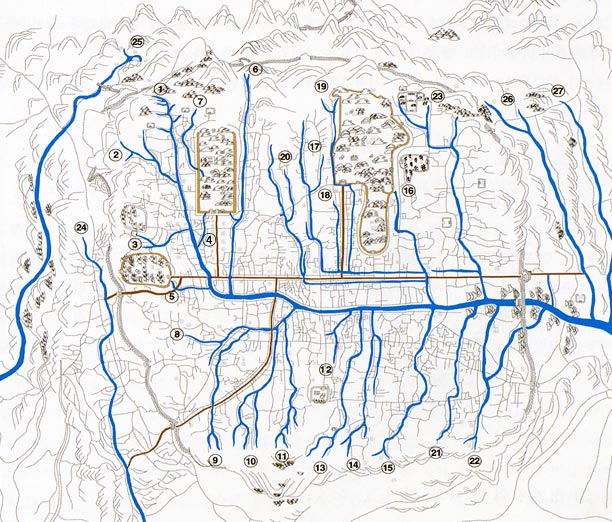
Nowadays, the Han River tells what's North and what's South, but waterways still account for 8.1% of Seoul's land (below in 2010):

After pouring concrete all over the place to tame the powerful Hangang and its tributaries, to stabilize unstable riverbanks, and to prevent recurring floods, the city has reopened its heart to its waterways, rediscovered them as leisure paths and environmental treasures. Following the restoration of Cheonggyecheon, the Hangang Renaissance, and the restoration of neighborhood streamlets, masses of humans, birds, and even fishes have flocked back to Seoul's watersides. Yes, more concrete was often poured in the process, but biomass keeps growing, embankments are often doubled with natural fish nurseries, and significant wetlands have been created.


Citizens are already very active along these waterways, thanks to all the infrastructure needed by strollers, cyclists, or workout maniacs:

But water level and street level are seldom seamlessly connected, and for good reasons: flash floods remain a constant threat, and these waterways help the city cope with extreme downpour. On such occasions, riversides must be evacuated immediately. Still, more citizens could spend more leisure time there, particularly when they crave for more free and cool open spaces.

More than a decade after his Hangang Renaissance project, Mayor OH Se-hoon aims at a 'Jicheon Renaissance' leveraging Seoul's 332 km of waterways. Not just with more hardware, but with more content and culture, a better connection to local neighborhoods and markets, More 'emotion', as part of an 'Emotional City' of the future vision.

Starting with 4 pilot projects along three streamlets (Dorimcheon, Jeongneungcheon, and Hongjecheon), with 2 more sites by 2030 (Anyangcheon and Jungnangcheon):

  • Hongjecheon will never fulfill its great potential as long as the Naebu Expressway disgraces it (see "Along Hongjecheon, my way or the highway"), and the pilot will focus on two spots: upstream at Hongjimun and Tangchundaeseong, midway at the artificial waterfall near Seodaemun District Office, with a place to have a drink.


  • Dorimcheon is more about the connection to the neighborhood and its businesses, with decks to make the transition and chill out:


  •  Jeongneungcheon will add a cultural layer through a new media art space:


Of course, all this requires water, particularly since the city intends to make these shallow streamlets a bit deeper (from a very thin 10 cm to a more significant 30 cm). So backstage, there's a lot of work to improve water and waste management. 

Today, 18 streamlets including Cheonggyecheon are actually fed with water recycled from the Han River, and climate change has spectacularly dried up the whole nation. Even if I knew Seoul experienced very few precipitations last Winter, I was stunned to see in a recent treck up Bukhansan, how parched soils were. But the only time water streamed by was magical:

As usual, I guess we'll have more imperfect, odd spaces requiring some improvement in further iterations. But overall, Seoul keeps democratizing access to quality time and nature, even if that's in not so natural spaces.

Seoul Village 2022
Welcome to our Korean Errlines! Follow Seoul Village on Facebook and Twitter, follow me on Instagram.
Download 'Seoul VillageS', the free ebook.
Bookmark and Share


Thursday, March 10, 2022

YSY does it?

Every five year, I have the same dream: that Korea switches to a two-round system for its presidential elections, which would not only reflect more accurately the diversity of opinions, but also result in mergers much more transparent, fair, and based on policies. But no. As usual, we witnessed last minute, winner-takes-all mergers between individuals. And as usual, the dozen-plus roster boiled down to two heavyweights snatching 95% of the cake. 

I wish SIM Sang-jun had raised the issue during her otherwise perfect concession speech. She did claim 800k votes and AHN Cheol-soo at least one third of that even without running (judging by the 300k invalid votes due to last minute withdrawals), but both would have scored much much higher otherwise, forcing main candidates to move closer to the center before the second round.

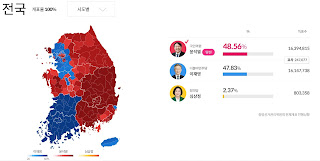
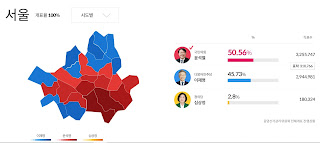
If none of the polls that followed the YOON-AHN alliance* were made public because they were too close to the elections, they all put the opposition candidate ahead by two to seven points. Yet YOON eventually finished only less than 250k votes ahead of LEE - less than what he gained in Seoul alone:


The capital city confirmed its 2021 rejection of a ruling party that lost not only key strongholds there, but also 4 of the 5 assembly seats in play nationwide on the same election night (by a much wider margin than for the presidential election).

Absolutely not Trumpian on that one, LEE Jae-myung conceded very gracefully. He would have had a difficult time trying to contest the score after the troubling incidents in Seoul, Gyeonggi-do, or Jeju-do that cast serious doubts about electoral integrity. The nation could even have faced a major crisis if LEE had won very narrowly. MOON Jae-in and the controversial head of the National Election Commission NOH Jeong-hee did apologize for the 'incidents', but they involved officials who had to be more than aware of the existential threat their behavior represented for democracy, and they looked disturbingly consistent with the extreme episodes witnessed during the administration's attacks on justice.

Hopefully, this closer than expected final gap was mainly due to the ruling party's last ditch mobilization of its formidable turnout machine combined with a weakened motivation on the other side: AHN guaranteed YOON's win, why vote for such an uninspiring candidate?

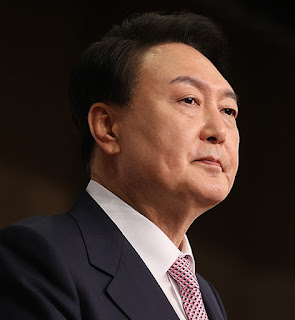
By all means, YOON Suk-yeol, a reluctant politician, was not a good candidate. And he was far from always a candidate for good.

I disagree with many elements of the candidate's program, but I want him to deliver the goods on one key front: democracy, justice, the constitution.

Korea needs the YOON who, as a student under the dictatorship, led a trial of CHUN Doo-hwan.

Korea needs the YOON who, in 2013, was suspended for refusing to stop investigating the meddling of LEE Myung-bak's secret services into the 2012 presidential elections.

Korea needs the YOON who joined the team that prosecuted PARK Geun-hye.

Korea needs the YOON MOON Jae-in handpicked as his Eliot Ness to lead the nation prosecutors and justice reform, and who said no when MOON told him to stop investigating Cho Kuk or Cheong Wa Dae corruption.

Korea needs the YOON whom both the extreme left and the extreme right hate. 

And that YOON would better show up. Five years ago**, Korea needed the MOON who stood for democracy, and ended up with another one who undermined it. This divided nation can't afford another betrayal.

YOON's one mission as a candidate was to kick the ruling party out of Cheong Wa Dae, and that will be done when the transition is over. As a president-elect, his mission will be to gather a team that can inspire voters for the upcoming legislative elections, but also reach across the aisle, to moderates among a hostile assembly. 

Very transparent about his lack of experience as a politician, the man has a reputation to delegate a lot, to let pros do their job, and to take full responsibility. YSY does it. So casting will be key.

Candidate YOON needed the People Power Party to run and AHN Cheol-soo to win, President YOON simply can't succeed with the PPP platform. And clearly, there's no way he can unite the nation if he keeps including LEE Jun-seok's anti-feminist agenda. Ideally, that young lad should be the first one to be shown the door, and AHN Cheol-soo should lead the transition team.

I'm not forgetting another essential role of the President: representing and defending the nation in these very troubled times. And Russia's invasion of Ukraine already impacted the campaign and the region:

  • not very good news for a nuclear-free peninsula: another motive for North Korea to keep its weaponry, another motive for South Korea to revive its civil program (MOON Jae-in even had the gall to say the nuclear energy he's been dismantling for years was strategic for the nation's future....)
  • not very good news for Yankees-Go-Home cheerleaders: while LEE Jae-myung struggled with his base, YOON Suk-yeol could herald the alliance full throttle. Joe Biden didn't even wait for concession or acceptance speeches to congratulate his preferred (and fellow gaffe-a-day) candidate.
  • not very good news for XI Jinping's plans to invade Taiwan. And now he knows bullies can be bullied. XI has yet to congratulate a man who made no mystery about where he stands between the US and China.
  • good news for the Korea-Japan dialog: YOON sent clear, positive signals. Let's hope his sense of justice will make him nonetheless stand for the last survivors of Imperial Japan's sexual slavery system, who can't wait for another term.

Tensions are likely to exacerbate in the region because of Putin's war, but much of the ambiguity will be gone, which may paradoxically be helpful for some meaningful diplomacy (including why not with North Korea). Interesting to see how existing and new alliances evolve or take shape.

On all fronts, please, more pragmatism and common sense, less ideology (yes,
that includes you, Milton Friedman).

Please, more transparency, more accountability.

As usual, I'll be keeping a critical eye on the rulers. With cautious hope.


Seoul Village 2022
Welcome to our Korean Errlines! Follow Seoul Village on Facebook and Twitter, follow me on Instagram.
Download 'Seoul VillageS', the free ebook.
Bookmark and Share

* see "AHN Cheol-soo joins YOON Suk-yeol"

** see "A new MOON Jae-in?"  


Wednesday, March 2, 2022

AHN Cheol-soo joins YOON Suk-yeol

Last night, following the last presidential debate, AHN Cheol-soo decided to stop his campaign and give his full support to YOON Suk-yeol. Expected almost from the start*, this move was postponed until the last possible moment to mark AHN's ballot papers, even if voting has already started overseas.

"Ahn Cheol-soo and Yoon Seok-youl in joint presser to announce campaign merger" (20220303 - twitter.com/theseoulvillage/status/1499159949062017025 @theSeoulVillage)

AhnLab founder lifts YOON's candidacy on such key issues as innovation, economy, education, or health. Mostly, he brings guarantees about his capacity to unite around the center, and to mobilize younger generations.

A reluctant candidate and a mediocre campaigner, YOON hesitated a long time before joining the PPP, an irrelevant opposition party where he had to compose with obsolete paleo-conservatives on one extreme and aggressive young anti-feminists on the other: PARK Geun-hye supporters never forgave him his role in her imprisonment, and LEE Jun-seok excels at dragging his candidacy down. Today, YOON was obviously relieved to see AHN unlock the shackles and help him focus on what matters most to him: healing Korean democracy, starting with justice.

The first mission of the united ticket is to prevent LEE Jae-myung from reaching power. Protected by the government, the controversial populist was able to cruise during the campaign without fear of being investigated in the Daejang-dong scandal. And if the family of the women murdered by his nephew (whom he defended during the trial) sued him for dismissing the double murder as 'dating violence', this most Trumpian character played the clock by delaying his answers to the judge beyond the legal limits, pushing the next steps until after the elections. 

Imagine what this man could do if he reached presidency and enjoyed the total impunity created by the ruling party's most outrageous reform: the de facto end of oversight of the executive power and the creation of the highly controversial Corruption Investigation Office, which was instantly weaponized to harass YOON and to protect Cheong Wa Dae from embarrassing scandals.

On that one, MOON clearly insulted ROH Moo-hyun's memory: the late president, a man who genuinely cared for democracy and justice, would have been appalled by a move that also betrayed the spirit of 2016, when the population overwhelmingly called for a defense of both, and the respect of separation of powers.

Beyond LEE and Trump, I often make a parallel between Korea's ruling party and the US Republican party. Both have lost their way on what used to make them most respectable. Both need to lose in 2022 if they don't want to lose their souls. And both need to humbly return to the drawing board (preferably not to push for more gerrymandering or deceitful schemes).

It may sound indecent to talk about existential threat when thousands die in Ukraine under Russian aggression, but this time, Korea must get it right, and heal from its core. And its center.


Seoul Village 2022
Welcome to our Korean Errlines! Follow Seoul Village on Facebook and Twitter, follow me on Instagram.
Download 'Seoul VillageS', the free ebook.
Bookmark and Share

* and not even one year after AHN's merger with OH Se-hoon ("After OH Se-hoon's Hangang Renaissance, Who In 2022?")

Wednesday, January 26, 2022

More Gwanghwamun Square previews

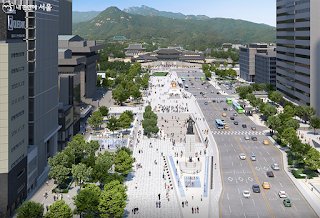
Seoul revealed new visuals of Gwanghwamun Square 3.0, which shall be inaugurated in July.

They prolong the last major iteration presented in 2019 ("Gwanghwamun Square 3.0 re-Deep-Surfaces"), which corrected one of the worst urbanistic blunders  of the initial version ("Gwanghwamun Square Enters Third Dimension"). PARK Won-soon's team rushed the construction a few months before the elections without conducting any decent impact survey, and work started late 2020. As soon as OH Se-hoon returned as mayor, he paused the site to assess the situation, but the changes could only be cosmetic.

The Woldae extension in front of the palace gate will only be created next year, so we have yet to see how vehicles flow around Yulgok-ro's future curve. Adjusting to the modifications already in place is not always easy. As expected, the intersection in front of Sajik-dan helps reconnect both sides of Sajik-dong, but the impossible new U-turn just North of the Government building stops functioning as soon as traffic slows down (too close before a major traffic light, unlike the old one heading for Sajik tunnel).

Most important, Seoul's defining axis is preserved, with its iconic Gwanghwamun-Gyeongbokgung-Bugaksan perspective, and pedestrians will enjoy a 20 m-wide park with a vast selection of tree species, guaranteeing natural shade and oxygen as they grow. That's where most of the extension (from 18 to 40,000 square meters) comes from. People will be able to sit on benches and along the Haechi Madang ramp, where street animations may bloom next to the new media wall.

Sejong-daero's pedestrian and cycling experience has already been improved with the new green walks and bike lanes added on the way to Namdaemun (see "Lower Sejongdaero's turn"). With its fountain tunnel and pavement fountain, the 'Gwanghwamun' Lounge section is likely to welcome kids and keep them fresh during the Summer. If some artifacts found during the renovation shall be on display in the cultural section, most of the Joseon era infrastructures (see timeline*) shall be covered again. I hope the tribute to Yukjo street will not look to corny. 


On the Eastern side, Junghak-dong will not host a simple reconstitution of the old Uijeongbu site, but a fusion hanok exhibition space. I wish there were more trees in that section, but that can (and probably will, if they want the spot to be successful) be fixed later.

This Uijeongbu project was on display at the Seoul Hall Of Urbanism (see again timeline below*) during the low key, pandemic-plagued 3rd edition of the Seoul Biennale of Architecture and Urbanism. SBAU will return in September 2023, with CHO Byung-soo (BCHO Architects) as its Director. This architects knows a bit about dao, and Seoul could do with some more harmony...

Ganghwamun Square reopening in the heat of the Summer will be a perfect crash test. I'm pretty sure Seoulites will quickly make it their own. At least during the evenings. And as much as that damned coronavirus will allow.


Seoul Village 2022
Welcome to our Korean Errlines! Follow Seoul Village on Facebook and Twitter, follow me on Instagram.
Download 'Seoul VillageS', the free ebook.
Bookmark and Share


* From @theSeoulVillage timeline: 


"Gwanghwamun Square last week. Seoul started controversial revamping without a proper impact survey..." (20201220 - twitter.com/theseoulvillage/status/1336888158437265408)


"The few changes since the initial plan won't prevent the expected traffic pandemonium. Tragic lack of urban planning, urbanism vision from Seoul... Sejong-daero Gwanghwamun" (20210221 - twitter.com/theseoulvillage/status/1364019424752115720)


"Western side of Sejong-daero / Gwanghwamun Square to close tomorrow for the controversial revamping (future Jeokseon-dong loop in the foreground)" (20210305 - twitter.com/theseoulvillage/status/1367760419218018306)

"As expected, works on the Western side of Gwanghwamun Square for its extension reveal Joseon time artifacts and structures related to former ministries. Here, a waterway in Jeokseon-dong (between Baekundongcheon & Junghakcheon - see seoulvillage.blogspot.com/2009/08/baekun #urbanism)." (20210319 - twitter.com/theseoulvillage/status/1372721209939431427)

"I guess mainly to evacuate overflows towards Baekundongcheon, to contain water damage in case of heavy rains. Gwanghwamun Square urbanism Jeokseon-dong Photo Chosun Ilbo" (20210319 - twitter.com/theseoulvillage/status/1372721211789037583)
"OH Se-hoon hits pause button on controversial Gwanghwamun Square revamping. Also asks AHN Cheol-soo to suggest talents for Seoul." (20210410 - twitter.com/theseoulvillage/status/1380664510638264322)


"Seoul's unearthed Yukjogeori during Gwanghwamun Square revamping:" (20210511 - twitter.com/theseoulvillage/status/1391895161337090049)


"Gwanghwamun's future Uijeongbu site at Seoul HOUR (Seoul Biennale / SBAU):" (20211028 - twitter.com/theseoulvillage/status/1453500318226935809)


Sunday, January 16, 2022

From Human Town to Gather Town

Interesting to draw a parallel between OH Se-hoon's last two urban concepts: 'Human Town', which he didn't have time to fully roll out and scale up before the abrupt end of his previous mandate (see " OH Se-hoon launches the "Seoul Human Town" concept"), and 'Gather Town' ('Moa Town'), which has just been announced, less than a year after his return to office.

Both concepts rely on a common goal: revitalizing neighborhoods without destroying them with the usual 'New Town' model, offering community services usually found in big projects while preserving a nuclear, lower rise structure.

Seoul notes that 87% of low-rise neighborhoods don't meet requirements for redevelopment, often because they are not derelict or old enough. Yet many are poorly maintained because they stretch without a common purpose, and their dwellers already struggle to maintain shared spaces within their own buildings.

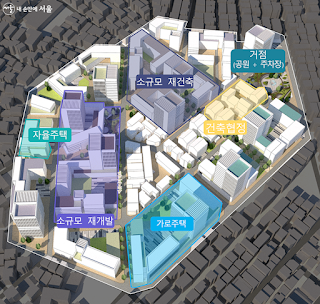
Where Human Town proposed a smart and light cosmetic revamping, Gather Town hybrid formula includes partial redevelopment to replace shared houses and 'villas' with low-to-mid-rise apartments, while preserving the street structure. Key regulations will be eased, for example the threshold for the proportion of deteriorated units, the type of buildings included. Where big projects cover over 100k square meters and take 8 to 10 years to complete, Moa Towns will start from 1,500m2 and only require 2 to 4 years. Seoul aims at 20 projects every year, and 2,404 units by 2025.

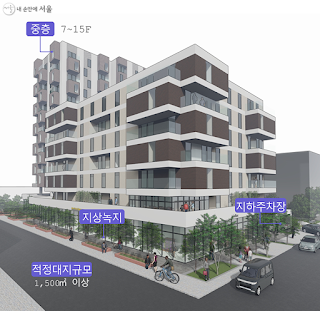
So unlike with Human Town, where individual units keep evolving at their own pace, it won't really the same neighborhood. But shared infrastructures can go much further, for instance a big underground parking that will fully liberate street level, and allow the removal of all these ugly ground floors on pilotis in favor of actual life spaces (shops, terraces, plants and parks, community services like libraries or day care centers...). 

Provided the design is up to the ambition, lively pockets can emerge in the middle of forsaken neighborhoods, and radiate across them.

I like the notion that pragmatism allows the combination of several techniques (certain sections can be redeveloped, other maintained, see schema below), but I wouldn't want it to become just a shortcut to build quickly something that lacks consistence and soul. You want a village where citizens breathe and enjoy walking.

If this rendering of a street (below) doesn't seem very exotic to Western eyes, 80s zoning sure beats the 50s Grands Ensembles that have kept popping up across Seoul ever since the sixties. And this looks much more welcoming than dense, tree-less 'villa' clusters. Provided of course these mid-rise sections conveniently hidden in the background remain a tiny part of the program. Note the post-covid architecture with individual balconies and on the second floor a shared outdoor space running along what must be community services or shops.

The first two projects mentioned on January 13th are Myeonmok-dong, Jungnang-gu, a vast low-rise neighborhood at the feet of Achasan, and Beon-dong in Gangbuk-gu, around Dream Forest and Odong Park, between Suyu-dong, Mia-dong, and Chang-dong, close to the Ssangmun-dong of Seong Gi-hun and Cho Sang-woo (both fictional characters sharing a lot with their author HWANG Dong-hyuk, a true local*).

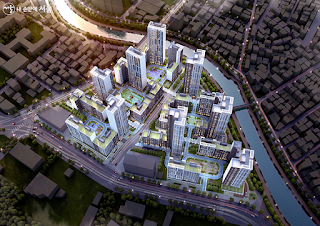
The Beon-dong project is not small at all (50,000 m2), and the one in Myeonmok-dong is almost twice bigger (97,000 m2). Sorry, but to me, this looks much more like a mini-New Town that to an improved old-town:

Beon-dong's 'Gather Town'
 

Obviously, 'Gather Town'  is less human centric than 'Human Town'. More top down than bottom up, with a top that rises a bit too high above 'low rise' levels... 

Seoul Village 2022
Welcome to our Korean Errlines! Follow Seoul Village on Facebook and Twitter, follow me on Instagram.
Download 'Seoul VillageS', the free ebook.
Bookmark and Share

* BTW ICYMI I was mentioned in Charlie Usher's article on not so glamorous Seoul neighborhoods ("The heart of Seoul – the working-class neighbourhoods captured by Squid Game and Parasite"). Of course, less glamorous doesn't mean less valuable, to the contrary. And if you haven't watched it yet, go binge "Squid Game - an addictive slap in the face".

Tuesday, January 4, 2022

Seoul Village Season XVI

Happy New Year of the Tiger! Let's see how this young cub grows and roars.

And let's hope the pandemic will spare us another scary sequel...

As we've known from the start (see "Kudos to Korea's 4 Ts, but please no complacency"), we can never let our guard down while riding such roller coasters. This year, as expected, after failing to secure vaccines as early as other wealthy nations, Korea caught up very quickly once they arrived. But a populist decision to ease restrictions at the worst moment (during a surge and before year end festivities - not to mention an unexpected new variant) led to record cases, hospitalizations, and deaths. Fortunately, the population started to react and the government to backpedal, so the last couple of weeks have seen a steady decline in the number of cases. Keep safe and carry on.


This year, barring more surprises (and we've had our share of those lately), the presidential election could be the most defining moment for a country where the balance of powers has been dramatically altered over the past few years.

LEE Jae-myung is now leading in the polls, with the help of YOON Suk-yeol (definitely not a seasoned politician), and of course MOON Jae-in. Interesting contrast: while LEE remains totally protected from any investigation around the Daejang-dong scandal, the controversial CIO has been spying the phones of campaigning opposition members in a local version of the Watergate...

In a brilliant lame duck move, MOON pardoned PARK Geun-hye, the equivalent to throwing an elephant into the opposition's already unstable porcelain store before the elections: now YOON, who investigated the scandals surrounding the former president and CHOI Soon-sil, will have an even tougher time getting votes from hardcore PARK supporters... 

That LEE Jae-myung could envision the White House in spite of his sulfurous reputation and the ruling party's unpopularity speaks volumes about the opposition's ineptitude. Character-wise, LEE is clearly closer to Donald TRUMP than to KIM Dae-jung - but at least, unlike the former POTUS, he's working very hard to change his image during the campaign.

Beyond securing the elections, MOON is focusing his final months on an intense lobbying to formally end the Korean War, which requires an agreement from other stakeholders. But unless Trump returns to power, the US will demand significant concessions from KIM Jong-un, and that is precisely what MOON wants to avoid.

MOON Jae-in's goal is to remove pressure on the North Korean regime and US troops from the Peninsula. South Korea's recent displays of weaponry and hikes in military budgets are supposed to prove that the nation can defend itself (should of course its leaders actually decide to defend it). Needless to say, both China and Russia would also love to see Yankees go home. 

Soft-power-wise, at least, Seoul can count on its Weapons of Mass Distraction, even if topping 2021 will be very hard for 'k-content' providers.

We'll need some cheering up to cope with real life drama (and at the macro level household debt, inflation, rising rates, overdue bubble bursts across the globe...).

Maybe we don't want that tiger to roar, after all. A cute yawn could be a welcome break.


Please be safe, but remain wild and playful. Have a great, full, and happy 2022.


Seoul Village 2022
Welcome to our Korean Errlines! Follow Seoul Village on Facebook and Twitter, follow me on Instagram.
Download 'Seoul VillageS', the free ebook.
Bookmark and Share


Sunday, December 26, 2021

7 Seoul subway / railway updates

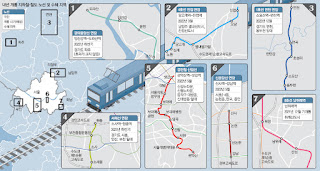
MK published yesterday an interesting article* on the impact of 7 recent or upcoming subway / railway developments on real estate, which allows us to see of these old friends have fared since their announcements**.

The Maeil Kyeongje's 7 projects (NB our focus below doesn't follow these numbers)

 . Line 1 extension Northwards from Soyosan Station (3 new stations - Choseong-ri, Jeongok, and Yeoncheon): 

Since this extension mostly doubles an existing train, the article logically mentions a low impact on real estate. but it does make commuting more seamless for densely inhabited parts of Yeoncheon-gun, and allows Seoulites to venture further up the Dongducheon valley (not necessarily closer to the DMZ, though: it follows the same axis in this area).

 . Line 4 extension Eastwards from Danggogae Station (3 new stations - Byeollae Byeolgaram, Onam, and Jinjeop):

To be inaugurated next March, this 14.9 km extension is a game changer for this section of Namyangju dotted with major new towns (Byeollae and Jinjeop-eup). But as usual, what a shame that such major clusters were not connected to the grid from day one. 

Of course, this means more commuter traffic for a line already supporting older generation bed towns, but it will also help one of them, Nowon, grow as a cultural hub in Northeast Seoul. Furthermore, the article reminds us of two other projects that will help cope with the flow:

  • Seoul considers doubling Line 4 with an express service for the 31.7 km section within city limits, between Danggogae and Namtaeryeong, with potentially 12 more stations concerned (all the ones connected to other lines). That would leave 12 stations with only the standard service, along with the ones in Gyeonggi-do.
  • The extension of Line 8 Northwards from Amsa Station to Byeollae Station (Gyeongchun Line) by the end of 2023 could later be prolonged to Byeollae Byeolgaram Station via a new station, Byeollae Jungang, further anchoring Byeollae to the South, and making it a transport hub east of Seoul around a decent 'Byeollae Line' backbone.

 . Inauguration of Namwirye Station (Line 8):

Located between Bokjeong and Sanseong Stations in Seongnam, Namwirye doesn't really support Wirye New Town which, as the author mentions, would have much more impact. But he's not taking into account a tramway bound to deliver the goods: the construction of the Wirye Line is just starting these days.

'#Seoul about to start the construction of its first #tramway in decades (#WiryeLine - 12 stations, 5.4 km - to open i 2025). Line announced 8 years ago (http://seoulvillage.blogspot.com/2013/08/seoul-lrt-projects-update-part-22.html) #transports' (20211220 - @theseoulvillage)


 . Gyeongui Jungang Line extension Northeastwards from Imjingang Station to Dorasan Station

In this part of Paju, as the article confirms, 'nothing to do with real estate'. This line is simply inching further towards Kaesong, now a reasonable walk away... provided of course you've got all the papers to enter the DMZ at that most strategic point. For the moment, you're mostly connecting Seoul to a giant, empty parking lot: doesn't look like many workers will commute any time soon to the Kaesong Industrial Complex... Let's hope that some day, this dead end will be prolonged into a friendlier North Korea.


 . Seohae Line extension Northwards from Sosa Station to Wonjong Station (via Bucheon Stadium Station)

As we've already seen (in "Twice upon a time in the West"), there's a lot going on around Bucheon. This vertical will split much earlier the traffic to/from Seoul between the North (Line 1) and the South (Line 7). And it will later be prolonged not only to Gimpo Airport, but also across the river, to Line 3 (Daegok Station, after a stop in Neunggok Station).

If Daegok seems a bit isolated between Goyang's 'old and new' New Towns (Ilsan to the West, Hwajeong to the East), Line 3 leads to more glamorous sites: downtown Seoul and Gangnam. And I wouldn't be surprised to see this new, vertical airport line that will go from Goyang to Hwaseong (for now, Ansan remains the Southern limit) venture further to the North-Northeast and connect to more New Towns.


 . Sillim Line inauguration (from Gwanaksan Station to Saetgang Station)

Thanks to this precious new vertical connected to Line 9 (Saetbang), Line 1 (Daebang), Line 7 (Boramae), Line 2 (Sillim), 'I live in Bongcheon-dong' will sound a lot more uplifting. But in parallel to this LRT,  Western Seoul needs more verticals (Gangnam-gu already getting it's fourth!), starting with Seobu Line...


 . Shinbundang Line Northwards extension from Gangnam Station to Sinsa Station:  

The article made its headline on the star extension because it's about real estate and money, and we're talking expensive real estate (Gangnam-daero), and expensive stations: Gangnam on Line 2, Sinnonhyeon on Line 9, Nonhyeon on Line 7, and Sinsa-dong on Line 3. No new stations, but hopefully fewer cars on the Hannam Bridge once Sinbundang's next profitable extension to the North will lead across the river and Yongsan, all the way to Yongsan Station.

*

Beyond railway and subway projects, Maeil Kyeongje also mentioned work on more sections of the capital region's Second Ring Expressway, which will definitely have some impact. But what the region needs is more public transportation, and a better dialog within Gyeonggi-do, beyond the usual Seoul-suburbs dialog.

It's always good to connect existing dots, and the Ansan-Bucheon-Goyang axis is very welcome, but no new major urban projects should be allowed without a direct connection to the network.

The problem is that Gyeonggi-do is poorly managed, and this has something to do with the way big cities compete with each other without a real regional authority. Only the State has the potential to force some collaboration, or at least more coopetition and less competition within Gyeonggi-do. The lack of political will and strategic vision results in the multiplication of projects cannibalizing each other, a suicidal rat race as the population ages and declines. Clearly, there are countless ways of spending less, better, and still generating much more value for everyone.

 
Seoul Village 2021
Welcome to our Korean Errlines! Follow Seoul Village on Facebook and Twitter, follow me on Instagram.
Download 'Seoul VillageS', the free ebook.
Bookmark and Share

* ""딱 역 3개인데, 폭발력 엄청나다"…판교 분당 부동산 난리난 이유" (Maeil Business Newspaper 20211226)
** see "Seoul subway to gain 89 km by 2025" (June 2015), "Seoul LRT Projects Update (Part 1/2)" and "Seoul LRT Projects Update (Part 2/2)" (August 2013, following "If you ain't broke, fix it: Seoul, Welfare and Railways Deficits" - July 2013). See also all subway related posts.