NEW - download 'Seoul VillageS (서울 마을들)', my collection of 12 short fictions now adapted into short films! Get your free copy of the ebook (4 editions: English, French, Korean, Bilingual English-Korean)!

Showing posts with label Danggogae. Show all posts

Sunday, December 26, 2021

7 Seoul subway / railway updates

MK published yesterday an interesting article* on the impact of 7 recent or upcoming subway / railway developments on real estate, which allows us to see of these old friends have fared since their announcements**.
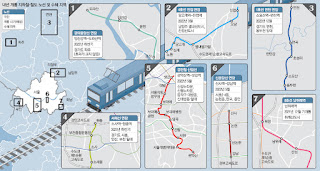
The Maeil Kyeongje's 7 projects (NB our focus below doesn't follow these numbers)

 . Line 1 extension Northwards from Soyosan Station (3 new stations - Choseong-ri, Jeongok, and Yeoncheon): 

Since this extension mostly doubles an existing train, the article logically mentions a low impact on real estate. but it does make commuting more seamless for densely inhabited parts of Yeoncheon-gun, and allows Seoulites to venture further up the Dongducheon valley (not necessarily closer to the DMZ, though: it follows the same axis in this area).

 . Line 4 extension Eastwards from Danggogae Station (3 new stations - Byeollae Byeolgaram, Onam, and Jinjeop):

To be inaugurated next March, this 14.9 km extension is a game changer for this section of Namyangju dotted with major new towns (Byeollae and Jinjeop-eup). But as usual, what a shame that such major clusters were not connected to the grid from day one. 

Of course, this means more commuter traffic for a line already supporting older generation bed towns, but it will also help one of them, Nowon, grow as a cultural hub in Northeast Seoul. Furthermore, the article reminds us of two other projects that will help cope with the flow:

  • Seoul considers doubling Line 4 with an express service for the 31.7 km section within city limits, between Danggogae and Namtaeryeong, with potentially 12 more stations concerned (all the ones connected to other lines). That would leave 12 stations with only the standard service, along with the ones in Gyeonggi-do.
  • The extension of Line 8 Northwards from Amsa Station to Byeollae Station (Gyeongchun Line) by the end of 2023 could later be prolonged to Byeollae Byeolgaram Station via a new station, Byeollae Jungang, further anchoring Byeollae to the South, and making it a transport hub east of Seoul around a decent 'Byeollae Line' backbone.

 . Inauguration of Namwirye Station (Line 8):

Located between Bokjeong and Sanseong Stations in Seongnam, Namwirye doesn't really support Wirye New Town which, as the author mentions, would have much more impact. But he's not taking into account a tramway bound to deliver the goods: the construction of the Wirye Line is just starting these days.

'#Seoul about to start the construction of its first #tramway in decades (#WiryeLine - 12 stations, 5.4 km - to open i 2025). Line announced 8 years ago (http://seoulvillage.blogspot.com/2013/08/seoul-lrt-projects-update-part-22.html) #transports' (20211220 - @theseoulvillage)


 . Gyeongui Jungang Line extension Northeastwards from Imjingang Station to Dorasan Station

In this part of Paju, as the article confirms, 'nothing to do with real estate'. This line is simply inching further towards Kaesong, now a reasonable walk away... provided of course you've got all the papers to enter the DMZ at that most strategic point. For the moment, you're mostly connecting Seoul to a giant, empty parking lot: doesn't look like many workers will commute any time soon to the Kaesong Industrial Complex... Let's hope that some day, this dead end will be prolonged into a friendlier North Korea.


 . Seohae Line extension Northwards from Sosa Station to Wonjong Station (via Bucheon Stadium Station)

As we've already seen (in "Twice upon a time in the West"), there's a lot going on around Bucheon. This vertical will split much earlier the traffic to/from Seoul between the North (Line 1) and the South (Line 7). And it will later be prolonged not only to Gimpo Airport, but also across the river, to Line 3 (Daegok Station, after a stop in Neunggok Station).

If Daegok seems a bit isolated between Goyang's 'old and new' New Towns (Ilsan to the West, Hwajeong to the East), Line 3 leads to more glamorous sites: downtown Seoul and Gangnam. And I wouldn't be surprised to see this new, vertical airport line that will go from Goyang to Hwaseong (for now, Ansan remains the Southern limit) venture further to the North-Northeast and connect to more New Towns.


 . Sillim Line inauguration (from Gwanaksan Station to Saetgang Station)

Thanks to this precious new vertical connected to Line 9 (Saetbang), Line 1 (Daebang), Line 7 (Boramae), Line 2 (Sillim), 'I live in Bongcheon-dong' will sound a lot more uplifting. But in parallel to this LRT,  Western Seoul needs more verticals (Gangnam-gu already getting it's fourth!), starting with Seobu Line...


 . Shinbundang Line Northwards extension from Gangnam Station to Sinsa Station:  

The article made its headline on the star extension because it's about real estate and money, and we're talking expensive real estate (Gangnam-daero), and expensive stations: Gangnam on Line 2, Sinnonhyeon on Line 9, Nonhyeon on Line 7, and Sinsa-dong on Line 3. No new stations, but hopefully fewer cars on the Hannam Bridge once Sinbundang's next profitable extension to the North will lead across the river and Yongsan, all the way to Yongsan Station.

*

Beyond railway and subway projects, Maeil Kyeongje also mentioned work on more sections of the capital region's Second Ring Expressway, which will definitely have some impact. But what the region needs is more public transportation, and a better dialog within Gyeonggi-do, beyond the usual Seoul-suburbs dialog.

It's always good to connect existing dots, and the Ansan-Bucheon-Goyang axis is very welcome, but no new major urban projects should be allowed without a direct connection to the network.

The problem is that Gyeonggi-do is poorly managed, and this has something to do with the way big cities compete with each other without a real regional authority. Only the State has the potential to force some collaboration, or at least more coopetition and less competition within Gyeonggi-do. The lack of political will and strategic vision results in the multiplication of projects cannibalizing each other, a suicidal rat race as the population ages and declines. Clearly, there are countless ways of spending less, better, and still generating much more value for everyone.

 
Seoul Village 2021
Welcome to our Korean Errlines! Follow Seoul Village on Facebook and Twitter, follow me on Instagram.
Download 'Seoul VillageS', the free ebook.
Bookmark and Share

* ""딱 역 3개인데, 폭발력 엄청나다"…판교 분당 부동산 난리난 이유" (Maeil Business Newspaper 20211226)
** see "Seoul subway to gain 89 km by 2025" (June 2015), "Seoul LRT Projects Update (Part 1/2)" and "Seoul LRT Projects Update (Part 2/2)" (August 2013, following "If you ain't broke, fix it: Seoul, Welfare and Railways Deficits" - July 2013). See also all subway related posts.

Wednesday, December 18, 2013

Seoul-Namyangju? Check. East Gyeonggi? Still To Be Defined

Now with the full support of Seoul, Namyangju, and the Ministry of Transport, the extension of Subway Line 4 from Danggogae Station (Sanggye-dong, Nowon-gu, Seoul) to Jinjeop Station (Jinjeop-myeon, Namyangju) shall be, as expected, delivered by 2019.

Pre-feasibility studies confirmed a project we already detailed earlier, most recently last year*:
"In a diagonal parallel to the Gyeongcheon Line (railway for Chuncheon), the 14.5 km extension from Danggogae will create three stations in the city of Namyangju: Byeollae (Byeollae-dong), Onam (Onam-eup), and Jinjeop (Jinjeop-eup). All three correspond to new towns, not to mention (see reminder) today's terminal itself, Danggogae Station, at the center of the future Sanggye New Town. I bet many inhabitants may feel more like in an extension of Nowon-gu than in a new Namyangju neighborhood: there's no direct railway connection to Namyangju city hall in Geumgok-dong, and Nowon Station with its city hall and attractions is just 1 to 4 stations away.

Sanggye, Danggogae, and Byeollae all lie along Deongneung-ro, an axis already very congested by traffic jams. The only road cutting through Buramsam (in its middle) became an important entry point into northeastern Seoul when the Seoul Ring Expressway was completed: located halfway between Uijeongbu I.C. and Guri I.C., Byeollae I.C. instantly relieved the saturated Toegyewon I.C. gateway. But the road was not dimensioned for that traffic, and turned into a bottleneck."
I positioned Danggogae, Byeollae, Onam, and Jinjeop on Seoul Village map, and as you can see, a stop in  Jinjeop-eup could be added (maybe near Naegok-ri,, between Byeollae and Onam):


View Seoul Village in a larger map

If you zoom out from there, you see how this Eastern New Town Line takes the Wangsukcheon valley towards Pocheon, not the greatest 'pull' to prolong it even further.

But again, the way new towns have been decided across the capital region never followed any grand, long term vision combining from the start urban development with transit solutions. For instance, it would have been so easy to plan an arch from Uijeongbu to Hanam via Namyangju and Guri, in order to build a strong vertical backbone for eastern Gyeonggi-do, and instead of weak horizontal fishbones sticking out from the capital, a sounder dialog with Seoul.
 
Note that this Eastern New Town Line, that has been on the map for ages, was not even mentioned in Seoul Metropolitan Rapid Transit Master Plan. Now you know why I preferred the previous 'big picture' I added in my focus, where such hubs as Nowon-Sanggye appear more clearly (see "If you ain't broke, fix it: Seoul, Welfare and railways deficits").

Seoul Village 2013
Welcome to our Korean Errlines! Follow Seoul Village on Facebook and Twitter
Bookmark and Share
Add this page to your favorites

* see "Spectacular extensions of Seoul Subway Lines 4-5-6-7 ?" (April 2010), followed by "Seoul subway updates : gos, no-gos, maybes" (January 2011) and "Nowon confirmed as Seoul's northeast hub" (October 2012)

Tuesday, October 2, 2012

Nowon confirmed as Seoul's northeast hub

PARK Won-soon recycled yet another project of the OH Se-hoon administration: turning Nowon into Seoul's northeastern hub. The old concept received a boost last month, when the government accepted to lower the share of expenses to be paid by local authorities from 40 to 25%.

Which means two things:
- the extension of Subway Line 4 from Danggogae to Namyangju, first announced in 2007, will be delivered. I had little doubt about that: it was the soundest and most profitable project among the four laid out two years ago (see "Spectacular extensions of Seoul Subway Lines 4-5-6-7 ?" - April 2010, followed by "Seoul subway updates : gos, no-gos, maybes" - January 2011)
- the heart of Nowon, around Nowon Station itself, will be beefed up as scheduled, but instead of the major air terminal initially planned (see my "Nowon-gu" focus of June 2007), a gigantic complex shall rise, with 40+ storey apartment towers, hotels, and a commercial and convention center aiming at rivaling the COEX Mall

After that, Nowon-gu will finally discard its image of bed town, and extend its already strong influence over Gyeonggi-do neighbors: after Jangam new town (Uijeongbu, Line 7), Namyangju new towns (Line 4) are more likely to feel anchored to this hub within Seoul city limits than to their own local administration. 

For Nowon's future commercial hub, the location has long be selected: Dobong Driver's License test grounds and Seoul Metro train depot occupy three quarters of a huge block next to Nowon Station, and both have been expected to move for years. Four important roads surrounding this massive area:
- East: Dongil-ro, northeast Seoul's backbone, between Nowon and Madeul Stations (Line 7).
- South: Sanggye-ro, between Jungnangcheon and Nowon Station (with subway Line 4 overground)
- West: Dongbu Expressway, along Jungnangcheon

- North: Nowon-ro, in front of Jungang Apt Block 10 and Nowon High School, leading to Sanggye Bridge and Dobong-gu.

The extension of Line 4 also confirms Nowon Station as Northeast Seoul's brightest spot:
- To the West, Dobong Station (Lines 1 and 4) will be even more distanced. Yes, the Uijeongbu axis is bound to grow stronger, and the future Suyu LRT won't be that far, but if Seoul reaches further northwards, it will be through Line 7. For the people living in Jangam new town, even from the other side of Seoul Ring Expressway (# 100), Nowon Station feels already much closer than downtown Uijeongbu.
- Along Line 7, Nowon's closest rival lies far down south, at the intersection with Line 2: Konkuk University Station has been completely revived by the Starcity - Emart complex. Gunja (intersection with Line 5) has some potential, and Taereung may go up should Line 6 be prolonged, but catching up with Nowon won't be that easy.
- The old but vital Line 4 vertical already connects Seoul with southern Gyeonggi-do, carrying people from 5 cities (Siheung, Ansan, Gunpo, Anyang, and Gwacheon) straight into 9 of the capital's 25 districts (Seocho, Dongjak, Yongsan, Jung, Jongno, Seongbuk, Gangbuk, Dobong, Nowon). But if Nowon was the last frontier new town back in the late 1980s, it is now becoming the entry point to Seoul for a new generation of new towns, this time from northeast Gyeonggi-do.

In a diagonal parallel to the Gyeongcheon Line (railway for Chuncheon), the 14.5 km extension from Danggogae will create three stations in the city of Namyangju: Byeollae (Byeollae-dong), Onam (Onam-eup), and Jinjeop (Jinjeop-eup). All three correspond to new towns, not to mention (see reminder) today's terminal itself, Danggogae Station, at the center of the future Sanggye New Town. I bet many inhabitants may feel more like in an extension of Nowon-gu than in a new Namyangju neighborhood: there's no direct railway connection to Namyangju city hall in Geumgok-dong, and Nowon Station with its city hall and attractions is just 1 to 4 stations away.

Sanggye, Danggogae, and Byeollae all lie along Deongneung-ro, an axis already very congested by traffic jams. The only road cutting through Buramsam (in its middle) became an important entry point into northeastern Seoul when the Seoul Ring Expressway was completed: located halfway between Uijeongbu I.C. and Guri I.C., Byeollae I.C. instantly relieved the saturated Toegyewon I.C. gateway. But the road was not dimensioned for that traffic, and turned into a bottleneck.

Construction for the subway shall start in 2015 and end in 2019, but expect more hiccups on the way, starting with the feasibility studies planned during 2013, after the elections.

To be continued.

Seoul Village 2012
Welcome to our Korean Errlines! Follow Seoul Village on Facebook and Twitter

Monday, September 5, 2011

Junggye's "Baeksa Village" shall survive

Here's one of my favorite Seoul villages. If you take a Nowon-gu map, it's easily recognizable as the only area with a crooked shape in an ocean of neat appartment blocks. That's actually how I spotted it for the first time, and I wasn't disapointed by the place, one of Seoul's last typical "moon villages" ("달동네") with a soul of its own and an almost rural lifestyle. I took this picture* of kids playing there exactly seven years ago, and I remember the red peppers drying up on the streets, or the old people inviting us for a chat on their mat at a fork in the road.

Located on the Western slopes of Buramsan, "백사 마을" (Baeksa Maeul or Baeksa Village) doesn't owe its name to the fact that it hosts the 104-san beonji of Junggye-bun-dong (also spelled "baeksa"), but to a legendary "white snake" ("baeksa"). And "White Snake Village"'s serpentine main "street" leads you to the edge of a forest that didn't exist back in 1967, when the area first drew the attention of the media (and when Park Chung-hee's reforestation program hadn't turned Seoul's bald red hills into green lungs yet).

Last time I visited the place back in 2004, there were already talks of redevelopment. You could see many "budongsan" opening shop at the feet of the village, and in those new town crazy years, I wouldn't have bet any buck on a survival for this forsaken place.

Baeksa Maeul again made the (local) headlines not so long ago, when LH Corporation's new town plans were made public. Not very original, but at least we were spared the usual tombstone giants.


Today, the village makes national headlines because all plans have been dropped (in financial turmoil, LH has cancelled many programs over the past year), and local authorities have opted for a softer "remodelling" that partially preserves the shape, the streets, and hopefully the spirit of this very cute place. Among other sources, I recommend this KBS video ("
마지막 달동네 ‘백사마을’, 마을 한켠에 보존") where you can enjoy many different views on Baeksa Village, including films from 1967 :


I'm really happy. Not only because White Snake Village has a chance to survive without losing its soul, but because all this noise shall boost preservation for the other few surviving gems and moon villages still clinging to the city's mountain slopes.

More likely, speculators will rush here and there to snatch cheap land and build big mansions before local authorities manage to secure the areas. Not far from there in Sanggye, I could see that happen in Danggogae's former slums years ago.

Seoul Village 2011
NEW : follow Seoul Village on
Facebook and Twitter

* you've seen this picture in "Junggye Maeul" (June 2007), as well as, among other "Seoul crumbs", in dragedies.

---
UPDATE 20110906 : added a snapshot from the KBS video showing the village before/after remodelling.

Monday, January 3, 2011

Seoul subway updates : gos, no-gos, maybes

Political and budgetary tensions tend to slow down infrastructure projects, and only a few months after promising announcements (see "Spectacular extensions of Seoul Subway Lines 4-5-6-7 ?"), some subway line extensions are already being reconsidered. Here's the score as of today :

- Line 7 : the Northern terminus, Jangam Station, is quite close to booming Uijeongbu, and it made perfect sense to complete the connection with the closest hub, Nowon Station (unlike the inital project, which went all the way up to Pocheon)... but this case is now officially closed : rentability for this extension was evaluated at only 43% of the break even point, probably because Uijeongbu is already on Subway Line 1. So Jangam, a former shantytown now almost completely redevelopped, remains the last post before expressway 100.

- Line 5 : the
extension to Hanam just passes the threshold (rentability : 1.04). Now it's just a matter of time and priorities.

- Line 4 :
obviously the most vital project of all, the Danggogae-Namyangju extension will as expected fly, but a bit beyond schedule : if it scored 1.27 for rentability, financing remains an issue, and local officials wasted one year instead of pushing it.

Note that Seoul Metro (Lines 1, 2, 3, 4) started a trial with LED lights in several stations along Line 3 : they burn 28 W instead of 32 for fluorescent systems. It sure will take more than new bulbs to finance new subway stations, but that's a good resolution for 2011.

Seoul Village 2011

Monday, June 18, 2007

Nowon-gu

Copyright Stephane MOT
Nowon-gu (노원구; ) is Seoul's Northeastest and most populated district.
Population : 619,509 inhabitants (2006)
Area : 35.44 km² (max 6 km W-E, max 9 km N-S)
City Hall and official website : http://english.nowon.seoul.kr/.

Photo : "Nowon noway" (2004 - Copyright Stephane MOT)

Geography :

Nowon's main frontiers are :

  • to the West, the Jungnangcheon. Part of the district (Wolgye-dong) lies on the other side of this confluent of the Han river which also separates Nowon from Dobong-gu.

  • to the East, Buramsan and Suraksan mountains (and beyond, the city of Namyangju)

  • to the North, the city of Uijongbu

  • to the South, the district of Jungnang-gu (plus Seongbuk-gu for Wolgye-dong)
Nowon consists of 24 dong and 5 major areas (see map) :
  • Sanggye - North (10 dong)

  • Junggye - Center East (5 dong)

  • Hagye - Center South (2 dong)

  • Wolgye - South West (4 dong)

  • Gongneung - South East (3 dong)

History :

Originally a quiet and flat valley of fields dotted with a few villages of farmers (some names do subsit - ie Madeul Station), Nowon was untill 1988 the Eastern part of Dobong-gu.


The new "gu" was meant to become a bed town for the booming population, mainly newly formed households who couldn't afford more central areas. Like in Jamsil, this massive development included from the start tens of blocs of 5 to 15 storey appartment buildings. But here, most appartments were small and remote from the new city centers.

Yet, thanks to its strong internal / demographical dynamics, Nowon managed to grow from a cheap bed town into a major hub at the North of the capital, with a soul of its own and Nowon Station at its heart :
  • transports : the crossroads of subway lines 4 and 7 will also welcome a major city air terminal bound to serve the North of Seoul and the neighboring cities. The old train terminal will be relocated in Namyangju and the Dobong driving center in a more remote area of the district).

  • commerce : all businesses and national / international franchises, including a Lotte Department Store born a medium range Midopa Department Store in 1992 and now the most luxurious store in North East Seoul. The city air terminal will also host a major commercial center.

  • services : the city hall, major corporations' local branches, plus all the district's motels are near the station.

  • culture : the baby boomers turned teenagers boost the Dept Store's movie theaters, and the local cultural center regularily proposes foreign shows. A new stadium is under construction.

  • environment : Sanggye's central area is getting greener. Closer thant the old mountain's regional parks : the Jungnangcheon's riverside park, the future central park, restoration of a smaller stream...
The most select area of the gu, Junggye, remains the hottest spot for schools and housing (plus many important stores, including a Lotte Mart and a Carrefour turned Homever in 2006). A new subway line will connect Eunhaeng Sageori / 은행사거리 (Crossroads of the Banks), a major center. Between Nowon and Eunhaeng Sageori, the small stream joining Suraksan and Bulamsan mountains to Jungnangcheon, Danghyeoncheon (당현천), will be restored and could become an important cultural axis.

Sanggye New Town will totally reshape Danggogae Station area... destroying some of the few slums remaining after the completion of Seoul's circular highway 100. The remote Junggye maeul is also disappearing. I had the time to take a few pictures of both before realtors took the rest...

Nowon was meant as a popular district, as in popular for the people. Traditionnaly spared by the real estate bubble, Nowon is now getting popular for investors as well, and many Gangnam-gu speculators have recently contributed to a dramatic rise in housing prices. Many blocks are being redevelopped and all the ingredients of a pleasant place are already there.

Stephane MOT 2006

books, movies, music