NEW - download 'Seoul VillageS (서울 마을들)', my collection of 12 short fictions now adapted into short films! Get your free copy of the ebook (4 editions: English, French, Korean, Bilingual English-Korean)!

Showing posts with label Sajik-dong. Show all posts

Wednesday, January 26, 2022

More Gwanghwamun Square previews

Seoul revealed new visuals of Gwanghwamun Square 3.0, which shall be inaugurated in July.
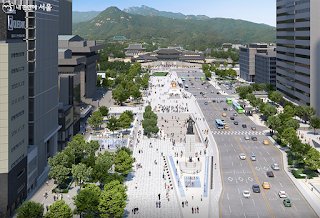
They prolong the last major iteration presented in 2019 ("Gwanghwamun Square 3.0 re-Deep-Surfaces"), which corrected one of the worst urbanistic blunders  of the initial version ("Gwanghwamun Square Enters Third Dimension"). PARK Won-soon's team rushed the construction a few months before the elections without conducting any decent impact survey, and work started late 2020. As soon as OH Se-hoon returned as mayor, he paused the site to assess the situation, but the changes could only be cosmetic.

The Woldae extension in front of the palace gate will only be created next year, so we have yet to see how vehicles flow around Yulgok-ro's future curve. Adjusting to the modifications already in place is not always easy. As expected, the intersection in front of Sajik-dan helps reconnect both sides of Sajik-dong, but the impossible new U-turn just North of the Government building stops functioning as soon as traffic slows down (too close before a major traffic light, unlike the old one heading for Sajik tunnel).

Most important, Seoul's defining axis is preserved, with its iconic Gwanghwamun-Gyeongbokgung-Bugaksan perspective, and pedestrians will enjoy a 20 m-wide park with a vast selection of tree species, guaranteeing natural shade and oxygen as they grow. That's where most of the extension (from 18 to 40,000 square meters) comes from. People will be able to sit on benches and along the Haechi Madang ramp, where street animations may bloom next to the new media wall.

Sejong-daero's pedestrian and cycling experience has already been improved with the new green walks and bike lanes added on the way to Namdaemun (see "Lower Sejongdaero's turn"). With its fountain tunnel and pavement fountain, the 'Gwanghwamun' Lounge section is likely to welcome kids and keep them fresh during the Summer. If some artifacts found during the renovation shall be on display in the cultural section, most of the Joseon era infrastructures (see timeline*) shall be covered again. I hope the tribute to Yukjo street will not look to corny. 


On the Eastern side, Junghak-dong will not host a simple reconstitution of the old Uijeongbu site, but a fusion hanok exhibition space. I wish there were more trees in that section, but that can (and probably will, if they want the spot to be successful) be fixed later.

This Uijeongbu project was on display at the Seoul Hall Of Urbanism (see again timeline below*) during the low key, pandemic-plagued 3rd edition of the Seoul Biennale of Architecture and Urbanism. SBAU will return in September 2023, with CHO Byung-soo (BCHO Architects) as its Director. This architects knows a bit about dao, and Seoul could do with some more harmony...

Ganghwamun Square reopening in the heat of the Summer will be a perfect crash test. I'm pretty sure Seoulites will quickly make it their own. At least during the evenings. And as much as that damned coronavirus will allow.


Seoul Village 2022
Welcome to our Korean Errlines! Follow Seoul Village on Facebook and Twitter, follow me on Instagram.
Download 'Seoul VillageS', the free ebook.
Bookmark and Share


* From @theSeoulVillage timeline: 


"Gwanghwamun Square last week. Seoul started controversial revamping without a proper impact survey..." (20201220 - twitter.com/theseoulvillage/status/1336888158437265408)


"The few changes since the initial plan won't prevent the expected traffic pandemonium. Tragic lack of urban planning, urbanism vision from Seoul... Sejong-daero Gwanghwamun" (20210221 - twitter.com/theseoulvillage/status/1364019424752115720)


"Western side of Sejong-daero / Gwanghwamun Square to close tomorrow for the controversial revamping (future Jeokseon-dong loop in the foreground)" (20210305 - twitter.com/theseoulvillage/status/1367760419218018306)

"As expected, works on the Western side of Gwanghwamun Square for its extension reveal Joseon time artifacts and structures related to former ministries. Here, a waterway in Jeokseon-dong (between Baekundongcheon & Junghakcheon - see seoulvillage.blogspot.com/2009/08/baekun #urbanism)." (20210319 - twitter.com/theseoulvillage/status/1372721209939431427)

"I guess mainly to evacuate overflows towards Baekundongcheon, to contain water damage in case of heavy rains. Gwanghwamun Square urbanism Jeokseon-dong Photo Chosun Ilbo" (20210319 - twitter.com/theseoulvillage/status/1372721211789037583)
"OH Se-hoon hits pause button on controversial Gwanghwamun Square revamping. Also asks AHN Cheol-soo to suggest talents for Seoul." (20210410 - twitter.com/theseoulvillage/status/1380664510638264322)


"Seoul's unearthed Yukjogeori during Gwanghwamun Square revamping:" (20210511 - twitter.com/theseoulvillage/status/1391895161337090049)


"Gwanghwamun's future Uijeongbu site at Seoul HOUR (Seoul Biennale / SBAU):" (20211028 - twitter.com/theseoulvillage/status/1453500318226935809)


Thursday, January 24, 2019

Gwanghwamun Square 3.0 re-Deep-Surfaces

Seoul recently* unveiled the winning concept for Gwanghwamun Square renovation, and 'Deep Surface' confirmed the hopes and worries we shared in April last year (see "Gwanghwamun Square Enters Third Dimension"). As expected, things are also getting political. The good news is that the debate will continue more publicly until the end of this year. Work is still supposed to start next year, and the goods to be delivered in 2021, ahead of the 2022 presidential elections.


1) Everybody's happy...


'Deep Surface' was bound to please key members of the jury, starting with Dominique Perrault, who probably appreciated the major role played by underground structures... and maybe this new slope as an homage to his iconic Ewha ECC:


Landscape architect Adriaan Geuze (West8) certainly fell for this spectacularly lush Amazonian canopy, owed to a rendering artist who obviously projected us around year 2175, when the newly planted trees reach maturity:


If you miss already Gwanghwamun Square's vast stretches exposed to Seoul's merciless summers and winters, stand reassured, the same artist also offered this more realistic view:


Of course, SEUNG Hyo-sang and YOO Hong-jun remain key jurors when it comes to selecting a project suitable for both the Mayor and the President: the former City Architect is now heading the Presidential Commission on Architecture Policy, and the former Cultural Heritage Administration boss had earlier been mandated by MOON Jae-in to study the feasibility of his campaign pledge, eventually abandoned, to move the presidency out of Cheong Wa Dae.

SEUNG, who oversaw Seoul's shift from redevelopment to urban regeneration, must have enjoyed the focus on pedestrians and citizens, the historical continuum, and the respect of recent heritage. YOO can also be happy: if the Ministry of Culture and Tourism foots one third of the bill (Seoul Metropolitan Government the rest), the Historic Square covers 36,000 sqm compared to 24,000 for Citizen Square.

To better understand the big picture, I recommend to combine the first illustration above (perspective from Gyeongbokgung) with this project map: 


2) ... but not everybody's happy


From the start, this project's key challenges were only 10% about architecture and 90% about urbanism. As I explained before, more than the vertical alterations along Sejong-daero (extension of the square, reduction from 10 to 6 lanes), the main revolution is horizontal, what I called 'The Royal T' being transformed into a crooked Y as Sajik-ro plunges towards the South, suppressing the Western end of Sajik-ro 8-gil, and the tunnel that came with it. Sajik-ro now marks the frontier between two Gwanghwamun Squares: Historic Square (North), and Citizens Square (South).

Again, it's not just the gate that's brought closer to the center, but also the traffic. Again, merging Sajik-ro with Sajik-ro 8-gil means merging transit circuits with neighborhood circuits, and creating new unnecessary bottlenecks. And yet again, what about the bus and bicycle lanes? I'm afraid I have to stick to what I wrote last April: "Unfortunately, like with Seoullo, impact surveys have obviously been eluded in a race to meet electoral deadlines, and authorities chose to worsen traffic situations by not tackling them". Before heralding the future Gwanghwamun Square as the equivalent to the Arc de Triomphe in Paris, Mayor PARK Won-soon should have learned that for all Parisians, Place de l'Etoile is a symbol for extreme and messy traffic.

I'm not the only one to wonder if every impact is truly taken into account: as soon as the new blueprint was revealed, the authorities in charge of policing and traffic said that they had yet to agree with what's proposed, and a key administration wished it had been consulted for the road cutting through its premises.

If Seoul City is very unlikely to drop the piece de resistance from its master plan, it is also very unlikely that a satisfying solution can be found to the problems it generates. Before the end of this year? Impossible. I wish it could be compensated with public transportation, but even if the GTX A (Unjeong Paju to Dongtan) and Shinbundang Line eventually join Subway Lines 1, 2, 5 in the ambitious transportation hub envisioned, new bottlenecks will severely limit its multimodal potential.

I guess I made my point on this crucial issue, so we can move on. Now shall we further look into 'Deep Surface'?


3) Deep Surface Inside Out

Just a few elements from this very rich and complex project:


  • 2 squares instead of 1: that makes storytelling much more simple. Picture on one side the changing of the guards on Woldae (the ritual stage to be rebuilt in front of the gate), next to the hanok cluster already under reconstruction (next to the Museum of Contemporary History), and on the other side a k-pop concert at the feet of Sejong Cultural Center. Also, it's easier to contain a demonstration on the aptly named Citizens Square, while tourists claim their safer haven by the palace and its museums (not to mention pictures of the landmarks not photobombed by PARK Geun-hye supporters). Of course, there's still that humongous Government Complex ruining Historic Square's narrative and perspective, but you can always say it's a tribute to Sejongno's Yukjo tradition**.


  • In Jeokseon-dong, Jeokseon Hyundai Building seems to be turned into a 'Seoul Metro Museum'. I wonder what the tenants (e.g. Bloomberg, Korea's youth hostels association) think of it.
  • There's a lot of fuss about the potential moving of King Sejong and Yi Sun-shin statues (closer to Sejong Cultural Center), but I'm not a fan of these erections, and to me that's nothing compared to the road mess I mentioned earlier. Note that Haetae statues move back, closer to where they were in Joseon times, but nobody seems to care. 
  • Sejongno Park might at last find some purpose and relevance. 
  • I wonder why Terrace Lawn, the new slope connecting above with underground, doesn't have an actual  slope, accessible for wheelchairs or baby strollers. I hope they'll fix this ASAP.
  • ...

I'm curious to see how Seoulites will roam the space, rediscover Sejongno's Western sides, how 'Gwanghwamun Samgeori' will join 'Sejongno Sageori' in our vocabulary, how History will keep unfolding on Gwanghwamun Square 3.0.

Whatever happens, this will remain Seoul's political and cultural epicenter, and its most defining perspective (Sejongno-Gwanghwamun-Gyeongbokgung-(Cheong Wa Dae)-Bugaksan-Bukhansan).


Seoul Village 2019
Welcome to our Korean Errlines! Follow Seoul Village on Facebook and Twitter
Bookmark and Share
Add this page to your favorites


* ICYMI:


' announces new plans for . will eventually have a station, even if it slows the whole 'express' promise. The square itself will, as expected (), be on the side.' (20190121 - https://twitter.com/theseoulvillage/status/1087168047687753728) 'On the bright side, trees will make the new slope more enjoyable. (For the dark side, see )' (20190121 - https://twitter.com/theseoulvillage/status/1087169753074946049)


'Reminder: V.3.0 will cause traffic nightmares in downtown . Maybe that's what Mayor meant when he compared the project to ' Plaza...' (20190121 - https://twitter.com/theseoulvillage/status/1087470786531581952)
** the notorious six ministries. Note that the project still includes a Yukjo Street tribute and its restaurant tradition. Reminds me of that old joke with a mobster telling his staff he went to Sejong Cultural Center last night, only to be asked in return 'which restaurant?' by thugs for whom the name only refers to a foodies neighborhood.

Tuesday, April 10, 2018

Gwanghwamun Square Enters Third Dimension

Seoul Metropolitan Government and the Cultural Heritage Administration unveiled yesterday their plans for a 'New Gwanghwamun Square' by 2021, and they came up with a weird 'solution' for the potential traffic conundrum I mentioned four years ago, when the project started taking a clearer shape (see "Gwanghwamun, Donhwamun, and the Tale of two Royal Roads").


Gwanghwamun Square 3.0 - the royal Sejongno-Gwanghwamun-Gyeongbokgung-Cheong Wa Dae-Bugaksan-Bukhansan perspective

This modification of Seoul's most defining center has potentially even greater consequences than the previous one, which we followed step by step a decade ago. I will as usual focus on the urbanistic impacts (passing by many familiar spots), but since this is also about Korea's center of power ever since its capital was founded, I'd better start with some political context.


It's the politics, stupid?

Such a project deserves to be carried by both the local (SMG) and national (CHA) governments, and PARK Won-soon as well as MOON Jae-in happen to have a special bond with a site where PARK Geun-hye started and ended her presidency.

Started? If we all remember the massive, peaceful demonstrations that led to PGH's destitution, who could possibly forget that kitschissime wishtree** on Gwanghwamun Square, her first symbolic stop on her way to Cheong Wa Dae?

During his own campaign, MOON Jae-in pledged to move the presidential offices from Cheong Wa Dae to Sejongno, and the presidential residence closer to Gwanghwamun, in order to cleanse the feet of Bugaksan, and to honor the place where democracy took a stand and won. MOON also picked Gwanghwamun Square to celebrate his victory.

Retrospectively, I shudder when I remember AHN Hee-jung's over-the-top cheering that night - back then, I didn't know he couldn't even control his darkest pulsions... anyway, his DSK / #metoo moment completely revived the ambitions of a man who tried to steal the show on the very same night.

Only weeks ago, PARK Won-soon was clearly out of the game for the 2022 presidential elections, and about to be dumped by his own party for the upcoming mayoral elections (June 2018). Now he's leading the polls by far (against WOO Sang-ho and PARK Young-sun for the primaries, and against AHN Cheol-soo and KIM Moon-soo beyond), and this new project looks like the ideal platform for both ballots: he can make a splash in 2018 on the very site that boosted his predecessor's reelection***, and deliver the goods just months before 2022. Of course, PWS already combined a major urban project with a major political event before, but PGH's impeachment derailed Seoullo 7017's perfect timing ahead of the 2017 elections (see "Seoullo 7017, and more roads to Seoul").

Now is the right moment to communicate a grand scheme and vision, big enough to mask PARK's most recent shortcomings: he barely managed to avoid criticism for Seoul's waste management crisis by sending deputies to face the media, and he let his rival WOO preempt the usually well coveted 'public transportation' territory by campaigning on a new metropolitan authority, including yet another revival of the key Seobuseon project (after 2013, when "Seobu Line confirmed as Seoul's LRT top priority", the city dropped the ball once again).

So yes, it's about politics. But regardless of this context, Gwanghwamun Square and its surroundings needed a fix.


3.7 times bigger, 3.7 times better?

So what's the plan? Basically, the pedestrian zone grows not only, as expected, to the West and along nearby streets, but also right in front of the gate, making the road map much more complex, what I dubbed Seoul's 'Royal T'**** turning into a Y:


Seoul also revived its old ambition to restore Baekundongcheon, Cheonggyecheon's main source, the diagonal still visible on today's map (see "Baekundongcheon / Gwanghwamun-gil - A River Runs Through It"*****).

Seoul city advertises about the 3.7 factor by which pedestrian surface booms from 18,840 m2 to 69,300 m2, the reduction of traffic lanes to 6 along Sejong-daero, and its renewed demands to the State for a GTX extension to Gwanghwamun.

All this sounds very positive and environment friendly, but no really new green spaces are planned, and the extended square might make Summers and Winters even more merciless in what looks more like Tiananmen Square, or the barren landing site that preceded Yeouido Park.

There are still no dedicated lanes for buses or bicycles, and buses shall be redirected South, which seems recipe for disaster for public transportation around downtown Seoul, particularly since the new road map deprives Sajik-ro 8-gil (formerly Naejadong-gil) from its role of main NS/EW dispatcher.

Compared to Gwanghwamun 2.0, the 2009 revolution that brought pedestrians back to the heart of the capital, this Gwanghwamun 3.0 adds only marginal change to their experience. I like the idea of restoring the 'parvis' in front of Gwanghwamun, the Eastern pavillions and hanok around a 'History Square' that could liven up the walk from Seochon to Bukchon... but pushing traffic further downtown, and adding new bottlenecks to already saturated axes does seem like a big price to pay. 

Unfortunately, like with Seoullo, impact surveys have obviously been eluded in a race to meet electoral deadlines, and authorities chose to worsen traffic situations by not tackling them. Even the curve of the new road following the back of the central government building (that by the way shouldn't be on that History Square) tells about quick and dirty fixes without consideration for the big picture.

What Seoul needed was a consistent vision and plan to prepare its whole historic center Sadeamun (intra muros) for a driverless future. What Seoul delivered was a dangerously incomplete, short-sighted, ill-prepared PR stunt.

The city will take one year to select a proposal, start work in January 2020, and finish by EOY 2021. Mayor PARK missed by a few months last time, and 2021 seems safe enough a goal for him to inauguration the new (if not improved) Gwanghwamun Square. 

I sincerely hope he'll reconsider this plan, and grow some ambition for our city.

Seoul Village 2018
Welcome to our Korean Errlines! Follow Seoul Village on Facebook and Twitter
Bookmark and Share
Add this page to your favorites

* see "The Anipang Election: Park wins big, but who won?"
** see "Park 2 Day 1 in pictures"
*** will OH Se-hoon rise again (on billboards, at least - see "OH Se-hoon returns... but did he ever leave?")
**** see "Inwangsan's Great Wall and Seoul's Royal "T" Time"
***** note that since my 2009 focus, the streets West of Sejong-daero have been renamed Saemunan-ro 9-gil and Saemunan-ro 5ga-gil. Seoul also renewed the project of highlighting walls around Sajik-dan and Sajik-park.

Tuesday, April 12, 2016

The Yongsan itch and the Sajik balm

One up, one down. Seoul speeds up for the redevelopment of Yongsan 4, and puts the brakes on Sajik 2.

We've known for a while* that the future Yongsan Park would be surrounded by high rise structures. After burning their fingers on the doomed Yongsan IBD project, authorities decided to offer their all-you-can-build gifts to speculators in smaller packages, wrapped in green. Here, at the Hangangdae-ro - Seobinggo-ro interesection (Hangangno-dong), a tentative 'Yongsan Parkway' serves as an environmental alibi for more 30-40+ towers:


In Jongno-gu, a far less popular - and far less tragical** - "drama" has also been running for years: the redevelopment of what I call Sajik Heights, the hilly neighborhood nested between Sajik-ro / Sajik Tunnel, Space Bon, and Gyeonghuigung. I've walked its alleyways countless times, and even wrote a short story about Kim Ki-chan meeting my fictional Kim Mudangnim there (the great photographer also used to live in Sajik-dong).


A pigeon, a hanok, a hilly alleyway, Inwangsan - Sajik Heights in 2009

For a decade, Sajik Heights has been preparing for the transformation, and Lotte Castle eventually won the right to build the New Town.


As far as 'urban continuity' goes, it looked consistent with the Gyeonghuigung Xii (Gyonam New Town) rising from the other side of the tunnel / hill / (now almost totally obliterated) fortress wall... 

But Seoul city seized a debate over modifications to stop the process***. Among the landmarks to be protected (let's hope in a less destructive way than nearby Dilkusha****), the 1906 house where Josephine Eaton Peel Campbell lived. I visited that place at the top of the hill, around the time it was used as an office by local residents. It seems to have never been used for the purpose the Campbell estate sold it, which was to promote the education of young girls, in the tradition of Campbell herself, the founder of Baehwa (girls' schools and women's university in Pirun-dong).

Residents are now wondering what's best for them, particularly after witnessing what happened in the vicinity: Gyonam? newtonized. Seochon? bukchonized. So what for Sajikistan?

Whatever happens in the future, something of the old neighborhood shall survive. Or evolve. 

Anyway, it would be nice to see something decent next to a potential UNESCO Heritage site (Yeol still working hard on the Sajik-dan revival*****).

Seoul Village 2016
Welcome to our Korean Errlines! Follow Seoul Village on Facebook and Twitter
Bookmark and Share
Add this page to your favorites
.
* see for instance "Yongsan park - fake forests and real estates" (Feb. 2011)
** if a person died in Yongsan, no casualties for the only tragedy I witnessed when I lived in Sajik-dong, a hanok fire back in 2009.
*** "사직2구역 재개발 추진 7년…110년 된 캠벨 사택 어쩌나" (JoongAng Ilbo 20160413)
**** less forsaken than 5 year ago (see "Sajik Heights and micro-hanokization"), the building seems to have undergone serious change in the name of 'preservation' 
***** rites have been performed for a long while, and the restoration helped as well (see "Sajik-dan enshrined, Naeja-dong revived ?")

Saturday, December 7, 2013

A stroll through Seoul, following in PARK Wan-suh's footsteps

Atelier des Cahiers, who published PARK Wan-suh's autobiographical novel "Who ate up all the shinga?" last year ("Hors les murs" in French*), had the wonderful idea** to produce this video in the footsteps of the author and her young alter-ago, where key places mentioned in the book are illustrated with excerpts and pictures from the Seoul of then and now.

A very pleasant stroll downtown (even if you don't understand French!), featuring so many familiar spots on the way from Seoul Station to Inwangsan via Hyeonjeo-dong, Sajik-dong, Pirun-dong, Seochon...:


You can also prolong this "promenade hors les murs" on the publisher's website:


"Promenade hors les murs - sur les pas de Pak Wan-seo" (with photos, maps and page numbers for reference)


We can even spot this old cablecar (which I hope won't return! see "No cablecars in Bukhansan, please"):

"Hors les murs" is now also available on Kindle format, along with PARK's "Trois jours en automne" ("Three days in that autumn"), and many other titles published by Atelier des Cahiers, among which:

...


Seoul Village 2013
Welcome to our Korean Errlines! Follow Seoul Village on Facebook and Twitter
Bookmark and Share
Add this page to your favorites

* "Hors les murs"
Auto-fiction by PAK Wan-seo, traduit du coreen par Helene Lebrun
Editions Atelier des Cahiers 2012 - Collection Littératures 

ISBN 978-2-9529286-8-7

** Reminder (and shameless self-promotion) - Atelier des Cahiers also had the wonderful idea to publish one of my fictions in the anthology "Impressions papier Hanji" (now also available for download in Kindle format, 10 short stories about Korea in French, by four female Korean authors and six male French authors):

Impressions Papier Hanji
Dix nouvelles franco-coréennes
Editions Atelier des Cahiers 2010 - Collection Littératures
ISBN 978-2-9529286-4-9 
(n)

. Alain ROBBE-GRILLET ("Mon double coréen")
. KIM Da-eun ("Madame")
. Antoine COPPOLA ("La véritable histoire de Li Jin et de son horrible sacrifice")
. CHOI Myeong-jeong ("Pojangmacha")
. Eric SZCZUREK ("La joueuse de Baduk")
. Stéphane MOT ("de Vermis Seoulis")
. KIM Ae-ran ("Le couteau de ma mère")
. François LAUT ("Jours d'après")
. EUN Hee-kyung ("La voleuse de fraises")
. Michel LOUYOT ("Le poète sans nom")