NEW - download 'Seoul VillageS (서울 마을들)', my collection of 12 short fictions now adapted into short films! Get your free copy of the ebook (4 editions: English, French, Korean, Bilingual English-Korean)!

Showing posts with label Hangang. Show all posts

Wednesday, July 8, 2026

Seoul Summer Beach and Swag

From July 20 to August 9, a giant, free water park will welcome Seoulites on Gwanghwamun Square and Sejongno Park. After drawing about 900k visitors in 2004 and 1.5M last year, Seoul Summer Beach could be even more popular with a 3rd edition featuring pools, slides, and a sand playground. 

Who knows? BTS 'could spend a lifetime watching you swim'

The sandy space will be under a 12 m wide dome that brings more to mind an igloo than a summer beach, and won't allow you to fully enjoy Seoul's most iconic scenery, but sand can be messy, particularly during the rainy season. And hygiene should be less an issue; as a Parisian, I've never dared basking in Paris Plage's sandy stretches. 


I remember chatting with PARK Won-soon about Paris Plage. 
First meant for Parisians who can't afford going on holidays, this yearly festival covers the expressway along the Seine (now reclaimed by pedestrians) with a beach anyone can enjoy for free. The former mayor was toying with the idea of adapting that other Parisian tradition (following Velib, La Nuit Blanche etc), but it wouldn't make much of a splash along the Han River (too wide a river, riversides more disconnected from the rest of the city, Hangang Park already boasting its own water activities...). 

Gwanghwmun Square and Sejongdaero are much more relevant and impactful for this kind of festivities.

Which doesn't mean that the rest of the city will remain dry: we've seen neighborhood parks transformed into water parks during the summer long before Seoul Summer Beach existed, and there are so many ways of having fun while getting soaked, from the Sinchon Water Gun Festival and its giant water slide along Yonsei-ro to PSY's torrential Summer Swag concerts.


My favorite drenched memory in Seoul remains the day I was caught by a sudden downpour in Jongno-gu. The time to run twenty meters to the closest shelter, I was already totally soaked. Because there was no way a bus or a taxi could accept me, I decided to just walk back home peacefully, simply enjoying the shower with a great smile. 

Of course, as Seoul and Korea well know*, too much water can be dangerous. So enjoy responsibly, and have a great summer.


Seoul Village 2026
Welcome to our Korean Errlines! Follow Seoul Village on Facebook, Bluesky, Threads, Substack, and X/Twitter, follow me on Instagram.
Download 'Seoul VillageS', the free ebook.

* and as PSY also knows now: he was once scolded for hosing his fans with 300 tons of water during a concert in the middle of a drought.

Sunday, December 3, 2023

Seoul Twin Eye - A Ferris Wheel With A Twist

Remember 'Seoul Ring', the tolkienesque totem that was supposed to overlook the Han River from the top of Haneul Park? Well it's back, but with a couple of twists.

'Seoul Twin Eye'

'Seoul Ring'

First, the wheel is not on top of the hill, but at its feet, in the World Cup Park, by the Nanji Lake and Peace Park, mounted on a 40 m pedestal to compensate for the altitude loss. Still, we're talking about something gigantic: 180 m wheels, 64 capsules, 1,440 people at a time...

Second, that's a double wheel, with intertwined rings. So you will move sideways as well as vertically, which can be a bit disturbing if not for sensitive stomachs, at least for your sense of balance. A bit like the Las Vegas Luxor's 'inclinator', but in a loop. Thankfully, the pace is slow, so that you can enjoy the view instead.


Third, there's a whole Barnum around it, with a zip line,  performance and exhibition halls, a fountain show on the lake, and many other facilities, almost Lotte World style. 


A monorail to the subway (World Cup Stadium Station Line 6) will add more infrastructure to what was supposed to be a park, but also draw much more visitors on very cold or very hot days.

This KRW 910 bn extravaganza may not be the final concept. At this stage, Seoul city just gave the best score to the Seoul Twin Eye Consortium featuring SH Corporation, with SK Ecoplant leading the construction. Should its preferred bidder position be confirmed, this consortium will enjoy a 30-year concession.

Note that the company in charge of guaranteeing the structure, ARUP, already worked on the giant ferris wheel by the Thames, but at least Seoul decided to do something different from London. So as the name (which may not be final) suggests: 'Seoul Twin Eye' vs 'London Eye', rather a me-two than a me-too project?


Seoul Village 2023
Welcome to our Korean Errlines! Follow Seoul Village on Facebook and Twitter, follow me on Instagram.
Download 'Seoul VillageS', the free ebook.
Bookmark and Share


Friday, April 29, 2022

Seoul's Waterfront Renaissance

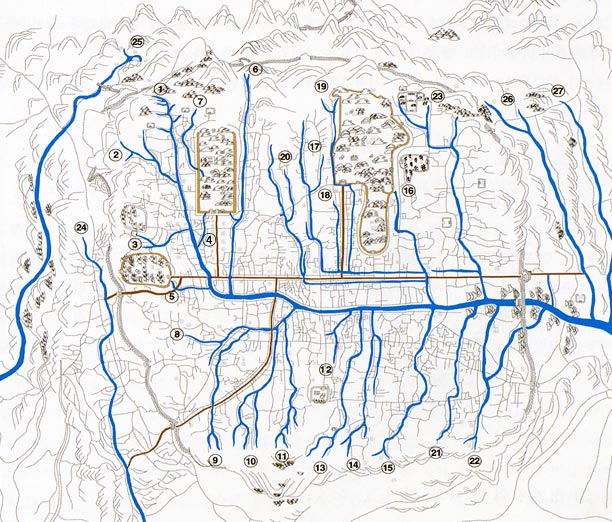
Seoul has always been defined by its most valuable environmental assets: its countless waterways, and the mountains that feed them. 

From the start, the capital revolved around Cheonggyecheon and its network of streamlets:

Nowadays, the Han River tells what's North and what's South, but waterways still account for 8.1% of Seoul's land (below in 2010):

After pouring concrete all over the place to tame the powerful Hangang and its tributaries, to stabilize unstable riverbanks, and to prevent recurring floods, the city has reopened its heart to its waterways, rediscovered them as leisure paths and environmental treasures. Following the restoration of Cheonggyecheon, the Hangang Renaissance, and the restoration of neighborhood streamlets, masses of humans, birds, and even fishes have flocked back to Seoul's watersides. Yes, more concrete was often poured in the process, but biomass keeps growing, embankments are often doubled with natural fish nurseries, and significant wetlands have been created.


Citizens are already very active along these waterways, thanks to all the infrastructure needed by strollers, cyclists, or workout maniacs:

But water level and street level are seldom seamlessly connected, and for good reasons: flash floods remain a constant threat, and these waterways help the city cope with extreme downpour. On such occasions, riversides must be evacuated immediately. Still, more citizens could spend more leisure time there, particularly when they crave for more free and cool open spaces.

More than a decade after his Hangang Renaissance project, Mayor OH Se-hoon aims at a 'Jicheon Renaissance' leveraging Seoul's 332 km of waterways. Not just with more hardware, but with more content and culture, a better connection to local neighborhoods and markets, More 'emotion', as part of an 'Emotional City' of the future vision.

Starting with 4 pilot projects along three streamlets (Dorimcheon, Jeongneungcheon, and Hongjecheon), with 2 more sites by 2030 (Anyangcheon and Jungnangcheon):

  • Hongjecheon will never fulfill its great potential as long as the Naebu Expressway disgraces it (see "Along Hongjecheon, my way or the highway"), and the pilot will focus on two spots: upstream at Hongjimun and Tangchundaeseong, midway at the artificial waterfall near Seodaemun District Office, with a place to have a drink.


  • Dorimcheon is more about the connection to the neighborhood and its businesses, with decks to make the transition and chill out:


  •  Jeongneungcheon will add a cultural layer through a new media art space:


Of course, all this requires water, particularly since the city intends to make these shallow streamlets a bit deeper (from a very thin 10 cm to a more significant 30 cm). So backstage, there's a lot of work to improve water and waste management. 

Today, 18 streamlets including Cheonggyecheon are actually fed with water recycled from the Han River, and climate change has spectacularly dried up the whole nation. Even if I knew Seoul experienced very few precipitations last Winter, I was stunned to see in a recent treck up Bukhansan, how parched soils were. But the only time water streamed by was magical:

As usual, I guess we'll have more imperfect, odd spaces requiring some improvement in further iterations. But overall, Seoul keeps democratizing access to quality time and nature, even if that's in not so natural spaces.

Seoul Village 2022
Welcome to our Korean Errlines! Follow Seoul Village on Facebook and Twitter, follow me on Instagram.
Download 'Seoul VillageS', the free ebook.
Bookmark and Share


Thursday, June 7, 2018

Riding along 'horizontal verticals' in Magok District (Part III)

This is the final part of my focus on Magok District:
    1. Framing Magok (Part I - Location)
    2. Magok's horizontal verticals (Part II - Cluster)
    3. Magok's lifespace (Part III - Environment)
The future Seoul Botanic Park will feature 3,0000 plant species (its flower-shaped indoor facility - bottom right - is already visible from a distance).


***


3) Magok's lifespace


If Gangseo-gu is not an usual darling for real estate speculators, Magok scores much better than most Seoul neighborhoods. Beyond its potential and dynamics in terms of location, connectivity, or research hub, people seem to believe in its quality of life, and to trust SH Corporation for delivering the goods.

Rebranded two years ago Seoul Housing and Communities Corporation*, this public institution has led the development from its early stages, with a mandate to put families, environment and sustainable mobility at the core of the project, a clear difference with other innovation clusters where business preempted everything.

Seoul Business Agency (SBA) did play a central role in Magok as it did in the DMC, but in the latter, residential developments were secondary, and not considered as a key factor of success. And we saw how the Gale International - Posco tandem struggled in Songdo.

Pangyo too enjoyed a partnership between national and local authorities for its Pangyo Techno Valley (Gyeonggi Institute of Science and Technology Promotion established in 2010), but for its residential areas, it only had to surf on the Bundang wave, and from the start flush with private money, that very hyped 'New Town' got 'blessed' with more than a few luxury residences.

Like Pangyo, Magok started essentially from scratch. Revamping Guro Digital Complex, and supporting its evolution into a XXIst century G-Valley demands different efforts from Seoul and Kicox (Korea Industrial Complex Corporation).

Magok wasn't dragged down by ailing neighborhoods in need of regeneration. The central role of public authorities is a guarantee that everybody will profit, not a sign of destitution. I don't think Magok will become as 'bling-bling' as Eastern Gangnam either, but I don't see that as an inconvenient.


How does this 'common good' approach translate into the landscape? For instance, beyond the central park, you don't have a collection of green spaces, each one managed by a gated apartment complex, but neighborhood parks connected by green corridors between open blocks. Branded M-Valley by SH Corporation, the residential complexes remain relatively low rise compared to other recent projects this side of the Han River, keeping in mind that this is a first development. Even if we're still in the classic 'apateu' model, there could be a greater sense of open community than in Pangyo's luxury town houses or from the top of a Songdo penthouse...

The green corridors are wider than Yeonnam-dong's 'Yeontral Park' (the Gyeongui Line Forest Trail), but without the streets, shops or restaurants on their sides, and only a few tables to picnic here and there, which minimizes noise pollution for the residents.

As I noticed before, along large sections of Seoul Botanic Park, blocks devoted to research centers sit right across the street (e.g. for the moment LG Science Park and Kolon One and Only Tower), which could be seen as a form of privatization, but could also become a motivation for them to open up, to let visitors roam their own land, to propose services that would flourish along the frontline in probably more anarchic ways, to blur the lines of a strict zoning. 

Tadao Ando's LG Art Center (see part II) provides a clearer example of how local communities can benefit from private infrastructure: parts of the program will involve residents, and the venue will eventually belong to Seoul city. 

For the moment, residential and research blocks stand out, and local businesses mostly develop around subway stations. The first significant hotel to open in the neighborhood mirrors its positioning: overlooking the park, Courtyard by Marriott is not the chain's most luxury brand, but provides quality stays for both business people and families.


*

Seoul issued guidelines and specs early in the project to make sure that environment, accessibility, or bicycle lanes were taken into account:


Water collection and filtering systems embedded in the buildings, roads, or parks
Accessibility and security at pedestrian crossings
Pedestrian crossings again, this time for bicycle lanes, always a tricky moment for cyclists
With its flatness and absence of major disruptors in its core (hills, river, railways, highways**), Magok District is perfect for cycling. 40% of all roads will have dedicated lanes, in a continuous network connecting the new neighborhood and its Seoul Botanic Park to the Hangang backbone. Beyond a 'Ddareungi' special zone facilitating commuting and leisure rides, or many bike parking facilities, four bike storage systems will be available at subway stations.


Bicycle-friendly Magok (left, one of the green diagonal corridors between apartment blocks - right, a protected bike lane that could be wider, like for instance the one along Seongmisan-ro in Seongsan-dong).
Magok's bicycle network
So it seems that even in this early stage, Magok is aiming at to the vision I finished my 2013 update with (see 'Magok District on cruise mode'):
"Now the most important remains to give some soul and consistence to this alleywayless place. You want to see residents and researchers venture beyond their homes and campuses, roam the streets, enjoy the city. The park and diagonal canal can give purpose, but let's not forget to optimize every single street for pedestrians and bicycles, make this neighborhood a destination from all directions, in continuity with Hangang Park, and the new neighboring communities (Banghwa, Balsan...)."
*

As usual, as an urbanist, I would have done things differently; Magok District doesn't signal a revolution in the Korean New Town or the Korean innovation cluster models. Yet it redefines Gangseo-gu, and beyond Southwest Seoul. It might even demonstrate that a big residential and business project South of the Han River can succeed without arrogance. What matters is that, ultimately, people live happily together in a place where trees, bicycles, and fellow earthlings are welcome.

Seoul Village 2018
Welcome to our Korean Errlines! Follow Seoul Village on Facebook and Twitter
Bookmark and Share
.
* see "Seoul summerscapes: death, taxes, and budongsan
** if Gonghangdae-ro is a wide and busy axis, it can't be compared to the Gyeongbu Expressway that separates Seopangyo and Dongpangyo

Sunday, May 20, 2018

Riding along 'horizontal verticals' in Magok District (Part I)

As we've seen before*, Magok District deserves specific attention as Seoul's last big chunk of undeveloped land (until they decide to chop off all remaining mountains), and one of Korea's ambitious innovation clusters.

If new pieces keep being added every now and then to this urban jigsaw puzzle, recent weeks have seen major developments and PR operations, particularly with the inauguration of LG Science Park by MOON Jae-in, two years after PARK Geun-hye's speech at its groundbreaking ceremony. Of course, since many initiatives in Korea boil down to real estate, a lot of this PR aims at promoting new residences in a neighborhood that's been rather overperforming the market.

Time seems ripe for an update on Magok's narrative, reality, and fundamentals. Could it mark an evolution in Seoul's postwar urbanism (for the big picture, see 'Inhuman, all too human Seoul')? Certainly not a real disruption, since in many ways it remains a classic, zoned Korean 'New Town'. And the focus being on business, let's see how this 'swamp thing' can compares to - or coopetes with? - neighborhoods I've seen rise from a landfill (Digital Media City), the sea (Songdo), or a valley (Pangyo).

Like my 2013 focus on the DMC and Songdo***, I'll slice this one into 3 pieces:
    1. Framing Magok (Part I - Location)
    2. Magok's horizontal verticals (Part II - Cluster)
    3. Magok's lifespace (Part III - Environment)


'Magok's future Seoul Botanic Park' (20180518 - www.instagram.com/p/Bi6Wi5illxo)


***

1) Framing Magok

What better image to help you grasp the scale and level of completion of the 3.6 M square meter Magok District than this recent aerial view?


Magok District from above in 2017 (Seoul Metropolitan Government)

Stretching over Magok-dong and Gayang-dong, Magok District lies at the very heart of Gangseo-gu, which badly needed a center to make better sense. It's articulated around the gu's backbone: its road to Gimpo Airport, Gonghang-daero.
  • To the West: Banghwa-daero, Banghwa New Town, and Gonghang-dong which hosts the airport. 
  • To the North: Olympic Expressway and the Han River
  • To the East: Gangseo-ro (East), and Deungchon-dong. 
  • To the South: the new Balsan District and Gangseo Agricultural and Marine Products Market.


Actually, only a tendril of Seoul Botanic Park - but a most essential one - reaches the Han River. Most of the district remains under Yangcheon-ro, blocked to the West by the Seonam Water Recycling Center, and to the East by Gungsan, a cute hill which I hope will be preserved, along with the village at its feet.

Magok's four defining dimensions were 'industrial', 'business and commercial', 'residential', 'parks and green', with zones clearly visible from the initial masterplan:


Within the district, three main axes have been created to border its 503,000 sqm park:
  • Magokjungang-ro to the West, with Magok Station (Line 5) at the intersection with Gonghangdaero, and Magongnaru Station (Line 9, and soon AREX) to split what's North of it into two even parts. If Gongangdaero is as wide as a highway, Magongnaru area is booming around the relatively narrow winding road leading to previously developed Banghwa-dong. 
  • The much quieter Magokdong-ro to the East separates for the moment two LG research blocks, with Kolon's spectacular One and Only Tower (!) at the interection with the third axis.
  • Magokjungang 10-gil marks the park's Southern border, with LG Science Park on the frontline (obviously, LG's L still stands for Lucky; the early bird did catch the worm).
So this is basically the frame being filled step by step...
' map keeps filling up (ad in my mailbox)' (20141207 - twitter.com/theseoulvillage/status/541499306344448000)
 ... its central park still missing, but continuously advertised as a key asset:


***


Keep in mind this brief framing of Magok District when we move on to its business purpose (Part II) and living environment (Part III). It already reveals precious advantages:
  • a simple, compact, and flat map
  • seamlessly integrated to its urban vicinity, unlike Songdo, or even Pangyo (highway) and the DMC (railway). As you know, I value "urban continuity" as a key factor of success.
  • even if it's located in the capital's far west, Magok District is very close to the airport (a clear advantage over Pangyo for instance), but also directly connected to the historic center (Gwanghwamun via Line 5), and to key business hubs (e.g. Yeouido, Yeongdongdaero via Bongeunsa Line 9). When AREX opens at Magongnaru Station, the synergies with DMC and Guro Digital Complex, both one stop away, will be even easier.
  • in spite of the Olympic Expressway, Magok provides a unique corridor to the Han River, and its park enjoys relatively little competition in a wide radius. Can it bring Gangseo-gu's half million inhabitants closer together, and reach beyond?

Seoul Village 2018
Welcome to our Korean Errlines! Follow Seoul Village on Facebook and Twitter
Bookmark and Share
Add this page to your favorites

* e.g. "Magok District on cruise mode", "Magok District: SIM City as in "Seoul Intra Muros"? Alleyways as in "Seoul Inter Muros"?", all posts related to Magok District.
** "Songdo, DMC: sequence is of the essence (Part I)", "Part II", "Part III"