NEW - download 'Seoul VillageS (서울 마을들)', my collection of 12 short fictions now adapted into short films! Get your free copy of the ebook (4 editions: English, French, Korean, Bilingual English-Korean)!

Showing posts with label real estate. Show all posts

Thursday, December 4, 2025

Business as usual

As usual in Seoul, real estate and urbanism are never far from the headlines, but let's skip topical stuff and limit to mere footnotes recent controversies (this Seoul city erection in front of Jongmyo*? that measure from the national government**?).

Let's talk shop. 

You see in with those 'for rent' signs, you measure it with the speed at which new stores tend to close: small businesses are really feeling the pinch***. Part of it is conjunctural - the Korean economy as a whole is struggling, and demographics don't bode well for the future. Part of it is structural - more than COVID, the labor reforms that preceded changed fundamentally the street experience for Seoulites: used to a city that never slept, they're now coping with last orders at 9 pm or restaurants closing for dinner altogether.

And of course, more and more Koreans are now ordering everything online. Not just these GenZ who don't cook and limit their IRL shopping experiences to retailtainment or browsing Seongsu-dong's pop-up streets like their parents did with fashion magazines. Yes, Seoul's last mile equation is not sustainable (and as much as I appreciate last minute, early morning, ultra fresh deliveries, I'm glad their social costs are being investigated), but the trend is global, and all cities have to adapt.

It's harder to adapt when the urban hardware is obsolete. 

You're less inclined to contribute to your neighborhood's vitality when 'proximity' shops and services are not so close and in Seoul, apartment blocks tend to cut citizens from their city.

In the old gen 'apateu' blocks, a building devoted to businesses was generally included near the main entrance, sometimes in secondary entrances. This 'open ring' was seldom complete, but everybody walked or drove by these shops every day, particularly since few parking spaces were underground. These businesses belonged to the community.


Some housing complexes are more blended with their surroundings, their edges consisting of mixed use buildings. Even if there's less often greenery to compensate****, pedestrians enjoy (functionally speaking) a better street experience from the outside (urban continuity, diversity...). On the other hand, the inside may seem more exclusive. 
By nature mixed use buildings, officetels usually include shops and services. But when those take too big a share residents can easily feel overwhelmed. Many exclusive, high rise projects with only a couple of buildings have a mall on the lower floors, a 'vertical buffer' that's de facto a separate building with a devoted parking to preserve the residents' quality of life. But then, since it takes anyway 10 mn to leave your luxurious apartment and reach an entrance that's far from everything, many prefer to take their car and shop elsewhere, and this vertical city can turn into a tale of two cities. 

Another tricky model is what I call the 'captive cluster'; very common in greenfield 'new towns' across the capital region and around major cities. In the middle (in best cases) or at the edge (too often) of a group of apateu blocks that can involve different developer brands, urban planners insert a low rise block of mixed use buildings with all the shops and services on the ground floor. Some can be relatively well done, making the best of what's left of a natural landscape (e.g. waterways), and you can almost enjoy a village atmosphere that changes from the dull tombstone collections around, particularly since each lot owner build their own. But too often these clusters fail because there are not enough candidates to open shop*****, or because they've been poorly designed. 

Instead of an open grid, some of these clusters (particularly recent ones) propose only one or two car entrances and force visitors into a full round along a conveyor belt before exiting. On purpose, like a journey in an Ikea store makes you browse the whole catalogue. Except people move by car because these new towns are humongous, and the streets and parking spaces are seldom as entertaining, well drawn, and planned. Sometimes, these clusters are even split into two independent halves that don't communicate directly. And this 'captiveness' is actually a sales argument to recruit new businesses... Needless to say, not very sustainable.


If Seoul's 'MOA Town' concept signaled an evolution from massive tabula rasa to partial redevelopment, allowing more diverse cityscapes and ecosystems (see "From Human Town to Gather Town"), the market remains dominated by big projects, New Towns that obliterate real cities. 

It's not its big blocks but its remaining villages that make Seoul special. If we neuter them, if we destroy diversity, city centers will die. If we do nothing they'll die out, even if a few local markets miraculously manage to thrive and warm up whole neighborhoods.

I've been advocating pragmatic approaches to revive decaying city centers. They all involve bringing back inhabitants, even if that means designing exceptions to the rules, for example by allowing mixed uses in low rise business areas, or small scale revamps that involve shared facilities or obligations (e.g. elevators, parking spaces). Some may be implemented, stay tuned.


Seoul Village 2025
Welcome to our Korean Errlines! Follow Seoul Village on Facebook, Bluesky, Threads, Substack, and X/Twitter, follow me on Instagram.
Download 'Seoul VillageS', the free ebook.

* ICYMI Seoul city decided to replace Sewoon Sangga with a park between Jongmyo and Namsan, but also to 'compensate' by allowing much taller buildings in the vicinity, which of course doesn't fit preservation or UNESCO Heritage guidelines:


Adieu #SewoonSangga. #Seoul to replace #KimSwoogeun landmark with a park between #Jongmyo & #Namsan. But bdg heights raised to 71.9m on #Jongro (+16.9) & 141.9m on #Cheonggyecheon (+43.2). Will #UNESCO accept? #세운상가 #urbanism (20251104 SeoulVillage on X)

** ICYMI the government extended Seoul's speculative zone from the 3 usual districts (Gangnam, Songpa, Seocho) to the whole city, which resulted in a freeze in transactions (except in the 3 districts that became relatively more attractive), and a hike in rental costs. Like previous reforms, the aim seems to be crushing further the middle class and making first purchases impossible (the guy in charge of the reforms was driven by his idea that first time homeowners tended to vote more conservative)....

*** Big players are not spared, but if HomePlus will yet again change hands (Carrefour, HomeEver, Tesco... WhatEver?), its financial trouble have a lot to do with MBK Partners' disastrous management.

**** Wangsimni New Town's Majang-ro 19-gil sets a better example with dense trees on both sides,  

***** yes, these new towns also include new schools, so it's not just dwellings that are in oversupply nationwide
 

Sunday, June 23, 2024

On Korea's Jigsaw, Urban Footprint, and Urban Replanning

If you're a frequent flyer on my Korean errlines, you've had your fill of rants about recurring blunders in urban planning, the persistence of obsolete visions of urbanism, or (re)development equations that totally ignore plummeting demographics.

Well criticizing is easy. Urban harmony is like life or democracy: a very delicate, dynamic balance of power, a complex, evolutive system of checks and balances. No one will ever achieve perfection, and that's the beauty of it.

Besides, I see some glimmers of hope. Korea has eventually started worrying seriously about its shrinking population, seeking more inter-regional solidarity and cooperation, thinking about reviving ailing city centers in smarter ways... 

Korea is starting to realize that the real estate paradigm it's been addicted to for decades has become a Ponzi scheme, a sub-zero sum game where eventually everybody loses, even the wealthy ones who won't be able to resell their 'luxury condos' with a profit after paying much more for them than they would have for the most outrageous Manhattan penthouses.

Korea is starting to realize that it can't afford 'affordable housing' if that means building apartment blocks in greenbelt areas, that when a 'new town' succeeds somewhere, it means that somewhere else, an older town in depleting.

Korea is starting to realize that it can't keep adding new non-matching pieces to an ever growing jigsaw puzzle on an ever shrinking table, that these absurd urban footprint dynamics can't be sustained any longer.

The 5th Comprehensive National Territorial Plan, which covers the most critical 2020-2040 period, already mentions sustainability and other sound principles, but all is not set in marble and a lot has happened since it was released 5 years ago: rural desertification and fertility rate diminution accelerated dramatically, the GTX and other projects reshuffled whole decks... So a revised version is expected next year, for the 2026-2040 period.

Improving inter-regional solidarity and cooperation remains a key goal, particularly where they prove already challenging at the intra-regional level because of political divisions or fierce city rivalries. 

In addition to their autonomy, such special self-governing provinces as Jeollabuk-do or the recently upgraded 'Gangwon State' don't have to deal with special cities punching holes in their maps. In comparison, Gyeonggi-do must cope not only with giant neighbors nesting in its midst (Seoul and Incheon*), but also with a complex history of city creation explaining odd administrative shapes, or new towns stretching over different cities (e.g. Dongtan).

Granting a special status to a local government was generally done without much concern for the impacts around, which prevented all parties from reaching their full potential.

Wherever you stand on the fierce political fight over the creation of Sejong City (the left wanted to move the capital city to a new, central location to balance development across South Korea - the right refused to undermine Seoul and maintained part of the government there), you have to admit that from an urbanism point of view, things could have been done a bit better.

We're not talking Brasilia or Nusantara, a new capital erected far away from existing hubs: Sejong City seats right* next to the metropolitan city of Daejeon, South Korea's 5th largest cit, its central hub, and already the seat of several  central administrations, and right next to Cheongju, Chungcheongnam-do's capital.

Daejeon lies less than one hour away from Seoul via KTX but no, Sejong City must not enjoy express connectivity with the 'old' capital because then civil servants would commute instead of moving to Sejong**. And no, Daejeon's subway shouldn't come all the way to Sejong's vital parts. At its inception, it's almost as if Sejong City was designed as a local competitor instead of a national facilitator.

17 years after its creation, Sejong claims 400k souls, Daejeon remains around 1.5M, and Cheongju inched up from 650 to 720k. Common sense would have led to something more  rational, even simply two cities instead of three: the regional capital Cheongju and a-name-it-whatever-you-fancy-as-long-as-you-spare-local-susceptibilities national capital bis. If arranged harmoniously, I bet the latter would be today a thriving 2.5-3M strong metropolis.

Mind you, both Daejeon and Sejong are faring relatively well nowadays, but I'm not surprised to see the Sejong City - Daejeon - Chungnam - Chungbuk ensemble included in the potential revisions to Korea's 5th CNTP. Some consistency would clearly make the meta-region more competitive internationally - with the caveat that it wouldn't present an official one-stop front. 

Same with 'sudogwon', the capital region (Seoul-Incheon-Gyeonggi-do): unlike say the Ile de France region that encompasses Paris and its surroundings, it doesn't really exist as an official entity with representatives. It does make sense for the national government to be directly involved in an area representing half the nation's population and GDP, but the World's 4th metropolitan bloc can't fully leverage its potential. Of course, adding another administrative layer and the tensions that go with them, particularly with dwindling resources, may not necessarily be the panacea. Some even envision Daejeon + Sejong + Chungnam + Chungbuk as an 'ultra-wide megacity' - at least that would avoid the ego problem of who gets to be granted the regional capital status...

The debates promise to be complex and animated, but it's important to get every stakeholder involved, to identify all the impacts of each option, to learn from past mistakes, to minimize / optimize the urban footprint, to think urbanism beyond cities, towns, and other labels, wherever humans decided to settle or to build (be it a road, a remote factory, a farm, or even a field), and not to build for builders' sake.


Seoul Village 2024
Welcome to our Korean Errlines! Follow Seoul Village on Facebook and Twitter, follow me on Instagram.
Download 'Seoul VillageS' (free ebook - short fictions now adapted into short films)
Bookmark and Share


* If the cities are administratively continuous, there's no actual urban continuum... but then again, few cities in Korea excel at urban continuity.

** Likewise, I still can't stomach the fact that the railway from Seoul to Incheon Airport was deliberately delayed until a few years after inauguration because that would have hurt taxi businesses. Or that Songdo didn't have a subway from day one (hello? a ginormous polder built from scratch?). At least nowadays, if new big fat greenfield 'new towns' keep popping up, most of them include a railway connection.

Sunday, December 26, 2021

7 Seoul subway / railway updates

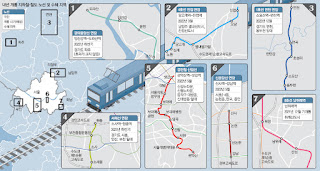
MK published yesterday an interesting article* on the impact of 7 recent or upcoming subway / railway developments on real estate, which allows us to see of these old friends have fared since their announcements**.

The Maeil Kyeongje's 7 projects (NB our focus below doesn't follow these numbers)

 . Line 1 extension Northwards from Soyosan Station (3 new stations - Choseong-ri, Jeongok, and Yeoncheon): 

Since this extension mostly doubles an existing train, the article logically mentions a low impact on real estate. but it does make commuting more seamless for densely inhabited parts of Yeoncheon-gun, and allows Seoulites to venture further up the Dongducheon valley (not necessarily closer to the DMZ, though: it follows the same axis in this area).

 . Line 4 extension Eastwards from Danggogae Station (3 new stations - Byeollae Byeolgaram, Onam, and Jinjeop):

To be inaugurated next March, this 14.9 km extension is a game changer for this section of Namyangju dotted with major new towns (Byeollae and Jinjeop-eup). But as usual, what a shame that such major clusters were not connected to the grid from day one. 

Of course, this means more commuter traffic for a line already supporting older generation bed towns, but it will also help one of them, Nowon, grow as a cultural hub in Northeast Seoul. Furthermore, the article reminds us of two other projects that will help cope with the flow:

  • Seoul considers doubling Line 4 with an express service for the 31.7 km section within city limits, between Danggogae and Namtaeryeong, with potentially 12 more stations concerned (all the ones connected to other lines). That would leave 12 stations with only the standard service, along with the ones in Gyeonggi-do.
  • The extension of Line 8 Northwards from Amsa Station to Byeollae Station (Gyeongchun Line) by the end of 2023 could later be prolonged to Byeollae Byeolgaram Station via a new station, Byeollae Jungang, further anchoring Byeollae to the South, and making it a transport hub east of Seoul around a decent 'Byeollae Line' backbone.

 . Inauguration of Namwirye Station (Line 8):

Located between Bokjeong and Sanseong Stations in Seongnam, Namwirye doesn't really support Wirye New Town which, as the author mentions, would have much more impact. But he's not taking into account a tramway bound to deliver the goods: the construction of the Wirye Line is just starting these days.

'#Seoul about to start the construction of its first #tramway in decades (#WiryeLine - 12 stations, 5.4 km - to open i 2025). Line announced 8 years ago (http://seoulvillage.blogspot.com/2013/08/seoul-lrt-projects-update-part-22.html) #transports' (20211220 - @theseoulvillage)


 . Gyeongui Jungang Line extension Northeastwards from Imjingang Station to Dorasan Station

In this part of Paju, as the article confirms, 'nothing to do with real estate'. This line is simply inching further towards Kaesong, now a reasonable walk away... provided of course you've got all the papers to enter the DMZ at that most strategic point. For the moment, you're mostly connecting Seoul to a giant, empty parking lot: doesn't look like many workers will commute any time soon to the Kaesong Industrial Complex... Let's hope that some day, this dead end will be prolonged into a friendlier North Korea.


 . Seohae Line extension Northwards from Sosa Station to Wonjong Station (via Bucheon Stadium Station)

As we've already seen (in "Twice upon a time in the West"), there's a lot going on around Bucheon. This vertical will split much earlier the traffic to/from Seoul between the North (Line 1) and the South (Line 7). And it will later be prolonged not only to Gimpo Airport, but also across the river, to Line 3 (Daegok Station, after a stop in Neunggok Station).

If Daegok seems a bit isolated between Goyang's 'old and new' New Towns (Ilsan to the West, Hwajeong to the East), Line 3 leads to more glamorous sites: downtown Seoul and Gangnam. And I wouldn't be surprised to see this new, vertical airport line that will go from Goyang to Hwaseong (for now, Ansan remains the Southern limit) venture further to the North-Northeast and connect to more New Towns.


 . Sillim Line inauguration (from Gwanaksan Station to Saetgang Station)

Thanks to this precious new vertical connected to Line 9 (Saetbang), Line 1 (Daebang), Line 7 (Boramae), Line 2 (Sillim), 'I live in Bongcheon-dong' will sound a lot more uplifting. But in parallel to this LRT,  Western Seoul needs more verticals (Gangnam-gu already getting it's fourth!), starting with Seobu Line...


 . Shinbundang Line Northwards extension from Gangnam Station to Sinsa Station:  

The article made its headline on the star extension because it's about real estate and money, and we're talking expensive real estate (Gangnam-daero), and expensive stations: Gangnam on Line 2, Sinnonhyeon on Line 9, Nonhyeon on Line 7, and Sinsa-dong on Line 3. No new stations, but hopefully fewer cars on the Hannam Bridge once Sinbundang's next profitable extension to the North will lead across the river and Yongsan, all the way to Yongsan Station.

*

Beyond railway and subway projects, Maeil Kyeongje also mentioned work on more sections of the capital region's Second Ring Expressway, which will definitely have some impact. But what the region needs is more public transportation, and a better dialog within Gyeonggi-do, beyond the usual Seoul-suburbs dialog.

It's always good to connect existing dots, and the Ansan-Bucheon-Goyang axis is very welcome, but no new major urban projects should be allowed without a direct connection to the network.

The problem is that Gyeonggi-do is poorly managed, and this has something to do with the way big cities compete with each other without a real regional authority. Only the State has the potential to force some collaboration, or at least more coopetition and less competition within Gyeonggi-do. The lack of political will and strategic vision results in the multiplication of projects cannibalizing each other, a suicidal rat race as the population ages and declines. Clearly, there are countless ways of spending less, better, and still generating much more value for everyone.

 
Seoul Village 2021
Welcome to our Korean Errlines! Follow Seoul Village on Facebook and Twitter, follow me on Instagram.
Download 'Seoul VillageS', the free ebook.
Bookmark and Share

* ""딱 역 3개인데, 폭발력 엄청나다"…판교 분당 부동산 난리난 이유" (Maeil Business Newspaper 20211226)
** see "Seoul subway to gain 89 km by 2025" (June 2015), "Seoul LRT Projects Update (Part 1/2)" and "Seoul LRT Projects Update (Part 2/2)" (August 2013, following "If you ain't broke, fix it: Seoul, Welfare and Railways Deficits" - July 2013). See also all subway related posts.

Wednesday, September 22, 2021

Seoul 2030 - a software update

Mayor OH Se-hoon unveiled the 'Seoul Vision 2030' he announced on his inaugural address last April*, an occasion to highlight differences with his 'predesuccessor' PARK Won-soon.

By picking the slogan 'Seoul, a fair city that runs again', ever the ambitious OH delivers two not so subliminal political messages:

  • I want to rally all citizens who want an end to the unfair system that's controlling local and national politics, and 
  • it's not just Seoul that's moving again: I'm running again, with 2027 in sight.

The goal remains the same as a few months before he left office: to lift the capital into the World's top 5 cities. The difference is that since then, under PARK, Seoul has lost its momentum and regressed from 10th in 2010 to 17th last year, which makes the task all the more daunting. To foot the KRW 48 tn bill (USD 41 bn), OH bets on a surge in real estate revenues as well as on undisclosed budget trade-offs. Not sure the equation stands, but Seoul must do something to stop the bleeding as its population shrinks and its businesses struggle.

This 'Seoul Vision 2030' is more about software than about hardware. Typically, it doesn't challenge the urban planning part of 'Seoul Master Plan 2030' laid out in 2015, with its triangle of international hubs (historic center / Yeouido-Yeungdeungpo / Gangnam) and its 7 metropolitan hubs (Yongsan, Sangam-DMC-Susaek, Cheongnyangni-Wangsimni, Jamsil, Magok, Gasan-Daerim, Changdong-Sanggye). Such macro projects are freight trains that can't be rerouted at will. OH can't even stop lighter projects such as the controversial Gwanghwamun Square revamping**; only pause to adjust and adapt in order to limit the negative impacts and to improve urban continuity.

But of course, this being Seoul, a lot of real estate remains on the menu. And hundreds of thousands of new dwellings will be added to the existing oversupply.

The bad news is that redevelopment is unleashed on a large scale, with significant deregulation and the removal of key constraints (F.A.R.), and that a lot of the few remaining Seoul villages could suffer.

"Old #Seoul neighborhoods potentially open for redevelopment jumps from 14 to 50% through #Seoul's new #urbanism guidelines... brace for the worst." (20210527 - twitter.com/theseoulvillage/status/1397728062775513090)

Focusing around certain subway stations may help spare some of them, and result in Hapjeong-izing more neighborhoods (no mentions about new subway projects, but that could come, as usual, closer to next year's elections...):

"#Seoul confirms plan to 'revitalize' #subway station areas (250m radius around stations), starting with 13 pilot projects. Higher rise allowed, mixed uses residential / commercial / offices / services. Will #Hapjeong-style clusters multiply? I'd prefer more stations. #urbanism" (20210705 - twitter.com/theseoulvillage/status/1411963191089721346)
On the upside (literally), new neighborhood parks are planned in proto-urban limbos around Seoul mountains. If done properly (that's a big if), it could paradoxically protect the mountains themselves by creating sanitized but green buffer leisure spaces in stead of unlimited, littered gateways that push unruly crowds deeper into the wild. Most visitors would enjoy a pleasant moment without needing to reach any further, leaving more space to wildlife and respectful mountain lovers.
"#Seoul creates new neighborhood parks in decrepit mountainous areas where development projects have failed for 20 years, starting this year in #Cheonwangsan (#Cheongwandong and #Hangdong, #Gurogu) and #Choasan (#Changdong, #Dobonggu and later #Wolgyedong, #Nowongu). #urbanism"
(@theSeoulVillage 20210910 - twitter.com/theseoulvillage/status/1436132137258795017)

Seoul targets a 40% greenhouse gas reduction by 2030 and carbon neutrality by 2050, but to achieve that, will it continue to outsource part of the dirty job to Gyeonggi-do (see "Seoul Power Play: One Less Nuclear Plant, One More Coal Plant")?

Obsessed with Seoul's business competitiveness, OH Se-hoon wants to seize a momentum and snatch as much of the Hong Kong exodus away from Singapore as possible, and to attract FDIs getting cautious about Korea's neighbors Japan (who wants to be the next Carlos GHOSN?) and China (hard-soft power supremacy challenged worldwide, investors wary of XI Jinping's authoritarian moves). Foreign media were already flocking in before South Korea's government pushed its own laws stiffling press freedom.  In that context, the creation of an agency modeled after Singapore's EDB makes perfect sense. How it articulates with existing entities (SBA etc) remains to be seen.

How Yeouido can turn into an international finance magnet without structural reforms at the national level also puzzles me.

Like during his first mandate, OH wants to boost international tourism, this time up to 20M visitors a year. He insists on culture which is of course essential, but that will take more than a 'Seoul Festa' and kpop events.

I'm more interested in how Seoul intends to nurture and boost the local startup ecosystem, deep and wide. Hosting 40 unicorns by 2030? that's mostly for the show. Building new clusters? as if there weren't enough already... I prefer the concept of mentoring programs for seniors: recent trends already show more 50-year+ executives joining previously almost exclusively young crews, but there's a need for a much broader-reaching, more inclusive approach. 

The 5 pillars of 'Seoul Vision 2030' are "fairness, coexistence, safety***, future sensitivity, global leadership", and 'future sensitivity' is a nice way of saying the whole population should be involved, innovation requires pedagogy and respect for everyone.

"Fairness", and "coexistence" are the most beautiful and difficult challenges. Seoul aims at equal opportunity, fostering women activity and youth employment, seniors access to lifelong learning programs, Seoul Learn online education platform for underprivileged students... Basic income will even be tested. Ending the gender war among younger generations should be added as a core Seoul Development Goal.

By the way, on Thursday, the 3rd SBAU (Seoul Biennale of Architecture and Urbanism) kicked off. An anticlimatic event in a most complex climate, but always the opportunity to connect a few new dots and to confront different visions of different cities:


Seoul Village 2021
Welcome to our Korean Errlines! Follow Seoul Village on Facebook and Twitter, follow me on Instagram.
Download 'Seoul VillageS', the free ebook.
Bookmark and Share

* The launch of a Seoul Vision 2030 Committee was the 5th pledged made by the new Seoul Mayor:

"
The 5 pledges of #Seoul mayor #OhSehoon (NB: good luck with that):" (@theSeoulVillage 20210428 - twitter.com/theseoulvillage/status/1387308187209015300)


** see among others "Gwanghwamun Square 3.0 re-Deep-Surfaces"

*** mostly in a pandemic context.

Monday, July 26, 2021

Seoul: inhuman, all too human

"If Paris were a recurring hero in series of novels, Seoul would rather be a shape-shifting character, always mutating between two short stories. That could be the very definition of a city: a very real work of fiction always trying to liberate itself from its authors."


Published not long after Park Won-soon took office, my essay on Seoul urbanism is now available in English. You can download it for free on Academia.edu: "Seoul: inhuman, all too human"*.

Fun to see what changed and what didn't since then. I might consider a sequel, which would probably cover the successes, failures, and impostures of urban regeneration.

(photo: urban farming along Danghyeoncheon, before Nowon-gu revamped it).

*

SEOUL: INHUMAN, ALL TOO HUMAN

One megalopolis, a hundred villages, a thousand visages

1) The industry of dreams – the ideal city

. Industrial housing revolution: from the virtuous cycle to the bubble

. From mass market consumer goods to fashion and services, from utopia to
dystopia

2) Humans in transit

. Communities and shared spaces

. Life and survival of villages

3) Ideal city 2.0 and new utopias

. The end of an era, but not yet the end of the real estate dream

. From "hard city" to "soft city"

. From New Town to Human Town, villages are back in favor


Seoul Village 2021
Welcome to our Korean Errlines! Follow Seoul Village on Facebook and Twitter, follow me on Instagram.
Download 'Seoul VillageS', the free ebook.
Bookmark and Share


* for the original version (in French), see "Inhuman, all too human Seoul"

Thursday, April 8, 2021

After OH Se-hoon's Hangang Renaissance, Who In 2022?

If both Seoul and Busan delivered landslide victories to PPP candidates, yesterday's by-elections were less a conservative triumph than a crushing defeat for the ruling party, and a double-edged sword win for moderates between two much more consequential votes.

Here's the score:

  • Busan: PARK Hyun-joon (PPP) 63% - KIM Young-choon (DP) 34%
  • Seoul: OH Se-hoon (PPP) 57.5% - PARK Young-sun (DP) 39%
  • Both winners claimed 100% of the districts*.
     

OH Se-hoon campaigning in Sinchon on April 6 (photo S.M.)

PARK and OH offered rather humble acceptance speeches out of respect for the context and the expectations of voters, but also in sharp contrast with the ruling party who, last year, interpreted their landslide win at the 2020 legislative elections as, instead of a referendum on the handling of the pandemic, an absolute mandate for the very reforms that, under normal circumstances, should have led to their defeat:

  • They not only kept undermining the separation of powers in the name of justice reform, but prolonged the CHO Kuk scandals with the CHOO Mi-ae and YOO Mee-yang scandals... They even managed to create, all by themselves, their strongest presidential challenger to date: YOON Suk-yeol.
  • They not only pushed even further suicidal real estate reforms that kept crushing the middle class and leading have-nots to have even less, but also got entangled in the LH scandals.

No wonder even the inept, irrelevant PPP could defeat this embarrassing crew. Yet conservatives shouldn't make the same mistake as the DP, and believe or claim that conservatism won. It's a democratic, centrist alliance that made all the difference. And what Korea wants, what Korea needs now is neither an ideological, stubborn conservative rule, nor a ideological, stubborn left, but a pragmatic, moderate, centrist, uniting leadership**. 

Actually, conservatives lost the PPP primaries when center-right OH Se-hoon defeated NA Kyung-won. And the pact OH cemented with AHN Cheol-soo (who won the centrist primaries against  KEUM Tae-sup) worked perfectly: they wrapped up their poll-based primaries right on time, and campaigned together in a rare display of political fair play.

Centrist leader AHN Cheol-soo and weather vane kingmaker KIM Chong-in on stage in Sinchon, campaigning for OH Se-hoon on the eve of the 4.7 elections (photos S.M.)

When announced the winner yesterday on TV, OH Se-hoon was obviously very moved, and remained seated for a few seconds. Probably thinking about the miscalculation that cost him his job ten years ago, when he put it in the balance for an unnecessary referendum on school lunches (ironically, the left won by campaigning against a measure of social justice usually pushed by socialist parties - only the rich pay for it)***. Maybe remembering his exile in Kingali and Lima, his failed political return five years ago (see "OH Se-hoon returns... but did he ever leave?").  Certainly reflecting about how, just weeks ago, he was still an underdog...

Now OH looks ideally positioned for the 2027 presidential elections, except for the fact that he is once more facing a hostile majority at the Seoul metropolitan council. He only won the job for 15 months (the remainder of PARK Won-soon's mandate), and will have to campaign again next year with little chance to bring significant change in between: even before the elections, LEE Nak-yon let everybody know that his party would obstruct his every move... LEE's dumb statement immediately backfired but anyway, after yesterday's debacle, the ruling party's former front-runner doesn't stand any chance for 2022's main prize: Cheong Wa Dae.

Who will win next year's presidential elections? 

If the PPP learns the lessons from Seoul, they will try to further evolve, and build a big tent reaching for the center and YOON Suk-yeol, whom AHN Cheol-soo has already been rooting for. A PPP momentum means less room for a fully independent candidate. I'm not sure the former top prosecutor will want to run, but this liberal certainly won't do it under a very conservative banner.

The ruling party will probably try to perform some cosmetic changes and bring new faces, but they have to abandon the anti-democracy path they've chosen recently, and preferably with a better candidate than a Trump-style populist like LEE Jae-myung. He could win, but then Korea would lose.

Whatever The Future brings, this being Korea, we shall be hearing some more about real estate during the campaign...

'WTF. Seoul election results by... subway lines and stations!!! Actually quite entertaining. Oh Se-hoon. Park Young-sun' (@theSeoulVillage - 20210407 - twitter.com/theseoulvillage/status/1379795550023774213)


Seoul Village 2021
Welcome to our Korean Errlines! Follow Seoul Village on Facebook and Twitter, follow me on Instagram.
Download 'Seoul VillageS', the free ebook.
Bookmark and Share

* Beyond Seoul's 25 'gu', OH even won every single 'dong' / neighborhood, except 3:

  • Seongsan 1-dong (Mapo-gu) by 168 votes
  • Hwagok 8-dong (Gangseo-gu) by 309 votes
  • Guro 3-dong (Guro-gu) by 863 votes. 

** I should add 'inclusive', because that's also what Korea needs. But not yet what Korea wants. OH Tae-yang, the first openly LGBT candidate for Seoul mayor, finished 9th out of 12 with 6,483 votes (0.13%). That's a first step, but Korean politics remain overwhelmingly homophobic.

*** In case you forgot, the referendum that caused OH Se-hoon his job, and the scandal that hit his rival KWAK No-hyun right afterwards, opening a path for a very lucky PARK Won-soon: "Seoul free school lunch referendum (continued)" (20110612), "In memoriam OH Se-hoon" (20110824), "Kwak's "gros couac" (20110830)

Monday, September 24, 2018

Land mining Seoul

Seoul is once again* about to lose more of its ever shrinking greenbelt area. The main difference with last time? Mayor PARK Won-soon is opposing the move, because it might hurt his presidential ambitions: even if acted now, the move wouldn't translate into new dwellings before 6 to 7 years, and trees would be torn down too close to the 2022 elections.

'Shame on 's Ministry of Land and Territory, which is considering reducing even more 's protected greenbelt areas to provide more . When there's already oversupply, and fewer people living in the capital!' (20180921 - twitter.com/theseoulvillage/status/1042933809820446720)

'This time, mayor is opposing the move, which may backfire for his presidential bid' (20180921 - twitter.com/theseoulvillage/status/1042948381071630338)
Seoul does want to add 62,000 dwellings, by using idle land and relaxing FAR rules. The Ministry of Land, Transport, and Maritime Affairs targets 50,000, but to achieve that goal, intends to tear down greenbelt areas (300,000 sqm).

This good-cop-bad-cop routine between the government and PARK Won-soon doesn't fool anyone. Particularly the week MOON Jae-in all but knighted him as first in line of succession by inviting him (along with his Gangwon-do rival) to Pyongyang for his third summit with KIM Jong-un, pretexting their first-in-line-when-the-gimchi-hits-the-fan-ness (nevermind Gyeonggi-do).

Anyway, MOON's government doesn't have much to lose in taking the blame for destroying Seoul's last lungs: they're not running in 2022, and they are already under fire for their miserable handling of real estate bubbles: everything they try is fueling them now, in anticipation of their downfall. The intentions are good, but like Paris with environment, they leave it up to an ideological ayatollah with little understanding of environmental and economical collateral damage.

Anyway, speculation keeps ruining Seoul. To the point that in some instances, pools of homeowners bully, boycott, and force into bankruptcy realtors who dare post prices too low for their taste.

One thing is sure: there is already an oversupply of dwellings, and Seoul's population has shrunk under PARK Won-soon's watch. Gaping inequalities remain, and heavy regulation is required, but adding further artificial and counterproductive distortions won't help. New social housing projects should propose prices that are fair and affordable, not cowardly indexed at bubble-level-minus-20%.

An opening of North Korea would definitely change the equation. Co-organizing Olympics with North Korea in 2032? Not so much. And where would they be held, without abandoning the one-city rule? Seoul-Pyongyang? Kaesong? Panmunjom?

Seoul Village 2018
Welcome to our Korean Errlines! Follow Seoul Village on Facebook and Twitter
Bookmark and Share
Add this page to your favorites

* see "We reject as false the choice between our welfare and our well being", "Tighten your greenbelt"... 
** "풀어도 문제, 놔둬도 고민"…서울 그린벨트 '딜레마' (Chosun Ilbo 20180919)