NEW - download 'Seoul VillageS (서울 마을들)', my collection of 12 short fictions now adapted into short films! Get your free copy of the ebook (4 editions: English, French, Korean, Bilingual English-Korean)!

Showing posts with label Gangwon-do. Show all posts

Sunday, June 23, 2024

On Korea's Jigsaw, Urban Footprint, and Urban Replanning

If you're a frequent flyer on my Korean errlines, you've had your fill of rants about recurring blunders in urban planning, the persistence of obsolete visions of urbanism, or (re)development equations that totally ignore plummeting demographics.

Well criticizing is easy. Urban harmony is like life or democracy: a very delicate, dynamic balance of power, a complex, evolutive system of checks and balances. No one will ever achieve perfection, and that's the beauty of it.

Besides, I see some glimmers of hope. Korea has eventually started worrying seriously about its shrinking population, seeking more inter-regional solidarity and cooperation, thinking about reviving ailing city centers in smarter ways... 

Korea is starting to realize that the real estate paradigm it's been addicted to for decades has become a Ponzi scheme, a sub-zero sum game where eventually everybody loses, even the wealthy ones who won't be able to resell their 'luxury condos' with a profit after paying much more for them than they would have for the most outrageous Manhattan penthouses.

Korea is starting to realize that it can't afford 'affordable housing' if that means building apartment blocks in greenbelt areas, that when a 'new town' succeeds somewhere, it means that somewhere else, an older town in depleting.

Korea is starting to realize that it can't keep adding new non-matching pieces to an ever growing jigsaw puzzle on an ever shrinking table, that these absurd urban footprint dynamics can't be sustained any longer.

The 5th Comprehensive National Territorial Plan, which covers the most critical 2020-2040 period, already mentions sustainability and other sound principles, but all is not set in marble and a lot has happened since it was released 5 years ago: rural desertification and fertility rate diminution accelerated dramatically, the GTX and other projects reshuffled whole decks... So a revised version is expected next year, for the 2026-2040 period.

Improving inter-regional solidarity and cooperation remains a key goal, particularly where they prove already challenging at the intra-regional level because of political divisions or fierce city rivalries. 

In addition to their autonomy, such special self-governing provinces as Jeollabuk-do or the recently upgraded 'Gangwon State' don't have to deal with special cities punching holes in their maps. In comparison, Gyeonggi-do must cope not only with giant neighbors nesting in its midst (Seoul and Incheon*), but also with a complex history of city creation explaining odd administrative shapes, or new towns stretching over different cities (e.g. Dongtan).

Granting a special status to a local government was generally done without much concern for the impacts around, which prevented all parties from reaching their full potential.

Wherever you stand on the fierce political fight over the creation of Sejong City (the left wanted to move the capital city to a new, central location to balance development across South Korea - the right refused to undermine Seoul and maintained part of the government there), you have to admit that from an urbanism point of view, things could have been done a bit better.

We're not talking Brasilia or Nusantara, a new capital erected far away from existing hubs: Sejong City seats right* next to the metropolitan city of Daejeon, South Korea's 5th largest cit, its central hub, and already the seat of several  central administrations, and right next to Cheongju, Chungcheongnam-do's capital.

Daejeon lies less than one hour away from Seoul via KTX but no, Sejong City must not enjoy express connectivity with the 'old' capital because then civil servants would commute instead of moving to Sejong**. And no, Daejeon's subway shouldn't come all the way to Sejong's vital parts. At its inception, it's almost as if Sejong City was designed as a local competitor instead of a national facilitator.

17 years after its creation, Sejong claims 400k souls, Daejeon remains around 1.5M, and Cheongju inched up from 650 to 720k. Common sense would have led to something more  rational, even simply two cities instead of three: the regional capital Cheongju and a-name-it-whatever-you-fancy-as-long-as-you-spare-local-susceptibilities national capital bis. If arranged harmoniously, I bet the latter would be today a thriving 2.5-3M strong metropolis.

Mind you, both Daejeon and Sejong are faring relatively well nowadays, but I'm not surprised to see the Sejong City - Daejeon - Chungnam - Chungbuk ensemble included in the potential revisions to Korea's 5th CNTP. Some consistency would clearly make the meta-region more competitive internationally - with the caveat that it wouldn't present an official one-stop front. 

Same with 'sudogwon', the capital region (Seoul-Incheon-Gyeonggi-do): unlike say the Ile de France region that encompasses Paris and its surroundings, it doesn't really exist as an official entity with representatives. It does make sense for the national government to be directly involved in an area representing half the nation's population and GDP, but the World's 4th metropolitan bloc can't fully leverage its potential. Of course, adding another administrative layer and the tensions that go with them, particularly with dwindling resources, may not necessarily be the panacea. Some even envision Daejeon + Sejong + Chungnam + Chungbuk as an 'ultra-wide megacity' - at least that would avoid the ego problem of who gets to be granted the regional capital status...

The debates promise to be complex and animated, but it's important to get every stakeholder involved, to identify all the impacts of each option, to learn from past mistakes, to minimize / optimize the urban footprint, to think urbanism beyond cities, towns, and other labels, wherever humans decided to settle or to build (be it a road, a remote factory, a farm, or even a field), and not to build for builders' sake.


Seoul Village 2024
Welcome to our Korean Errlines! Follow Seoul Village on Facebook and Twitter, follow me on Instagram.
Download 'Seoul VillageS' (free ebook - short fictions now adapted into short films)

Bookmark and Share


* If the cities are administratively continuous, there's no actual urban continuum... but then again, few cities in Korea excel at urban continuity.

** Likewise, I still can't stomach the fact that the railway from Seoul to Incheon Airport was deliberately delayed until a few years after inauguration because that would have hurt taxi businesses. Or that Songdo didn't have a subway from day one (hello? a ginormous polder built from scratch?). At least nowadays, if new big fat greenfield 'new towns' keep popping up, most of them include a railway connection.

Wednesday, March 27, 2024

GTXtension(s) - fast transit rather than mass commuting?

In case you missed it, three new projects of GTX (Great Train eXpress) lines were announced earlier this year. Since we're getting closer to the inauguration of the first section on March 30 (GTX-A from Suseo to Dongtan), but also to key elections on April 10, I'll spare you all the wonderful urban development pledges that have popped up from all sides (I guess merging Gimpo with Seoul was one of the most radical), and talk a bit more about these Great Train extensions and GTX-tensions.

By stretching ABC and adding DEF, the network reaches further North, South, West, and East, and draws a first ring around Seoul and across Gyeonggi-do (GTX-F):

If GTX clearly brings places closer together, dividing by 3 the time to join Suseo and Dongtan, and if it reaches relatively fast speeds (105 km/h in its inaugural section, with peaks at 180 km/h), the system is 'express' in the sense that it makes few stops. And so far, it has more or less managed to resist intense pressure to add intermediary stations, particularly within Seoul. 

Which makes the success of seamless multimodal transport hubs even more critical, and I'm not sure that will be the case from day one. 'Luckily', the traffic shall not be too massive, because as it is conceived now, GTX can't really handle mass commuting. 

Beyond the limited number of trains per hour, their shortness is an issue, and commuters may struggle to find a spot to hop in, particularly in intermediary stations. I've experienced rush hour on Paris region's RER, with its long, double-decker trains, and that's not always pleasant... We may not see scenes similar to Line 9 saturation on steroids, but expect at least significant frustration from a lot of people who were expecting GTX as the instant panacea.

GTX provides fast transit before mass transit, it shortens connections before coping with mass commuting, and that's already something big. Even if you won't commute to work there, simply knowing that you can go to Seoul very quickly for lunch, dinner, or on a weekend can make moving far away less alienating. 

These massive and costly extensions do add Gangwon-do (Chuncheon and Wonju) and Chungcheongnam-do (Cheonan) to the equation, but also risk of further widening the gaps between sudogwon (Seoul-Incheon-Gyeonggi) and the rest of Korea as well as within the capital region and within the capital itself. With its relatively cheap fees (KRW 3.2K + 250 per 5 km), GTX may even cannibalize such alternatives as KTX.

The choices of routes and stations is always debatable and many areas within and beyond Seoul will remain underserved, but I always welcome transversal approaches in transport, and cooperation within the capital region. Nowadays, Seoul is collaborating much closer with Gyeonggi-do, including for its Climate Card now, and a ring bringing Gyeonggi closer together and bypassing the capital altogether marks a significant step.

Somehow, GTX is forcing the emergenceof  the grand vision, the great debate that's always been lacking. The way this whole region keeps developing remains a litany of missed opportunities, particularly since most of this urban and transport development (or lack of) relied on new towns built from scratch. And you know how often I complain about so much urban planning without urbanism or planning.

Now we're hearing about covering the Gyeongin Expressway and the rift between the Eastern and Western sides of Dongtan new town, and both will cost a fortune, but the Seoul-Inchon axis dates from ages ago, and that rift should have been solved from Dongtan's very conception. As demographics plummet and finances shrink, Korea can't afford not to get it right from the beginning. 

This nation is so great at alphabets, it should contemplate beyond ABCDEF.


Seoul Village 2024
Welcome to our Korean Errlines! Follow Seoul Village on Facebook and Twitter, follow me on Instagram.
Download 'Seoul VillageS', the free ebook.
Bookmark and Share

Saturday, August 1, 2020

Wonju's Academy Theater

While Korea keeps mass producing movie theater 'chaebolplexes'*, old landmarks keep disappearing one by one. The very last hidden gem lies in Wonju's center, one block away from the Minsok Pungmul Market. Built in 1963, Academy Theater closed its doors in 2006, but over the past few years, citizens have been involved in its revival as a cultural experience many cities would die to propose.

Forget home cinema: this is the home of cinema, complete with the owner's quarters above the theater. And this is not your usual, overly sanitized and storytold, clinically urban-regenerationed space, but a genuine time capsule that preserved, beyond its walls, a unique atmosphere, details that make all the difference; whole rows of seats from the origins, an actual silver screen, ancient projectors and accessories, vantage points for the police to monitor the audience, even a pool overlooked by a wall featuring in 3D Doctor Zhivago or Lawrence of Arabia (as close to the originals as that cult statue of Cristiano Ronaldo)...


... or this incredible ticket booth:


We learned from Steve Shields** that back in early 1976, when he went there, this ticket booth didn't have ondol but a stove, with an exhaust pipe to the street "belching horrible black smoke and noxious fumes. The ondol in this photo, as scary as it looks, was a marked improvement."

Steve also confirmed that the police monitored the audience, but "those cops were usually plain clothes. In any event, there were armed soldiers everywhere on the streets guarding against NK infiltrators. Always on the lookout for hair length violation too. We learned to simply mind our own business, behave properly."

Generations of citizens laughed, cried, and more or less 'properly' kissed in this Academy, now the sole survivor among the five movie theaters that were built in Wonju between 1945 and 1969***. The army base one, Gunin Geukjang, disappeared in 1996. The other four dotted the C-road (now Pyeongwon-ro), which logically became known as Cinema Road. But in 2006, they all closed: one year before, the first multiplex had landed in the city. Singonggan and the oldest of them all, Wonju Theater, were destroyed in 2008. The youngest one, Munhwa Theater, disappeared in 2015. Saving Academy Geukjang became an emergency.

I'm not talking therapeutic relentlessness: this landmark doesn't have to compete with Wonju multiplexes, nor with its nondescript facilities (e.g. Chiak Art Center or Baekun Art Hall). It will naturally and simply bring something a 355,000 citizen-strong city needs to make full cultural sense, but can never build from scratch. Not a time capsule stuck in the past, but a future-proof place all generations will love and feel proud of. From an urbanism point of view as well, that's a no brainer - just look at the map.

And there's a much greater potential than for a place like La Pagode, the very special movie theater I went to decades ago in Paris, closed for years and now in a miserable state, but on the right track to be renovated: Academy Geukjang is much bigger and open; a major landmark on a major axis. I loved to see the passion among the citizens, and from the Wonju Media Center. I will love to see Wonju youth, and people from much further away flock to it.


Seoul Village 2020
Welcome to our Korean Errlines! Follow Seoul Village on Facebook and Twitter, follow me on Instagram.
Download 'Seoul VillageS', the free ebook.
Bookmark and Share

** As he reacted to my post on Korea Heritage Society's Facebook page.
*** useful context from "'원주 마지막 단관 극장' 아카데미극장…"보존해야"" (Yonhap News Agency 20170926)

Friday, September 5, 2014

Freeways as Dividers, Connectors, and Destinations

On Chuseok, I have a special thought for Korea Expressway teams. This is their busiest moment of the year, and they have no time to spend with their families because they want to make sure you do it safely.

Last spring, I visited their facilities in Gungnae-dong, Bundang-gu, Seongnam-si, Gyeonggi-do. A great moment! That's where they monitor the traffic for the whole nation, and where they broadcast 176 updates every day.


And live from Korea expressways main broadcasting station
twitter.com/theseoulvillage/status/482092363821481984
From Korea Expressway's control room
twitter.com/theseoulvillage/status/488670603504005120


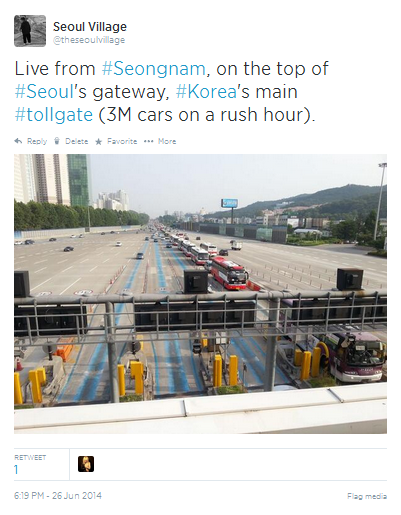
They're also right at Seoul's main gateway. You know how much I love to wander along Seoul alleyways, but I must confess that I enjoyed overlooking tens of lines of traffic from the rooftop of that tollgate:


This four-decade-old structure stretches for 400-500 m over Korea's main backbone: Gyeongbu Expressway, a.k.a. Expressway No. 1. The site reminded me how freeways can be at the same time fantastic connectors, great dividers, and awesome destinations.


*** HIGHWAYS AS CONNECTORS ***


Korean regions are much better interconnected than they were a couple of decades ago, and from 3,762 km in 2013, the national expressway network will grow to 6,160 km by the end of the decade. If the old Seoul-Busan diagonal remains clearly visible, the grid will be more balanced, with 7 North/South and 9 East/West axes. All points on mainland shall be within only 30 mn from an exit.


The network now and tomorrow (Korea Expressway Corporation - ex.co.kr)


When Beijing's building its 7th ring road (940 km), Korea's capital region is still working on its 2nd belt: after the "100", Sudogwon's "400" will connect Incheon, Ansan, Songsan, Bongdam, Osan, Ichon, Gangsang, Yangpyeong, Hwado, Pocheon, Paju, and Gimpo.


*** HIGHWAYS AS DIVIDERS ***


Of course, highways are not necessarily a sign of progress, and many in Korea still believe that adding roads is the only solution to all traffic problems. And even before talking about induced demand: how many times did we see public transportation systems be considered only after the construction of a New Town?

Cities and highways are mutually exclusive, that's why everything must be made to prevent them from meeting. That's also why Los Angeles cannot be considered a city, and Seoul is struggling to survive. And don't try to limit direct contacts at ground level by elevating the roads: it only worsens the situation (see for instance "Along Hongjecheon, my way or the highway").

Beltways that actually relieve urban centers can be a lesser evil, but even they can increase traffic and environmental damage (see for example the not really discreet Incheon-Ansan section of Seoul's second belt in the 2nd part "Connectivity, Continuity and Consistence" of my "Songdo, DMC: sequence is of the essence" trilogy).

Now back to that tollgate and Expressway No. 1. The view below illustrates how that Amazon of concrete divides the landscape even more dramatically than a natural or political border - hard to tell if the odds for a pedestrian to survive a crossing are better than at the DMZ: 


Live from Seongnam, on the top of Seoul's gateway, Korea's main tollgate (3M cars on a rush hour).
twitter.com/theseoulvillage/status/482090698359832576

(NB: West to the right, East to the left)
The contrast is even more spectacular on Google Maps:
  • To the East, Bundang stretches its 'apateu' blocks around Tancheon stream.
  • To the much West, from the green slopes of Gwanggyosan, the narrow valleys of Gungnae-dong and Geumgok-dong join Daewangpangyo-ro, a road parallel to the freeway from Geumgok I.C. (South) to Seoul beltway #100 via Pangyo New Town (North). 
  • In the center, Expressway No. 1 and its tollgate bulge (reminds me of the boa that swallowed an elephant in 'Le Petit Prince'):


The tollgate from above (NB: West to the left, East to the right)

I clearly remember watching, during the nineties, Bundang New Town rise from a sea of cranes, while the suburbs on the Western side remained stuck in time - and the mountains relatively spared.

I also remember wondering why natural embankments were not included in the New Town's original master plan: instead of the usual sinister noise barriers, green slopes would have made that side of the freeway much more pleasant. I knew that it took more space, but when you build a town from scratch, you shouldn't compromise on key elements that impact its sustainability and its perception both from the inside and from the outside...

Pangyo New Town didn't fare much better a couple of years later (see "Pangyo from scratch to crash"): noise barriers? checked - elevated highway? checked... Of course urban planners didn't seize the opportunity to cover a wide section of the highway between Bundang and Pangyo...

But I've already spilled way too much venom on Korea's New Towns here and there, and they're not the topic of the day. Furthermore, 'greenfield new towns' like Bundang now belong to the past (see "New Town out, Redevelopment in, back to the Urban Jungle").


*** HIGHWAYS AS DESTINATIONS ***


Many people see highways as tunnels in time, a moment when life is suspended between a departure and a destination, a lost moment. But the path is a destination in itself, and freeways remain an eternal source of inspiration - beyond the vast 'road movie' culture.

Smooth roads, green rest areas equipped with showers, lounges, and free wi-fi... the freeway experience in Korea has nothing to do with the nightmare of yore, and the people in charge are fully aware of importance of always improving safety and quality, of making the most of existing infrastructures (e.g. solar energy production on abandoned roads). They truly care about - yes - your happiness.

So if you drive during this Chuseok break, even if you are stuck in thick traffic, relax.

And don't hesitate to stretch time. Don't forget to take a break every two hours, the rest areas are also here for that. Why not opt out and back in, seize the opportunity and discover a part of Korea you didn't plan to see?


With my new friend in Gangwon-do. Her potatoes were fantastic, and her joy illuminated our day.
twitter.com/theseoulvillage/status/483117975265087488
(Last June, during a trip in Gangwon-do, we were invited to Gwirae-myeon, Wonju-si. Now bypassed by a bigger road, the village has seen many shops and restaurant close, which gives it a very special atmosphere)


Seoul Village 2014
Welcome to our Korean Errlines! Follow Seoul Village on Facebook and Twitter
Bookmark and Share
Add this page to your favorites


Friday, October 25, 2013

Paradise City v. Sin City

Last Tuesday, Paradise Group unveiled its "Paradise City" project on Yeongjongdo, a walking distance from Incheon International Airport. Construction starts next year and the first section shall be delivered by 2017. Ultimately, 160,000 visitors shall come daily, including a majority of Chinese tourists and business travelers*.

The KRW 1.9 Tn resort will include hotels, restaurants, convention spaces, and of course Paradise's speciality: foreigner-only casinos. The group already operates one nearby at the Hyatt Regency Incheon, and shouldn't remain the only big player for long in what seems to be the future Korean Las Vegas.


Paradise City
If you remember, a few years ago, IFEZ considered casinos as a potential 'vertical' to boost then ailing Songdo**. If the International Business District has since signed investors more consistent with its initial positioning, the potential remains huge for a gateway that welcomes tens of millions of visitors every year, including a growing number of Chinese citizens, some of whom already own a flat in Songdo. Yeongdongpo already boasts significant tourist infrastructures, and recent visa exemptions for short term stays considerably boosted the market of passengers in transit.


Incheon dreams of becoming the Northeast Asia rival to Macau, and the local casino king Stanley Ho doesn't seem to mind. He even wants to join the party, along with Universal Entertainment (Japan) and Vegas giant Ceasars Entertainment (USA, in a JV with Indonesia's Lippo Group***). But since foreign companies are not allowed to run casinos in Korea, they've been denied agreements so far, giving a head start to the national champion. This might change, and the same players are probably waiting for further regulation evolutions, in particular a "cruise bill" that could allow foreigner-only floating casinos (a life saver for OH Se-hoon's Floating Island?).


The next day, Gangwon-do announced a plan to develop Korea's first nude beach.
Try to top(less) that, KIM Jong-un! In his arms race for olympic gold and tourist silver (brand new water park, Masikryong Ski Resort), the young leader might be tempted to develop new unclad vehicles.


Seoul Village 2013
Welcome to our Korean Errlines! Follow Seoul Village on Facebook and Twitter
Bookmark and Share
Add this page to your favorites 

*"Paradise Co. to build casino complex near Incheon airport" (Yonhap News 20131022)
** "DMC at full throttle - Songdo from Sim City to Sin City?" (2011/04)
*** Midan City: midancity.com

Saturday, July 13, 2013

Gangwon-do Battlefield - 강원도 전쟁터 (무): Mu, The Lost Continent?

Gangwon-do, Autumn 2009. A field in the middle of nowhere, antropomorphous freak radishes left behind by the farmer. A surreal battlefield.

For a sunday special, a short video* of this limb limbo:


No radishes were harmed in the making of this video.

See other videos on Seoul Village's YouTube channel.

Seoul Village 2013
Welcome to our Korean Errlines! Follow Seoul Village on Facebook and Twitter
Bookmark and Share
Add this page to your favorites

* "Gangwon-do Battlefield - 강원도 전쟁터 (무)"

Thursday, March 14, 2013

Am I My Hanok's Keeper? Peter E. Bartholomew's Defense and Illustration of Korean Architecture

Like many Westerners appalled by the hanok genocide in Korea, I'm often playing God blaming Cain ("Where's your hanok?" - "I don't know, am I my hanok's keeper?" - "What have you done? Listen! Your cultural heritage’s blood cries out to your lineage from the ground"). Of course, this gallic brat cockily ranting around is not only useless but undermining the cause.

Hopefully, the cause of hanok preservation did progress dramatically, thanks to voices that carried much more than sterile criticism: true love for Korean architecture only actual hanok's keepers could manifest. And "The Guardian of The Hanok" managed to bring change because he could reach both Korean authorities and the general public.

Last Tuesday, Peter E. Bartholomew faced a large and already won-over audience for his lecture organized by the Royal Asiatic Society, Korea Branch: "Catastrophic Losses of Korea's Architectural Heritage from 1910 and Continuing Today". He could have continued for days and much more this vibrant defense and illustration of Korean architecture.


Peter E. Bartholomew, a.k.a. The Guardian of Hanok

The "Guardian of the Hanok" started his love affair with Korea's traditional architecture in 1968, when he arrived from the States in Gangneung, Gangwon-do. For five years, Bartholomew stayed in Seongyojang, an amazing three-century-old residence which, still today, belongs to a former royal family. Emerging from a sea of lotus, here's the pavillion where a younger (and, judging by his own pictures, a hairier) Peter had his first experience of hanok restoration:

 
Bartholomew illustrated his exciting presentation of the science, aesthetics, philosophy, and poetry of hanok with hundreds of pictures covering all periods, styles, and regions, including from his own hanok in Dongsomun-dong, Seongbuk-gu, where he's been living for more than 30 years.

I will simply add this spectacular view over Ikseon-dong, Jongno-gu for three reasons:


- First, it shows a key yet little known element of hanok architecture mentioned by Peter: the reddish layer of dense clay under the roof tiles, which are here about to be rearranged.
- Second, that's the opportunity to say hello to Robert J. Fouser: another great hanok keeper (just finishing his lovely home in Seochon), Robert recently wrote about this most charming but endangered neighborhood in Seoul Magazine (see "Seoul's Hanok Island: Unhyeongung Royal Residence and Ikseon-dong" and Robert Koehler's photographs)
- Third, it exposes at the same time the beauty, the strength, and the fragility of Korean architecture, as it is in the nude. Note the tile 'backbones' marking the roof lines, and the roof at the lower corner of the picture ("georgeous curves", would probably say "The Guardian of the Hanok").

Peter E. Bartholomew painted an impressive census of the 15 to 20,000 architectural treasures directly controlled by Korean administrations in 1910, from royal palaces to local governments or military compounds. He then told the sad story of annihilation. Not even one percent survived after three man-made tragedies: the Japanese occupation, the Korean war, and of course, the architectural and urban genocide that followed and still today continues.

This story became even more personal for him when he had to lead the resistance against the planned destruction of his neighborhood's last traditional houses. Bartholomew showed us the 2004 official document proving how hanoks were specifically targeted to pave the way for a major development across Dongsomun-dong. The group of hanok keepers managed to save the neighborhood - making many speculators unhappy -, and eventually won in court against the Seoul Metropolitan Government (an episode mentioned in "The Empress's Last Bang").

This decision of justice (and the media coverage it caused) was a defining moment in the fight for preservation: being associated to the destruction of hanok clearly became politically incorrect, and really bad PR at the international level, particularly following the global outcry over the mass destruction of hutongs ahead of the 2008 Beijing Olympics*. Sign of the times: Seoul mayor named the "Guardian of the Hanok" a honorary citizen the year following the battle in court.

If much pedagogy remains to be done to change mindsets, mainstream media are now more and more often documenting cases, serving the cause, and the perceived value of hanok has clearly evolved, even if that's not always a good thing (see "Stop The Hanok Genocide... And Stop Revival As Reenactment" or more recently "Build a hanok and they will come - Marketing impostures and genuine slow urbanism"). Maybe recurrent programs could help: in France, for instance, such TV programs as "Chefs d'oeuvres en peril" (1960s) or "La France defiguree" (1970s) helped raised public awareness. Preservation movements gained momentum, architectural treasures got saved, and ultimately more sustainable policies emerged.

Korea's Cultural Heritage Administration (cha.go.kr) and other organizations are already doing a lot for the architectural heritage, but there's an emergency to save treasures that are neither in protected areas nor under the spotlights.

Seoul Village 2013
Welcome to our Korean Errlines! Follow Seoul Village on Facebook and Twitter
Bookmark and Share
Add this page to your favorites

* NB: I'm pretty sure similar architectural tragedies are happening across Asia. Keepers of the world, unite?

---
ADDENDUM 20130331 - RASKB video of the conference:

Wednesday, September 21, 2011

KTX coast to coast Incheon-Gangneung

It was part of the Pyeongchang 2018 bid but now that's official: the KTX Incheon airport line will be prolonged all the way to Gangneung by 2015, connecting key entry points (ICN, Seoul) to the future olympic venues and the East Sea. A major milestone for a national network in permanent development for conventional as well as high speed lines.

Historically, Korean railways followed the Seoul-Busan axis: the Gyeongbu Line and Jungang Line are basically Nortwest-Southeast parallels, the former starting from Seoul Station and the latter from Cheongnyangni (two multimodal hubs about to be more closely connected in the future).

The KTX dramatically shrunk distances, and now Daejeon competes with Daegu as the main hub between the capital and Busan because it lies at the intersection of the KTX Gyeongbu Line (Seoul-Busan 2h10)and the Honam Line (Seoul-Mokpo 1h46). Initially planned for 2014, Seoul-Gangneung is expected to take 1h39, largely within the goal set by railway authorities for all intra-korean lines (two hours maximum).

The Incheon Airport KTX line (not to be confused with the AREX - "
AREX on time for Seoul - Gimpo - Incheon" - even if it shares the infrastructure) reaches Wonju West station in Gangwon-do, with 5 stops in between:
- Susaek (Gyeongui Line, close to the DMC and Subway Line 6) in Susaek-dong, Eunpyeong-gu, Seoul
- Yongsan (other KTX lines, Jungang Line, and Subway Line 1) in Hangangno 3-ga, Yongsan-gu, Seoul
- Cheongnyangni (Jungang Line, Gyeongwon Line) in Jeonnong-dong, Dongdaemun-gu, Seoul
- Mangu (Gyeongchun Line, Jungang Line, Subway Line 1) in Sangbong-dong, Jungnang-gu, Seoul
- Yongmun (Jungang Line) in Yangpyeong-gun, Gyeonggi-do

The old Wonju Station being also on Jungang Line, this is basically an AREX-Jungang combo.

The Wonju-Gangneung extension will connect the two cities that gave their name to the Gangwon-do province when it was founded in 1395 (GANGneung + WONju = GANGWON). Wonju remained the capital for centuries but now Chuncheon rules: it claims 1.4 mn souls compared to 310,000 for Wonju and 230,000 for Gangneung.

Only two stops are scheduled between WON and GANG: Pyeongchang and Daegwallyeong, both in Pyeongchang-gun. Daegwallyeong is famous for the Daegwallyeong Sheep Farm, but two major olympic venues are located in this myeon: Alpensia and Yongpyong resorts.

When I think that driving to Yongpyong took us 6 hours back in 1992, if we were smart enough to leave Seoul before 6 AM to avoid the traffic on the old road... infrastructures have so much improved over the past two decades!

Well. Not all infrastructures proved successful. This new KTX line looks like another nail in Yangyang International Airport's coffin: that's by far the closest one to Pyeongchang as the crow flies, and it's quite ok (yours truly used it back in 2002), but it's a commercial flop and totally desert except for the occasional charter flight.

Even on steroids, a crow cannot beat a KTX.

Seoul Village 2011
NEW : follow Seoul Village on
Facebook and Twitter

Tuesday, February 9, 2010

Take a ride on the wild side (Peace Bicycle Nuri Road)

The first 43 kilometers of the Peace Bicycle Nuri Road will open by the end of this year and by 2015, it should run sea to sea all along the DMZ, for 495 kilometers, doubling the existing leisure road and some mountain paths*.

The first 43 km will cover 3 "gun" (counties) of Gangwon-do, starting from the East :

- Goseong-gun (North of Sokcho, a county between the mountains and the East Sea, blessed with beaches, temples, lakes and hiking trails) : 7 km near the Nangman "romantic" road
- Yanggu-gun (a county mixing war scars and beautiful sceneries) : 20 km around Dutayeon (두타연), North of Dosolsan and very close to the border, deep into the mountains. Among the touristic spots : Dutayeon Pond, Dutayeon Falls, observation posts, NK Infiltration Tunnel...
- Hwacheon-gun (a mountainous county crossed by the Northern arm of the Han river) : 16km near the Peace Dam (Pyeonghwaeui Dam) over the North Hangang in Hwacheon-eup.

Eco-tourists will have a better access to Gangwon-do wonders. Of course, this first batch is not a continuous line yet : each stretch is too short to reach the next one, and to link Goseong-gun with Yanggu-gu you need to cross Inje-gun. But eventually, ambitious bikers will be able to ride all along the Demilitarized Zone, with eight stops along the way, specifically designed** to welcome them.

Bicycle infrastructure are a major concern for the MOPAS (Ministry of Public Administration and Safety), which plans to boost usage from 1.2% to 5% of the transport mix between 2009 and 2012 across the country. Bicycle paths will be expanded from 9,170 to 17,600 km and penetration rate for bicycles is expected to double from 16.6% to 30.0%.

A lot of money will be invested, and business opportunities reach beyond infrastructures and eco-tourism : until recently, the bulk of bikes were imported but local manufacturers like Samchuly keep improving and are receiving all the attention from authorities.

As China embraces the automobile age, Korea rediscovers the virtues of the "petite reine". The Pyongyang-Seoul line will probably take more time...

Seoul Village 2010

* see Korea.net ("
Gov't to build bicycle path along DMZ" - 20100209)

** Please, make these as discreet and environmental friendly as possible : genuine eco-tourists don't want bike parking lots blaring the county anthem with a glass building topped with the colorful county character...

Wednesday, December 30, 2009

Pyeongchang 2018 vs Sejong City 2010 ?

LEE Kun-hee received presidential pardon from LEE Myung-bak, officially to boost the chances of Pyeongchang in its bid for the 2018 Winter Olympics. The son of Samsung founder LEE Byung-chol, who helped turn the national champion into a global star, resigned as chairman during the investigations that led to his conviction earlier this year for embezzlement and tax evasion. Following the Olympic "tradition", LEE Kun-hee also had to put his IOC membership on hold. This pardon allows him to vote and lobby more efficiently for the Pyeongchang case.

Of course, should Pyeongchang win, many will wonder what kind of lobbying was involved. The very year he became an IOC member (1996), LEE had been convicted for bribing former presidents Chun Doo-hwan and Roh Tae-woo. He was (already!) pardoned the following year and that's one of the reasons why his 2009 sentence was considered rather kind : "only" 3-year prison + 5-year probation + KRW 110 bn.

Of course, Samsung is a top olympic sponsor and it helps : everybody remembers the 1996 Coca Cola Games in Atlanta... And everybody knows Sochi owes its olympic status to one powerful man : Vladimir Putin. But summing up Pyeongchang 2018* to the Samsung Olympics or the LEE Kun-hee Games would be unfair. The whole country has been behind the project for a very long while, and after Vancouver 2010 and Sochi 2014, holding the games in Asia would make sense. The winning city will be declared in July 2011 and as much as 2018 rivals Annecy and Munich, Pyeongchang must watch competition from China for 2022.

Still, Pyeongchang looks like the perfect alibi for LEE Myung-bak who badly needed one to grant a second pardon to Korea's most powerful man. If the measure caused the usual popular indignation, it didn't really come as a surprise. And it probably didn't come for free either : rumors have it Samsung may be the chaebol recently evoqued as a major investor for the second-version-of-the-yet-to-be-built Sejong City**... both LEEs would then share each other's burden.

To make it more look like part of a grand scheme for Gangwon-do, the Government announced today a new Seoul-Chuncheon railway. After the Seoul-Chuncheon Expressway inaugurated last summer, an undisputable argument in favor of Pyeongchang 2018.


Seoul Village 2009

* official website :
pyeongchang2018.org

** see "
Sejong City and the beauty of lameduckhood"

Sunday, November 1, 2009

Anheung Jjinbbang (Anheung)

It all started outside of the village, quite far beyond the bridge, on road 42 in the direction of Hoengseong : a house facing a vast plain covered with fields.

"Anheung Jjinbbang" opened another shop in front of the Myeon Office (Township), probably to maintain a presence in a "maeul" transformed in Jjinbbang Land : about every other house in Anheung sells steamed buns.

But people are only queuing for the original one, which made the place famous... and I guess the family rich, judging by their parking lot on route 42 and the line at the Myeon Office, like in front of a Village theater in NYC. But the movie marquee keeps advertising the same blockbuster : Route 42, Bun To Be Wild, a.k.a. your classic jjinbbang filled with red bean.

It goes in a few bites and it's only for the pick-up, but Seoulites stay in line for over one hour on Sunday afternoons, on they way back to the Capital.

The staff keeps preparing 6 large plates every 20 mn, each plate the equivalent of 3 boxes tops, because here you buy it by boxes of 20 (KRW 7,000). And one single customer can leave with a 5-storey tower in his arms : two boxes for the family, one for the neighbor, another as a trophy for collegues stuck in the city... and one for the road.

The same guy probably never purchases more than one jjinbbang in a week (heck, more likely than not not more than 3 during a whole year), but nobody seems to complain. This "jjinbbang village" is a touristic attraction and this very place an institution.

I gave up after the 4th one on the way back, but I went that far only because the traffic made the trip last for 4 hours.

Anheung Jjinbbang / 안흥찐빵 (snack)
Anheung-ri, Anheung-myeon, Hoengseong-gun, Gangwon-do, South Korea 225-821
342.4570

Seoul Village 2009

Sunday, October 25, 2009

Dunnae Minsokchon (Dunnae)

Don't be deterred by the name and decor of this restaurant : if "Dunnae Folk Village" is abusively covered with traditional and wooden artifacts, their food is the real stuff : not make-believe junk, but simple country food with an intense and unique taste. The kind of meals that deserve a trip if you really love Korean food, and like to discover new / old tastes.

Definitely the perfect stop after a morning in Gangwon-do forests and fields, enjoying their autumn best : even a few hours after eating about one and a half Korean cow (hanu) in every possible ways, I felt positively ravenous.

Still now, one day later, I'm drooling just remembering a few dishes :

- side dishes (banchan / 반찬) featuring mountain herbs (san namul / 산나물)

- Deodeok gui (더덕구이) : grilled deodok. Deodeok (도덕) is a variety of bellflower (codonopsis lanceolata) similar to toraji. Fibers seem softer.

- Taegisan Dodeok Sundae (태기산 더덕순대) : intestine / blood sausage with dodeok from nearby Taegi mountain.

- chondubu (촌두부) : a fantastic "village tofu / dubu" - You can have it with soy sauce or gimchi, but I liked it best as it came : in a very light warm broth, probably plain water with a touch of cereal, giving a slightly smoky flavor.

- namul doenjang jjigae (나물 된장찌게) : since I'm used to the best homemade doenjang, I'm difficult to move for this classic. This one is really ok.

- dondeure namulbab (돈드레 나물밥) : healthy rice and herbs bibim with doenjang sauce

- biji jjigae (비지찌개) : no meat, and an incredible taste. It reminded me of the feeling I have when I savor my favorite rich bread soup in the deep Perigord Noir (the one you finish with red wine before attacking the confit de canard pommes sarladaises... if you still have room left after the foie gras).

- ... I'm probably missing one or two steps there but that's part of the game.

Seoul Village 2009

Dunnae Minsokchon / 돈내 민속촌 (restaurant)
Gangwon-do, Hoengseong-gun, Dunnae-myeon, Dunnae, ROK
From the market, the street along the stream right before the bridge. About half a mile after the school.
Tel : +82.33.342.7807.5949


PS: thank you Mr Bae, from Byeolmuri pension, for the address.

Sunday, June 28, 2009

Royal Joseon Tombs Become UNESCO World Heritage Properties

For its 33rd session (to be finalized tomorrow, June 30), UNESCO added 13 sites to its prestigious World Heritage List*, but put 3 on the Danger list and even removed one, the Dresden Elbe Valley, because a bridge had been built in the middle of the heritage zone in spite of strong warnings issued in 2006.

A clear message to all countries boasting such prestigious properties : big responsibilities come with the honor, so take good care of them or else...

Typically, preserving Korea's newly listed property (its ninth**) will require some organization : it stretches over 1756.9 ha (4251.7 ha including buffer zones), and 18 locations scattered across Seoul, Gyeonggi-do (most notably the Donggureung complex in Guri), and Gangwon-do (1 site).

After Goguryeo Tombs, Gyeongju Tumuli, Jongmyo, and even certain Dolmens, the UNESCO is once more celebrating Korean funeral traditions and rites : an ensemble of over 50 tombs of either Kings and Queens (generally ending in "neung" / 릉), or other members of royal family ("won" / 원), including a royal concubine and a 9 month boy. Some tomb names end in "myo" / 묘, the more generic term for cemeteries and graves.

The obligation to preserve buffer areas beyond the sites is excellent news for the environment and the quality of life around the dead : as the UNESCO pointed out, Joseon Tombs are "typically protected by a hill facing south toward water and layers of mountain ridges in the distance"**. One more argument in favor of
the protection of Seoul mountains !

Excellent news also for certain Districts which struggled to build an identity or to draw tourists (ie Unpyeong-gu, Dobong-gu, Nowon-gu, Seongbuk-gu). Tombs are generally well specified in maps and signs, but most of the people leaving nearby didn't care much about those cultural assets (when there's a really nice park or an elaborate complex, that's a different story). For sure, associations which pushed for the UNESCO recognition will feel less lonely now.

Main Royal Joseon Tombs :


In Gangwon-do (1 site, 1 tomb) :

. 1 in Yeongweol (Yeongwol-gun, Yeongwol-eup, Yeongheung-ri) : one more reason to visit Jangneung King Danjong's Tomb (see "King Danjong and Korea's curse") !

In Seoul (6 sites, 11 tombs) :

. Dobong-gu (1 site, 1 tomb) : Yonsangunmyo in Banghak-dong
. Dongdaemun-gu (0 site, 2 tombs) : Sunginwon and Yeonghwiwon are located on Hongneung-gil in Cheongnyangni-2-dong, but associated with Uireung site in Seongbuk-gu. In the former lies the young Yi Jin (1921-1922), son of King Yeongchin, Korea's last Crown Prince. In the latter, King Gojong's first royal concubine Sunheon - 1854-1911).
. Gangnam-gu (1 site, 2 tombs) : Seonjeongneung in Samseong-dong regroups Jeongneung (King Jeongjong - 1488-1544), and Seollung (Queen Gonghye - 1456-1474).
. Nowon-gu (1 site, 2 tombs) : Taegangneung (Taereung and Gangneung) in Gongneung-dong.
. Seocho-gu (1 site, 2 tombs) : Heoninneung (Heonneung and Inneung) in Naegok-dong.
. Seongbuk-gu (2 sites, 2 tombs) : Uireung includes Uireung itself, the tomb of King Gyeongjong (1688-1724) in Seokgwan-dong, and two tombs located in Dongdaemun-gu. Uireung used to be managed (and not so poorly preserved) by the KCIA. I wonder how the other site, Jeongneung (in Jeongneung-dong), ever managed to get the nod from the UNESCO : it now lies at the feet of Naebu expressway before the Bugak Tunnel leading to Pyeongchang-dong, and this poor place often comes up when I think of peaceful areas ruined by development. Unless... could it be a plot to remove the Naebu overpass ?

In Gyeonggi-do (15 sites, 45 tombs) :

. Gaeseong (2 sites, 2 tombs) : Huneung and Joeneung, respectively in Ryeongjeong-ri and in Sangdo-ri, two villages located in Panmun-gun (Panmun county).
. Gimpo (1 site, 1 tomb) : Jangneung in Gimpo-eup, Pungmu-ri (site different from Paju's Jangneung)
. Goyang (2 sites, 16 tombs, including one in the city of Gwangmyeong) : Seosamreung or the "3 Western graves" (Hwireung, Hyoneung, and Yoeneung, plus Sogyeongwon, Uiryeongwon, Hyochangon and Hwimyo) are all located in Wondang-dong, Deokyang-gu. Seooreung or the "5 Western graves" (Changneung, Gyeongneung, Heungneung, Ikneung, and Myeongneung) are in Yongdu-dong, but the "site" also includes tombs in Wondang-dong (Daebinmyo, Sugyeongwon, and Sunchangwon), and Yeonghoewon in Noonsa-dong, Gwangmyeong... a city on the other side of Seoul.
. Guri (1 site, 9 tombs) : the Donggureung complex in Toegyewon-myeon, Inchang-dong clearly stands out for its shape and significance. It hosts Geonwolleung, the tomb of King Taejo (1335-1408), founder of the Joseon Dynasty, and 8 others (Hyeonneung, Mokneung, Huineung, Sungneung, Hyeneung, Wonneung, Suneung, Gyeongneung).
. Hwaseong (1 site, 2 tombs) : Yoonggeonneung (Yoongneung and Geonneung) in Annyeong-dong.
. Namyangju (4 sites, 8 tombs) : Saneung (in Jingeon-eup, Saneung-ri) owes its name to the "four graves" ("sa neun") it boasts : Saneung itself (tomb of Queen Jeongsun, 1440-1521), Gwanghaegunmyo, Anbinmyo, and Seongmyo. Hongyuneung (Hongneung and Yuneung) is in Gumgeok-dong and Hongseondaewongunmyo in Hwado-eup, Changhyeon-ri. Gwangneung hosts the "bad" King Sejo in Jinjeon-eup, Bupyeong-ri.
. Paju (2 sites, 4 tombs) : Jangneung (different from Gimpo's - this one is in Tanhyeon-myeon, Galhyeon-ri) and Samreung (in Jori-eup, Bongilcheon-ri). As the name suggests, Samreung boasts three tombs : Gongneung, Seunneung, and Yeongneung.
. Yangju (1 site, 1 tomb) : Onneung in Yeoju-gun, Jangheung-myeon, Ilyeong-ri.
. Yeoju (1 site, 2 tombs) : Yeongneung in Neunseo-myeon, Hwangdae-ri consists of Joseon Sejongdaewangneung Yeongneung, tomb of the Great King Sejong (1397-1450) and his wife Queen Soheon, and Joseon Hyojong Yeongneung, tomb of the bellicose King Hyojong (1619-1659).

The Cultural Heritage Administration of Korea are working on the best way to cope with this wonderful honor and harmonize the visits. They just opened a specific website (not in English yet but it's a matter of days I guess) : royaltombs.cha.go.kr.

And of course, don't restrict your visits to UNESCO stars and Joseon royalty. There are tombs all over Seoul, for example in the National Cemetery, or Hyochang Park, and even almost anonymous ones in bits of land clinging to mountains. I even saw one in Sanggye right at the feet of an appartment building. To me, the epitomy of the Seoul tombstone appateu.

SM 2009

* see "13 new sites have been added to UNESCO’s World Heritage List which lost one site while three were placed on the Danger List" (UNESCO 20090628)

** Korea now owns 9 of the list's 890 properties (8 cultural properties and 1 natural property) :
. 3 since 1995 : Haeinsa Temple Janggyeong Panjeon, depositories for the Tripitaka Koreana Woodblocks (see Seoul Village focus), Jongmyo Shrine, and Seokguram Grotto + Bulguksa Temple
. 2 were added in 1997 :Changdeokgung Palace Complex and Hwaseong Fortress
. 2 in 2000 : Gyeongju Historic Areas and the Dolmen Sites in Gochang, Hwasung and Ganghwa
. 1 in 2007 : Korea's only natural property, Jeju Volcanic Island and Lava Tubes
. 1 in 2009 : Royal Tombs of the Joseon Dynasty

*** UNESCO's description of the property :

The Royal Tombs of the Joseon Dynasty (Republic of Korea) form a collection of 40 tombs scattered over 18 locations. Built over five centuries, from 1408 to 1966, the tombs honoured the memory of ancestors, showed respect for their achievements, asserted royal authority, protected ancestral spirits from evil and provided protection from vandalism. Spots of outstanding natural beauty were chosen for the tombs which typically have their back protected by a hill as they face south toward water and, ideally, layers of mountain ridges in the distance. Alongside the burial area, the royal tombs feature a ceremonial area and an entrance. In addition to the burial mounds, associated buildings that are an integral part of the tombs include a T-shaped wooden shrine, a shed for stele, a royal kitchen and a guards’ house, a red-spiked gate and the tomb keeper’s house. The grounds are adorned on the outside with a range of stone objects including figures of people and animals. The inscription of the Joseon Tombs completes the two earlier series of Korean Peninsula royal tombs inscribed on UNESCO’s World Heritage List: the Gyeongju Historic Areas, Republic of Korea, and Complex of Koguryo Tombs, Democratic People’s Republic of Korea.

Saturday, May 16, 2009

Namuga Ineun Jib (Seoul)

There's a tree in this house. That's the truth and the name of the restaurant located in the elbow of Gyeonghuigung-gil.

I wonder what will happen to this tree and this old wooden house - first half of the XXth century I guess, with something vaguely Western to it... In the green painted veranda, facing a small backyard and the said tree, you almost feel like in a countryside family home, maybe not far from the sea.

The restaurant will soon move to the building next door, more modern and functional, and it probably won't feel the same... but there's no reason why food should taste any worse a few meters down the street.

Because Namuga Itneun Jip proposes a fantastic experience for Korean food lovers, who will enjoy new flavors, with a focus on tofu and Gangwon-do food. And an incredible series of banchan, featuring a radish (무) to die for.

Namuga Itneun Jip / 나무가 있는 집 (restaurant)
1-209 Shinmunro 2-ga, Jongno-gu, Seoul, ROK
Tel : +82.737.3888

SM 2008 / Seoul Village

see other restaurants in Seoul and Korea.