NEW - download 'Seoul VillageS (서울 마을들)', my collection of 12 short fictions now adapted into short films! Get your free copy of the ebook (4 editions: English, French, Korean, Bilingual English-Korean)!

Showing posts with label Pangyo. Show all posts

Thursday, June 7, 2018

Riding along 'horizontal verticals' in Magok District (Part III)

This is the final part of my focus on Magok District:
    1. Framing Magok (Part I - Location)
    2. Magok's horizontal verticals (Part II - Cluster)
    3. Magok's lifespace (Part III - Environment)
The future Seoul Botanic Park will feature 3,0000 plant species (its flower-shaped indoor facility - bottom right - is already visible from a distance).


***


3) Magok's lifespace


If Gangseo-gu is not an usual darling for real estate speculators, Magok scores much better than most Seoul neighborhoods. Beyond its potential and dynamics in terms of location, connectivity, or research hub, people seem to believe in its quality of life, and to trust SH Corporation for delivering the goods.

Rebranded two years ago Seoul Housing and Communities Corporation*, this public institution has led the development from its early stages, with a mandate to put families, environment and sustainable mobility at the core of the project, a clear difference with other innovation clusters where business preempted everything.

Seoul Business Agency (SBA) did play a central role in Magok as it did in the DMC, but in the latter, residential developments were secondary, and not considered as a key factor of success. And we saw how the Gale International - Posco tandem struggled in Songdo.

Pangyo too enjoyed a partnership between national and local authorities for its Pangyo Techno Valley (Gyeonggi Institute of Science and Technology Promotion established in 2010), but for its residential areas, it only had to surf on the Bundang wave, and from the start flush with private money, that very hyped 'New Town' got 'blessed' with more than a few luxury residences.

Like Pangyo, Magok started essentially from scratch. Revamping Guro Digital Complex, and supporting its evolution into a XXIst century G-Valley demands different efforts from Seoul and Kicox (Korea Industrial Complex Corporation).

Magok wasn't dragged down by ailing neighborhoods in need of regeneration. The central role of public authorities is a guarantee that everybody will profit, not a sign of destitution. I don't think Magok will become as 'bling-bling' as Eastern Gangnam either, but I don't see that as an inconvenient.


How does this 'common good' approach translate into the landscape? For instance, beyond the central park, you don't have a collection of green spaces, each one managed by a gated apartment complex, but neighborhood parks connected by green corridors between open blocks. Branded M-Valley by SH Corporation, the residential complexes remain relatively low rise compared to other recent projects this side of the Han River, keeping in mind that this is a first development. Even if we're still in the classic 'apateu' model, there could be a greater sense of open community than in Pangyo's luxury town houses or from the top of a Songdo penthouse...

The green corridors are wider than Yeonnam-dong's 'Yeontral Park' (the Gyeongui Line Forest Trail), but without the streets, shops or restaurants on their sides, and only a few tables to picnic here and there, which minimizes noise pollution for the residents.

As I noticed before, along large sections of Seoul Botanic Park, blocks devoted to research centers sit right across the street (e.g. for the moment LG Science Park and Kolon One and Only Tower), which could be seen as a form of privatization, but could also become a motivation for them to open up, to let visitors roam their own land, to propose services that would flourish along the frontline in probably more anarchic ways, to blur the lines of a strict zoning. 

Tadao Ando's LG Art Center (see part II) provides a clearer example of how local communities can benefit from private infrastructure: parts of the program will involve residents, and the venue will eventually belong to Seoul city. 

For the moment, residential and research blocks stand out, and local businesses mostly develop around subway stations. The first significant hotel to open in the neighborhood mirrors its positioning: overlooking the park, Courtyard by Marriott is not the chain's most luxury brand, but provides quality stays for both business people and families.


*

Seoul issued guidelines and specs early in the project to make sure that environment, accessibility, or bicycle lanes were taken into account:


Water collection and filtering systems embedded in the buildings, roads, or parks
Accessibility and security at pedestrian crossings
Pedestrian crossings again, this time for bicycle lanes, always a tricky moment for cyclists
With its flatness and absence of major disruptors in its core (hills, river, railways, highways**), Magok District is perfect for cycling. 40% of all roads will have dedicated lanes, in a continuous network connecting the new neighborhood and its Seoul Botanic Park to the Hangang backbone. Beyond a 'Ddareungi' special zone facilitating commuting and leisure rides, or many bike parking facilities, four bike storage systems will be available at subway stations.


Bicycle-friendly Magok (left, one of the green diagonal corridors between apartment blocks - right, a protected bike lane that could be wider, like for instance the one along Seongmisan-ro in Seongsan-dong).
Magok's bicycle network
So it seems that even in this early stage, Magok is aiming at to the vision I finished my 2013 update with (see 'Magok District on cruise mode'):
"Now the most important remains to give some soul and consistence to this alleywayless place. You want to see residents and researchers venture beyond their homes and campuses, roam the streets, enjoy the city. The park and diagonal canal can give purpose, but let's not forget to optimize every single street for pedestrians and bicycles, make this neighborhood a destination from all directions, in continuity with Hangang Park, and the new neighboring communities (Banghwa, Balsan...)."
*

As usual, as an urbanist, I would have done things differently; Magok District doesn't signal a revolution in the Korean New Town or the Korean innovation cluster models. Yet it redefines Gangseo-gu, and beyond Southwest Seoul. It might even demonstrate that a big residential and business project South of the Han River can succeed without arrogance. What matters is that, ultimately, people live happily together in a place where trees, bicycles, and fellow earthlings are welcome.

Seoul Village 2018
Welcome to our Korean Errlines! Follow Seoul Village on Facebook and Twitter

Bookmark and Share
.
* see "Seoul summerscapes: death, taxes, and budongsan
** if Gonghangdae-ro is a wide and busy axis, it can't be compared to the Gyeongbu Expressway that separates Seopangyo and Dongpangyo

Monday, May 21, 2018

Riding along 'horizontal verticals' in Magok District (Part II)

This is the second part of my focus on Magok District:
    1. Framing Magok (Part I - Location)
    2. Magok's horizontal verticals (Part II - Cluster)
    3. Magok's lifespace (Part III - Environment)


***


2) Magok's horizontal verticals

In the first part we saw how, by its simple location and connectivity, Magok District enjoyed key assets for a business hub. In the third one, we'll see if its environment can, as advertised, attract researchers and creative minds. Here, we'll focus on the innovation cluster promise.

The signature used in recent advertorials sounds familiar, and as usual with previous Korean projects sharing similar ambitions in the past, 'Korean Silicon Valley Magok' ("한국의 실리콘밸리 마곡") is supposed to create a haven where big fish and small fry cohabit. But as usual, chaebol struggle to envision innovation clusters beyond proprietary ecosystems, which can become a major hurdle for diversity and creativity (see "Redrawing Korean Maps - Innovation Clusters").

Magok doesn't aim at aggregating value around business 'verticals' like the Sangam DMC, conceived as the name suggests for media and entertainment, or even Songdo, when it was desperately looking for a way to reboot and better market itself. Here, we're into 'convergence and fusion technology', more in the Pangyo Techno Valley vein, but with a stronger industrial - manufacturing touch.

As the first big fish to sign for this former swampy rice paddy area, LG Group set the tone for 'convergence and fusion', pooling Research and Development teams from key subsidiaries (LG Electronics, LG Chem, LG Display...) in its LG Science Park complex (18 buildings, capacity of 25,000 employees) to better tackle such challenges as robotics or A.I.. Similarly, Lotte Group is looking for new synergies between Lotte Food, Lotte Confectionery, Lotte Chilsung Beverage, and Lotteria...

Should we dub this higher stage of chaebolism 'horizontal verticals'?


Clockwise, the site of Tadao Ando's future LG Art Center / LG Science Hall, LG Science Park's ISC (Integrated Support Center), Kolon One and Only Tower.
LG Science Park Integrated Support Center (www.instagram.com/p/Bi8rK-slfWJ)

LG also provides the neighborhood with a cultural venue designed by Tadao Ando. The new LG Art Center will open in 2020 on Magokjungang 10-gil, across the LG Science Park and next to the park itself. The group will operate the theater for thirty years before offering it to Seoul city.


It's way too early to judge this new ecosystem, particularly since, like in the DMC, small players are supposed to join after the big ones. Urbanism and architecture can give us clues about the potential, though. For instance, LG Science Park can look like series of containers from a distance, but many buildings are porous, with atria and green walkways, giving the ensemble a campus-like touch, more open to its surroundings than other, more monolithic centers.

Unlike the actual Silicon Valley, where most companies of all sizes and shapes settled in existing urban or peri-urban environments, this research complex consists of contiguous lots, most of which will be developed by one powerful player. So if you're having a coffee in the Eastern half of Magok District, chances are it will be in a building owned by one of those, which may alter the way you pitch your startup over a cup of java.


***

If Magok District will welcome garage startups, they are not its main target. The aim is to boost innovative research in industries that do have fuzzy edges, but also complex cores and cycles, and it already signed enough significant players to succeed. More will want to join in a site ideally located for logistics and within the capital city, but quality of life will also be a factor. Ideally, Magok's environment must stimulate creativity, but in not necessarily too 'speedy' and disruptive ways. 

Is it likely to deliver? That's what we'll check in our last part of this focus.

 
Seoul Village 2018
Welcome to our Korean Errlines! Follow Seoul Village on Facebook and Twitter
Bookmark and Share
Add this page to your favorites
.

Sunday, May 20, 2018

Riding along 'horizontal verticals' in Magok District (Part I)

As we've seen before*, Magok District deserves specific attention as Seoul's last big chunk of undeveloped land (until they decide to chop off all remaining mountains), and one of Korea's ambitious innovation clusters.

If new pieces keep being added every now and then to this urban jigsaw puzzle, recent weeks have seen major developments and PR operations, particularly with the inauguration of LG Science Park by MOON Jae-in, two years after PARK Geun-hye's speech at its groundbreaking ceremony. Of course, since many initiatives in Korea boil down to real estate, a lot of this PR aims at promoting new residences in a neighborhood that's been rather overperforming the market.

Time seems ripe for an update on Magok's narrative, reality, and fundamentals. Could it mark an evolution in Seoul's postwar urbanism (for the big picture, see 'Inhuman, all too human Seoul')? Certainly not a real disruption, since in many ways it remains a classic, zoned Korean 'New Town'. And the focus being on business, let's see how this 'swamp thing' can compares to - or coopetes with? - neighborhoods I've seen rise from a landfill (Digital Media City), the sea (Songdo), or a valley (Pangyo).

Like my 2013 focus on the DMC and Songdo***, I'll slice this one into 3 pieces:
    1. Framing Magok (Part I - Location)
    2. Magok's horizontal verticals (Part II - Cluster)
    3. Magok's lifespace (Part III - Environment)


'Magok's future Seoul Botanic Park' (20180518 - www.instagram.com/p/Bi6Wi5illxo)


***

1) Framing Magok

What better image to help you grasp the scale and level of completion of the 3.6 M square meter Magok District than this recent aerial view?


Magok District from above in 2017 (Seoul Metropolitan Government)

Stretching over Magok-dong and Gayang-dong, Magok District lies at the very heart of Gangseo-gu, which badly needed a center to make better sense. It's articulated around the gu's backbone: its road to Gimpo Airport, Gonghang-daero.
  • To the West: Banghwa-daero, Banghwa New Town, and Gonghang-dong which hosts the airport. 
  • To the North: Olympic Expressway and the Han River
  • To the East: Gangseo-ro (East), and Deungchon-dong. 
  • To the South: the new Balsan District and Gangseo Agricultural and Marine Products Market.


Actually, only a tendril of Seoul Botanic Park - but a most essential one - reaches the Han River. Most of the district remains under Yangcheon-ro, blocked to the West by the Seonam Water Recycling Center, and to the East by Gungsan, a cute hill which I hope will be preserved, along with the village at its feet.

Magok's four defining dimensions were 'industrial', 'business and commercial', 'residential', 'parks and green', with zones clearly visible from the initial masterplan:


Within the district, three main axes have been created to border its 503,000 sqm park:
  • Magokjungang-ro to the West, with Magok Station (Line 5) at the intersection with Gonghangdaero, and Magongnaru Station (Line 9, and soon AREX) to split what's North of it into two even parts. If Gongangdaero is as wide as a highway, Magongnaru area is booming around the relatively narrow winding road leading to previously developed Banghwa-dong. 
  • The much quieter Magokdong-ro to the East separates for the moment two LG research blocks, with Kolon's spectacular One and Only Tower (!) at the interection with the third axis.
  • Magokjungang 10-gil marks the park's Southern border, with LG Science Park on the frontline (obviously, LG's L still stands for Lucky; the early bird did catch the worm).
So this is basically the frame being filled step by step...
' map keeps filling up (ad in my mailbox)' (20141207 - twitter.com/theseoulvillage/status/541499306344448000)
 ... its central park still missing, but continuously advertised as a key asset:


***


Keep in mind this brief framing of Magok District when we move on to its business purpose (Part II) and living environment (Part III). It already reveals precious advantages:
  • a simple, compact, and flat map
  • seamlessly integrated to its urban vicinity, unlike Songdo, or even Pangyo (highway) and the DMC (railway). As you know, I value "urban continuity" as a key factor of success.
  • even if it's located in the capital's far west, Magok District is very close to the airport (a clear advantage over Pangyo for instance), but also directly connected to the historic center (Gwanghwamun via Line 5), and to key business hubs (e.g. Yeouido, Yeongdongdaero via Bongeunsa Line 9). When AREX opens at Magongnaru Station, the synergies with DMC and Guro Digital Complex, both one stop away, will be even easier.
  • in spite of the Olympic Expressway, Magok provides a unique corridor to the Han River, and its park enjoys relatively little competition in a wide radius. Can it bring Gangseo-gu's half million inhabitants closer together, and reach beyond?

Seoul Village 2018
Welcome to our Korean Errlines! Follow Seoul Village on Facebook and Twitter
Bookmark and Share
Add this page to your favorites

* e.g. "Magok District on cruise mode", "Magok District: SIM City as in "Seoul Intra Muros"? Alleyways as in "Seoul Inter Muros"?", all posts related to Magok District.
** "Songdo, DMC: sequence is of the essence (Part I)", "Part II", "Part III"

Friday, September 5, 2014

Freeways as Dividers, Connectors, and Destinations

On Chuseok, I have a special thought for Korea Expressway teams. This is their busiest moment of the year, and they have no time to spend with their families because they want to make sure you do it safely.

Last spring, I visited their facilities in Gungnae-dong, Bundang-gu, Seongnam-si, Gyeonggi-do. A great moment! That's where they monitor the traffic for the whole nation, and where they broadcast 176 updates every day.


And live from Korea expressways main broadcasting station
twitter.com/theseoulvillage/status/482092363821481984
From Korea Expressway's control room
twitter.com/theseoulvillage/status/488670603504005120


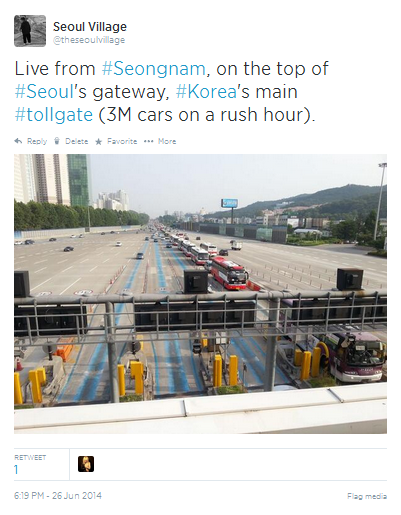
They're also right at Seoul's main gateway. You know how much I love to wander along Seoul alleyways, but I must confess that I enjoyed overlooking tens of lines of traffic from the rooftop of that tollgate:


This four-decade-old structure stretches for 400-500 m over Korea's main backbone: Gyeongbu Expressway, a.k.a. Expressway No. 1. The site reminded me how freeways can be at the same time fantastic connectors, great dividers, and awesome destinations.


*** HIGHWAYS AS CONNECTORS ***


Korean regions are much better interconnected than they were a couple of decades ago, and from 3,762 km in 2013, the national expressway network will grow to 6,160 km by the end of the decade. If the old Seoul-Busan diagonal remains clearly visible, the grid will be more balanced, with 7 North/South and 9 East/West axes. All points on mainland shall be within only 30 mn from an exit.


The network now and tomorrow (Korea Expressway Corporation - ex.co.kr)


When Beijing's building its 7th ring road (940 km), Korea's capital region is still working on its 2nd belt: after the "100", Sudogwon's "400" will connect Incheon, Ansan, Songsan, Bongdam, Osan, Ichon, Gangsang, Yangpyeong, Hwado, Pocheon, Paju, and Gimpo.


*** HIGHWAYS AS DIVIDERS ***


Of course, highways are not necessarily a sign of progress, and many in Korea still believe that adding roads is the only solution to all traffic problems. And even before talking about induced demand: how many times did we see public transportation systems be considered only after the construction of a New Town?

Cities and highways are mutually exclusive, that's why everything must be made to prevent them from meeting. That's also why Los Angeles cannot be considered a city, and Seoul is struggling to survive. And don't try to limit direct contacts at ground level by elevating the roads: it only worsens the situation (see for instance "Along Hongjecheon, my way or the highway").

Beltways that actually relieve urban centers can be a lesser evil, but even they can increase traffic and environmental damage (see for example the not really discreet Incheon-Ansan section of Seoul's second belt in the 2nd part "Connectivity, Continuity and Consistence" of my "Songdo, DMC: sequence is of the essence" trilogy).

Now back to that tollgate and Expressway No. 1. The view below illustrates how that Amazon of concrete divides the landscape even more dramatically than a natural or political border - hard to tell if the odds for a pedestrian to survive a crossing are better than at the DMZ: 


Live from Seongnam, on the top of Seoul's gateway, Korea's main tollgate (3M cars on a rush hour).
twitter.com/theseoulvillage/status/482090698359832576

(NB: West to the right, East to the left)
The contrast is even more spectacular on Google Maps:
  • To the East, Bundang stretches its 'apateu' blocks around Tancheon stream.
  • To the much West, from the green slopes of Gwanggyosan, the narrow valleys of Gungnae-dong and Geumgok-dong join Daewangpangyo-ro, a road parallel to the freeway from Geumgok I.C. (South) to Seoul beltway #100 via Pangyo New Town (North). 
  • In the center, Expressway No. 1 and its tollgate bulge (reminds me of the boa that swallowed an elephant in 'Le Petit Prince'):


The tollgate from above (NB: West to the left, East to the right)

I clearly remember watching, during the nineties, Bundang New Town rise from a sea of cranes, while the suburbs on the Western side remained stuck in time - and the mountains relatively spared.

I also remember wondering why natural embankments were not included in the New Town's original master plan: instead of the usual sinister noise barriers, green slopes would have made that side of the freeway much more pleasant. I knew that it took more space, but when you build a town from scratch, you shouldn't compromise on key elements that impact its sustainability and its perception both from the inside and from the outside...

Pangyo New Town didn't fare much better a couple of years later (see "Pangyo from scratch to crash"): noise barriers? checked - elevated highway? checked... Of course urban planners didn't seize the opportunity to cover a wide section of the highway between Bundang and Pangyo...

But I've already spilled way too much venom on Korea's New Towns here and there, and they're not the topic of the day. Furthermore, 'greenfield new towns' like Bundang now belong to the past (see "New Town out, Redevelopment in, back to the Urban Jungle").


*** HIGHWAYS AS DESTINATIONS ***


Many people see highways as tunnels in time, a moment when life is suspended between a departure and a destination, a lost moment. But the path is a destination in itself, and freeways remain an eternal source of inspiration - beyond the vast 'road movie' culture.

Smooth roads, green rest areas equipped with showers, lounges, and free wi-fi... the freeway experience in Korea has nothing to do with the nightmare of yore, and the people in charge are fully aware of importance of always improving safety and quality, of making the most of existing infrastructures (e.g. solar energy production on abandoned roads). They truly care about - yes - your happiness.

So if you drive during this Chuseok break, even if you are stuck in thick traffic, relax.

And don't hesitate to stretch time. Don't forget to take a break every two hours, the rest areas are also here for that. Why not opt out and back in, seize the opportunity and discover a part of Korea you didn't plan to see?


With my new friend in Gangwon-do. Her potatoes were fantastic, and her joy illuminated our day.
twitter.com/theseoulvillage/status/483117975265087488
(Last June, during a trip in Gangwon-do, we were invited to Gwirae-myeon, Wonju-si. Now bypassed by a bigger road, the village has seen many shops and restaurant close, which gives it a very special atmosphere)


Seoul Village 2014
Welcome to our Korean Errlines! Follow Seoul Village on Facebook and Twitter
Bookmark and Share
Add this page to your favorites


Monday, October 7, 2013

Four Seasons Seoul

Just to wrap up my January 2012 post on Mirae Asset's luxury hotel project in Gwanghwamun ("A 6 Star Hotel in Gwanghwamun?"), which as expected went to Four Seasons, and will open on May 2015:


See also "Four Seasons Hotels and Resorts enters Korea" (Four Seasons PR 20130904)

For the prestigious hotel group, Seoul fills a gap in an increasingly strategic region. Mirae Asset confirm their ambitions in hospitality businesses: they bought the Four Seasons Sydney a few days before the deal was announced (from Eureka Funds Management, see "Four Seasons sold for $340 million" - The Sydney Morning Herald 20130821), and also pilot the Courtyard by Marriott in Pangyo.

Now I realize that I never shared any image of a project I often pass by. Well the working site is not that spectacular...

March 14, 2013 (much more advanced today!)
... and the architecture not very original either:


The future 317-room hotel near Sejongno Sageori
 
As far as office spaces are concerned, Gwanghwamun area has been dotted with many new towers over the past years, and in order to fill them, operators had to suck tenants out of older and lower tier buildings. If many hotels will open across Seoul in the months and years to come, this shouldn't be the case for a hospitality franchise targeting elites.

Still, competition will be fierce. Particularly since all major players have completed renovation, most recently their main rival, The Shilla Seoul, which at last decided to act as a leader by opening a high end Korean restaurant: even if they don't make a fortune with 'La Yeon', that's a higher calling (see "Korean Cuisine Aiming At World's Top Five. China is watching"). I would be disappointed if Four Seasons Seoul failed to propose fine Korean dining.


Seoul Village 2013
Welcome to our Korean Errlines! Follow Seoul Village on Facebook and Twitter
Bookmark and Share
Add this page to your favorites

Thursday, March 7, 2013

Sudogwon New Town Blues

I've not always been kind to Korean New Towns in general, and to doomed "greenfield" projects in the Incheon - Gyeonggi area in particular (see for instance "From urban mirages to urban decay", or "Wet eyes for wetlands and urban mirages"*), but today Korea JoongAng Daily didn't mince their words in this title: "Collapse of Incheon new town is end of era" (Korea JoongAng Daily 20130308).

The article was triggered by a decision from the Korean Ministry of Land, Transport and Maritime Affairs to strip part of Geomdan New Town from its New Town status, consequently allowing residents to follow new projects of their own. The journalist mentions other new towns struggling in the capital region (a.k.a Sudogwon = Seoul + Incheon + Gyeonggi-do): new ones - such as in Dongtan or Paju - as well as old darlings - Yongin and Bundang lost 22 and 25% of their value over the past 5 years.

The 10 projects listed in the article** are expected to deliver 613,000 apartments for 1.6 million people between 2001 and 2020. I think most dwellings have already been completed, but they only represent a portion of all Sudogwon new towns - the ones with national government support (for instance not a single one in Seoul, not Incheon's Songdo and Cheongna, not Gyeonggi-do's Namyangju and co...). And of course there's the competition from yet other new towns: property value in Sejong City jumped by almost 22% last year, compared to a disappointing 2.18% for Sudogwon, and net migration into Sudogwon nosedived from 209,000 people in 2002 to 8,000 in 2012. And of course, new towns themselves represent only a portion of all urban developments***.

By 2020, the population of Seoul Capital Area is expected to be the same as it is today, about 25.5 million souls. Of course, household structures do evolve, and change in North Korea could radically modify the equation, but again, you can't beat demographics, and this is a non-zero-sum game: even if, by miracle, all these New Towns were to succeed, some Older Towns would necessarily fail.

And again, this is "the end of an era, but not yet the end of the real estate dream"*. The "apateu = guaranteed jackpot" illusion is not completely dead, and new mirages keep popping up.

From the start, Geomdan New Town was not the sexiest project. And even downsized, it will struggle next to Gimpo New Town, a huge bed town recently delivered, and not very far from Magok District (see "Magok District: SIM City as in "Seoul Intra Muros"? Alleyways as in "Seoul Inter Muros"?"). Something's gotta give between all the residential projects, but also between their industrial sidekicks (over 2.2 M square meters for the new and improved Incheon Geomdan General Industrial Complex). Geomdan's New Town status was granted in October 2006, at the peak of the bubble, and many projects have been reconsidered in the years that followed, but I don't remember seing any strategic vision laid out regarding the big picture following the big collapse. Only more denial, and new non-vital projects specially designed to help friendly constructors keep busy and afloat.

Today's KJD article

At a time when financial products propose yields barely superior to inflation rates, Sejong City's +22% could sound sexy, but this project was a walking dead not so long ago, and remains subject to political hiccups. Furthermore, Sejong City demonstrated once more the limits of urban planning in Korean new towns: after lobbying against a KTX station that would have allowed many civil servants to commute to Seoul instead of settling down in the new adminstrative center, authorities are now complaining about the lack of connections with the capital.

Nothing new under the sun: I was flabbergasted to learn that the subway between the future Incheon International Airport and Seoul would be on purpose delayed until years after ICN's inauguration, just to spare cab drivers. And outraged to see how Pangyo had been designed against all elementary rules of urbanism****. I once discussed with Seoul urban planners about the need to take into account all the impacts of a new town (for instance on traffic) from the earliest stages of the conception of a project, instead of trying to catch up and fix things after the delivery, and they said it would be nice if directions could work together to make that happen... When they do exist, impact studies are seldom comprehensive, which shouldn't come as a surprise when structural decisions regarding pharaonic projects can be made and unmade on impulse, ahead of a last minute press conference.

Yesterday, George W. Bush was invited for a few hours in Seoul to boost some real estate project. One could have expected a more relevant anti-real-estate-bubble lucky charm for Korea.

Seoul Village 2013
Welcome to our Korean Errlines! Follow Seoul Village on Facebook and Twitter
Bookmark and Share
Add this page to your favorites

* I didn't spare Seoul new towns either, including in my 2011 essay "Inhuman, all too human Seoul":
One megapolis, a hundred villages, a thousand faces
1)The industry of a dream - the ideal city
- Industrial revolution of housing: from the virtuous cycle to the bubble
- From mass market products to fashion and services, from utopia to dystopia
2) Humans in transit
- Communities and shared spaces
- Life and survival of Seoul villages
3) The Ideal City 2.0 and new utopias
- The end of an era, but not yet the end of the real estate dream
- From "hard city" to "soft city"
- From New Town to Human Town, villages are back in favour
Conclusion

** Geomdan, Gimpo Hangang, Dongtan 1, Dongtan 2, Pyeongtaek Godeok, Gwanggyo, Pangyo, Wirye, Yangju, Paju Unjeong

*** Sign of the times: today, in the paper, there was a leaflet for an apartment block from the "premium" brand everybody fought for just years ago. Now the sales pitch highlights the fact that the price tag is KRW 250 M below that of the neighborhood, and there's even a coupon to claim a gift if you visit the model house...

**** see "Pangyo from scratch to crash". Note that even if Pangyo New Town is becoming a laughingstock for urbanists, wealthy investors keep purchasing land around it to build their private mansions, the latest fad for a flock that previously migrated from Hannam-dong to Apgujeong-dong to Bundang. They'll probably join the lobby pushing for a new airport East of Seoul, the perfect vehicle to boost land value back to pre-bubble levels in a distressed area.