NEW - download 'Seoul VillageS (서울 마을들)', my collection of 12 short fictions now adapted into short films! Get your free copy of the ebook (4 editions: English, French, Korean, Bilingual English-Korean)!

Showing posts with label Changsin-dong. Show all posts

Sunday, April 26, 2026

SeMA's saemaeuldeul

SeMA's latest branch was inaugurated on March 12 in Siheung-dong, Geumcheon-gu. Between an elementary school, big apateu blocks, the huge district office and its namesake subway station, this long, low rise structure designed by KIM Chan-joong sits in a small park and dons a headband reflecting light like a screen, probably an echo to its dedication to new media art.

The new ship is docked to its neighborhood through an anchor outdoor installation (Yaloo's Shininho Landing), and an inaugural exhibition ('Mneme topos') honoring its own construction. Nothing revolutionary or pretentious; visitors are even entertained with fun signage from the parking lot to various outdoor spots. The idea seems to make families and newbies comfortable, contemporary art accessible to everyone. 

Seo-Seoul Museum of Art fills a cultural gap in southwest Seoul, and somehow combines Siheung-dong's nature dimension with Doksan-dong's industrial culture. Going to Geumnarae Central Park with the kids or to the district office for some administrative stuff? You can seize the opportunity and take a short cultural break. 

#SeoSeoulMuseumofArt in #Geumcheongu, #Seoul.#culture #architecture pic.twitter.com/DsmrQsiSbu

— Seoul Village 🇺🇦 (@theseoulvillage) April 24, 2026

Previously, SeMA only had one site south of the Hangang, in Gwanak-gu: the Nam-Seoul Museum of Art inaugurated in September 2004 in the former Belgian Consulate building relocated to Namhyeon-dong 21 years earlier.

Before Seo-Seoul, SeMA's last inauguration (in May 2025) was at the diagonal opposite in Chang-dong, Dobong-gu. A sliced dark cube - or should I say a camera obscura? - The Photography Seoul Museum of Art is a more daunting beast, with an edgier inaugural program featuring familiar names, but also experimental artists I'd never knew graced the Park Chung-hee era.


As it opens, step by step, new Seoul villages to art, SeMA welcomes as always visitors for free. In case you missed any, here are the other venues:

  • Seosomun Main Building: SeMA's Main Branch is located in Seosomun-dong, Jung-gu, in the original Supreme Court (built in 1928). Inaugurated in 1988, it moved in 2002 from Sinmunno-2-ga, Jongno-gu, within Gyeonghuigung grounds (now the site of the Seoul Museum of History).

  • Buk-Seoul Museum of Art: inaugurated in September 2013 in Junggye-dong, Nowon-gu, SeMA's second biggest branch filled a regional void and often proposes interesting exhibitions


  • Also:
    • Archives, Seoul Museum of Art (inaugurated in April 2023 on the main axis of Pyeongchang-dong, Jongno-gu).
    •  SeMA Storage (inaugurated in 2016 in the former Innovation Park in Nokbeon-dong, Eunpyeong-gu )
    • SeMA Bunker (inaugurated in October 2017 under the Yeouido park and former runway - in Yeouido-dong, Yeongdeungpo-gu)
    • Nanji Residency SeMA  (in Sangam-dong, Mapo-gu)
    • Paik Ground (formerly Nam Jun Paik memorial house, inaugurated on March 10, 2017 in Changsin-dong, Jeongno-gu)


Seoul Village 2026
Welcome to our Korean Errlines! Follow Seoul Village on Facebook, Bluesky, Threads, Substack, and X/Twitter, follow me on Instagram.
Download 'Seoul VillageS', the free ebook.


Monday, June 22, 2020

Nine new museums in Seoul by 2023


Last Sunday*, Seoul announced nine new museums for the 3 years to come, after inaugurating five others over the past three years. As this map shows, downtown's dominance in cultural sites shall grow even stronger, but a few underserved neighborhoods will get their fair share:


The 5 museums inaugurated between 2017 and 2019 (NB this list doesn't count infrastructures that are not managed by the city, like the Seoul HOUR opened last year**:

The 9 museums to be inaugurated by 2023:

Melike Altinisik Architects' winning project for Robot Science Museum
As you can see, quantity doesn't always mean quality, but I'm looking forward to returning to neighborhoods I haven't roamed in a while... and I really can't wait to see that last one. Please, don't disappoint me!

Seoul Village 2020
Welcome to our Korean Errlines! Follow Seoul Village on Facebook and Twitter, follow me on Instagram.

Bookmark and Share


* see "사진·한식·로봇…서울시 '테마형 뮤지엄' 9개소 개관" (Seoul Metropolitan Government 20200622)
** see "Seoul Hall of Urbanism and Architecture, Seoul Biennale 2019 Symposium"

Saturday, September 2, 2017

Seoul Biennale of Architecture and Urbanism 2017

Good to see the first Seoul Biennale of Architecture and Urbanism come to life two years after that kick-off symposium at the Seoul Museum of History! Roaming its venues is also the opportunity to see how the city's urban regeneration programs* advance, particularly in Seun Sangga, Mapo Depot / Oil Tank Culture Park, and Donuimun Museum Village.

*
From SIBAU to the Seoul Biennale

Ever since the event was announced, I expected something special. If you remember the context well, it was supposed to crown the presidential campaign of Mayor PARK Won-soon ahead of the November elections, by showcasing his vision and realizations, starting with the Seoullo 7017 inaugurated only months before**. PARK Geun-hye's impeachment and the mayor's failed campaign purged the biennale from that noise, making it all the more interesting.

To me, this inaugural biennale really started in October 2015, with a symposium opening up the debate about what (yet) a(nother) biennale should be, how to make it relevant in an already crowded calendar.
'City architect of Seoul SEUNG Hyo-sang at 2015 SIBAU - new keywords for architecture and urbanism' (20171026 - twitter.com/theseoulvillage/status/658455212521197568)
Back then, the project was known as SIBAU (Seoul International Biennale of Architecture and Urbanism), which almost resonated like a tribute to Walter Gropius. The 'I', and the acronym altogether, were later discarded, probably because a Seoul biennale can only be international, and because there can only be one Seoul Biennale.

Announced last year, the theme, 'Imminent Commons', conveys a sense of emergency in troubled times. Nine commons were selected along ecology (earth, wind, water, fire), and technology (Making, Moving, Communicating, Sensing, Recycling) lines.

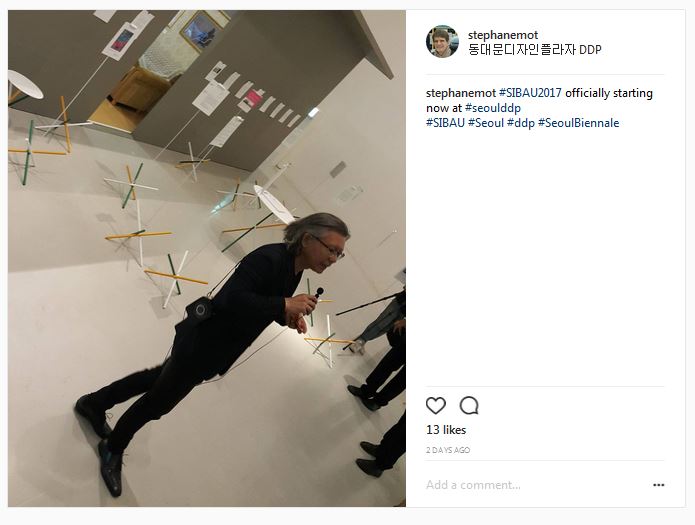
On Friday, for the V.I.P. preview day, PAI Hyungmin (co-director with Alejandro Zaera-Polo) launched the first edition with a tour of the cities exhibition at the DDP, followed by the opening forum featuring Ricky BURDETT, and a presentation of the festivities planned across the capital.

www.instagram.com/p/BYesjexllHS
Pyongyang opens the show with a cosy interior filled with HWANG Jin-yong songs, but lacking the portraits of KIM I and KIM II, masked on the wall to comply with anti-propaganda laws.

Pyongyang interior at SIBAU 2017 City Expo. Soundtrack HWANG Jin-yong (20170831 twitter.com/theseoulvillage/status/903464391495917568)

Of course, Le Corbusier chimed in again*** to reunite both Korean capitals in the most urbanistically dystopian way:

Pyongyang 2015, Le Corbusier 1935, Seoul 1970... Corbu wins, urbanism loses (20170831 www.instagram.com/p/BYeutqWFZUO)

Among the more formally invited cities, Oslo proposed a bucolic catalogue of its edible natural assets, and Paris prolonged its presentation at the Pavillon de l'Arsenal.

So come visit the DDP for this expo, but don't forget to enjoy the 'off' parts of the festival, and side venues that deserve more attention than Zaha's last gasp. Again, to me, this complex is more sculptural than architectural, and a perfect example of the very negation of urbanism. It totally ignored the urban context, and would rather suit Dubai than the center of Seoul...

That (re)said, I'll focus on three of the seven other venues (I'll save Changsin-dong for other occasions).

*
Urban regeneration - 3 works in progress

So let's return to Seun Sangga, Mapo Depot / Oil Tank Culture Park, and Donuimun Museum Village (you can also check "Urban Regeneration: 27 Projects For Seoul" to refresh your memory).

SEUN SANGGA is still undergoing the first phase of its revamping (see previous episodes). The priority was to improve connectivity across the neighborhoods, and you can see a great deal of  new staircases and escalators all over the place. As demanded in the competition brief, the Northern and Southern halves of KIM Swoo-geun's cruise ship are being reconnected. And like most projects, this one added new neighborhood / urban regeneration exhibition spaces.

The main problem with this new and improved Seun? It somehow spoils key assets of the old one, particularly the view on Cheonggyecheon (there were probably more discreet ways to connect the deck and the stream than this bulky staircase), and the feeling of space when you walk the deck (I love Seoul alleyways, but adding new structures all along the way was a mistake). But this was a very challenging project, and if Seun's fragile ecosystem and spirit subsists, this will be a victory.

'Seun Sangga recovered its arms, with a massive staircase obliterating the best view over Cheonggyecheon' (20170831 - www.instagram.com/p/BYf512xlAvb)
"Sneak peek from #Seun Electronic Museum / #세운전자박물관, which opens tomorrow" (20170831 - www.instagram.com/p/BYfQ1_mFAD0)

MAPO DEPOT (now Oil Tank Culture Park) also lost some of its charm. Even the creative squatters who occupied the abandoned site have joined the main stream by optimizing their FAR with new containers, and surrounding their now legalized lot with a classic fence and hedge. I understand that you couldn't keep the tanks 'in their juice', but there's a bit too much concrete for my taste, and the cathedral-like volumes have shrunk too dramatically. Tank #3 has been spared, so you still can have a gist of what it used to be, but you can't get inside that one. Nevertheless a spectacular site, with rocks carved to prevent neighboring parts of the city from suffering in case of explosion, and a fun walk particularly during the Seoul Architecture Festival, with plenty of talks and exhibitions to enjoy.

'At the former #MapoOilDepot for the #SeoulArchitectureFestival. Only the ghosts of the tanks subsist. They lost their inner volumes, shells, souls.' (20170831 - www.instagram.com/p/BYiJ3y5l-uM/?taken-by=stephanemot)

I'll give DONUIMUN MUSEUM VILLAGE a similarly unfairly lukewarm review. Mind you, I'm more than ever glad that this section of Gyonam New Town has not been transformed into Gyeonguigung Xii's park (see the Gyonam saga), I was ready for significant changes towards gentrification, and I guess it has become a very pleasant spot for visitors, but. If you knew the place as it used to be, it feels like a caricatural movie set of it, without its main roles. Between the messy old place and this sanitized, manucured village, I wish the cursor had been placed a little more towards the past. I'm really okay with a new central place that transforms the dense eating/drinking cluster into a more open village, but the hanok alleyway where I used to eat has been destroyed and rebuilt, recycling only a few beams, and replacing the most charming curves with anonymous straight lines. And why not keep more vintage bits of walls, the tree that made that eatery's madang so cute, or the wooden windows that made that two story Japanese house so special? I had so much hope when the project started...

It's a bit like Sissel Tolaas' exciting Seoul smellscape (in one of the tallest buildings of that low rise neighborhood), where you can sniff scents captured across the city center, between the DDP and this DMV: smells are synthetized and amplified, not like the original, but a distant echo.

'Sissel Tolaas and her Seoul smellscape in the new Donuimun Museum Village' (20170831 - twitter.com/theseoulvillage/status/903556640154173441)
Anyway, the site and its expos are definitely worth visiting.
 
Seoul shall use the space as a guest house hub after the biennale, but I hope it will host future editions as well.

Meanwhile, enjoy this first edition, and this ever changing city of ours!

*


Seoul Biennale of Architecture and Urbanism 2017 (20170901-1105): seoulbiennale.org


Seoul Village 2017
Welcome to our Korean Errlines! Follow Seoul Village on Facebook and Twitter
Bookmark and Share
Add this page to your favorites


* see among others "Urban Regeneration: 27 Projects For Seoul"
** see "Seoullo 7017, and more roads to Seoul"
*** see "Don't miss Le Corbusier in Seoul... The artist, not the urban planner!"

Thursday, April 18, 2013

Hoehyeon Apt, Chungjeong Apt, Dongdaemun Apt, Ogin Apt...

They are touchingly ugly, and sometimes dangerous, but we can't help loving them.

They? Seoul's venerable apartment blocks of the first generation, survivors from the sixties.

I just followed Robert Fouser's link to an article* on modern architectural heritage in Seoul, mentioning Dongdaemun Apt (Changsin-dong, Jongno-gu) and illustrated with a mugshot of my beloved "Hulk Building" (Chungjeong Apt, Chungjeongno, Seodaemun-gu). Immediately resurfaced vivid memories of the amazing Hoehyeon Apt (Hoehyeon-dong, Jung-gu) and of other more or less hidden gems.

Chungjeong Apt is certainly not hiding. You can't miss this cult green thing between Chungjeongno Station and K1 REIT Building, with its metal staircase hanging from its temple like a stray lock of dirty hair (what "Hulk" is hiding is the French Embassy, from which the tall trees emerge in the back):


Some of these old timers have been unplugged, most recently Ogin Apt (Ogin-dong, Jongno-gu), at the feet of Inwangsan. And I can't remember the name of that other block, next to the Hyatt, that was wiped out at about the same time as the former Japanese Governor General Building**, but I visited friends there at least once a week, and there were still the small signs preventing people from taking pictures from the windows (to spy Yongsan Garrison?)...

My all time fave remains Hoehyeon Apt, on the other side of Namsan. I even wrote a fiction about it. That place is simply bewitching, and if I were a photographer or a filmmaker I'd probably spend years haunting it. Before being eaten alive by it.

Straight from a cartoon by Miyazaki Hayao on antidepressants (or straight from a M.C. Escher nightmare), the derelict structure somehow manage to hang from Namsan, anchored by scrawny staircases themselves on the verge of collapse. At its inception a model for Korean collective housing, Hoehyeon Apt is an insult to today's standard of living, and was even declared hazardous a couple of years ago.

Hoehyeon Apartment at its brightest
 
Hoehyeon Apartment - Namsan side
 
Hopefully, the 'vintage' spirit that has been on Seoul air for a a decade has helped Seoulites reconsider these time capsules, a spectacular and shameful part of their heritage.

Seoul Village 2013
Welcome to our Korean Errlines! Follow Seoul Village on Facebook and Twitter
Bookmark and Share
Add this page to your favorites

* "서울서 가장 오래된 충정 아파트, 근현대 문화유산 '보류'" (thanks for the link!)
** then the National Museum of Korea. I'm glad both structures are gone now.

Thursday, May 21, 2009

Jongno-gu dongs

Seoul's 600 year-old center, Jongno-gu, stretches over 23.9 km² and comprises 19 dong (administrative areas).

That very much matches the average: I divided Seoul's superficy (605.25 km²) and total of "dongs" (522) into 25 (the number of "gu" or districts), and got averages of 24.2 km² and 20.8 dong.

But beyond these 19 "administrative" dong (행정동) lie 87 "court" dong (법정동), most dating from the early Joseon dynasty. Many "dong" names are engraved in national history and literature. Some designate functions, because of the kind of offices or services you would find in the area.

Most dongs are simply microscopic: taking out Pyeongchang-dong (8.92 km²) leaves an average 0.17 km² for its 86 peers, and a significant portion of what's left is covered by vast mountains, parks, or royal palaces.

Regroupments, renamings, and even extensions were performed all along the XXth century, most notably:

  • on April 1, 1914: under the Japanese Occupation, redistribution and renaming of the city's 186 dongs, implementation of Japanese namings. This completed the 1910 degradation of the Capital as "Gyeongseong-bu", an almost anomymous section of Gyeonggi-do, part of the annihilation of all references to Korea's identity as an independant power. Note that when Gyeongseong was renamed Seoul on August 15th, 1948, it gained a status of "Special City" which somehow marked, beyond the independence from Gyeonggi-do, the independence from colonial rule (the final "Seoul Teukbyeolsi" label was awarded exactly one year later). Jongno-gu heads the other 6 districts : Dongdaemun-gu, Jung-gu, Seodaemun-gu, Seongdong-gu, Yeongdeungpo-gu, and Yongsan-gu.
  • on October 1, 1946: many renamings, mostly denipponification reversing changes made during the Occupation.
  • in 1949: Seongbuk-dong, now a diplomats' lair on the other side of the Samcheong Tunnel but traditionally a Beverly Hills for Chaebol owners, leaves Jongno-gu for newly formed Seongbuk-gu
  • on October 1, 1975: new city regulations ruled on September 23, 1975 extended Jongno-gu's jurisdictions well beyond the old intra muros city, most notably :
    . to the West: Muak-dong and Gyonam-dong added from Seodaemun-gu. Gyonam is on the "wrong" side of the old Dongnimmun gate and the fortress wall, but after the completion of Sajik tunnel, it obviously completed a newly formed large block around Gyeonghuigung. Incorporating Muak-dong adds the other side of Inwangsan.
    . to the East: Sungin-dong and Changsin-dong taken from Dongdaemun-gu, completing the "sadaemun" tableau (the gu now encompasses the 4 main gates)
    . to the North: Buam-dong and Pyeongchang-dong join the party, wrapping Bugaksan in the gu, and putting Cheonghwadae and Gyeongbokgung, symbols of yesterday's and today's power, in the center of the map.
FULL LIST OF JONGNO "DONG" (19 "Administrative", 87 "Court"):

Buam-dong (부암동 - 3 court dongs): Buam-dong, Hongji-dong, Sinyeong-dong.

Changsin 1-dong (창신1동 - 1/3): Changsin-dong (covers 3 administrative dongs).

Changsin 2-dong (창신2동 - 1/3): Changsin-dong (covers 3 administrative dongs).

Changsin 3-dong (창신3동 - 1/3): Changsin-dong (covers 3 administrative dongs).

Cheongun-dong (청운동 - 3): Cheongun-dong, Gungjeong-dong, Singyo-dong.
Gahoe-dong (가회동 - 4): Gahoe-dong, Jae-dong, Gye-dong, Wonseo-dong.

Gyonam-dong (교남동 - 6): Gyobuk-dong, Gyonam-dong, Haengchon-dong (Hengchon-dong), Hongpa-dong, Pyeong-dong, Songwol-dong.
Hyehwa-dong (혜화동 - 4): Hyehwa-dong, Myeongnyun-dong 1-ga, Myeongnyun-dong 2-ga, Myeongnyun-dong 4-ga.

Hyoja-dong (효자동 - 6): Changseong-dong, Hyoja-dong, Nuha-dong, Nusang-dong, Ogin-dong, Tongin-dong.
Ihwa-dong (이화동 - 3): Dongsung-dong, Ihwa-dong, Yeongeon-dong.

Jongno 1.2.3.4 ga-dong (종로1.2.3.4가동 - 28): Bongik-dong, Cheongjin-dong, Doneui-dong, Gongpyeong-dong, Gwancheol-dong, Gwanhoon-dong, Gwansu-dong,
Gwonnong-dong, Gyeongun-dong, Gyeonji-dong, Hoonjeong-dong (Hunjeong-dong), Ikseon-dong, Ineui-dong, Insa-dong (Insadong), Jangsa-dong, Jongno 1-ga, Jongno 2-ga, Jongno 3-ga, Jongno 4-ga, Junghak-dong, Myo-dong, Nagwon-dong, Seolin-dong, Susong-dong, Waryong-dong, Wonnam-dong, Wooni-dong, Yoeji-dong.

Jongno 5.6 ga-dong (종로5.6가동 - 5): Chungsin-dong, Hyojoe-dong, Jongno 5-ga, Jongno 6-ga, Yeonji-dong.
Muak-dong (무악동 - 1): Muak-dong.

Myeongnyun 3-ga-dong (명륜3가동 - 1):
Myeongnyun-dong 3-ga.

Pyeongchang-dong (평창동 - 2): Gugi-dong, Pyeongchang-dong.
Sajik-dong (사직동 - 12): Chebu-dong, Dangju-dong, Doryeom-dong, Jeokseon-dong, Naeja-dong, Naesu-dong, Pilun-dong, Sajik-dong, Sejongno-dong (세종로동), Shinmunro 1-ga, Shinmunro 2-ga, Tongeui-dong (Tongui-dong).
Samcheong-dong (삼청동 - 7): Anguk-dong, Hwa-dong, Palpan-dong, Sagan-dong, Samcheong-dong, Sogyeok-dong, Songhyeon-dong.

Sungin 1-dong (숭인1동 - 1/2): Sungin-dong (covers 2 administrative dongs).

Sungin 2-dong (숭인2동 - 1/2): Sungin-dong (covers 2 administrative dongs).

Jongno-gu keeps changing very quickly, and it's getting hard not to bump into areas under redevelopment. Population should increase significantly in the years to come. There are only 180,000 inhabitants nowadays, but registered population tops 1.4 M, and 2M people live there during daytime (many office headquarters). Some dongs may disappear (ie Pyeong-dong in the future Gyonam New Town / Dongnimmun New Town).

SM 2009