NEW - download 'Seoul VillageS (서울 마을들)', my collection of 12 short fictions now adapted into short films! Get your free copy of the ebook (4 editions: English, French, Korean, Bilingual English-Korean)!

Showing posts with label GTX. Show all posts

Sunday, June 23, 2024

On Korea's Jigsaw, Urban Footprint, and Urban Replanning

If you're a frequent flyer on my Korean errlines, you've had your fill of rants about recurring blunders in urban planning, the persistence of obsolete visions of urbanism, or (re)development equations that totally ignore plummeting demographics.

Well criticizing is easy. Urban harmony is like life or democracy: a very delicate, dynamic balance of power, a complex, evolutive system of checks and balances. No one will ever achieve perfection, and that's the beauty of it.

Besides, I see some glimmers of hope. Korea has eventually started worrying seriously about its shrinking population, seeking more inter-regional solidarity and cooperation, thinking about reviving ailing city centers in smarter ways... 

Korea is starting to realize that the real estate paradigm it's been addicted to for decades has become a Ponzi scheme, a sub-zero sum game where eventually everybody loses, even the wealthy ones who won't be able to resell their 'luxury condos' with a profit after paying much more for them than they would have for the most outrageous Manhattan penthouses.

Korea is starting to realize that it can't afford 'affordable housing' if that means building apartment blocks in greenbelt areas, that when a 'new town' succeeds somewhere, it means that somewhere else, an older town in depleting.

Korea is starting to realize that it can't keep adding new non-matching pieces to an ever growing jigsaw puzzle on an ever shrinking table, that these absurd urban footprint dynamics can't be sustained any longer.

The 5th Comprehensive National Territorial Plan, which covers the most critical 2020-2040 period, already mentions sustainability and other sound principles, but all is not set in marble and a lot has happened since it was released 5 years ago: rural desertification and fertility rate diminution accelerated dramatically, the GTX and other projects reshuffled whole decks... So a revised version is expected next year, for the 2026-2040 period.

Improving inter-regional solidarity and cooperation remains a key goal, particularly where they prove already challenging at the intra-regional level because of political divisions or fierce city rivalries. 

In addition to their autonomy, such special self-governing provinces as Jeollabuk-do or the recently upgraded 'Gangwon State' don't have to deal with special cities punching holes in their maps. In comparison, Gyeonggi-do must cope not only with giant neighbors nesting in its midst (Seoul and Incheon*), but also with a complex history of city creation explaining odd administrative shapes, or new towns stretching over different cities (e.g. Dongtan).

Granting a special status to a local government was generally done without much concern for the impacts around, which prevented all parties from reaching their full potential.

Wherever you stand on the fierce political fight over the creation of Sejong City (the left wanted to move the capital city to a new, central location to balance development across South Korea - the right refused to undermine Seoul and maintained part of the government there), you have to admit that from an urbanism point of view, things could have been done a bit better.

We're not talking Brasilia or Nusantara, a new capital erected far away from existing hubs: Sejong City seats right* next to the metropolitan city of Daejeon, South Korea's 5th largest cit, its central hub, and already the seat of several  central administrations, and right next to Cheongju, Chungcheongnam-do's capital.

Daejeon lies less than one hour away from Seoul via KTX but no, Sejong City must not enjoy express connectivity with the 'old' capital because then civil servants would commute instead of moving to Sejong**. And no, Daejeon's subway shouldn't come all the way to Sejong's vital parts. At its inception, it's almost as if Sejong City was designed as a local competitor instead of a national facilitator.

17 years after its creation, Sejong claims 400k souls, Daejeon remains around 1.5M, and Cheongju inched up from 650 to 720k. Common sense would have led to something more  rational, even simply two cities instead of three: the regional capital Cheongju and a-name-it-whatever-you-fancy-as-long-as-you-spare-local-susceptibilities national capital bis. If arranged harmoniously, I bet the latter would be today a thriving 2.5-3M strong metropolis.

Mind you, both Daejeon and Sejong are faring relatively well nowadays, but I'm not surprised to see the Sejong City - Daejeon - Chungnam - Chungbuk ensemble included in the potential revisions to Korea's 5th CNTP. Some consistency would clearly make the meta-region more competitive internationally - with the caveat that it wouldn't present an official one-stop front. 

Same with 'sudogwon', the capital region (Seoul-Incheon-Gyeonggi-do): unlike say the Ile de France region that encompasses Paris and its surroundings, it doesn't really exist as an official entity with representatives. It does make sense for the national government to be directly involved in an area representing half the nation's population and GDP, but the World's 4th metropolitan bloc can't fully leverage its potential. Of course, adding another administrative layer and the tensions that go with them, particularly with dwindling resources, may not necessarily be the panacea. Some even envision Daejeon + Sejong + Chungnam + Chungbuk as an 'ultra-wide megacity' - at least that would avoid the ego problem of who gets to be granted the regional capital status...

The debates promise to be complex and animated, but it's important to get every stakeholder involved, to identify all the impacts of each option, to learn from past mistakes, to minimize / optimize the urban footprint, to think urbanism beyond cities, towns, and other labels, wherever humans decided to settle or to build (be it a road, a remote factory, a farm, or even a field), and not to build for builders' sake.


Seoul Village 2024
Welcome to our Korean Errlines! Follow Seoul Village on Facebook and Twitter, follow me on Instagram.
Download 'Seoul VillageS' (free ebook - short fictions now adapted into short films)

Bookmark and Share


* If the cities are administratively continuous, there's no actual urban continuum... but then again, few cities in Korea excel at urban continuity.

** Likewise, I still can't stomach the fact that the railway from Seoul to Incheon Airport was deliberately delayed until a few years after inauguration because that would have hurt taxi businesses. Or that Songdo didn't have a subway from day one (hello? a ginormous polder built from scratch?). At least nowadays, if new big fat greenfield 'new towns' keep popping up, most of them include a railway connection.

Wednesday, March 27, 2024

GTXtension(s) - fast transit rather than mass commuting?

In case you missed it, three new projects of GTX (Great Train eXpress) lines were announced earlier this year. Since we're getting closer to the inauguration of the first section on March 30 (GTX-A from Suseo to Dongtan), but also to key elections on April 10, I'll spare you all the wonderful urban development pledges that have popped up from all sides (I guess merging Gimpo with Seoul was one of the most radical), and talk a bit more about these Great Train extensions and GTX-tensions.

By stretching ABC and adding DEF, the network reaches further North, South, West, and East, and draws a first ring around Seoul and across Gyeonggi-do (GTX-F):

If GTX clearly brings places closer together, dividing by 3 the time to join Suseo and Dongtan, and if it reaches relatively fast speeds (105 km/h in its inaugural section, with peaks at 180 km/h), the system is 'express' in the sense that it makes few stops. And so far, it has more or less managed to resist intense pressure to add intermediary stations, particularly within Seoul. 

Which makes the success of seamless multimodal transport hubs even more critical, and I'm not sure that will be the case from day one. 'Luckily', the traffic shall not be too massive, because as it is conceived now, GTX can't really handle mass commuting. 

Beyond the limited number of trains per hour, their shortness is an issue, and commuters may struggle to find a spot to hop in, particularly in intermediary stations. I've experienced rush hour on Paris region's RER, with its long, double-decker trains, and that's not always pleasant... We may not see scenes similar to Line 9 saturation on steroids, but expect at least significant frustration from a lot of people who were expecting GTX as the instant panacea.

GTX provides fast transit before mass transit, it shortens connections before coping with mass commuting, and that's already something big. Even if you won't commute to work there, simply knowing that you can go to Seoul very quickly for lunch, dinner, or on a weekend can make moving far away less alienating. 

These massive and costly extensions do add Gangwon-do (Chuncheon and Wonju) and Chungcheongnam-do (Cheonan) to the equation, but also risk of further widening the gaps between sudogwon (Seoul-Incheon-Gyeonggi) and the rest of Korea as well as within the capital region and within the capital itself. With its relatively cheap fees (KRW 3.2K + 250 per 5 km), GTX may even cannibalize such alternatives as KTX.

The choices of routes and stations is always debatable and many areas within and beyond Seoul will remain underserved, but I always welcome transversal approaches in transport, and cooperation within the capital region. Nowadays, Seoul is collaborating much closer with Gyeonggi-do, including for its Climate Card now, and a ring bringing Gyeonggi closer together and bypassing the capital altogether marks a significant step.

Somehow, GTX is forcing the emergenceof  the grand vision, the great debate that's always been lacking. The way this whole region keeps developing remains a litany of missed opportunities, particularly since most of this urban and transport development (or lack of) relied on new towns built from scratch. And you know how often I complain about so much urban planning without urbanism or planning.

Now we're hearing about covering the Gyeongin Expressway and the rift between the Eastern and Western sides of Dongtan new town, and both will cost a fortune, but the Seoul-Inchon axis dates from ages ago, and that rift should have been solved from Dongtan's very conception. As demographics plummet and finances shrink, Korea can't afford not to get it right from the beginning. 

This nation is so great at alphabets, it should contemplate beyond ABCDEF.


Seoul Village 2024
Welcome to our Korean Errlines! Follow Seoul Village on Facebook and Twitter, follow me on Instagram.
Download 'Seoul VillageS', the free ebook.
Bookmark and Share

Sunday, December 25, 2022

Seoul Innovation Park on steroids

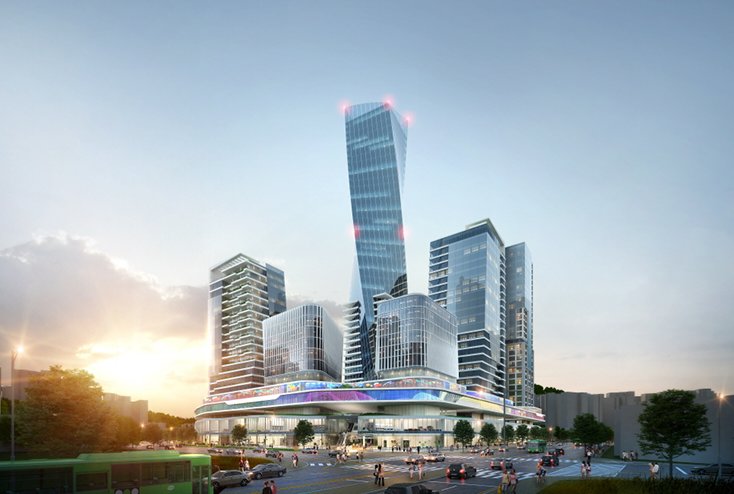
We've already seen Eunpyeong-gu's former KCDC site mutate into a makers' hub*, a vibrant Nokbeon-dong neighborhood park, and a cultural crossroads** in an underprivileged part of Seoul. Now the city wants to turn this low rise oasis into its gazillionth high rise utopia.

Meet the new and improved Seoul Innovation Park:


Quite a change from nowadays:

"Vegan Festival in Seoul Innovation Park, Eunpyeong-gu." (@theSeoulVillage 20170511- twitter.com/theseoulvillage/status/866195549707358208)

Okay, all cars shall be parked underground instead of these traditional outdoor sprawls, plus there's also going to be this manicured 'Seoul UIC Campus' (University of Seoul Industry Cooperation), but that's not the same as a laid-back park full of happy families:

As you well know, I'm all for fixing the capital city's unbalances, and Northeast Seoul clearly deserves a boost. Besides, the city already owns this 110,000 sqm site, and it's next to a subway station (Bulgwang Station), close to the Yeonsinnae transport hub (Subway Lines 3 and 6, GTX-A - see "GTX, meet Sinbundang Line"). 

But not exactly there. And we've already seen this not so disruptive concept of futuristic, buzzword-friendly city within the city, with its iconic landmark tower - here, 60 more floors to be filled in a market already suffering from oversupply. Yet another empty alibi for yet another real estate nonsense (many 'apateu' have already risen nearby)? And of all models, why pick the COEX as a symbol of success? 


Needless to say, the grove with its old trees at the entrance, under which kids would play and seek fresh shelter in the Summer, is gone. From the outside, this could be any mall:


This time, it's different, they say. We go 'beyond zoning', we're truly mixing commercial, residential, and business. And this time, promise, we'll build and startups will come. SH Corporation will make sure a diversity of people build a genuine community, a 'Golden Village' where elderlies, newlyweds, single households share the same spaces with all facilities required in changing times.

Sincerely hope that flies but frankly, Seoul, you can do better.


"Seoul's project for Seoul Innovation Park (Nokbeon-dong, Eunpyeong-gu)? A coex-ish hub, very Oh Sehoon-ish urbanism:" (@theSeoulVillage 20221220 - https://twitter.com/theseoulvillage/status/1605025577102032896)


Seoul Village 2022
Welcome to our Korean Errlines! Follow Seoul Village on Facebook and Twitter, follow me on Instagram.
Download 'Seoul VillageS', the free ebook.
Bookmark and Share

* starting with Seoul Creative Lab and Hyebin's FabLab:

"Always nice to visit Seoul Innovation Park's FabLab! Eunpyeong-gu, Seoul." (@theSeoulVillage 20161207 - https://twitter.com/theseoulvillage/status/806453941252673536)

** including, most recently, SEMA Storage in a former KCDC warehouse (see "Nine new museums in Seoul by 2023")

Thursday, January 24, 2019

Gwanghwamun Square 3.0 re-Deep-Surfaces

Seoul recently* unveiled the winning concept for Gwanghwamun Square renovation, and 'Deep Surface' confirmed the hopes and worries we shared in April last year (see "Gwanghwamun Square Enters Third Dimension"). As expected, things are also getting political. The good news is that the debate will continue more publicly until the end of this year. Work is still supposed to start next year, and the goods to be delivered in 2021, ahead of the 2022 presidential elections.


1) Everybody's happy...


'Deep Surface' was bound to please key members of the jury, starting with Dominique Perrault, who probably appreciated the major role played by underground structures... and maybe this new slope as an homage to his iconic Ewha ECC:


Landscape architect Adriaan Geuze (West8) certainly fell for this spectacularly lush Amazonian canopy, owed to a rendering artist who obviously projected us around year 2175, when the newly planted trees reach maturity:


If you miss already Gwanghwamun Square's vast stretches exposed to Seoul's merciless summers and winters, stand reassured, the same artist also offered this more realistic view:


Of course, SEUNG Hyo-sang and YOO Hong-jun remain key jurors when it comes to selecting a project suitable for both the Mayor and the President: the former City Architect is now heading the Presidential Commission on Architecture Policy, and the former Cultural Heritage Administration boss had earlier been mandated by MOON Jae-in to study the feasibility of his campaign pledge, eventually abandoned, to move the presidency out of Cheong Wa Dae.

SEUNG, who oversaw Seoul's shift from redevelopment to urban regeneration, must have enjoyed the focus on pedestrians and citizens, the historical continuum, and the respect of recent heritage. YOO can also be happy: if the Ministry of Culture and Tourism foots one third of the bill (Seoul Metropolitan Government the rest), the Historic Square covers 36,000 sqm compared to 24,000 for Citizen Square.

To better understand the big picture, I recommend to combine the first illustration above (perspective from Gyeongbokgung) with this project map: 


2) ... but not everybody's happy


From the start, this project's key challenges were only 10% about architecture and 90% about urbanism. As I explained before, more than the vertical alterations along Sejong-daero (extension of the square, reduction from 10 to 6 lanes), the main revolution is horizontal, what I called 'The Royal T' being transformed into a crooked Y as Sajik-ro plunges towards the South, suppressing the Western end of Sajik-ro 8-gil, and the tunnel that came with it. Sajik-ro now marks the frontier between two Gwanghwamun Squares: Historic Square (North), and Citizens Square (South).

Again, it's not just the gate that's brought closer to the center, but also the traffic. Again, merging Sajik-ro with Sajik-ro 8-gil means merging transit circuits with neighborhood circuits, and creating new unnecessary bottlenecks. And yet again, what about the bus and bicycle lanes? I'm afraid I have to stick to what I wrote last April: "Unfortunately, like with Seoullo, impact surveys have obviously been eluded in a race to meet electoral deadlines, and authorities chose to worsen traffic situations by not tackling them". Before heralding the future Gwanghwamun Square as the equivalent to the Arc de Triomphe in Paris, Mayor PARK Won-soon should have learned that for all Parisians, Place de l'Etoile is a symbol for extreme and messy traffic.

I'm not the only one to wonder if every impact is truly taken into account: as soon as the new blueprint was revealed, the authorities in charge of policing and traffic said that they had yet to agree with what's proposed, and a key administration wished it had been consulted for the road cutting through its premises.

If Seoul City is very unlikely to drop the piece de resistance from its master plan, it is also very unlikely that a satisfying solution can be found to the problems it generates. Before the end of this year? Impossible. I wish it could be compensated with public transportation, but even if the GTX A (Unjeong Paju to Dongtan) and Shinbundang Line eventually join Subway Lines 1, 2, 5 in the ambitious transportation hub envisioned, new bottlenecks will severely limit its multimodal potential.

I guess I made my point on this crucial issue, so we can move on. Now shall we further look into 'Deep Surface'?


3) Deep Surface Inside Out

Just a few elements from this very rich and complex project:


  • 2 squares instead of 1: that makes storytelling much more simple. Picture on one side the changing of the guards on Woldae (the ritual stage to be rebuilt in front of the gate), next to the hanok cluster already under reconstruction (next to the Museum of Contemporary History), and on the other side a k-pop concert at the feet of Sejong Cultural Center. Also, it's easier to contain a demonstration on the aptly named Citizens Square, while tourists claim their safer haven by the palace and its museums (not to mention pictures of the landmarks not photobombed by PARK Geun-hye supporters). Of course, there's still that humongous Government Complex ruining Historic Square's narrative and perspective, but you can always say it's a tribute to Sejongno's Yukjo tradition**.


  • In Jeokseon-dong, Jeokseon Hyundai Building seems to be turned into a 'Seoul Metro Museum'. I wonder what the tenants (e.g. Bloomberg, Korea's youth hostels association) think of it.
  • There's a lot of fuss about the potential moving of King Sejong and Yi Sun-shin statues (closer to Sejong Cultural Center), but I'm not a fan of these erections, and to me that's nothing compared to the road mess I mentioned earlier. Note that Haetae statues move back, closer to where they were in Joseon times, but nobody seems to care. 
  • Sejongno Park might at last find some purpose and relevance. 
  • I wonder why Terrace Lawn, the new slope connecting above with underground, doesn't have an actual  slope, accessible for wheelchairs or baby strollers. I hope they'll fix this ASAP.
  • ...

I'm curious to see how Seoulites will roam the space, rediscover Sejongno's Western sides, how 'Gwanghwamun Samgeori' will join 'Sejongno Sageori' in our vocabulary, how History will keep unfolding on Gwanghwamun Square 3.0.

Whatever happens, this will remain Seoul's political and cultural epicenter, and its most defining perspective (Sejongno-Gwanghwamun-Gyeongbokgung-(Cheong Wa Dae)-Bugaksan-Bukhansan).


Seoul Village 2019
Welcome to our Korean Errlines! Follow Seoul Village on Facebook and Twitter
Bookmark and Share
Add this page to your favorites


* ICYMI:


' announces new plans for . will eventually have a station, even if it slows the whole 'express' promise. The square itself will, as expected (), be on the side.' (20190121 - https://twitter.com/theseoulvillage/status/1087168047687753728) 'On the bright side, trees will make the new slope more enjoyable. (For the dark side, see )' (20190121 - https://twitter.com/theseoulvillage/status/1087169753074946049)


'Reminder: V.3.0 will cause traffic nightmares in downtown . Maybe that's what Mayor meant when he compared the project to ' Plaza...' (20190121 - https://twitter.com/theseoulvillage/status/1087470786531581952)
** the notorious six ministries. Note that the project still includes a Yukjo Street tribute and its restaurant tradition. Reminds me of that old joke with a mobster telling his staff he went to Sejong Cultural Center last night, only to be asked in return 'which restaurant?' by thugs for whom the name only refers to a foodies neighborhood.

Tuesday, April 10, 2018

Gwanghwamun Square Enters Third Dimension

Seoul Metropolitan Government and the Cultural Heritage Administration unveiled yesterday their plans for a 'New Gwanghwamun Square' by 2021, and they came up with a weird 'solution' for the potential traffic conundrum I mentioned four years ago, when the project started taking a clearer shape (see "Gwanghwamun, Donhwamun, and the Tale of two Royal Roads").


Gwanghwamun Square 3.0 - the royal Sejongno-Gwanghwamun-Gyeongbokgung-Cheong Wa Dae-Bugaksan-Bukhansan perspective

This modification of Seoul's most defining center has potentially even greater consequences than the previous one, which we followed step by step a decade ago. I will as usual focus on the urbanistic impacts (passing by many familiar spots), but since this is also about Korea's center of power ever since its capital was founded, I'd better start with some political context.


It's the politics, stupid?

Such a project deserves to be carried by both the local (SMG) and national (CHA) governments, and PARK Won-soon as well as MOON Jae-in happen to have a special bond with a site where PARK Geun-hye started and ended her presidency.

Started? If we all remember the massive, peaceful demonstrations that led to PGH's destitution, who could possibly forget that kitschissime wishtree** on Gwanghwamun Square, her first symbolic stop on her way to Cheong Wa Dae?

During his own campaign, MOON Jae-in pledged to move the presidential offices from Cheong Wa Dae to Sejongno, and the presidential residence closer to Gwanghwamun, in order to cleanse the feet of Bugaksan, and to honor the place where democracy took a stand and won. MOON also picked Gwanghwamun Square to celebrate his victory.

Retrospectively, I shudder when I remember AHN Hee-jung's over-the-top cheering that night - back then, I didn't know he couldn't even control his darkest pulsions... anyway, his DSK / #metoo moment completely revived the ambitions of a man who tried to steal the show on the very same night.

Only weeks ago, PARK Won-soon was clearly out of the game for the 2022 presidential elections, and about to be dumped by his own party for the upcoming mayoral elections (June 2018). Now he's leading the polls by far (against WOO Sang-ho and PARK Young-sun for the primaries, and against AHN Cheol-soo and KIM Moon-soo beyond), and this new project looks like the ideal platform for both ballots: he can make a splash in 2018 on the very site that boosted his predecessor's reelection***, and deliver the goods just months before 2022. Of course, PWS already combined a major urban project with a major political event before, but PGH's impeachment derailed Seoullo 7017's perfect timing ahead of the 2017 elections (see "Seoullo 7017, and more roads to Seoul").

Now is the right moment to communicate a grand scheme and vision, big enough to mask PARK's most recent shortcomings: he barely managed to avoid criticism for Seoul's waste management crisis by sending deputies to face the media, and he let his rival WOO preempt the usually well coveted 'public transportation' territory by campaigning on a new metropolitan authority, including yet another revival of the key Seobuseon project (after 2013, when "Seobu Line confirmed as Seoul's LRT top priority", the city dropped the ball once again).

So yes, it's about politics. But regardless of this context, Gwanghwamun Square and its surroundings needed a fix.


3.7 times bigger, 3.7 times better?

So what's the plan? Basically, the pedestrian zone grows not only, as expected, to the West and along nearby streets, but also right in front of the gate, making the road map much more complex, what I dubbed Seoul's 'Royal T'**** turning into a Y:


Seoul also revived its old ambition to restore Baekundongcheon, Cheonggyecheon's main source, the diagonal still visible on today's map (see "Baekundongcheon / Gwanghwamun-gil - A River Runs Through It"*****).

Seoul city advertises about the 3.7 factor by which pedestrian surface booms from 18,840 m2 to 69,300 m2, the reduction of traffic lanes to 6 along Sejong-daero, and its renewed demands to the State for a GTX extension to Gwanghwamun.

All this sounds very positive and environment friendly, but no really new green spaces are planned, and the extended square might make Summers and Winters even more merciless in what looks more like Tiananmen Square, or the barren landing site that preceded Yeouido Park.

There are still no dedicated lanes for buses or bicycles, and buses shall be redirected South, which seems recipe for disaster for public transportation around downtown Seoul, particularly since the new road map deprives Sajik-ro 8-gil (formerly Naejadong-gil) from its role of main NS/EW dispatcher.

Compared to Gwanghwamun 2.0, the 2009 revolution that brought pedestrians back to the heart of the capital, this Gwanghwamun 3.0 adds only marginal change to their experience. I like the idea of restoring the 'parvis' in front of Gwanghwamun, the Eastern pavillions and hanok around a 'History Square' that could liven up the walk from Seochon to Bukchon... but pushing traffic further downtown, and adding new bottlenecks to already saturated axes does seem like a big price to pay. 

Unfortunately, like with Seoullo, impact surveys have obviously been eluded in a race to meet electoral deadlines, and authorities chose to worsen traffic situations by not tackling them. Even the curve of the new road following the back of the central government building (that by the way shouldn't be on that History Square) tells about quick and dirty fixes without consideration for the big picture.

What Seoul needed was a consistent vision and plan to prepare its whole historic center Sadeamun (intra muros) for a driverless future. What Seoul delivered was a dangerously incomplete, short-sighted, ill-prepared PR stunt.

The city will take one year to select a proposal, start work in January 2020, and finish by EOY 2021. Mayor PARK missed by a few months last time, and 2021 seems safe enough a goal for him to inauguration the new (if not improved) Gwanghwamun Square. 

I sincerely hope he'll reconsider this plan, and grow some ambition for our city.

Seoul Village 2018
Welcome to our Korean Errlines! Follow Seoul Village on Facebook and Twitter
Bookmark and Share
Add this page to your favorites

* see "The Anipang Election: Park wins big, but who won?"
** see "Park 2 Day 1 in pictures"
*** will OH Se-hoon rise again (on billboards, at least - see "OH Se-hoon returns... but did he ever leave?")
**** see "Inwangsan's Great Wall and Seoul's Royal "T" Time"
***** note that since my 2009 focus, the streets West of Sejong-daero have been renamed Saemunan-ro 9-gil and Saemunan-ro 5ga-gil. Seoul also renewed the project of highlighting walls around Sajik-dan and Sajik-park.

Monday, May 2, 2016

Yeongdong-daero Underground City, Korea (YUCK?)

Last March, KEPCO surpassed Hyundai Motor in market capitalization (KRW 37 tn vs 34). Ironically, since Hyundai's financial trouble have something to do with their purchase from KEPCO, in September 2014, of prime land along Yeongdong-daero, for a whopping USD 10 bn.

As you know (e.g. Yeongdongwon focus in last year's "Diagonal crossings, High Lines, and Business Verticals (how pedestrians and businesses remodel Seoul... and vice-versa)"), that site will host the group's future HQ - Hyundai Motor Global Business Center - at the core of a redesigned COEX-Jamsil business district that will stretch over both sides of Tancheon stream (Samseong-dong and Daechi-dong in Gangnam-gu, Jamsil-dong in Songpa-gu), and grow what is already a significant transportation hub into a gigantic one.

Yesterday, Seoul Metropolitan Government released more details about that part of the puzzle, an 'underground city' to be delivered by 2021:
  • A big whale: 160,000 square meters under Yeongdong-daero (6 underground floors, 630 m long, 70 wide, 51 deep). Cost: KRW 1.169 tn
  • A multimodal hub: subway (Samseong Station on Line 2, Bongeunsa on Line 9), bus (including the City Air Terminal), express railways (GTX-A Samseong-Dongtan, GTX-C Uijeongbu-Samseong-Gunpo, KTX Northeast extension), LRT (Wirye-Sinsa Line - see "Seoul LRT Projects Update (Part 2/2)"). Expected gains in commuting times to Dongtan and City Hall: from respectively 41 and 29 mn by car, to 20 and 5 mn by rail

Views presented last year

The hub will also include various culture and service facilities, and a shopping area complementing the COEX Mall. Pedestrians shall have a better time navigating a space until now devoted to Car Almighty.

With its countless traffic lanes, Yeondong-daero looks like a pre-Gwanghwamun-plaza Sejongno on steroids, and this project seems to consider a similar, tree-less, tip-of-the-iceberg central walkway. But it's not as if masses will roam the surface like downtown: distances are even greater, and most of the fun will remain indoor. As nice as Bongeunsa is, it doesn't rival with Jongno landmarks and Bugaksan.

Still, this transport hub certainly looks less nightmarish than Banpo's Express Bus Terminal, because the Yeongdong-daero / Teheran-ro intersection is far less messy, and because you don't have 'apateu' blocks the scale of say a Banpo Xi. One can also hope that the user experience will be better thought through, more seamless.

How much this will cannibalize business from COEX Mall or Lotte World remains to be seen. But it's already adding trouble to the old business center of Gangnamistan: vacancy rates are expected to keep growing in Gangnam Business District (around Gangnamdae-ro and Teheran-ro at Gangnam Station), even if Hyundai Motor is moving in the time to build its new extravaganza.
Common sense, demographic and economic trends tend to make us think that a success story here would mean a failure somewhere else. And this zero-sum game leaves us every year with more infrastructures to fill.

Let's hope that this 'underground city', which unlike many pharaonic projects does have a purpose, won't be the vast magma chamber of a supervolcano bubble, but at least a successful transport hub.


Seoul Village 2016
Welcome to our Korean Errlines! Follow Seoul Village on Facebook and Twitter
Bookmark and Share
Add this page to your favorites
.