NEW - download 'Seoul VillageS (서울 마을들)', my collection of 12 short fictions now adapted into short films! Get your free copy of the ebook (4 editions: English, French, Korean, Bilingual English-Korean)!

Showing posts with label hanok. Show all posts

Thursday, May 16, 2019

Switzerland v. Gyonam-dong Alps

Nevermind that dull tower rising over Pyeong-dong, down the hill; the new Swiss Embassy truly was the last missing piece in Gyonam-dong's jigsaw puzzle. How does it fit? Can it add some soul to a lobotomized neighborhood? First impressions after a visit organized on May 15, just days before its inauguration.

***
In 1974, to build its Embassy, the Confederation purchased a land enjoying a spectacular view over the valley West of Sadaemun's fortress walls, all the way from Namsan to Inwangsan. Over the decades that followed, and particularly the past fifteen years, high rise buildings and apartment blocks have claimed big chunks of it, and 6 years ago the neighborhood was almost totally wiped out to make room for Gyonam / Donuimun New Town and its anonymous towers, destroying priceless wonders in the process (see "In memoriam Samdong Samgeori, Gyonam-dong" ).

The Swiss could have looked for another location, and maybe join such Embassy clusters as Seongbuk-dong or Itaewon / Hannam-dong, but they courageously decided to stay. Well they did move to Hannam-dong though, but only the time to avoid that apocalyptic mutation, and to replace their nondescript red brick lair with something new. Here it is, now facing Gyeonam-dong alps instead of Geumhwasan and Tongil-ro valley:

Photo Erae Architects - Swiss Embassy website

Halfway between Hong Lampa house in Hongpa-dong, and the sanitized* Donuimun Museum Village in Sinumunro 2-ga, the new landmark confirms this section of Songwol-gil as some kind of green and architecturally diverse oasis.

One roof, continuous wings, a central madang... the 2019 Swiss Embassy clearly honors the hanok style, but with a modern, deconstructed twist, and a broken version of the traditional 'ㅁ' or 'ㄷ' shapes:

The open spiral from above (mockup - Burckhardt Partner website)
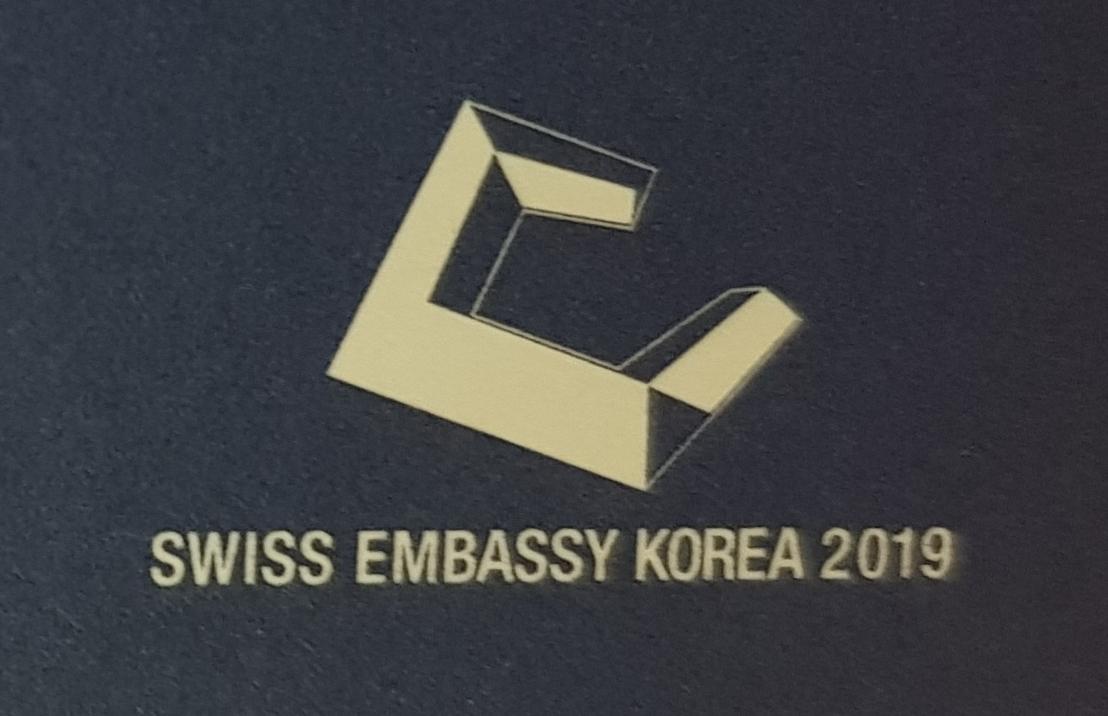
Logo created for the Embassy inauguration
More an open keyring than a locked up Swiss bank vault, this Embassy wraps you up without cutting you from its environment, providing at the same time intimacy and transparency. The wide windowpanes facing the courtyard enable a dialog between the four wings (multipurpose, chancery, representation space, residence of Ambassador Linus von Castelmur), but the building is also open to its surrounding. Even the metal fence lets you see through. And if some semi-private spaces (cafeteria, living room) display some sort of ceramic moucharabieh, their lace is very wide. The biggest windows point to the sky or surrounding gardens, others direct your gaze to the greenest spots of the New Town, so that you never quite face its dead monoliths.

The outer concrete walls echo modern Swiss heritage, but wood is omnipresent, with epicea ceilings, staircases, slabs, and pilars. The lightness of the roof and structure, boosted by a gigantic sail cast over half the courtyard, could be achieved by the burial of most technical machinery in dedicated basement corridors. We also visited the nuclear shelter, compulsory for public structures of a certain size in Switzerland, but maybe not that irrelevant this side of the DMZ.


This environment-friendly building collects heat from the underground (30+ geothermal pumps), power from the sun, and water from the skies, sometimes in an artistic way, thanks to Lena Maria Thuring's 'Water connections' installation, where metal chains direct part of the flow from the rooftop to hanging stones and surface channels:


The visit was led by architects Nicolas Vaucher (Burckhardt Partner), and Lee In-ho (Erae Architects). Obviously, I followed the former:


Nicolas Vaucher in the madang, the staircase, the cafeteria, the nuclear shelter, the machinery, the residence's garden, the representation's dining room, the cultural section, the entrance.

Six years ago, I thought that all of Gyonam-dong's seven neighborhoods would disappear for good. They will never be brought back, but at least, somehow, part of Songwol-dong continues to exist under a new form.


Seoul Village 2019
Welcome to our Korean Errlines! Follow Seoul Village on Facebook and Twitter, follow me on Instagram.

Bookmark and Share
Add this page to your favorites

* see my lukewarm review in the "Seoul Biennale of Architecture and Urbanism 2017" focus

Monday, December 25, 2017

Care - Right Now!

A few days before that holiday celebrating a Jewish Palestinian son born to a refugee couple, this Seochon hanok resonated with touching stories of refugees and carpenters.

From Lesvos to Izmir to the Calais Jungle to a Seochon hanok - With Robert Mull and Hahm Donkyoon for Citizen Planet Right Now! School Of Politics - Duty of care, #socialresponsibility and the refugees crises
시민행성 당장!정치학교
(  - instagram.com/p/Bc5pX-pFjuA/)
For the launch of Citizen Planet's 'Right Now! School of Politics', Robert Mull was giving a lecture on 'Care - Architecture, Education, and Social Responsibility' that encompassed decades of involvement, from one Thatcher to another - from the Iron Lady era to Alpha Diagne, that Mauritanian refugee / artist who built and thatched with his own hands the Calais Jungle's iconic Blue House.

'We've dignified this bottom-up city with the care one would look at Florence or Seoul' (Robert Mull on Calais Jungle exhibitions at Barbican, SouthBank)

Robert Mull is a citizen of our planet, an educator, and a double agent in the field of architecture:
  • On the Dr Jekyll side, Robert has taught all over the globe, and headed prestigious institutions. He is currently Professor of Architecture and Design and Head of School at the University of Brighton, a Visiting Professor at the University of Umea, a partner in Beevor Mull Architects, and Director of Innovation at Publica.
  • On the Mr Hyde side, Robert is a relentless activist, and a thorn in the side of an architectural microcosm that too often indulges in navel gazing or disconnected extravaganzas. From his students, he expects bravery, passion with compassion, and an engagement in politics in the noble sense of the term. Even the initials of his Free Unit initiative (now a Global F.U.) send an irreverent message to a trade he often invites to humility (if not self-derision - in the Turncoats series, architects convene to expose their own vanities and impostures).
So here we were, citizens, architects, and citizen architects, cramming Citizen Planet's hanok in its Changseong-dong alleyway, just hectometers away from Korea's own Blue House.

For five years now, Citizen Planet has called social responsibility to mind. Its new Right Now! School of Politics doesn't have any political agenda, and isn't about ideology or idealism - it simply invites all citizens to embrace their responsibilities and to contribute to a better society. Right Now, because this is an urgent necessity. 

Yours truly, with HAHM Donkyoon (Head of Citizen Planet), and Robert MULL
Like caring for refugees.

Which may seem a distant priority for South Korea, a country posting embarrassing low recognition rates for refugees. Well, we do care for defectors trickling down from North Korea, but could we cope with another major flow? Today? At the very moment China builds massive refugee camps at its border? At a time when, for all we know, Seoulites themselves could be one tweet away from becoming refugees?

Yes, Seoul, the very city that makes refugees of its own citizens, barring them from returning to their childhood's neighborhood...

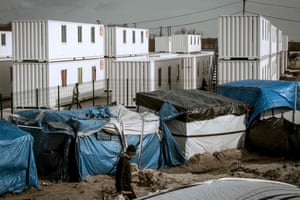
The official shipping container shelters stand in stark contrast to the self-built shelters of the camp.
The contrast between the anonymous containers erected by the French government, and the vibrant 'jungle' (photo Philippe Huguen - AFP/Getty Image) reminded me of familiar Seoul cityscapes ('apateu' v. 'daldongnae').

Refugee crises expose the best and the worst in all of us, providing Robert Mull with powerful examples of ethical approaches, how architects can fulfill what he calls their 'duty of care'.

We truly must care - starting with the words we use, and the way we look at each other, fellow citizens on our only planet.
 

'On the day Calais is demolished the media only mention migrants all reference to refugees has been dropped' (Calais Jungle map - Robert Mull on Twitter - 20161025)


Seoul Village 2017
Welcome to our Korean Errlines! Follow Seoul Village on Facebook and Twitter
Bookmark and Share
Add this page to your favorites

Tuesday, August 18, 2015

"K-Experience Culture Complex" To Replace KAL's Songhyeon-Dong Project. Really?

The Songhyeon-dong drama reminds me of the 'Trou des Halles' feuilleton in Paris. In both cases, a massive lot in the dead center of the capital remains empty for years while all stakeholders debate over its purpose. I wish a better ending to Seoul than the site of the former Paris wholesale market: then mayor Jacques Chirac opted for the behemoth of an urban mess that to this day cripples the city center (under renovation, Le Forum des Halles will reopen next year).

Left: Les Halles, Paris (from the 'trou des Halles' to the Forum des Halles to the new - and improved? - Forum des Halles) / Right: Songhyeon-dong, Seoul (from a hole in downtown Seoul to Mario Botta's caprice for KAL, to...?)

In case you missed the previous episodes*: 
  • Korean Air wants to build a 7-star hotel on prime land, the 30,000 sqm site formerly used for US Embassy staff in Songhyeon-dong, between the Gyeongbokgung and Insadong. 
  • To tame conservationists opposed to the project, KAL pledges to give it a 'hanok-ish' look.
  • But the main hurdle is legal: regulations forbid certain activities in the vicinity of schools. Intense lobbying to move the school and change the law ensues.
  • CHO Hyun-ah's "Nutrage" incident torpedoes KAL's ambitions on a land Hanjin Group (the chaebol piloted by her family) doesn't even own
  • Last May emerges a new path, more culture-oriented:
twitter.com/theseoulvillage/status/600102138790825984 (20150518 @theseoulvillage)

Since yesterday's presser**, we have a clearer picture of what may come next:
  • all the land shall be occupied by a "K-Experience Culture Center", to be completed by 2017
  • the government and Hanjin Group shall collaborate on the project
  • the building will respect hanok architecture, but with top notch technologies
  • no hotel (even if KAL didn't abandon all hope), no casino - but no formal pledge that they'll never appear...
Authorities seem trapped by binding engagements with Hanjin. Politically, they cannot let KAL do what they want, or they would face public outcry. But at the end of the day, behind the cultural alibi, the group must somehow get some decently fat cash cow to milk.

This "traditional" "K-Experience Culture Center" is a classic gimmick for empty cultural shells build in downtown Seoul, and I don't think that at this stage authorities have more clues about how they will fill it than they do for the similar hanokish traditional center planned across Changdeokgung (see "Gwanghwamun, Donhwamun, and the Tale of two Royal Roads"). Expect some tribute paid to long-gone Choseon landmarks.

Worse: the "K-Experience" part has the sirupy "hallyu" flavor Korea must ASAP stop spreading all across its cultural spectrum (see "Heralding cultural diversity - a stronger and more sustainable Korean Wave"). That's more like the "classic gimmick for empty cultural shells" built on the other side of the river (BTW yet another kpoop / kdrama center has been announced near Jamsil).

Meanwhile, on the other side of Sejong-daero, the Four Seasons Seoul is getting ready for inauguration (October). The 'hanok' touch lies mostly on its curves (not to mention Hwang Ran's installation in the lobby!)...
Hanok curves for the Four Seasons Seoul (Jongno, Seoul) - twitter.com/theseoulvillage/status/631776061731139585

... and Airbnb keeps growing its base in the Korean capital, still under regulatory radars...

Seoul Village 2015
Welcome to our Korean Errlines! Follow Seoul Village on Facebook and Twitter
Bookmark and Share
Add this page to your favorites

* e.g. "From The Outside, KAL's "7 Star Hanok Hotel" Showcases Excellence in Freight", ""Korean Air Grounded : Seoul 7 Star Hotel Delayed"
** featuring the Ministry of Culture, Sports and Tourism, as well as KAL's JO Seong-bae - see "[일문일답] 조성배 대한항공 상무 "송현동 부지에 호텔 건립 포함 안돼"" (Newsis 20150818) or "Korean Air hotel plan turns into culture center" (KJD 20150819)

Saturday, October 18, 2014

Cheong Alive, Jeonju Kicking

Last week, we had a fantastic time in a Jeonju blessed with a perfect weather... 


Autumn in Jeonju, Jeollabuk-do - 20141010
twitter.com/theseoulvillage/status/520443719456026625
... and a perfect alibi for returning to that lovely city: the 2014 Jeonju International Sori Festival (see links below).


Official poster of the 2014 JISF (Oct. 8-12) - sorifestival.com
I was specially looking forward to watching 'Cheong Alive', the opening concert:


Cheong Alive (淸 ALIVE), the inaugural concert
I knew that PARK Jechun and Miyeon would give their best, not only for Jeonju and Korea, but also for the country's younger generations and for the future, particularly in the wake of the Sewol tragedy. They delivered such an incredibly powerful creation that we came back the following night to watch it again, this time with 600 Korean kids in the audience.

'Cheong' is the SIM Cheong of Simcheongga, a great pansori classic that had already been adapted and updated in countless ways (some of which quite stimulating, like in "Bitter, Sweet Seoul"). In the story, the daughter of SIM sacrificed herself for her father, but comes back from the depths of the sea to become an Empress.

It took guts to cast only young pansori singers for the opening ceremony of such a prestigious festival, but the young talents were up to the task, and 'Cheong Alive' follows on from a long tradition, without forgetting to honoring pansori greats. Master KIM Cheong-man, the janggu player in that amazing 'Yeourak' Super Session (see "In the zone with Miyeon and Park Je chun"), even chaperons the younger generation during a multisensorial experience that's much more than a concert, an opera, and a musical wrapped in one. Bridging generations and lifting pansori to new territories, Miyeon's music claims you from the first to the last second, and keeps haunting you long afterwards.


'Cheong Alive', an amazing pansori musical for the Sori Festival opening ceremony in Jeonju. Bravo Park Jechun and Miyeon!
20141008 - twitter.com/theseoulvillage/status/519813170731315201
*
Mind you, I also crave for more traditional pansori, and loved KIM Yeon's take at another one of the five surviving great stories of pansori, Heungbuga, where humor plays a much larger role.


*

But the Sori Festival is not just Korea's best festival for traditional music, and if Songlines lists it among the 25 best in the world, that's also because it is truly international, and proposes very high quality music that don't often reach Korean shores (that's all about heralding cultural diversity, remember?*). I'm sure Jechun loved the incredible percussionists in these Iranian and Armenian groups:


From Iran, Sialk Ensemble - 20141010 twitter.com/theseoulvillage/status/520444186571460608


Duduk music from Armenia - 20141010 twitter.com/theseoulvillage/status/520592506069594113
*

The beauty of having festival venues, cultural assets, and great eateries scattered across the hanok village is that you can always find quiet or busy spots, depending on your mood:
Visitors and characters from all horizons roaming Jeonju hanok village. Sori Festival full throttle - 20101009
twitter.com/theseoulvillage/status/520057631625314304
Aaah Jeonju... special mention for the doenjang (with the zucchini leaves, bottom left) - #koreanfood - 20141010 twitter.com/theseoulvillage/status/520373873405988864

*
Of course, beyond the festival and the hanok maeul, there's a lot to see in Jeonju. 


The Nambu market deserves a triple visit for its outdoor street along Jeonjucheon, its covered section, and its trendier upper floor.


Jeonju Nambu Market - 20141010 twitter.com/theseoulvillage/status/520480117097644033
*
On the other side of the river, Dongseohak-dong is evolving into a arty neighborhood full of new cultural hotspots, but like in many other parts of the city, original vintage shop signs are preserved, and sometimes old trades, such as this time-capsulesque cushion puffing place:
One of Korea's few surviving cushion puffing services, in Jeonju - 20141011 twitter.com/theseoulvillage/status/520717462656937988
*
We went on to an amazing trip across Southern Korea, but more about that later.

I'm very glad I could enjoy Jeonju with old and new friends, and wish Chip were there as well, to taste the makgeolli we prepared together last July for the festival inauguration:

Preparing makgeolli with friends last July (see "Soriju seems to be the sweetest word")


*

See all posts related to Jeonju and to the Sori Festival, including:

Seoul Village 2014
Welcome to our Korean Errlines! Follow Seoul Village on Facebook and Twitter
Bookmark and Share
Add this page to your favorites

* talking about waves and shores, see "Heralding cultural diversity - a stronger and more sustainable Korean wave (Part I)", Part II, Part III

Tuesday, August 5, 2014

Bukhansan Eunpyeong Hanok Maeul

Remember Eunpyeong New Town's Hanok Village? In case you missed that milestone project at the feet of Bukhansan and of the new town's towers, here are the main posts where they've been mentioned so far:
I'm inflicting you another update today because in this morning's mail, we received this leaflet for "Bukhansan Eunpyeong Hanok Maeul":


For this project, SH Corporation (Seoul public housing organization) must convince people who are interested in a different proposition, and won't fall with the classic hard selling techniques. Yet they're targeting first-time hanok buyers, not hanok ayatollahs (sorry to that loyal segment of Seoul Village readers; I don't mean to be mean, but you know what I mean!).

Note the absence of mention of the New Town in the branding, the green dominant, and the - relatively - high quality format. This leaflet has been printed on a much higher quality paper and in a more intimate size than the usual real estate ads.

Also significant marketing-wise, a specific 'hanok pedagogy' to lift worries commonly formulated by prospects: won't air conditioning be prohibitive? aren't hanok expensive to build? isn't their maintenance a constant headache? You can live in a hanok and enjoy modern comfort and community services.

On the site too, they did their best to differentiate the hanok village from the New Town:

- The expression 'model house' was replaced by a more respectful 'demonstrative hanok'...


- ... and traditional ceremonies were even performed for the show last year:


At least, as the construction continues, this part of the working site isn't a sea of cranes.

Seoul Village 2014
Welcome to our Korean Errlines! Follow Seoul Village on Facebook and Twitter
Bookmark and Share
Add this page to your favorites

Wednesday, April 16, 2014

From The Outside, KAL's "7 Star Hanok Hotel" Showcases Excellence in Freight

Remember Korean Air's "hanok hotel" project in  Songhyeon-dong(see "Korean Air Grounded : Seoul 7 Star Hotel Delayed")? Rather than traditional Korean architecture, the first aerial views bring to mind plane hangars ("Excellence in Freight"?), computer chips, old tape recorder keys, or maybe the kind of golden piano keys Liberace's diamond-laden fingers would love to strike:


Source "7성급 한옥호텔'이라더니…귀퉁이 영빈관이 '고작'"  (News1 - 20140417) via Naver
The architect KIM Won - who worked with the great KIM Swoo-geun at Space Group - went as far as wondering if this was truly the work of a renowned colleague (Mario Botta, who did the round part of the Leeum), and how this thing could pretend to be inspired by hanok.

Yes, if you look closely in the upper left corner, you do find a couple of hanoks, but they sound very much like the "Hanok Alibi" I wrote about last year in "Build a hanok and they will come - Marketing impostures and genuine slow urbanism":


twitter.com/theseoulvillage/status/310299015470256128
And you can't even see them from the street the way you do for the Office of Royal Genealogy at the nearby MMCA Seoul*..., but that's consistent with a non-inclusive, resolutely exclusive 7-star concept that, otherwise and regardless of its degree of hanokness, seems optimized to leverage on intense foot traffic at a key touristic intersection, with a gallery facing Insadong. 

Note that unlike in Blingblingistan (a.k.a. Dubai), hotel classifications don't reach as far as 7 stars in Korea, but that's another story. At least - speaking of stories - this high-profile project remains low-rise...

... and at ground level for the moment, because the land has remained untouched so far. I took this view from across the street a couple of years ago...

November 2011
... and News1 published this close-up yesterday: 


Source "서울 호텔 이용률 78.9%, 공급과잉 우려"  (News1 - 20140416)
News1's shot was taken not far from where the gallery will be erected, at the bottom righ corner in the aerial view above. This angle prolongs the Insadong axis, and you can see the Folk Museum, Cheong Wa Dae, and Bugaksan in the background.

Note that this last picture illustrated an article about the mounting risk of hotel rooms oversupply in Seoul, a recurrent topic on my own "Korean errlines"**, and an issue raised yesterday by the CCEJ (Citizens' Coalition for Economic Justice) during a meeting where the so-called 'hanok hotel' came under fire.

Intense lobbying eventually seems to be paying for KAL, and leveraging the government's recent deregulation frenzy, an obviously tailor-made reform took care last month of the law that had blocked the company for years (no hotels could be built near schools, and there's a couple of them just next door):


"Law changes to allow hotels near schools. Will #KoreanAir build its 'hanokized' 7-star near #Anguk?" (20140327)
twitter.com/theseoulvillage/status/449016361151242241


So if you want an aerial view from a hotel with hanok, I suggest the one I took a couple of days ago from the 23rd floor of The Shilla:

"#Jangchung Gymnasium in its #Colosseum stage (in the distance, #DDPSeoul, #Doota Tower)"
twitter.com/theseoulvillage/status/455589503902568448
Following a bottom right - top left diagonal:
  • in the right corner: the hotel's Yeong Bing Gwan, a 1967 hanok used for weddings and receptions
  • in the center: the old Jangchung Gymnasium, beheaded during its renovation, almost looks like Roma's Colosseo
  • in the background: on the way to Doota Tower, the shining flank of the giant squid (the DDP - see "Sneak peek inside Dongdaemun Design Plaza and Park")
And of course, Wongudan's Hwanggungu Pavilion is still standing on Westin Chosun territory.

Seoul Village 2014
Welcome to our Korean Errlines! Follow Seoul Village on Facebook and Twitter
Bookmark and Share
Add this page to your favorites


* BTW if you fancy more animated aerial views of this block, re-watch "MMCA Seoul from above")
** along with the future magnets on each side of the Gyeongbokgung: this KAL hotel and the Four Seasons (see for instance "Four Seasons Seoul", "A 6 Star Hotel in Gwanghwamun?")

Wednesday, March 19, 2014

The Republic of Apartments

Even as the "apateu" model is coming to an end (see "Inhuman, all too human Seoul"), Korea remains "The Republic of Apartments" as much as "The Republic of Samsung". But beyond hardware or software, humans always take center stage in Seoul Museum of History's exhibitions, and the original title of this one ("아파트 인생") could be translated as "Apartment life", or maybe even an attenboroughesque "Life in apartments".


"The Republic of Apartments", another great (and moving) @SeoulMuseum show. Gyonam-dong a special guest
twitter.com/theseoulvillage/status/446085171901521920


*

As is often the case in my favorite Seoul museum, you can enjoy two exhibitions for the price of one (anyway, bonus: the entrance is always free!). And as an appetizer to the main dish, I started with the art gallery curated around a theme that, logically, permeates Korean culture.

Note this installation recounting decades of standardization (what I dubbed "the industrial revolution of housing") by timelapsing apartment maps, sizes and prices:


I browsed so many hundreds of "apateu" brochures and ads that I feel like I recognize them all!

More classic, AHN Sekwon's "Lights of Weolgok-dong" triptych, shot between 2005 and 2007, tells the sad and classic story of a charming Seoul neighborhood replaced by a dull new town scenery (as it happens, probably the Wolgok Samsung Raemian or the Wolgok Doosan We've):


Weolgok-dong series by AHN Sekwon (2005-2007)

Come to think of it, Hawolgok-dong is very close to Jongam-dong, also in Seongbuk-gu, where the first apartment blocks were erected in 1958 (Jongam Apartment)*.

*

Which leads us to the main show, a retrospective on the apartment phenomenon focusing on socio-cultural dimensions. Like often here (e.g. Jongno, Gwanghwamun, "Made in Changsin-dong" expos), it features a real interior that was still inhabited a few months earlier. The pensioner who lived in this one had to move because of the redevelopment:


At least, this time, the victim sacrificed on the altar of this urban nonsense was an "apateu" block, not an architectural wonder.

As expected, a lot of tributes were paid to one of the latest victims of Seoul's caricature of urbanism: Gyonam-dong lies (lied) just hectometers away, on the other side of Gyeonghuigung and the fortress walls. There's even a picture of our "Samdong Samgeori"! (by the way, I was very pleased to learn the other day from Robert J. Fouser that this amazing curved-roofed hanok has been, after all, protected and saved for good). 

Scenes of devastation and gutted hanok are nothing new, as this 1966 bird's eye view of demolished shacks in Inhyeon-dong reminds us.

And a whole section is devoted to the people displaced by evictions, including naturally the familiar images of Kim Dong-won's cult documentary "Sanggye-dong Olympic".

But as always, you're not in for a pure tearjerker. First, there's a lot of hope, love, and happiness - it's about humanity and humanness, life spaces rich in personal histories, with fair testimonies from ordinary citizens and middle class Seoulites. Second, the aim is to share with the visitors the experiences of insiders, help them understand the context and accept all sides of the past, reconciling citizens with their city and history.


*


*


Seoul Village 2014
Welcome to our Korean Errlines! Follow Seoul Village on Facebook and Twitter
Bookmark and Share
Add this page to your favorites

* special mention to Haengchon Apartment (1969)!