NEW - download 'Seoul VillageS (서울 마을들)', my collection of 12 short fictions now adapted into short films! Get your free copy of the ebook (4 editions: English, French, Korean, Bilingual English-Korean)!

Showing posts with label Yeonsinnae. Show all posts

Sunday, December 25, 2022

Seoul Innovation Park on steroids

We've already seen Eunpyeong-gu's former KCDC site mutate into a makers' hub*, a vibrant Nokbeon-dong neighborhood park, and a cultural crossroads** in an underprivileged part of Seoul. Now the city wants to turn this low rise oasis into its gazillionth high rise utopia.

Meet the new and improved Seoul Innovation Park:
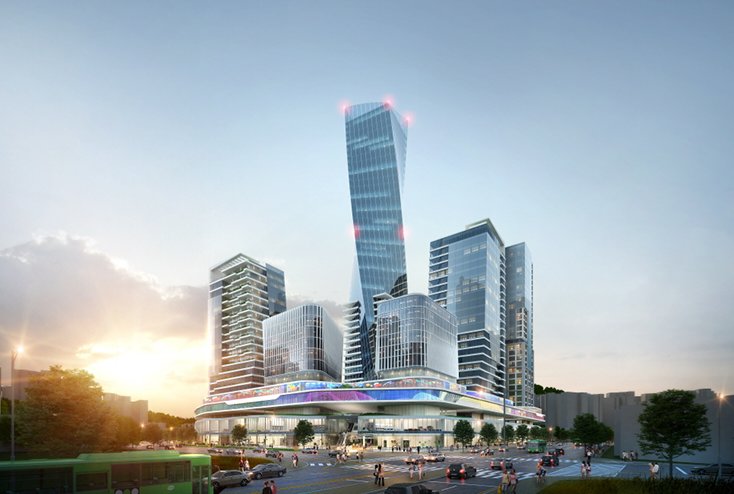


Quite a change from nowadays:

"Vegan Festival in Seoul Innovation Park, Eunpyeong-gu." (@theSeoulVillage 20170511- twitter.com/theseoulvillage/status/866195549707358208)

Okay, all cars shall be parked underground instead of these traditional outdoor sprawls, plus there's also going to be this manicured 'Seoul UIC Campus' (University of Seoul Industry Cooperation), but that's not the same as a laid-back park full of happy families:

As you well know, I'm all for fixing the capital city's unbalances, and Northeast Seoul clearly deserves a boost. Besides, the city already owns this 110,000 sqm site, and it's next to a subway station (Bulgwang Station), close to the Yeonsinnae transport hub (Subway Lines 3 and 6, GTX-A - see "GTX, meet Sinbundang Line"). 

But not exactly there. And we've already seen this not so disruptive concept of futuristic, buzzword-friendly city within the city, with its iconic landmark tower - here, 60 more floors to be filled in a market already suffering from oversupply. Yet another empty alibi for yet another real estate nonsense (many 'apateu' have already risen nearby)? And of all models, why pick the COEX as a symbol of success? 


Needless to say, the grove with its old trees at the entrance, under which kids would play and seek fresh shelter in the Summer, is gone. From the outside, this could be any mall:


This time, it's different, they say. We go 'beyond zoning', we're truly mixing commercial, residential, and business. And this time, promise, we'll build and startups will come. SH Corporation will make sure a diversity of people build a genuine community, a 'Golden Village' where elderlies, newlyweds, single households share the same spaces with all facilities required in changing times.

Sincerely hope that flies but frankly, Seoul, you can do better.


"Seoul's project for Seoul Innovation Park (Nokbeon-dong, Eunpyeong-gu)? A coex-ish hub, very Oh Sehoon-ish urbanism:" (@theSeoulVillage 20221220 - https://twitter.com/theseoulvillage/status/1605025577102032896)


Seoul Village 2022
Welcome to our Korean Errlines! Follow Seoul Village on Facebook and Twitter, follow me on Instagram.
Download 'Seoul VillageS', the free ebook.
Bookmark and Share

* starting with Seoul Creative Lab and Hyebin's FabLab:

"Always nice to visit Seoul Innovation Park's FabLab! Eunpyeong-gu, Seoul." (@theSeoulVillage 20161207 - https://twitter.com/theseoulvillage/status/806453941252673536)

** including, most recently, SEMA Storage in a former KCDC warehouse (see "Nine new museums in Seoul by 2023")

Sunday, March 10, 2013

Build a hanok and they will come - Marketing impostures and genuine slow urbanism

Sorry for posting yet another focus on urban developments - following last Thurday's "Sudogwon New Town Blues" -, but even if you're not among the (more than a few) researchers and experts in urbanism who roam this excuse for a blog, this is about Seoul villages, old and new. Yeah, I also suffer from hypergraphia*, but that's not the issue.

Anyway. Korean "model houses" are always worth visiting for at least three reasons (see "Inhuman, all too human Seoul"): to follow housing market(ing) trends, to measure gaps between different levels of reality and their representations, and to explore ethnological goldmines. 

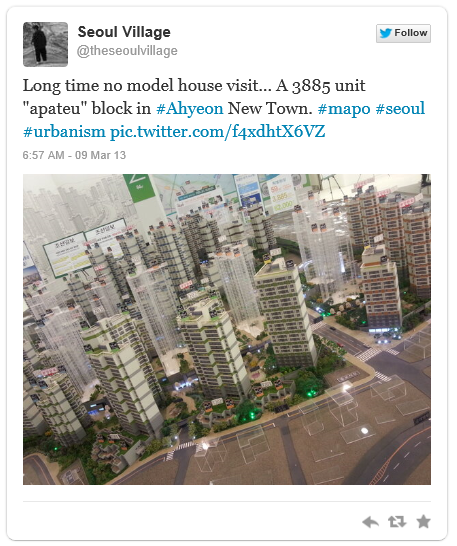
Yesterday, the piece de resistance was a rather classic project, this 3885-unit section of Ahyeon New Town:


see this Tweet on Tweeter

We'll get back to it later. Now check this medium-sized apartment block, also in Mapo-gu, and by the same developers, but this time solo (they partner with another chaebol on the previous project). As you can see, a brand new "hanok guest house" and its "hanok playground" sidekick are highlighted as star assets at the feet of the apartment towers, and in a pop-up that dwarves the rest of the mock-up:

see this Tweet on Tweeter
This "traditional" corner belongs to the condominium: all residents can enjoy the playground anytime, and a preferred rate when they want to rent the guest house, for instance when relatives visit for a special occasion.

If traditional pavillions or walls multiplied in the middle of new apartment complexes well before the real estate crisis**, the 'hanok fad' really caught in major commercial projects at the end of the naughties, from "hanok style interiors" to whole hanok complexes (see "New Towns : hanoks in Eunpyeong, a desert in Wangsimni", "Hanok New Town in Seongbuk-dong").

Most of the time, it's more a "Hanok Alibi": residents still opt for the usual "apateu" experience, and the traditional house only comes as a "feel good" factor, a marketing gimmick, like in a "Hanok Inside" campaign. Yes, we destroyed the old neighborhood but see, we respect traditional architecture. And if we can afford such a costly low rise construction on our very expensive land, it tells a lot about the value or our community and the values of its members. Anyway these days promoters seldom sell all apartments as easily as they used to, and for them cramming as many units as possible is not a winning proposition anymore...

On a more positive note, not so long ago, many prospects and customers would have been revolted by the idea of wasting money and space in this kind of old stuff. The fact that hanoks can "sell" confirms encouraging trends: at long last the general public is reconsidering Korea's architectural heritage, perceiving preservation efforts as positive (as long as they don't hinder your personal real estate projects, of course). And hanoks do sell: their market value has sharply risen in certain neighborhoods, where Seoul promotes and sponsors their creation and renovation.

At the individual level, building or restoring a hanok remains a statement, a long but rewarding process, and a perfect example of slow urbanism in a city where short term rules like a despot.

To a major development project, the "hanok touch" adds sense, anchors with the city's cultural continuum. But it works better when it's heartfelt, sincere, conceived from the start. 

As we saw, the hanok village was only a late addendum to Eunpyeong New Town, but without it, the project wouldn't be much distinguishable from any bedtown. And if it comes more as a transition to Bukhansan national park than to the cityscape, that's because the New Town is not contiguous with the rest of the district, except by the road and rail connections - mainly Tongil-ro, and Subway Line 3 between Yeonsinnae and Gupabal. Even if we are in Seoul, this is more a "greenfield new town", built in a valley of its own: the one carved by Changneungcheon, the stream that marks the Seoul-Goyang border in Jingwan-dong.

If I can't be satisfied with the destruction of part of Seoul's greenbelt for yet another real estate development, this looks much better than your usual tombstone "apateu" towers:

Eunpyeong New Town's hanok village: a new touristic entry point to Bukhansan... 

... but also a new neighborhood with over 200 private residences

Bonus: Eunpyeong Museum, yet another concrete dent into Seoul greenbelt (if you find it ugly, wait until you see the new Eunpyeong-gu office, on the other side of Tongil-ro)

If you prefer more intimate entry points to Bukhansan, you'll have to follow Bukhansan-ro further eastwards: not long after the T intersection with Yeonseo-ro, a streamlet will lead you up to the temple of Baekhwasa.

With its pedestrian highway of a paved road, this new gateway to the mountain is clearly meant for the masses. Environmentally debatable, Eunpyeong's hanok village shall become a touristic asset for the district and draw visitors from far away, among which some who would have never considered Bukhansan otherwise.

Hopefully, Eunpyeong new town shall not be just a residential dead end, or a bedtown lost in the outskirts, but a touristic destination, a neighborhood visitors will cross with a purpose, and - yes - a village with its own cultural life.

Again, time and the way humans behave will tell if this urbanistic and architectural project succeeds. Preferably, Eunpyeong Museum shouldn't be an empty shell, and the hanok village should become a neighborhood where real people live actually, not yet another artificial folk village.

Let's wait and see.

I told you I'd get back to Ahyeon New Town. I did, and here as well, you can find a hanok at the feet of the towers:


Not a part of the development, but a survivor:


Will it be transformed into a restaurant? Will it merge with its neighbors and grow into a five story building with a PC bang in the basement, a convenience store on the ground floor, and scores of non-descript offices or one-room units all the way up?

Let's wait and see.

We can wait as long as we want, we'll never see again some charming places of the old Ahyeon and Bukahyeon-dong.


Seoul Village 2013
Welcome to our Korean Errlines! Follow Seoul Village on Facebook and Twitter
Bookmark and Share
Add this page to your favorites

* and Seoul Village is only the tip of the iceberg ("HGTP (Hypergraphia Transfer Protocol) Turns 10: 03/03/03 - 13/03/03")
** Gwanghwamun Space Bon went as far as to throw in a stone bridge and a mini walled historic site... but they don't compensate for the lost hanok village at the heart of Sajik-dong. Note that the planned redeveloppement of Sajik heights, between the tunnel and Gyeonghuigung, also includes a "traditional" corner.

books, movies, music