NEW - download 'Seoul VillageS (서울 마을들)', my collection of 12 short fictions now adapted into short films! Get your free copy of the ebook (4 editions: English, French, Korean, Bilingual English-Korean)!

Showing posts with label Guro Digital Complex. Show all posts

Thursday, June 7, 2018

Riding along 'horizontal verticals' in Magok District (Part III)

This is the final part of my focus on Magok District:
    1. Framing Magok (Part I - Location)
    2. Magok's horizontal verticals (Part II - Cluster)
    3. Magok's lifespace (Part III - Environment)
The future Seoul Botanic Park will feature 3,0000 plant species (its flower-shaped indoor facility - bottom right - is already visible from a distance).


***


3) Magok's lifespace


If Gangseo-gu is not an usual darling for real estate speculators, Magok scores much better than most Seoul neighborhoods. Beyond its potential and dynamics in terms of location, connectivity, or research hub, people seem to believe in its quality of life, and to trust SH Corporation for delivering the goods.

Rebranded two years ago Seoul Housing and Communities Corporation*, this public institution has led the development from its early stages, with a mandate to put families, environment and sustainable mobility at the core of the project, a clear difference with other innovation clusters where business preempted everything.

Seoul Business Agency (SBA) did play a central role in Magok as it did in the DMC, but in the latter, residential developments were secondary, and not considered as a key factor of success. And we saw how the Gale International - Posco tandem struggled in Songdo.

Pangyo too enjoyed a partnership between national and local authorities for its Pangyo Techno Valley (Gyeonggi Institute of Science and Technology Promotion established in 2010), but for its residential areas, it only had to surf on the Bundang wave, and from the start flush with private money, that very hyped 'New Town' got 'blessed' with more than a few luxury residences.

Like Pangyo, Magok started essentially from scratch. Revamping Guro Digital Complex, and supporting its evolution into a XXIst century G-Valley demands different efforts from Seoul and Kicox (Korea Industrial Complex Corporation).

Magok wasn't dragged down by ailing neighborhoods in need of regeneration. The central role of public authorities is a guarantee that everybody will profit, not a sign of destitution. I don't think Magok will become as 'bling-bling' as Eastern Gangnam either, but I don't see that as an inconvenient.


How does this 'common good' approach translate into the landscape? For instance, beyond the central park, you don't have a collection of green spaces, each one managed by a gated apartment complex, but neighborhood parks connected by green corridors between open blocks. Branded M-Valley by SH Corporation, the residential complexes remain relatively low rise compared to other recent projects this side of the Han River, keeping in mind that this is a first development. Even if we're still in the classic 'apateu' model, there could be a greater sense of open community than in Pangyo's luxury town houses or from the top of a Songdo penthouse...

The green corridors are wider than Yeonnam-dong's 'Yeontral Park' (the Gyeongui Line Forest Trail), but without the streets, shops or restaurants on their sides, and only a few tables to picnic here and there, which minimizes noise pollution for the residents.

As I noticed before, along large sections of Seoul Botanic Park, blocks devoted to research centers sit right across the street (e.g. for the moment LG Science Park and Kolon One and Only Tower), which could be seen as a form of privatization, but could also become a motivation for them to open up, to let visitors roam their own land, to propose services that would flourish along the frontline in probably more anarchic ways, to blur the lines of a strict zoning. 

Tadao Ando's LG Art Center (see part II) provides a clearer example of how local communities can benefit from private infrastructure: parts of the program will involve residents, and the venue will eventually belong to Seoul city. 

For the moment, residential and research blocks stand out, and local businesses mostly develop around subway stations. The first significant hotel to open in the neighborhood mirrors its positioning: overlooking the park, Courtyard by Marriott is not the chain's most luxury brand, but provides quality stays for both business people and families.


*

Seoul issued guidelines and specs early in the project to make sure that environment, accessibility, or bicycle lanes were taken into account:


Water collection and filtering systems embedded in the buildings, roads, or parks
Accessibility and security at pedestrian crossings
Pedestrian crossings again, this time for bicycle lanes, always a tricky moment for cyclists
With its flatness and absence of major disruptors in its core (hills, river, railways, highways**), Magok District is perfect for cycling. 40% of all roads will have dedicated lanes, in a continuous network connecting the new neighborhood and its Seoul Botanic Park to the Hangang backbone. Beyond a 'Ddareungi' special zone facilitating commuting and leisure rides, or many bike parking facilities, four bike storage systems will be available at subway stations.


Bicycle-friendly Magok (left, one of the green diagonal corridors between apartment blocks - right, a protected bike lane that could be wider, like for instance the one along Seongmisan-ro in Seongsan-dong).
Magok's bicycle network
So it seems that even in this early stage, Magok is aiming at to the vision I finished my 2013 update with (see 'Magok District on cruise mode'):
"Now the most important remains to give some soul and consistence to this alleywayless place. You want to see residents and researchers venture beyond their homes and campuses, roam the streets, enjoy the city. The park and diagonal canal can give purpose, but let's not forget to optimize every single street for pedestrians and bicycles, make this neighborhood a destination from all directions, in continuity with Hangang Park, and the new neighboring communities (Banghwa, Balsan...)."
*

As usual, as an urbanist, I would have done things differently; Magok District doesn't signal a revolution in the Korean New Town or the Korean innovation cluster models. Yet it redefines Gangseo-gu, and beyond Southwest Seoul. It might even demonstrate that a big residential and business project South of the Han River can succeed without arrogance. What matters is that, ultimately, people live happily together in a place where trees, bicycles, and fellow earthlings are welcome.

Seoul Village 2018
Welcome to our Korean Errlines! Follow Seoul Village on Facebook and Twitter

Bookmark and Share
.
* see "Seoul summerscapes: death, taxes, and budongsan
** if Gonghangdae-ro is a wide and busy axis, it can't be compared to the Gyeongbu Expressway that separates Seopangyo and Dongpangyo

Thursday, March 12, 2015

Burying Seobu Expressway (not all car traffic, though)

Seoul eventually confirmed the completion of the transformation of the 10.33 km section of the Seobu Expressway into a 4-lane underground tunnel by 2019, between Seongsan Bridge (Yangpyeong-dong, Yeongdeungpo-gu) and Geumcheon I.C. (Doksan-dong, Guro-gu)*. 


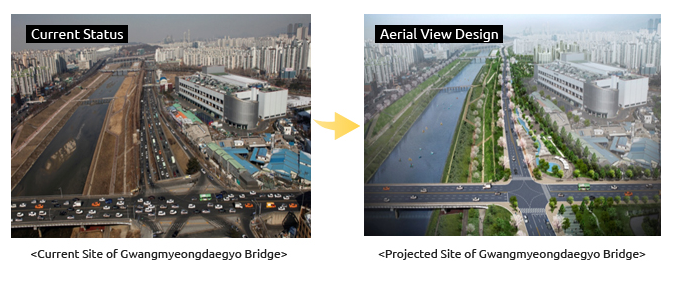
A standard road will double it at ground level, to - hopefully - take care of the local traffic, and to propose a more pleasant experience for residents and visitors: Anyangcheon will at long last be accessible through simple pedestrian crossings (from the Seoul side, Gwangmyeong residents being connected to the eastern side by footbridges), and new parks will be created, including a big one if Seoul manages to move that big, ugly garbage treatment unit. 

Overall, a greener look and feel (particularly with with these before-after pictures comparing winter and summer views!):


This clearly marks an improvement of the cityscape and quality of life in this part of the city, but not a disruption from the car-centric view. And don't expect to totally get rid of traffic noise: "vertical soundproof walls, currently installed between the Seobu Expressway and Gyeongbu Railroad Line, will be replaced with twice the amount of folded soundproof walls to reduce noise levels".

It may look a bit like Yangjaecheon, but a big part of this stretch is occupied by the Guro Digital Complex, not by mid-rise residences. In any case, good news for the district and for people working there. If sure the landowners in front of one of these crossings will find a better use of their ground levels...

Now if your start-up can't afford a Google-size campus for its staff, you can at least offer them a waterfront experience without the disgracious expressway a la Facebook (see "Zee Talk of Zee Town", "Google's Gtown wins over ZeeTown and the Large Apple Collider").


Seoul Village 2015
Welcome to our Korean Errlines! Follow Seoul Village on Facebook and Twitter
Bookmark and Share
Add this page to your favorites

* a Public Private Project on a Build Transfer Operate mode: "Seobu Underground Road To Be Constructed Through Private and Public Joint Agreement".

Monday, February 13, 2012

Guro-gu boom, a bang for the (renmin)buck

I recently mentioned Seoul's most expensive neighborhoods for opening shop (see "Six lanes of traffic"), but a recent article in Chosun Ilbo delivered a full picture at the district level for premium spaces, exposing a spectacular boom for Guro-gu and Geumcheon-gu (respectively +39.9% and +36.1% between 2011 and 2010 in the value per square pyeong)*. All districts posted gains (up to 12-15% for Gangbuk-gu, Jung-gu, Gangseo-gu, and Gwanak-gu), except Gangnam-gu (-1.8%), Dobong-gu (-2.2%), and Yongsan-gu (-11.2%).

As a result, the central and traditional office space strongholds Jung-gu and Jongno-gu moved to the top of the rankings, and Guro-gu jumped from the lower tier to third place. Gangnam-gu, the 2010 leader, was downgraded to 4th, and Seocho-gu (an anemic +0.2%) from 3rd to a distant 5th, threatened by Mapo-gu (+4.2%), and even Yeongdeungpo-gu (+8.1%).

The relative pause for the southern stars (Gangnam-Seocho) doesn't come as a surprise, following the bubble years. Yongsan's bad year is probably a side-effect of massive redevelopments: they're making room for the IDB and various new towns, particularly around Seoul Station (I'm really afraid the atmosphere around Malli-dong market** will not be the same after the evacuation).

Southwest Seoul is catching up nicely: Gangseo-gu certainly benefits from the new Line 9, and Geumcheon-gu from the Gasan Digital Complex, but as they develop their own infrastructures, Gyeonggi-do neighbors (e.g. Gimpo or Gwangmyeong) also contribute. On the other hand, they bring fresh competition: see how the new Lotte Mall Gimpo Airport is taking aim at such hotspots as Yeongdeungpo's Seoul Times Square.

So last year, it was Guro's time to shine. A nice reward for a district that discovers glamour after the transformation of Guro Industrial Complex into Guro Digital Complex (from factories to venture / IT startups), or the inauguration of D-Cube City***. Note that Garibong-dong, Seoul's center for Chinese communities, is naturally attracting Chinese money. Of course, along came the Chinese triads, and the fight for premium commercial space is raging at that level too, more than often involving North Korean / ethnic Chinese gangs. But that's an epiphenomenon, and don't picture yourself in the South Central L.A. of yore: you're in Seoul, and in Guro-gu, a vibrant district for families. Just enjoy the city!

Overall, another year of inflation: prime commercial estate surpasses KRW 100 M per pyeong* in 16 of the 25 districts, compared to 9 in 2010. But as expected, the gap between the 'richest' and the 'poorest' is decreasing: from 63% in 2010 (Gangnam-gu 126.6 M, Gangbuk-gu 77.590 M) to 58% in 2011 (Jung-gu 134.92 M, Dobong-gu 85.44 M).


Seoul Village 2012
NEW : follow Seoul Village on
Facebook and Twitter

*see "구로구 점포 권리금, 강남구 앞질렀다는데" (20120208 Chosun Ilbo). NB: 1 pyeong = 3.3 square meter.
** see "
Sungwoo Barbershop, Malli-dong Market"
*** about the latter, see "
D-Cube City and Korean Food Street (Byeokgyesu)"