NEW - download 'Seoul VillageS (서울 마을들)', my collection of 12 short fictions now adapted into short films! Get your free copy of the ebook (4 editions: English, French, Korean, Bilingual English-Korean)!

Showing posts with label Robert Koehler. Show all posts

Thursday, January 7, 2016

2016 Under The Carpet

What a transition to the new year!
  • As feared (see "Miracle?!?"), the December 28 deal between Japan and Korea was just a compromise to end the diplomatic impasse, and didn't resolve the 'Comfort Women' issue. The last survivors won't see justice, Shinzo ABE goes away with his classic elusive smokescreen, like last August*, and PARK Geun-hye with yet another journey into damage control mode. Obviously, the grandson of the war criminal in charge of forced labor and the daughter of the dictator who organized mass prostitution around UN/US army bases to collect foreign currencies** decided to sweep the sexual slavery issue under the rug, along with a hatchet that won't require such heavy tools to unearth.
  • The most hawkish clique of North Korea's "Juche Line" celebrated the mysterious death of "Sunshine Line" KIM Yang-gon with special fireworks: a new nuclear test that produced, according to KIM Jong-un himself, "the thrilling sound of a H-bomb explosion" - a bit far(t)-fetched, but even without adding to Beijing pollution, that underground blip was meant to infuriate the "Beijing Line".
  • When you think South Korea's opposition has reached the bottom, they keep digging their fingernails out: as MOON Jae-in and AHN Cheol-soo replay their old Burton-Taylor routine, PARK Won-soon ignores vetoes to start his risky landmark Seoul Station 7017 project. But presidential-candidate-wise, ruling party Saenuri must also cope with KIM Moo-sung, a man who confirmed he could collect embarrassing trumpisms.

As for me, I keep digging my own internet tomb with these clumsy lines. Seoul Village starts its 10th year, a spinoff of my even older 'blogules' for everything related to Seoul and Korea. 

Thank you, Dear Readers, for sticking to this inedible bibim of mine, that mixes non-edited posts*** about topics I fancy, ranging from "urbanism" to "culture" or "politics", with a touch of "business / techno" (the innovation side landing more often on my 'mot-bile' blog).

I know I should pull the plug, and I must confess I regularly toy with the idea for all of my blogs (and already did for most of them). Even more so following the actual H-bomb announcement of this turn of the year: the end of Robert Koehler's The Marmot's Hole.

Now that's pure class: say stop when you're at the top of the game, and even close the entrance to the comfort zone to resist the temptation to return to it. Hats off to you Robert!


Now that the Marmot's gone, will Robert Koehler the photographer bring new colors to rjkoehler.com?

And Happy New Year to all!

Seoul Village 2016
Welcome to our Korean Errlines! Follow Seoul Village on Facebook and Twitter

Bookmark and Share
Add this page to your favorites

* see "Decoding the Abe Statement: "why apologize for crimes Japan never committed?"
** see "Comfort Women': No Resolution Without Resoluteness. From Everyone, Please."
*** see "All posts"

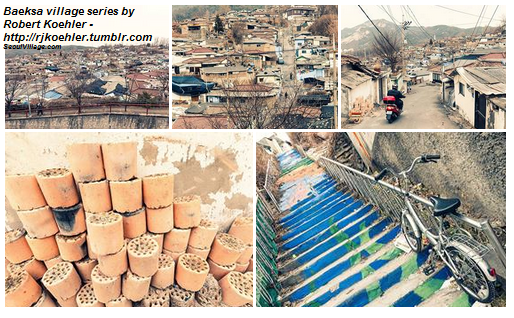
Tuesday, January 21, 2014

Over the moon

The day couldn't start any better: a beautiful series of pictures of Baeksa Village, one of my favorite 'moon villages'*. Thank you Robert Koehler!

On Robert Koehler Travel Photography site:
http://rjkoehler.tumblr.com/post/73834365491/located-in-northern-seoul-on-the-lower-flank-of
* see previous posts on Baeksa maeul:


Seoul Village 2014
Welcome to our Korean Errlines! Follow Seoul Village on Facebook and Twitter
Bookmark and Share
Add this page to your favorites
.

Thursday, March 14, 2013

Am I My Hanok's Keeper? Peter E. Bartholomew's Defense and Illustration of Korean Architecture

Like many Westerners appalled by the hanok genocide in Korea, I'm often playing God blaming Cain ("Where's your hanok?" - "I don't know, am I my hanok's keeper?" - "What have you done? Listen! Your cultural heritage’s blood cries out to your lineage from the ground"). Of course, this gallic brat cockily ranting around is not only useless but undermining the cause.

Hopefully, the cause of hanok preservation did progress dramatically, thanks to voices that carried much more than sterile criticism: true love for Korean architecture only actual hanok's keepers could manifest. And "The Guardian of The Hanok" managed to bring change because he could reach both Korean authorities and the general public.

Last Tuesday, Peter E. Bartholomew faced a large and already won-over audience for his lecture organized by the Royal Asiatic Society, Korea Branch: "Catastrophic Losses of Korea's Architectural Heritage from 1910 and Continuing Today". He could have continued for days and much more this vibrant defense and illustration of Korean architecture.


Peter E. Bartholomew, a.k.a. The Guardian of Hanok

The "Guardian of the Hanok" started his love affair with Korea's traditional architecture in 1968, when he arrived from the States in Gangneung, Gangwon-do. For five years, Bartholomew stayed in Seongyojang, an amazing three-century-old residence which, still today, belongs to a former royal family. Emerging from a sea of lotus, here's the pavillion where a younger (and, judging by his own pictures, a hairier) Peter had his first experience of hanok restoration:

 
Bartholomew illustrated his exciting presentation of the science, aesthetics, philosophy, and poetry of hanok with hundreds of pictures covering all periods, styles, and regions, including from his own hanok in Dongsomun-dong, Seongbuk-gu, where he's been living for more than 30 years.

I will simply add this spectacular view over Ikseon-dong, Jongno-gu for three reasons:


- First, it shows a key yet little known element of hanok architecture mentioned by Peter: the reddish layer of dense clay under the roof tiles, which are here about to be rearranged.
- Second, that's the opportunity to say hello to Robert J. Fouser: another great hanok keeper (just finishing his lovely home in Seochon), Robert recently wrote about this most charming but endangered neighborhood in Seoul Magazine (see "Seoul's Hanok Island: Unhyeongung Royal Residence and Ikseon-dong" and Robert Koehler's photographs)
- Third, it exposes at the same time the beauty, the strength, and the fragility of Korean architecture, as it is in the nude. Note the tile 'backbones' marking the roof lines, and the roof at the lower corner of the picture ("georgeous curves", would probably say "The Guardian of the Hanok").

Peter E. Bartholomew painted an impressive census of the 15 to 20,000 architectural treasures directly controlled by Korean administrations in 1910, from royal palaces to local governments or military compounds. He then told the sad story of annihilation. Not even one percent survived after three man-made tragedies: the Japanese occupation, the Korean war, and of course, the architectural and urban genocide that followed and still today continues.

This story became even more personal for him when he had to lead the resistance against the planned destruction of his neighborhood's last traditional houses. Bartholomew showed us the 2004 official document proving how hanoks were specifically targeted to pave the way for a major development across Dongsomun-dong. The group of hanok keepers managed to save the neighborhood - making many speculators unhappy -, and eventually won in court against the Seoul Metropolitan Government (an episode mentioned in "The Empress's Last Bang").

This decision of justice (and the media coverage it caused) was a defining moment in the fight for preservation: being associated to the destruction of hanok clearly became politically incorrect, and really bad PR at the international level, particularly following the global outcry over the mass destruction of hutongs ahead of the 2008 Beijing Olympics*. Sign of the times: Seoul mayor named the "Guardian of the Hanok" a honorary citizen the year following the battle in court.

If much pedagogy remains to be done to change mindsets, mainstream media are now more and more often documenting cases, serving the cause, and the perceived value of hanok has clearly evolved, even if that's not always a good thing (see "Stop The Hanok Genocide... And Stop Revival As Reenactment" or more recently "Build a hanok and they will come - Marketing impostures and genuine slow urbanism"). Maybe recurrent programs could help: in France, for instance, such TV programs as "Chefs d'oeuvres en peril" (1960s) or "La France defiguree" (1970s) helped raised public awareness. Preservation movements gained momentum, architectural treasures got saved, and ultimately more sustainable policies emerged.

Korea's Cultural Heritage Administration (cha.go.kr) and other organizations are already doing a lot for the architectural heritage, but there's an emergency to save treasures that are neither in protected areas nor under the spotlights.

Seoul Village 2013
Welcome to our Korean Errlines! Follow Seoul Village on Facebook and Twitter
Bookmark and Share
Add this page to your favorites

* NB: I'm pretty sure similar architectural tragedies are happening across Asia. Keepers of the world, unite?

---
ADDENDUM 20130331 - RASKB video of the conference: