NEW - download 'Seoul VillageS (서울 마을들)', my collection of 12 short fictions now adapted into short films! Get your free copy of the ebook (4 editions: English, French, Korean, Bilingual English-Korean)!

Showing posts with label Baekundongcheon. Show all posts

Wednesday, January 26, 2022

More Gwanghwamun Square previews

Seoul revealed new visuals of Gwanghwamun Square 3.0, which shall be inaugurated in July.
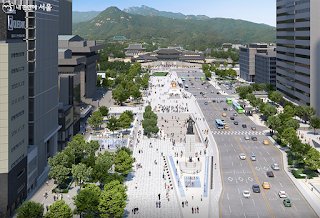
They prolong the last major iteration presented in 2019 ("Gwanghwamun Square 3.0 re-Deep-Surfaces"), which corrected one of the worst urbanistic blunders  of the initial version ("Gwanghwamun Square Enters Third Dimension"). PARK Won-soon's team rushed the construction a few months before the elections without conducting any decent impact survey, and work started late 2020. As soon as OH Se-hoon returned as mayor, he paused the site to assess the situation, but the changes could only be cosmetic.

The Woldae extension in front of the palace gate will only be created next year, so we have yet to see how vehicles flow around Yulgok-ro's future curve. Adjusting to the modifications already in place is not always easy. As expected, the intersection in front of Sajik-dan helps reconnect both sides of Sajik-dong, but the impossible new U-turn just North of the Government building stops functioning as soon as traffic slows down (too close before a major traffic light, unlike the old one heading for Sajik tunnel).

Most important, Seoul's defining axis is preserved, with its iconic Gwanghwamun-Gyeongbokgung-Bugaksan perspective, and pedestrians will enjoy a 20 m-wide park with a vast selection of tree species, guaranteeing natural shade and oxygen as they grow. That's where most of the extension (from 18 to 40,000 square meters) comes from. People will be able to sit on benches and along the Haechi Madang ramp, where street animations may bloom next to the new media wall.

Sejong-daero's pedestrian and cycling experience has already been improved with the new green walks and bike lanes added on the way to Namdaemun (see "Lower Sejongdaero's turn"). With its fountain tunnel and pavement fountain, the 'Gwanghwamun' Lounge section is likely to welcome kids and keep them fresh during the Summer. If some artifacts found during the renovation shall be on display in the cultural section, most of the Joseon era infrastructures (see timeline*) shall be covered again. I hope the tribute to Yukjo street will not look to corny. 


On the Eastern side, Junghak-dong will not host a simple reconstitution of the old Uijeongbu site, but a fusion hanok exhibition space. I wish there were more trees in that section, but that can (and probably will, if they want the spot to be successful) be fixed later.

This Uijeongbu project was on display at the Seoul Hall Of Urbanism (see again timeline below*) during the low key, pandemic-plagued 3rd edition of the Seoul Biennale of Architecture and Urbanism. SBAU will return in September 2023, with CHO Byung-soo (BCHO Architects) as its Director. This architects knows a bit about dao, and Seoul could do with some more harmony...

Ganghwamun Square reopening in the heat of the Summer will be a perfect crash test. I'm pretty sure Seoulites will quickly make it their own. At least during the evenings. And as much as that damned coronavirus will allow.


Seoul Village 2022
Welcome to our Korean Errlines! Follow Seoul Village on Facebook and Twitter, follow me on Instagram.
Download 'Seoul VillageS', the free ebook.
Bookmark and Share


* From @theSeoulVillage timeline: 


"Gwanghwamun Square last week. Seoul started controversial revamping without a proper impact survey..." (20201220 - twitter.com/theseoulvillage/status/1336888158437265408)


"The few changes since the initial plan won't prevent the expected traffic pandemonium. Tragic lack of urban planning, urbanism vision from Seoul... Sejong-daero Gwanghwamun" (20210221 - twitter.com/theseoulvillage/status/1364019424752115720)


"Western side of Sejong-daero / Gwanghwamun Square to close tomorrow for the controversial revamping (future Jeokseon-dong loop in the foreground)" (20210305 - twitter.com/theseoulvillage/status/1367760419218018306)

"As expected, works on the Western side of Gwanghwamun Square for its extension reveal Joseon time artifacts and structures related to former ministries. Here, a waterway in Jeokseon-dong (between Baekundongcheon & Junghakcheon - see seoulvillage.blogspot.com/2009/08/baekun #urbanism)." (20210319 - twitter.com/theseoulvillage/status/1372721209939431427)

"I guess mainly to evacuate overflows towards Baekundongcheon, to contain water damage in case of heavy rains. Gwanghwamun Square urbanism Jeokseon-dong Photo Chosun Ilbo" (20210319 - twitter.com/theseoulvillage/status/1372721211789037583)
"OH Se-hoon hits pause button on controversial Gwanghwamun Square revamping. Also asks AHN Cheol-soo to suggest talents for Seoul." (20210410 - twitter.com/theseoulvillage/status/1380664510638264322)


"Seoul's unearthed Yukjogeori during Gwanghwamun Square revamping:" (20210511 - twitter.com/theseoulvillage/status/1391895161337090049)


"Gwanghwamun's future Uijeongbu site at Seoul HOUR (Seoul Biennale / SBAU):" (20211028 - twitter.com/theseoulvillage/status/1453500318226935809)


Tuesday, April 10, 2018

Gwanghwamun Square Enters Third Dimension

Seoul Metropolitan Government and the Cultural Heritage Administration unveiled yesterday their plans for a 'New Gwanghwamun Square' by 2021, and they came up with a weird 'solution' for the potential traffic conundrum I mentioned four years ago, when the project started taking a clearer shape (see "Gwanghwamun, Donhwamun, and the Tale of two Royal Roads").


Gwanghwamun Square 3.0 - the royal Sejongno-Gwanghwamun-Gyeongbokgung-Cheong Wa Dae-Bugaksan-Bukhansan perspective

This modification of Seoul's most defining center has potentially even greater consequences than the previous one, which we followed step by step a decade ago. I will as usual focus on the urbanistic impacts (passing by many familiar spots), but since this is also about Korea's center of power ever since its capital was founded, I'd better start with some political context.


It's the politics, stupid?

Such a project deserves to be carried by both the local (SMG) and national (CHA) governments, and PARK Won-soon as well as MOON Jae-in happen to have a special bond with a site where PARK Geun-hye started and ended her presidency.

Started? If we all remember the massive, peaceful demonstrations that led to PGH's destitution, who could possibly forget that kitschissime wishtree** on Gwanghwamun Square, her first symbolic stop on her way to Cheong Wa Dae?

During his own campaign, MOON Jae-in pledged to move the presidential offices from Cheong Wa Dae to Sejongno, and the presidential residence closer to Gwanghwamun, in order to cleanse the feet of Bugaksan, and to honor the place where democracy took a stand and won. MOON also picked Gwanghwamun Square to celebrate his victory.

Retrospectively, I shudder when I remember AHN Hee-jung's over-the-top cheering that night - back then, I didn't know he couldn't even control his darkest pulsions... anyway, his DSK / #metoo moment completely revived the ambitions of a man who tried to steal the show on the very same night.

Only weeks ago, PARK Won-soon was clearly out of the game for the 2022 presidential elections, and about to be dumped by his own party for the upcoming mayoral elections (June 2018). Now he's leading the polls by far (against WOO Sang-ho and PARK Young-sun for the primaries, and against AHN Cheol-soo and KIM Moon-soo beyond), and this new project looks like the ideal platform for both ballots: he can make a splash in 2018 on the very site that boosted his predecessor's reelection***, and deliver the goods just months before 2022. Of course, PWS already combined a major urban project with a major political event before, but PGH's impeachment derailed Seoullo 7017's perfect timing ahead of the 2017 elections (see "Seoullo 7017, and more roads to Seoul").

Now is the right moment to communicate a grand scheme and vision, big enough to mask PARK's most recent shortcomings: he barely managed to avoid criticism for Seoul's waste management crisis by sending deputies to face the media, and he let his rival WOO preempt the usually well coveted 'public transportation' territory by campaigning on a new metropolitan authority, including yet another revival of the key Seobuseon project (after 2013, when "Seobu Line confirmed as Seoul's LRT top priority", the city dropped the ball once again).

So yes, it's about politics. But regardless of this context, Gwanghwamun Square and its surroundings needed a fix.


3.7 times bigger, 3.7 times better?

So what's the plan? Basically, the pedestrian zone grows not only, as expected, to the West and along nearby streets, but also right in front of the gate, making the road map much more complex, what I dubbed Seoul's 'Royal T'**** turning into a Y:


Seoul also revived its old ambition to restore Baekundongcheon, Cheonggyecheon's main source, the diagonal still visible on today's map (see "Baekundongcheon / Gwanghwamun-gil - A River Runs Through It"*****).

Seoul city advertises about the 3.7 factor by which pedestrian surface booms from 18,840 m2 to 69,300 m2, the reduction of traffic lanes to 6 along Sejong-daero, and its renewed demands to the State for a GTX extension to Gwanghwamun.

All this sounds very positive and environment friendly, but no really new green spaces are planned, and the extended square might make Summers and Winters even more merciless in what looks more like Tiananmen Square, or the barren landing site that preceded Yeouido Park.

There are still no dedicated lanes for buses or bicycles, and buses shall be redirected South, which seems recipe for disaster for public transportation around downtown Seoul, particularly since the new road map deprives Sajik-ro 8-gil (formerly Naejadong-gil) from its role of main NS/EW dispatcher.

Compared to Gwanghwamun 2.0, the 2009 revolution that brought pedestrians back to the heart of the capital, this Gwanghwamun 3.0 adds only marginal change to their experience. I like the idea of restoring the 'parvis' in front of Gwanghwamun, the Eastern pavillions and hanok around a 'History Square' that could liven up the walk from Seochon to Bukchon... but pushing traffic further downtown, and adding new bottlenecks to already saturated axes does seem like a big price to pay. 

Unfortunately, like with Seoullo, impact surveys have obviously been eluded in a race to meet electoral deadlines, and authorities chose to worsen traffic situations by not tackling them. Even the curve of the new road following the back of the central government building (that by the way shouldn't be on that History Square) tells about quick and dirty fixes without consideration for the big picture.

What Seoul needed was a consistent vision and plan to prepare its whole historic center Sadeamun (intra muros) for a driverless future. What Seoul delivered was a dangerously incomplete, short-sighted, ill-prepared PR stunt.

The city will take one year to select a proposal, start work in January 2020, and finish by EOY 2021. Mayor PARK missed by a few months last time, and 2021 seems safe enough a goal for him to inauguration the new (if not improved) Gwanghwamun Square. 

I sincerely hope he'll reconsider this plan, and grow some ambition for our city.

Seoul Village 2018
Welcome to our Korean Errlines! Follow Seoul Village on Facebook and Twitter
Bookmark and Share
Add this page to your favorites

* see "The Anipang Election: Park wins big, but who won?"
** see "Park 2 Day 1 in pictures"
*** will OH Se-hoon rise again (on billboards, at least - see "OH Se-hoon returns... but did he ever leave?")
**** see "Inwangsan's Great Wall and Seoul's Royal "T" Time"
***** note that since my 2009 focus, the streets West of Sejong-daero have been renamed Saemunan-ro 9-gil and Saemunan-ro 5ga-gil. Seoul also renewed the project of highlighting walls around Sajik-dan and Sajik-park.

Thursday, May 12, 2016

Take a walk on the Seoul side


More good news for pedestrians in Seoul: 10 streets will undergo a "road diet" this year, and twice more shall follow every year.

By "road diet", the metropolitan government means slimmer, curvier, healthier streets, like in this example where one traffic lane is turned into sidewalks:


Now if you look at the first 10 streets, some have already great assets as neighborhood connectors, short yet scenic and / or gastronomic walkways, often already lined with trees. But many have little to tell, like the 'apateu' blocks surrounding them. 

Here's the list, starting with my favorite:

  • Saemunan-ro-5-gil (Jongno-gu): between Gwanghwamun and Gyeongbokgung stations, the first parallel to the left of Sejong-daero, backstage for the governmental buildings or the Sejong Cultural Center, but centerstage for such great eateries as my beloved Gwanghwamun-jip (yummy gimchi jjigae below). Redefined by the Four Seasons Seoul, it also signals the beginning of the Baekundongcheon diagonal (see "Baekundongcheon / Gwanghwamun-gil - A River Runs Through It"), and I wouldn't be surprised if that diagonal became car-free in the future...
 

  • Noksapyeong-daero-26-gil, Yongsan-gu: known for its antique shops, this elbow connects Noksapyeong-daero and Bogwang-ro.
  • Seongsuil-ro-10-gil, Seongdong-gu: a treeless diagonal between Seongsuil-ro and Achasan-ro, and one of the old royal hunting trails - you can tell them because they radiate from where the old stone bridge used to cross Cheonggyecheon / Jungnangcheon.
  • Dongil-ro, Gwangjin-gu: further to the West, Northeast Seoul's backbone follows Jungnangcheon from Yeongdong Bridge. Seoul starts with the Southern section, more interesting around Jayang-dong, but very challenging because of that ugly bridge landing.
  • Gwanak-ro-30-gil, Gwanak-gu: a stretch lined with trees between Gwanak-ro and Kkachisan Park
  • Opaesan-ro-3-gil, Seongbuk-gu: not much to see either between Naebu Expressway and Wolgye-ro, but you already have sidewalks and trees.
  • Nowon-ro-1ga-gil, Nowon-gu: a lower section of Gongneung-dong around the school
  • Guil-ro-10-gil, Guro-gu: between Anyangcheon and the pack of railways south of Guro Station (Line 1), in Guro-dong.
  • Yeouidaebang-ro-44-gil, Dongjak-gu: a scenic walk around Daebang-dong Community Center, and along Noryangjin Neighborhood Park
  • Nonhyeon-ro, Gangnam-gu: maybe the city wants to improve the shopping experience of Gangnamites along the vertical axis between Maebong, Yeoksam, Eonju, Hak-dong, and Apgujeong stations. Or to remind them that they have feet, and that they could, for a change, spare the driver and spoil the Jimmy Choos.
This announcement followed series of updates by the city of its urban plans for 2025 issued last Autumn, including this list of zones preserved from demolition and reconstruction within Sadaemun / the fortress walls (Ikseon-dong also included):


Of course, you first notice the spots that WILL be redeveloped, like the Sajikistan I mentioned recently ("The Yongsan itch and the Sajik balm"). And the extension of semi-protected zones around Seun Sangga (Jugyo-dong, Ojang-dong, and Chungmuro 5-ga prolonging the direct neighborhoods listed in the regeneration project), or along Jong-ro near Jongmyo (e.g. Inui-dong)...

... not to mention the irony of seeing the DDP in an area 'preserved from large-scale redevelopment'.

Seoul Village 2016
Welcome to our Korean Errlines! Follow Seoul Village on Facebook and Twitter
Bookmark and Share
Add this page to your favorites

Saturday, April 6, 2013

Korean Literature Rocks

Let's make a test: if I tell you "lecture about Korean literature", what do you see?
. if you see a yangban scholar watching his pupils silently read in a Andong seowon, you know your classics
. if you see a cheering crowd and a Californian guy bringing the house down, you were at last Sunday's 10 Magazine Book Club meeting with Charles Montgomery


Charles Montgomery and the "Explorers Guide to Korean Literature" he prepared for the lecture.
Montgomery, who teaches at Dongguk University's English Interpretation and Translation Division, proves that you can do a lot to promote modern Korean literature without being fluent in Korean. Yes, he relies on translations, and yes, he's very much aware of the gaps they induce with the original works, but precisely: translation being the main channel trough which literature reaches new shores, you want to make sure that foreign readers enjoy to the fullest this wide array of tastes and flavors.

And nowadays, modern Korean literature is reaching new shores and levels of popularity. The literature originating from the peninsula as well as the one originating from the Korean diaspora: long before SHIN Kyung-sook won the 2011 Man Asian Literary Prize for "Please look after mom"* (2009), Chang-rae LEE claimed the 1996 Hemingway Foundation/PEN Award for "Native speaker" (1995), a book written in English.


Let's hope Korean publishers won't feel tempted to follow the suicidal path of a national movie industry that relies almost exclusively on blockbusters, and completely forgets to nurture its diversity**. As long as it respects and feeds the rest of the ecosystem, "commercial" literature shouldn't be despised. Just like with Korean cinema, Korean literature managed to bloom in France without the help of airport novels or bestsellers, but in general, such driving forces do make a difference: Montgomery monitors the sales of a panel of Korean authors on Amazon, and he noticed how, each time a new hit came out, the whole community received a boost beyond the individual who wrote it.

Even if he remains a "paper book" lover, Montgomery knows the importance of ebooks (his wife already owns hundreds of them), and the power of online media. His blog-portal Korea Modern Literature in Translation (ktlit.com***) reviews countless pieces of fictions, sharing bios and links to online resources and texts in the public domain. But that's never a tedious journey for the readers, who are regularly entertained with jokes and anecdotes, and routinely OMGed, LOLed or ^^ed. Montgomery also shares knowledge through Wikipedia, a preferred source that optimizes the chances for web surfers to become acquainted with Korean literature.


When you think that even Korean "airport novels" can't be found in Korean airports! The most obvious entry points for Korean culture are too often overlooked, as is the case with Korean cuisine (e.g. in Seoul, only 2 international 5 star hotels have a Korean restaurant****).

Hopefully, Koreans are reconsidering and reviving their literary heritage, and as we've seen before (in "Seochon's Dead Poets Society (YI Sang, YUN Dong-gu)"), nowhere as strongly as in Seochon area, where it all began. Note that on the Friday preceding this book club meeting, there was a party for a photo expo at YI Sang's former home along Baekundongcheon (now Jahamun-ro 7-gil), and that many came dressed and hair-styled according to the theme: 1930s Seoul. Saved by Arumjigi and renamed "제비다방" / "Jebi Dabang" / "Swallow Teahouse", after the two places the author opened in Seoul, the tiny house was soon completely packed. A perfect alibi to retreat to Aux Petits Verres across the street, and to enjoy nice coffee and cakes while comfortably observing a parade that really looked like 1930s Seoul... except maybe for the fact that rickshaws that probably never set a wheel in the peninsula, and that I rather felt on the "Roaring Myeongdong" than on the "Cultural Resistance Seochon" side of the city.

Anyway, on Sunday, when Roaring Charles encompassed at a fox trot pace centuries of Korean literature, everybody danced along. Of course that didn't leave us much time to discuss the selection of short stories he recommended ahead of the meeting*****, but we came back home with stimulating reading suggestions. Feel free to add your own suggestions to his "All modern Korean literature in translation online" list, and of course to join Barry Welsh's 10 Magazine Book Club (on Facebook: facebook.com/#!/groups/208460045872355).

If you're LOL (Literary Object Lover), that is.


Seoul Village 2013
Welcome to our Korean Errlines! Follow Seoul Village on Facebook and Twitter

* not to be confused with LTI Korea, formerly KLIT (Literature Translation Institute of Korea - http://eng.klti.or.kr/). KTLIT on Twitter: @ktlit.
** see "Saving Korean cinema... and even Chaebolplex". BTW if you're more into movies than into books, the Korean Film Archive uploaded a collection of movies dating from the 1940s to the 1990s on its YouTube channel (youtube.com/user/KoreanFilm), where you can watch them for free and with subtitles.
*** not to be confused with "Please look after dad's mummy", by KIM Jong-un
**** see "Korean Cuisine Aiming At World's Top Five. China is watching." And the Korean education system is also a problem for literature readership, but at least Seoul is creating new libraries (beyond the old City Hall, see "Seoul village libraries").
***** From the "colonial era" (1905-1945): "A society that drives you to drink" (HYON Chin-gon). From the "separation era" (1945-1965): "The crane" (HWANG Sung-won). From the "miracle on the Han River era": "The city of machines" (CHO Se-hui). From the "post-modern era": "Whatever happened to the guy in the elevator" (KIM Young-ha). NB: I also second Charles's motion when he recommends "The Road to Sampo" HWANG Sok-yong


Monday, August 6, 2012

Seochon's Dead Poets Society (YI Sang, YUN Dong-gu)

YI Sang (1910-1937) and YUN Dong-ju (1917-1945), two of the greatest Korean poets of the last century, died at an early age in Japan after being jailed for crime of opinion. They never lived in a free country: YI was born the very day the annexation treaty was concluded, YUN died a few months before the liberation. YUN did get involved in the independence movement but anyway, being a Korean poet was already a crime of opinion since under the Japanese occupation, Korean culture itself was illegal.

Both used to live in Seochon, west of the Gyeongbokgung. And like the rest of the neighborhood, their long forsaken places are now back in favor:

. YI's hanok was until recently split between two street shops, but it has been restored by the National Trust for Cultural Heritage and Arumjigi, and hosted the "Conversations with Yi Sang" event in spring last year. The address is 18 Jahamun-ro 7-gil (formerly Tongin-dong 154-10, Jongno-gu). A temporary street name if I ever saw one. I bet this strategic diagonal street will be renamed, but not after YI Sang. To me, this is Baekundongcheon-gil, after the main Cheonggyecheon tributary (supposedly) about to be restored*.

. YUN's house (actually the house of his classmate, a novelist) is now a nondescript 'villa' about halfway along Ogin-dong's main axis, at 57 Ogin-gil, formerly Nusang-dong 9, Jongno-gu. Ogin-gil connects Tongin Market and the not sorely missed Ogin Apartment, and that's probably the way YUN went up Inwang mountain for the walks that inspired him. He must have often followed the path towards Bugaksan (under which the Jahamun Tunnel was dug half a century later**), because the spot renamed "Hill of the Poet Yun Dong-ju" ("윤동주 시인의 언덕") in 2009 is located much further, next to Changuimun, the North Gate of Seoul fortress. Making up for the lack of museum to honor the poet, a Yun Dong-ju Literature House has recently been inaugurated on this hill. It hosts a collection of artifacts as well as literary events:
Yun Dong-ju Literature House (윤동주 문학관):
3-100 Cheongun-dong, Jongno-gu, Seoul, South Korea (119 Changuimun-ro).
Tel: +82 2.765.0703.


Unfortunately, not all former residences of artists have been saved***, yet the trend is definitely positive. As Seochon reclaims its past glory and welcomes more and more tourists, cultural assets are a key differenciator compared to Bukchon. Note that the other side of the Gyeongbokgung is also promoting preservation: the home of painter GO Hui-dong (1886-1965) in Wonseo-dong was saved from destruction at the last moment, and for a long while you could see it rot between protective metal walls. The hanok is now illuminating the elbow of Changdeokgung-gil.

For centuries, the names of many Seochon neighborhoods have been resonating in Korean literature, and if I wouldn't want to see the whole place transformed into a city-museum or a theme park, I wish less prestigious landmarks were also included in the big picture. I'm thinking about the cult Daeo Bookstore (대오서점), a tiny Blue House that recently threatened to fold its last pages:


Seoul Village 2012
Welcome to our Korean Errlines! Follow Seoul Village on Facebook and Twitter

* see "Baekundongcheon / Gwanghwamun-gil - A River Runs Through It".
** see "2 more tunnels up North"
*** not to mention a former empress (another Yun's place, see "The Empress's Last Bang").

---

UPDATE 20120808: I added the 3 places on Seoul Village Map (reminder: the blue line follows Baekundongcheon's path):


View Seoul Village in a larger map

Sunday, July 15, 2012

Suseongdong Valley


This valley depicted by landscape artist "Gyeomjae" Jeong Seon in his "Eight Scenes of Jang-dong" (early 18th century) has been officially restored last week.


Suseongdong Valley (수성동계곡) is located in Seochon, west of Jahamun-ro, and more precisely in Ogin-dong, Jongno-gu, just north of Baehwa school system. In the area, the main landmark used to be Ogin Apartment, a very ugly green structure reclaimed by the city a couple of years ago (when you walk up Inwangsan you can't miss it).


The program, initiated by Seoul city in May last year*, differs from the previous streamlet restorations because it involves natural rocks instead of concrete, so the result looks less artificial.

The waterway used to join Baekundongcheon, whose restoration may take more time than expected. Reminder**: Baekundongcheon followed nowaday's diagonal streets that go all the way down to Gwanghwamun Station, where the streamlet met Junghakcheon and turned into Cheonggyecheon.


Seoul Village 2012
Welcome to our Korean Errlines! Follow Seoul Village on Facebook and Twitter


* "서울시, 인왕산 수성동계곡 복원공사 30일 본격 착수"


** "Baekundongcheon / Gwanghwamun-gil - A River Runs Through It"

Tuesday, March 30, 2010

Pimatgol - a streamlet runs through it

On my way to Kyobo Bookstore (scavenging for bargains : the institution will close on April 1st for renovation (see "Kyobo Bookstore V2"), I observed the new construction site just across the main entrance, where the book center usually displays books on promotion outdoors.

Workers were building a stone sidewalk including what appears to be the future bed of Junghakcheon (중학천), the streamlet which used to run towards Cheonggyecheon* along the Eastern side of Gyeongbokgung and this very street, named after it : Junghakcheon-gil (in Cheongjin-dong, parallel to Sejongno and behind Kyobo Building, KT Art Hall, the US Embassy...).

The restored streamlet will reach Jongno Fire Station up the street, next to Jongno-gu Office and 340 m from Cheonggyecheon. But that's only the first step of the project, which will follow Samcheongdong-gil, the street bordering the Gyeongbokgung and leading so Seongbuk-dong :
. A second section of 1,020 m will connect the fire station to Jeongdok Public Library, or rather the intersection with Bukchon-gil, which also happens to be the entrance of the old Defense Security Command, now an art museum. Note that the library itself is not on this street bordering the Gyeongbokgung but in Hwa-dong, opposite Artsonje Center.
. A third section (1,040 m) will go from there to the end of Samcheongdong-gil. Actually, Junghakcheon was also known as Samcheongdongcheon (삼청동천).

In the first section or at least at this stage of construction, the renovation seems to be focusing more on "history / prestige" than on "wellbeing / ecosystem" : the waterway's bed is made of stone and in a straight line, not with rocks and plants** and following a curvy path.

Again, this is only the beginning, but we can already make out a small bridge which could be the future entrance of a Pimatgol 2.0, even if the bridge looks closer to main street (Jongro) than the old Pimatgol entrance (most recently signaled by a rotten wooden post and various bodily fluids). Anyway, right now, this bridge is a bridge to nowhere or rather a bridge to a vast wasteland : Pimatgol's last houses and restaurants have finally been erased (my bindaetteok place lasted much more than expected***).

Seoul Village 2010
see also "Baekundongcheon / Gwanghwamun-gil - A River Runs Through It"

* Reminder : technically, Junghakcheon connects with Baekundongcheon (백운동천) to create Cheonggyecheon. Next comes Namsandongcheon (남산동천), from the South and Namsan. The three waterways are either under restoration or about to be reopened.
** while I'm at it, when you see people pick up herbs along Seoul riversides, tell them not to eat them : many varieties can be used in traditional recipes, but those collected in such areas have been proven totally unfit for consumption and utterly "unwell being".
*** see "
Welcome to Pimatgol"

Friday, August 14, 2009

Baekundongcheon / Gwanghwamun-gil - A River Runs Through It

Gwanghwamun-gil is the small diagonal street between exits 7 and 4 of Gwanghwamun Station*. This traditionally messy area full of snacks**, restaurants, small shops, and office clerks flocking from Gwanghwamun Station to their towers, is evolving very quickly : buildings under renovation or destruction, old eateries giving way to modern franchises and new restaurants... another consequence of the Gwanghwamun revival.

Gwanghwamun-gil's unusual angle betrays an old age and indeed, on all ancient city maps, it literally jumps at your face as the beginning of the biggest road West of the Gyeongbok palace.

If you take a map of today's Seoul, you can easily retrace its path : you only have to remove Sejong Cultural Center, which was constructed over 30 years ago, to see the diagonal continue Northeastwards all the way to Inwangsan's old fortress.

The Northern section of the old road (about 1.7 km between Gyeongbokgung Station and Jahamun Tunnel / Buam-dong) is still clearly visible : that's Jahamun-gil, Seochon's main vertical road.

Back to the Southern, 800 m long "Gwanghwamun" section now : between Sejong Cultural Center and Jahamun-gil, the street splits into twin alleys named after local dongs (Dohyeon-dong-gil and Naesu-dong-gil) until it meets with Naejadong-gil. It then becomes a narrow path surrounded by office buildings, and reaches Sajikno between Gyeongbokgung Station exits 6 and 7.

This diagonal looks quite thin nowadays compared to the horizontal lines of Sajikno or even Naejadong-gil, but these two roads were considerably smaller before the opening of Sajik Tunnel (the first tunnel ever built in Seoul was inaugurated on May 30th, 1967). Of great historical significance, the link between Gyeongbokgung and Sajik-dan stopped at the shrine : a founding street for the future capital city, but not exactly today's six lanes of traffic.

Why was this diagonal so important then ? The biggest axis West of Sejongno simply follows Baekundongcheon (백운동천), the stream that becomes Cheonggyecheon when it meets Junghakcheon (중학천), exactly under today's Cheonggyecheon Square.

More vertical, Junghakcheon flows down from Bugaksan, through Samcheong-dong, following the Eaestern walls of Gyeongbokgung. This stream left its name to Junghakcheon-gil, the street behind US Embassy, KTF and Kyobo buildings, parallel to Sejongno.

Now let's take a 1946 map : Junghakcheon is still totally uncovered, but Baekundongcheon already hidden on its Southern section. Yet, the map shows 9 torrents joining it from Inwangsan :
- 3 at its root in Singyo-dong,
- 3 at Ogin-dong (still visible as Ogin-gil and other oblique Seochon streets),
- 2 from Sajik-dong (the street that is now between Space Bon and the KFA Building corresponds more or less to Sajikdongcheon or 사직동천, and when I walk there on a rainy day, I can this cub roar under my feet)
- plus the small one coming from Gyeonghuigung, Gyeonghuigungnaesucheon (경희궁내수천). A bridge has symbolically been rebuilt in front of the Seoul Museum of History.

All the waterway names have disappeared, but they sometimes pop up in ancient literature : Okryudongcheon (옥류동천), Daeunamcheon (대은암천), Malliroe rapids (만리뢰)... They might reemerge someday, just like the restoration of Cheonggyecheon marked the revival of ancient bridges.

Because if both affluents are totally covered now, they may see the light again, like Cheonggyecheon itself. Seoul City already plans to reopen Junghakcheon, and Baekundongcheon should come next. Unfortunately, the first thing they will see is 'Spring' : the most regrettable 20 meter-tall seashell / DNA structure erected by Coosje van Bruggen and Claes Oldenburg... part of Cheonggyecheon Restoration's collateral damage.

Imagine downtown after the restoration of its main streams and Seochon's revival... I hope it will be made with taste and consideration for yesterday's as well as tomorrow's Seoul : Seochon should remain alive, not turn into another Bukchon-style open air museum.

Seoul Village 2009

* from Sejongno Sageori to Sejong Cultural Center crossroads, where Sejongmunha-gil (perpendicular to Gwanghwamun Square) cuts Sejonggwandeuit-gil (which becomes Hyojaro to the North, the road to Cheonghwadae following Gyeongbokgung walls).
** including Gwanghwamun Jip, the best kimchi jjigae in town and Seoul's other Blue House. The main Blue House, of course, being a little bit up North, in the heart of Seochon : the very cute bookstore Daehoseojeom. Yet, I also heard of a third Blue House, a certain Cheongwadae, even further Northwards...