NEW - download 'Seoul VillageS (서울 마을들)', my collection of 12 short fictions now adapted into short films! Get your free copy of the ebook (4 editions: English, French, Korean, Bilingual English-Korean)!

Showing posts with label Chang-dong. Show all posts

Sunday, April 26, 2026

SeMA's saemaeuldeul

SeMA's latest branch was inaugurated on March 12 in Siheung-dong, Geumcheon-gu. Between an elementary school, big apateu blocks, the huge district office and its namesake subway station, this long, low rise structure designed by KIM Chan-joong sits in a small park and dons a headband reflecting light like a screen, probably an echo to its dedication to new media art.

The new ship is docked to its neighborhood through an anchor outdoor installation (Yaloo's Shininho Landing), and an inaugural exhibition ('Mneme topos') honoring its own construction. Nothing revolutionary or pretentious; visitors are even entertained with fun signage from the parking lot to various outdoor spots. The idea seems to make families and newbies comfortable, contemporary art accessible to everyone. 

Seo-Seoul Museum of Art fills a cultural gap in southwest Seoul, and somehow combines Siheung-dong's nature dimension with Doksan-dong's industrial culture. Going to Geumnarae Central Park with the kids or to the district office for some administrative stuff? You can seize the opportunity and take a short cultural break. 

#SeoSeoulMuseumofArt in #Geumcheongu, #Seoul.#culture #architecture pic.twitter.com/DsmrQsiSbu

— Seoul Village 🇺🇦 (@theseoulvillage) April 24, 2026

Previously, SeMA only had one site south of the Hangang, in Gwanak-gu: the Nam-Seoul Museum of Art inaugurated in September 2004 in the former Belgian Consulate building relocated to Namhyeon-dong 21 years earlier.

Before Seo-Seoul, SeMA's last inauguration (in May 2025) was at the diagonal opposite in Chang-dong, Dobong-gu. A sliced dark cube - or should I say a camera obscura? - The Photography Seoul Museum of Art is a more daunting beast, with an edgier inaugural program featuring familiar names, but also experimental artists I'd never knew graced the Park Chung-hee era.


As it opens, step by step, new Seoul villages to art, SeMA welcomes as always visitors for free. In case you missed any, here are the other venues:

  • Seosomun Main Building: SeMA's Main Branch is located in Seosomun-dong, Jung-gu, in the original Supreme Court (built in 1928). Inaugurated in 1988, it moved in 2002 from Sinmunno-2-ga, Jongno-gu, within Gyeonghuigung grounds (now the site of the Seoul Museum of History).

  • Buk-Seoul Museum of Art: inaugurated in September 2013 in Junggye-dong, Nowon-gu, SeMA's second biggest branch filled a regional void and often proposes interesting exhibitions


  • Also:
    • Archives, Seoul Museum of Art (inaugurated in April 2023 on the main axis of Pyeongchang-dong, Jongno-gu).
    •  SeMA Storage (inaugurated in 2016 in the former Innovation Park in Nokbeon-dong, Eunpyeong-gu )
    • SeMA Bunker (inaugurated in October 2017 under the Yeouido park and former runway - in Yeouido-dong, Yeongdeungpo-gu)
    • Nanji Residency SeMA  (in Sangam-dong, Mapo-gu)
    • Paik Ground (formerly Nam Jun Paik memorial house, inaugurated on March 10, 2017 in Changsin-dong, Jeongno-gu)


Seoul Village 2026
Welcome to our Korean Errlines! Follow Seoul Village on Facebook, Bluesky, Threads, Substack, and X/Twitter, follow me on Instagram.
Download 'Seoul VillageS', the free ebook.

Sunday, January 16, 2022

From Human Town to Gather Town

Interesting to draw a parallel between OH Se-hoon's last two urban concepts: 'Human Town', which he didn't have time to fully roll out and scale up before the abrupt end of his previous mandate (see " OH Se-hoon launches the "Seoul Human Town" concept"), and 'Gather Town' ('Moa Town'), which has just been announced, less than a year after his return to office.

Both concepts rely on a common goal: revitalizing neighborhoods without destroying them with the usual 'New Town' model, offering community services usually found in big projects while preserving a nuclear, lower rise structure.

Seoul notes that 87% of low-rise neighborhoods don't meet requirements for redevelopment, often because they are not derelict or old enough. Yet many are poorly maintained because they stretch without a common purpose, and their dwellers already struggle to maintain shared spaces within their own buildings.

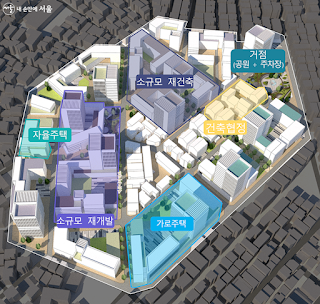
Where Human Town proposed a smart and light cosmetic revamping, Gather Town hybrid formula includes partial redevelopment to replace shared houses and 'villas' with low-to-mid-rise apartments, while preserving the street structure. Key regulations will be eased, for example the threshold for the proportion of deteriorated units, the type of buildings included. Where big projects cover over 100k square meters and take 8 to 10 years to complete, Moa Towns will start from 1,500m2 and only require 2 to 4 years. Seoul aims at 20 projects every year, and 2,404 units by 2025.

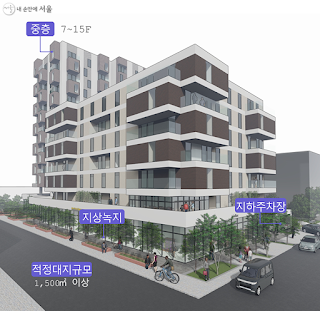
So unlike with Human Town, where individual units keep evolving at their own pace, it won't really the same neighborhood. But shared infrastructures can go much further, for instance a big underground parking that will fully liberate street level, and allow the removal of all these ugly ground floors on pilotis in favor of actual life spaces (shops, terraces, plants and parks, community services like libraries or day care centers...). 

Provided the design is up to the ambition, lively pockets can emerge in the middle of forsaken neighborhoods, and radiate across them.

I like the notion that pragmatism allows the combination of several techniques (certain sections can be redeveloped, other maintained, see schema below), but I wouldn't want it to become just a shortcut to build quickly something that lacks consistence and soul. You want a village where citizens breathe and enjoy walking.

If this rendering of a street (below) doesn't seem very exotic to Western eyes, 80s zoning sure beats the 50s Grands Ensembles that have kept popping up across Seoul ever since the sixties. And this looks much more welcoming than dense, tree-less 'villa' clusters. Provided of course these mid-rise sections conveniently hidden in the background remain a tiny part of the program. Note the post-covid architecture with individual balconies and on the second floor a shared outdoor space running along what must be community services or shops.

The first two projects mentioned on January 13th are Myeonmok-dong, Jungnang-gu, a vast low-rise neighborhood at the feet of Achasan, and Beon-dong in Gangbuk-gu, around Dream Forest and Odong Park, between Suyu-dong, Mia-dong, and Chang-dong, close to the Ssangmun-dong of Seong Gi-hun and Cho Sang-woo (both fictional characters sharing a lot with their author HWANG Dong-hyuk, a true local*).

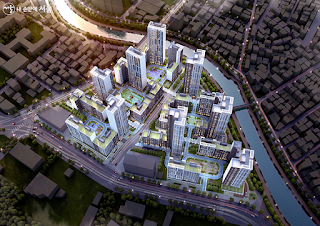
The Beon-dong project is not small at all (50,000 m2), and the one in Myeonmok-dong is almost twice bigger (97,000 m2). Sorry, but to me, this looks much more like a mini-New Town that to an improved old-town:

Beon-dong's 'Gather Town'
 

Obviously, 'Gather Town'  is less human centric than 'Human Town'. More top down than bottom up, with a top that rises a bit too high above 'low rise' levels... 

Seoul Village 2022
Welcome to our Korean Errlines! Follow Seoul Village on Facebook and Twitter, follow me on Instagram.
Download 'Seoul VillageS', the free ebook.
Bookmark and Share

* BTW ICYMI I was mentioned in Charlie Usher's article on not so glamorous Seoul neighborhoods ("The heart of Seoul – the working-class neighbourhoods captured by Squid Game and Parasite"). Of course, less glamorous doesn't mean less valuable, to the contrary. And if you haven't watched it yet, go binge "Squid Game - an addictive slap in the face".

Monday, June 22, 2020

Nine new museums in Seoul by 2023


Last Sunday*, Seoul announced nine new museums for the 3 years to come, after inaugurating five others over the past three years. As this map shows, downtown's dominance in cultural sites shall grow even stronger, but a few underserved neighborhoods will get their fair share:


The 5 museums inaugurated between 2017 and 2019 (NB this list doesn't count infrastructures that are not managed by the city, like the Seoul HOUR opened last year**:

The 9 museums to be inaugurated by 2023:

Melike Altinisik Architects' winning project for Robot Science Museum
As you can see, quantity doesn't always mean quality, but I'm looking forward to returning to neighborhoods I haven't roamed in a while... and I really can't wait to see that last one. Please, don't disappoint me!

Seoul Village 2020
Welcome to our Korean Errlines! Follow Seoul Village on Facebook and Twitter, follow me on Instagram.

Bookmark and Share


* see "사진·한식·로봇…서울시 '테마형 뮤지엄' 9개소 개관" (Seoul Metropolitan Government 20200622)
** see "Seoul Hall of Urbanism and Architecture, Seoul Biennale 2019 Symposium"

Sunday, July 26, 2015

Urban Continuity - Susaek-Sangam project back on tracks (and over DMC Station tracks)

Seoul and Korail signed a MOU* to redevelop over 172,000 sqm now covered with tracks and railway installations, most notably Changdong Train Depot (65,000 sqm) in Nowon-gu**, and the DMC Station area (over 30,000 sqm), for which an operator should be selected by the end of the year.

I already stressed the importance of doing the right thing for the most crucial Susaek-Sangam connection in Mapo-gu (e.g. in "A solution to the Great DMC-Susaek Rift?" in the 3rd part of my 2013 focus on Songdo and the DMC ("Songdo, DMC: sequence is of the essence (Part III)").

The project will cover 27,000 sqm at Susaek Station + 3,500 sqm for DMC Station itself:


The latest rendering shows more green and openings than the one suggested in 2013, which reminded me of the Great Slab of Paris La Defense:


To ensure an even greater urban continuity between Susaek-dong and Sangam-dong / DMC, pedestrians should be able to cross Susaek-ro to the North as seamlessly as Seongam-ro to the South, and through this more porous ensemble.

This key railway hub (AREX Airport Express, Subway Line 6, Gyeongui Line train) should merge with its surroundings horizontally, unlike the initial, vertical, aerotropolis vision. Remember the old plans featuring a landmark tower, where international businessmen would only see Incheon Airport and the DMC during their trip to Korea? Even commuters should feel invited to reach beyond the hub, deep into Susaek and Sangam.

And ideally, the tracks could be covered further to the West and to the East, prolonging the
"Gyeongui Line Forest Trail - An Urban Lifeline" now in full bloom around Yeonnam-dong for its first operational summer.

(at Yeonnam-dong by day) Gyeongui Line forest trail got greener
twitter.com/theseoulvillage/status/625207215603879936

(at Yeonnam-dong by night) Gyeongui Line forest trail by night now. Good to see so many citizens adopt it, even picnic on the lawn
twitter.com/theseoulvillage/status/625274339781246976

Over the two years following that focus on the trail, my long gone "Busan Corner"*** has again changed at least twice. It just became a jewelry shop - how's that for gentrification?

Seoul Village 2015
Welcome to our Korean Errlines! Follow Seoul Village on Facebook and Twitter
Bookmark and Share
Add this page to your favorites

* see for instance "서울 수색역세권 본격 개발한다…'DMC역 구역'부터 시작" (Yonhap 20150727)
** among the 27 key redevelopments confirmed last spring (see "Diagonal crossings, High Lines, and Business Verticals (how pedestrians and businesses remodel Seoul... and vice-versa)" followed by "Urban Regeneration: 27 Projects For Seoul")
*** "Busan Corner on Taxi-daero"

Friday, January 16, 2015

Diagonal crossings, High Lines, and Business Verticals (how pedestrians and businesses remodel Seoul... and vice-versa)

Seoul keeps at the same time looking for more sustainable urban planning approaches, and doing more mistakes, because as usual in this city we tend to try a lot of things, but seldom after serious impact surveys. At least that's far less boring than my other hometown Paris, where we tend to make decade-long impact surveys, but seldom do something else. As you well know, a Seoulite born in Paris, I tend to pile up useless bits on an ever changing cityscape. Here's a batch on recent evolutions for Seoul pedestrians and neighborhoods, with the Seoul High Line project as a natural bridge in-between.


Opening up the city to its citizens (not burying them!)

At the micro level, I really appreciate the recent multiplication of Ginza-style diagonal pedestrian crossings, which make life much more simple and safer for everybody. They de facto create temporary no-drive zones that can change a neighborhood without going all the way to car-free streets (e.g. Yonsei-ro). Pedestrians feel that they own the space, even if that's not all the time; there are even permanent tattoos on the macadam to prove they do:


With diagonal pedestrian crossings, you don't need to have a double PhD in statistics and physics to calculate the optimal path to reach point B alive

I am much less convinced by the project to create a vast underground pedestrian network connecting major Jongno-gu landmarks. That would signal a return to a car-centric past when pedestrians where parasites that had to move underground, like ants or termites, across downtown Seoul. I suspect this project to have something to do with the one I mentioned last fall, which would move Gwanghwamun Square sideways, and re-transform Sejongdae-ro into a highway (see "Gwanghwamun, Donhwamun, and the Tale of two Royal Roads"). In other words, back to square one, or rather back to Zero Gwanghawmun Square.

In the dowtown Seoul I discovered in the early 90s, pedestrians had to either use tunnels or aerial walkways to cross the major roads. And the Seoul High Line would somehow revive the latter.

Named after New York's High Line Park, itself inspired by the Promenade Plantee of Paris, the idea gained momentum in April last year, partly because the city needed to compensate for the planned destruction of an old walkway that Seoulites had deserted because winos had claimed it most of the time.


Leaving a landmark in the capital is very good PR, and a tradition for French presidents in Paris: Pompidou and Beaubourg, Mitterrand and the Pyramide du Louvre, Chirac and the Musee du Quai Branly... Note that Giscard missed the opportunity and tried later to claim the Musee d'Orsay as his work, and that Sarkozy didn't understand that he would have only one mandate (and that one building is easier to complete than a Grand Paris - Le Havre vision).

Leaving a landmark has also become a must for Seoul mayors eyeing a higher office: LEE Myung-bak had Cheonggyecheon (even if his greatest achievement was the creation of bus lanes), OH Se-hoon had Gwanghwamun Plaza (even if his greatest achievement was the revival of Sadaemun and the rebalancing of Gangbuk vs Gangnam, starting with the redistribution of taxes from the rich to the poor districts), and PARK Won-soon seems to be betting on the Seoul High Line.

Last month, Seoul citizens were invited to walk the line on a sunny Sunday afternoon - in other words: to vote with their feet in favor of the project.


PARK Chung-hee on the Seoul Station overpass (1970). But what fascinates me most is the background, Malli-dong and Kim Gi-chan's beloved Jungnim-dong.

Clearly, this walkway looks much better without cars. It is at the same time more scenic and less integrated to its surroundings than its NYC or Paris counterparts.

Covering the railways over a wide stretch would cost much more, but also provide a greater urban continuity. One thing is sure: if the taxi and bus corridors in front of the new Seoul Station have allowed the return of pedestrians at street level, the Toegye-ro - Tongil-ro - Sejongdae-ro - Hangangdae-ro intersection remains an utter mess, and with or without the High Line, it will require a complete and sustainable overhaul.


After its High Line, will benchmark-frenzy Seoul try to copy NYC's Low Line underground park project? (twitter.com/theseoulvillage/status/538224048778407936) - remind's me of OH Se-hoon's underground utopia (see "Seoul Goes Underground")


*
Reviving neighborhoods (not destroying them!)

As we've seen countless times New Town out, Redevelopment in, back to the Urban Jungle", "Inhuman, all too human Seoul", the Gyonam-dong saga...), Seoul has not completely given up its old, disfiguring 'New Town' model.


Another Seoul neighborhood destroyed in a 'New Town' project: in Hongeun-dong, Seodaemun-gu - twitter.com/theseoulvillage/status/555539522843201536 (BTW: join my 800+ followers on Twitter!)
Speculators still pretty much run the show. The Yongsan IBD is cancelled and the US base relocation postponed, but money can't wait for a new big vision. Eight high rise buildings (over 50 floors) have been authorized on both sides of the base, and the front row of buildings circling it will be allowed to go up to 20 floors, guaranteeing a fat return and a privatized view on the future park to a happy few investors, letting the rest of the district out of the loop. Even North of the Han River, Gangnam Style rules...

Yet officially, the trend remains to revive neighborhoods instead of annihilating them. After the 'Human Town' / 'Old Town' approach, a concept based on communities (e.g. "Yeonnam-dong, a new Human Town or a new Old Town, but mercifully not that old New Town"), the next buzzword could be 'industrial convergence', a concept based on business verticals or mini-clusters.

For the moment, this new umbrella for urban regeneration seems to cover too wide a spectrum, from actual industrial zones to more or less farfetched urban storytelling, with the Seoul High Line as its highlight.

The other day, as Seoul mayor met with Richard Plunz (Professor of Architecture, Planning, and Preservation at Columbia's GSAPP, Director of the Urban Design Lab at the Earth Institute), 7 zones were announced:
 
The seven 'industrial convergence' hubs

Let's have a closer look at these 'magnificent seven':
  • Seoul Digital Media City (Mapo-gu): I already wrote quite a lot about Sangam DMC (see all posts). I'll just add that it's already a national cluster for media and IT, so this is less about 'urban regeneration' than about piggybacking on existing dynamics. Note that the arrival of MBC was one of the few recent changes that helped put the DMC on Seoul's popular culture map: they instantly used their outdoor space to stage events and concerts (from their inauguration to the new year party), integrating the neighborhood in their broadcastings, a bit like Fox News on NYC's Avenue of the Americas. 
  • Seoul Station (Yongsan-gu): the verticals selected are history and tourism, more symbolized by the old station turned into Culture Station 284 than by the future High Line. Seoul Station itself will be beefed up as a key entry point to the capital, and many redevelopments are already under way in its vicinity (e.g. along Hangangdae-ro, Malli-dong, Seosomun Park...). Again, the High Line cannot be the only way to solve the urban mess at ground level.
  • Yeongdonggwon (Gangnam-gu - Songpa-gu): that's around coex and Jamsil Sports Complex, plus of course Hyundai's future HQs. This area didn't need to be wrapped under the MICE (Meetings, Incentives, Conferences, Exhibitions) banner.
  • Seun Sangga (Jongno-gu): inaugurated in 1967, KIM Swoo-geun's fascinating cruise ship forms a long bar between Jongmyo and Chungmuro. Its upper segment was destroyed a few years ago to make room for a small park on Jong-ro, but the reopening of Cheonggyecheon somewhat revived its crux. The whole neighborhood is a DYI paradise now roamed by more contemporary makers in search of odd parts and bits, and Seun Sangga's upper floor hosts the FabLab Seoul (got a project? need a 3D printer or a laser cutter? that's the place). Can this unique start-up hotspot avoid gentrification? Let's hope that at least, its safety will be improved - you don't want to be caught in a fire around here.


  • Seun Sangga's silicon belly - on FabLab's floor (BTW: you can also follow me on Vine!)

  • Chang-dong - Sanggye (Dobong-gu, Nowon-gu): back to Nowon's most coveted space: the Changdong train depot and the Dobong Driver's License Examination Center form a humongous site in Sanggye-dong*, a densely populated area full of apartment blocks divided in very small units. I've regularly posted about Nowon since my 2006 focus, often about subway projects, and always with this site in mind. Back in 2012, it was envisioned as a coex-style complex (see "Nowon confirmed as Seoul's northeast hub "). Last year, the four sections of the project were detailed: the train depot would become a 'Global Business Zone', the drivers center a 'Start-up Zone', and the two blocks on the other side of Jungnangcheon, in Chang-dong, a 'Global Life Zone' (leveraging on cultural and shopping venues built over the past decade). Now the focus is biotech. Whatever. Because of the real estate pressure, the only way here is up.
Changdong (Dobong-gu), Jungnangcheon, Sanggye (Nowon-gu). And more towers all over.


  • Mullae-dong - Yeongdeungpo (Yeongdeungpo-gu): a couple of blocks away from Seoul's Time Square, 'Ironworks alley' (철공소 골목) is not only a fantastic spot for post-industrial photo ops, but also a nest for young artists and designers. Or was, until recently: the usual curse of real estate speculation went even faster than for previous arty neighborhoods.
"Mullae Art Village, a Seoul village like no other (but aren't them all?)" (BTW: you can also follow me on Facebook!)
  • Janghanpyeong (Dongdaemun-gu): not exactly Seoul's most glamorous neighborhood (between Jangan-dong and Yongdap-dong, between the Naebu and the Dongbu expressways, West of the Cheonho Bridge knot and North of the water treatment plant), Janghanpyeong is known as a hub for used cars hunters, and that's the way the city wants it to remain. It could have some potential, though, once the water treatment is transformed into a more welcoming park.
All this is supposed to follow the model of a successful urban regeneration (!): Bukchon.
 
And all this is not supposed to bring confusion with the 5 zones presented last month. Seoul districts have been divided into five sectors: Seonamgwon (SW, project in Sangdo-dong, Dongjak-gu), Seobukgwon (NW, project in Sinchon), Dosimgwon (Center), Dongbukgwon (NE, projects in Seongsu-dong, Seondong-gu, and Jangwa-dong, Seongbuk-gu), Dongnamgwon (SE, project in Amsa-dong).

*

To be continued...


Seoul Village 2015
Welcome to our Korean Errlines! Follow Seoul Village on Facebook and Twitter
Bookmark and Share
Add this page to your favorites


* Yes, Chang-dong is in Dobong-gu, but Nowon split from Dobong in 1988, when the New Town was delivered (after a resistance narrated in Kim Dong-won's great documentary the Sanggye-dong Olympics). Note that Dobong, itself a spin-off from Seongbuk-gu (1973), was later split in two, spawning Gangbuk-gu in 1995.