NEW - download 'Seoul VillageS (서울 마을들)', my collection of 12 short fictions now adapted into short films! Get your free copy of the ebook (4 editions: English, French, Korean, Bilingual English-Korean)!

Showing posts with label France. Show all posts

Saturday, August 1, 2026

'Archaeology of the Present' with Nuances

If you're a frequent flyer on  these 'Korean errlines', you're used to digging through layers of history, culture, and cityscapes. You know that neither Seoul nor Korea can be captured, but  you also want to know which wonder each new excavation can expose, which emotions each new voice can trigger.

So you're probably going to enjoy Nuances' upcoming  'Archéologie du présent' exhibition.

Founded in 2025, Nuances brings together a multidisciplinary group of Francophone artists and creators living or working in South Korea. This unique collective draws on the dual Franco-Korean cultural influence to offer a sensitive and original perspective on contemporary Korean society, through the richness of its contrasts and rapid transformations.

To mark the 140th anniversary of diplomatic relations between France and South Korea, Nuances presents its first group exhibition; 'Archéologie du présent' ('Archaeology of the Present'), will open on August 6 at France Art Space in partnership with the Alliance Française of Busan. 


Full disclosure: I've been a member of Nuances since last spring, when a filmmaker friend proposed this scribbler to join the collective. He didn't even need to bait me with the exhibition theme (hard to imagine one hitting home more powerfully!): I already knew a few of the artists and the group, which radiates a contagious positive energy, reaches far beyond what I could imagine. I only had a glimpse of the works to be exhibited and can't wait to explore the full show.

So come visit France Art Space in Busan this summer (August 6 to 30). The exhibition will come to Seoul this autumn (October 1 to 14) in a place where 'Archaeology of the Present' will resonate very particularily: our beloved KOTE in Insadong.

Exposition « Archéologie du présent » 
August 6 to 30, 2026
France Art Space, Annex of GOEUN Museum of Photography
Haeundaero 452beongil 16, Haeundae-gu, Busan
Nuances: @nuancesartistes 

2026.8.6-30 Busan 
@franceartspace_busan
2026.10.1-14 Seoul @kote.kr
Artists and creators: Sebastien SIMON, Pascal BELMAS, Jungran KIM, Tim FRANCO, L'Atelier PIEPRZOV, Jim VIEILLE, Nils BOUVYER, Emmanuel WOLFS, Elodie CATHERINE, Zoe CONSTANS, Salome DUBOIS HAN, Stephane MOT, Kamy DOBI, Ines MOLLARD ZAIDI, Celia BRISOT


Seoul Village 2026
Welcome to our Korean Errlines! Follow Seoul Village on Facebook, Bluesky, Threads, Substack, and X/Twitter, follow me on Instagram.
Download 'Seoul VillageS', the free ebook.


PS: about the work I'll be presenting at the show (below): 'You are here (a spacetime capsule)' / 'Vous etes ici (capsule spatio-temporelle)' / '당신은 여기에 있다 (시공간 캡슐)'


Wednesday, July 8, 2026

Seoul Summer Beach and Swag

From July 20 to August 9, a giant, free water park will welcome Seoulites on Gwanghwamun Square and Sejongno Park. After drawing about 900k visitors in 2004 and 1.5M last year, Seoul Summer Beach could be even more popular with a 3rd edition featuring pools, slides, and a sand playground. 

Who knows? BTS 'could spend a lifetime watching you swim'

The sandy space will be under a 12 m wide dome that brings more to mind an igloo than a summer beach, and won't allow you to fully enjoy Seoul's most iconic scenery, but sand can be messy, particularly during the rainy season. And hygiene should be less an issue; as a Parisian, I've never dared basking in Paris Plage's sandy stretches. 


I remember chatting with PARK Won-soon about Paris Plage. 
First meant for Parisians who can't afford going on holidays, this yearly festival covers the expressway along the Seine (now reclaimed by pedestrians) with a beach anyone can enjoy for free. The former mayor was toying with the idea of adapting that other Parisian tradition (following Velib, La Nuit Blanche etc), but it wouldn't make much of a splash along the Han River (too wide a river, riversides more disconnected from the rest of the city, Hangang Park already boasting its own water activities...). 

Gwanghwmun Square and Sejongdaero are much more relevant and impactful for this kind of festivities.

Which doesn't mean that the rest of the city will remain dry: we've seen neighborhood parks transformed into water parks during the summer long before Seoul Summer Beach existed, and there are so many ways of having fun while getting soaked, from the Sinchon Water Gun Festival and its giant water slide along Yonsei-ro to PSY's torrential Summer Swag concerts.


My favorite drenched memory in Seoul remains the day I was caught by a sudden downpour in Jongno-gu. The time to run twenty meters to the closest shelter, I was already totally soaked. Because there was no way a bus or a taxi could accept me, I decided to just walk back home peacefully, simply enjoying the shower with a great smile. 

Of course, as Seoul and Korea well know*, too much water can be dangerous. So enjoy responsibly, and have a great summer.


Seoul Village 2026
Welcome to our Korean Errlines! Follow Seoul Village on Facebook, Bluesky, Threads, Substack, and X/Twitter, follow me on Instagram.
Download 'Seoul VillageS', the free ebook.

* and as PSY also knows now: he was once scolded for hosing his fans with 300 tons of water during a concert in the middle of a drought.

Tuesday, September 17, 2024

Summer Hit Wave

Sorry Seoul, I was out of town this Summer. Equally glad to miss your crushing, record heatwave, and thrilled to enjoy Paris 2024 and the most spectacular olympics and paralympics.

Rooting for both nations, this Parisian Seoulite was lucky enough to witness 3 gold medals for Korea:
  • Archery at Invalides (NB: silver for France):

    Little suspense there: as expected, KIM Woo-jin, KIM Je-deok and LEE Woo-seok destroyed all competition, kindly tipping France with one set in a final played under a merciless sun in a postcard setting (the Invalides at 9 o'clock, the Eiffel Tower at 12, the Pont Alexandre III and the Grand Palais at 3).


  • Fencing at Grand Palais (NB: bronze for France):

    In that very Grand Palais, arguably one of the most spectacular venues of the Games, OH Sanguk, PARK Sangwon, GU Bongil, and DO Gyeongdong had a tougher time defeating Hungary. But nothing could stop the men's sabre squad from claiming gold for the third time in a row, not even that eruption of the stands when Leon Marchand won his race in the middle of the final.


  • Badminton at Porte de la Chapelle Arena (NB: no frogs in sight except in the stands):

    Another expected triumph for Korea; this time for AN Se-young who let HE Bing Jiao remain hopeful for two thirds of the first set before switching to cruise mode all the way to victory.


Kudos to Paris, France, and Tony ESTANGUET for pulling out a fantastic event and particularly the most successful paralympics ever. FOMO brought Parisians who skipped the Olympics back for that 'return match', and over 95% of all seats were not only sold but also fully animated, even when audiences weren't allowed to make any noise (a silent 'ola' during blind football games? simply brilliant).

After the 2002 World Cup in Korea, I didn't think I could experience another moment of national communion around such a major sport event, particularly in a city where protesting is the national pastime. I'm happy I was wrong.

Needless to say, in both cases, the magic eventually rubs off, and national unity quickly collapses; but for all their defaults, I'll keep rooting for my two favorite countries. With this gift tee that pretty much wrapped up a smoking hot Summer:


Seoul Village 2024
Welcome to our Korean Errlines! Follow Seoul Village on Facebook and Twitter, follow me on Instagram.
Download 'Seoul VillageS', the free ebook.

Bookmark and Share

Tuesday, December 12, 2023

Can Korea sustain its cultural leadership?

Has Korea become a cultural leader and if so, what kind of leadership are we talking about, what drove this change, and can this momentum last?

In 'Can Korea sustain its cultural leadership?', an article published by the think tank 'Korea Europe & You' (20231111), I suggest a few threads.

---

Can Korea Sustain its Cultural Leadership?
Beyond the Korean waves, a vast ocean and growing expectations

At this moment in time, Korea can be considered as if not the, at least a cultural leader. But what kind of leadership are we talking about, and can this momentum last?

For now, Korea’s cultural leadership is recognized by the masses as well as by experts and elites:

  • Popular leadership? A legitimate claim when you produce such global phenomena as (yes, them again) PSY, Squid Game, or BTS.

  • Cutting edge leadership? Impossible to top the technical and visual perfection of K-pop groups developed like high tech products over years of intense training by ultra-pro entertainment companies; hard to rival with a creative ecosystem that churns out every year scores of One Source Multi Use or transmedia hits (webnovel-webtoon-seriesgames-OST…).

  • Avant-garde leadership? Elites consider the nation as a whole as the ultimate influencer and trendsetter. This is where you post your observers and researchers if you want to detect the next big thing; this is where you scout your curator if you want your art institution to shine; this is where you let your kid study for one semester even if you know they just come to live the Hallyu life – who knows, some of that magic could rub off on them...

​If Korea’s cultural leadership translates into considerable economic impacts, and not just for Korea Inc, the nation as a whole is not perceived as an overpowering or threatening leader. Unlike the United States, China, or Japan in the late 80s, Korea has never been a contender for the World’s biggest economy. This tiny peninsula (de facto an island) surrounded by bullies and hosting only 0.6% of mankind is more a David than a Goliath. Korea didn’t force respect by the scale of its market; rather through repeated over-performances. Even Korea’s soft power heroes look pretty soft: a buffoon performing a silly horse dance, losers trapped in a survival game, cute youngsters heralding love and compassion… not really Rambo material.

Without dictating anything, Korea somehow manages to set the tone, the pace, the rhythm. This strange leader is more inspirational than visionary, more praised for its way of sorting things out than for its charisma or authority. Clearly, this is not the kind of leader you fear, rather the kind you enjoy being around, the kind you like to follow.

Quite a quantum leap from Korea the ultimate best follower, the ‘we try harder’ Korea, the benchmark fanatic always eager to close the gap with unattainable role models. Yes, Korea has long been a role model for developing countries, but being looked up to by cultural superpowers, that’s a completely different game.

Korea couldn’t have reached the top by just following others. It took a cultural change to become a cultural leader. In turn, this leadership is now changing the very way Koreans see themselves.

‘Good artists copy, great artists steal’, and Korea didn’t hesitate to source creative talents overseas, particularly from Europe. For instance, many K-pop hits were made with the help of Swedish music producers, and Hyundai Motor Group owes in part its cultural revolution to Peter Schreyer, the German designer recruited in 2006 (a model recently followed by Korea’s fashion industry with Belgian designers). Yet opening up the creative pool or attracting the best talents shouldn’t be seen as a sign of weakness, rather as smart decisions to lead a group to the next level.

Protecting the local creative ecosystem when it was too weak was also good leadership because it was designed to help it grow stronger, not just curl up defensively. A few decades after Hollywood threatened to overwhelm Korea’s movie industry, a subtitled Korean movie triumphed at the Oscars, and Busan International Film Festival has become a locomotive for all Asian cinemas. If France inspired Korea to take action (screen quotas in 1995, BIFF in 1996), now the former is more trying to learn from the latter, and the recently created Academie France Coree du Cinema puts both nations on the same footing.

Korea’s startup scene wasn’t weak to start with, but it became even more competitive after Google, Facebook, or big international VCs barged in, offering new alternatives and global perspectives: local players upped their game, and young talents became less reluctant to start their own business or to join a startup instead of aiming for the usual conglomerate. A lot of them fail, but the local ecosystem needed talents who accept failure and risks as part of the creative process and their own training. Even beyond tech sectors, the lack of perspectives in the job market also forced many to try and create their own niches, to seek different approaches. Now Korea’s young leaders in tech are not chaebol heirs anymore, but successful entrepreneurs – a genuine cultural revolution.

If external influences did contribute to Korea’s cultural change, that’s only in supporting roles, as accelerators or catalysts for a country that still depends a lot on others for its survival (food, energy, raw materials, exports, security…). The nation’s fabled resilience became universally acknowledged during the pandemic: when other nations were at a standstill, Korea kept producing series and movies or holding art exhibitions, catching all the spotlight and drawing all media attention (coincidentally, the New York Times chose Seoul to move its Hong Kong hub in 2020). More eyes on the nation, more stories exposing all sides, even the dark ones (after all, isn’t that what many ‘k-contents’ are about?)... for better or worse, Korea was in the news, Korea became the news.

Now it’s not just the core K-drama fans that are familiar with how Koreans live, eat, love, work, or struggle; everybody knows what’s happening here, and many have realized that beyond Hallyu and K-pop, beyond these repeated Korean waves, a vast and diverse cultural ocean waited to be discovered.

Of course, Korea has brilliant creators, top notch players, and a (sometimes too) proactive government, but as always, its most precious natural resource remains its people. Many have in mind the usual cliché of the ever resilient, hard-working Korean that helped the nation become the best follower of the pack, but the shift to leadership was made possible by the growing influence of different profiles: not just these elites of young risk takers with innovative mindsets, but also masses of merciless ubersumers.

Korean ubersumers want everything now and exactly as they want it. They may not have much money or power as individuals, but collectively their reviews can make or break everything they touch. They’re the ones who force webtoonists and webnovelists to fine tune their series in real time and improve their stories after each episode, they’re the ones who make Korean cosmetics so competitive (and they already have to be to resit such extreme winters and summers), they’re the ones who push customer and after sales services to their extreme limits, demanding absurd delivery delays or return rates.

Of course, companies have learned how to tame, cajole, or manipulate macro and even micro influencers, but netizens have also learned how to cut through corporate storytelling and to expose any weakness or wrongdoing. From product quality to food safety to abuses in the workplace, once something pops up somewhere, the culprits have no choice but to fix things or to go bust.

In a nation where one-term presidents become lame ducks as soon as they’re elected and where chaebols are losing some their overpowering grip, netizens have also become the only unchecked political power. This formidable force showed its most positive side during the unprecedented democratic movement that united the nation towards Park Geun-hye’s impeachment in 2017. But these crowd dynamics also have less positive effects: disinformation can spread like wildfire on both sides of the aisle, and ever-growing consumer demands can lead to non-sustainable standards (Korea’s excellence in last mile economics does have a social cost).

For better or worse, internet and mobility were from the beginning meant for such a reactive, swift, and (literally) interactive people. Here, User Generated Contents were harnessed much earlier than anywhere else in the World: the first social network service, Cyworld (1999), was launched long before MySpace (2003), and OhMyNews (2000) predated all other citizen journalism platforms. At the turn of the millennium, when all eyes were on Scandinavia or Japan, SK Telecom was the World’s most innovative operator but back then, only experts knew about what was going on in Korea, and language barriers prevented a global success, delaying at the same time the emergence of truly open and competitive models. Now Korea’s webtoon and webnovel platforms aim at global domination.

The key factors of success had been there for a long while, but the mirror effect from the rest of the World proved crucial for cultural changes to overcome certain inertia, for a people of great achievers to get used to being on top, to gain the confidence of leaders. Accolades for Bong Joon-ho’s ‘Parasite’ were less perceived as a surprise than as a long overdue recognition for Korean cinema. Cannes and Hollywood knew this movie was not a flash in the pan because they had already been impacted before by movies like Park Chan-wook’s ‘Old Boy’. And now even subtitles aren’t an obstacle for generations used to surfing videos full of captions and comments.

Can this momentum last? Momentum means mass in motion, and Korea’s challenge is getting at the same time tougher and easier: on one hand, this mass is growing and requires less effort to move, on the other, it’s getting harder to surprise audiences expecting more, to make a bigger splash than past giga-hits. Yet even if Korea can’t pull out another tsunami, a great part of the public is now aware of its ocean, its smaller waves get easily noticed, and even its wavelets enjoy a greater visibility and impact than before.

The pedagogy is done. A lot more dimensions of Korean culture have been exposed than the usual suspects (K-pop and Korean drama), and the classic pushing forces (Korean companies and authorities promoting k-content from home, ecstatic fans from overseas) have been joined by millions of people boasting a more direct contact to Korean culture after visiting the country and/or learning the language in record numbers. Foreign companies and institutions follow the demand and add their own pulling forces when they opt for Korean brand ambassadors, when they seek Korean contents for their cultural events.

The risk of K-fatigue remains, of course, particularly with that pervasive, heavy ‘K’ branding. But now that the World’s cultural taste buds have been trained to Korean contents, more people know about Korean music beyond K-pop, Korean series beyond K-drama, Korean food beyond K-food. More people appreciate good music, good series, good food that happen to be Korean or to have some Korean touch; and they don’t need all that branding anymore. Inviting top European chefs to Korea to discover, taste, and test Korean dishes and ingredients over a decade ago had probably much deeper and longer lasting effects than all these costly advertising campaigns for ‘K-food’.

One can also wonder if the recent boom in tourism can last, but even now that top destinations have reopened in the region following the pandemic, and even after such dramatic failures as the tragic Halloween 2022 Itaewon stampede or the embarrassing Jamboree 2023 meltdown, tourists keep coming in record numbers. And in spite of a tendency to disgrace each new popular spot with architecturally debatable landmarks, Korea has become an expert at turning its assets into sustainable magnets, proposing such unique experiences as hanok stay or temple stay, and boasting 16 sites and 22 intangible assets on the UNESCO World Heritage list today compared to zero until 1995.

Is there a risk of hubris, then, with Koreans basking in global recognition, and younger generations far less prone than their elders to an inferiority complex towards Foreigners? Well to start with, Koreans never had doubts about a culture they struggled to defend when it was under existential threat during the Japanese occupation. And their new confidence makes them more daring than arrogant: after overprotecting their traditional arts, they are now much more open to mix them with modern influences. Pansori became a rock opera at the Jeonju Sori Festival with Miyeon and Park Jechun, or a madcap pop performance with Leenalchi and Ambiguous Dance Company.

Korean culture is here to stay, but in order to maintain global relevance, embracing cultural diversity and crossfertilization will be key. Korea’s main cultural challenge will be to overcome persisting discrimination towards certain minorities, to remain a leader who opens doors for others as well, to succeed its evolution into a more multicultural society. This aging nation will lose 40% of its population by the end of the century, and can’t afford to waste the endless potential of future growth drivers: Korean diasporas, Foreign Koreanophiles, and most existentially multicultural nationals.


Seoul Village 2023
Welcome to our Korean Errlines! Follow Seoul Village on Facebook and Twitter, follow me on Instagram.
Download 'Seoul VillageS', the free ebook.
Bookmark and Share

Sunday, July 5, 2020

'Jeronimo' and beyond

Frankly, 'Jeronimo' should be screened in every Korean high school. I'm not saying that because the director, Joseph JUHN, happens to be a friend - his documentary deservedly received awards and critical acclaim, and even praise from the President in Cheong Wa Dae. 'Jeronimo' has a rare power to move and to change people, starting with Joseph himself, as he kept discovering new layers of a very rich character, and of the wonderful Korean diaspora in Cuba.


You may not have watched the documentary yet, or even heard of Jeronimo Lim, so I won't give any spoilers. Know that there's everything; between History (slavery, independence, revolution etc), his story, their love story, and so much more.

I saw how 'Jeronimo' moved and impacted diverse audiences in different contexts, not just here, and not just Koreans - be they from this or that side of the DMZ, of multicultural background, or from different parts of the Korean diaspora. Because this is not just about the Korean identity (koreanity? koreanness? koreanhood?), and certainly not about nationalism, to the contrary! Beyond this touching community, beyond the longing and belonging, this is about humanity, inclusive, universal kinship.

Even after five screenings, I'm always moved. And now I almost see Jeronimo Lim, Cheon-taek, Patricia, Nelsonito, and all the others as family.


In Paris, after a screening on Joseph's European tour, in the new Centre Culturel Coreen, we could see people from very different nationalities in the audience feel a personal connection, an echo to their own families.

I believe this documentary should be screened in every Korean high school because it can change in a very positive manner the way Koreans consider not only their own diaspora, but the diasporas they don't even suspect exist in Korea**.

"#Jeronimo's international tour in #Paris - screening at the new #CentreCulturelCoreen. Always a pleasure,  #JosephJuhn!
#헤로니모" (20200220 - @theseoulvillage - twitter.com/theseoulvillage/status/1230333467809984514)
The other day in Insadong, at KOTE***, Joseph JUHN gave a talk about the Korean diasporas of yesterday, today, and tomorrow. Diasporas that, in the States, are on the streets to support #BlackLivesMatter, 28 years after the L.A. riots. Doing the right thing 31 years after Spike Lee's movie. Diasporas ready to become agents of positive change, within their communities and beyond. 


So (re)watch 'Jeronimo' on YouTube (youtube.com/watch?v=-CU7q4v-PxA), on Vimeo, or on your PPV platform (and check the website: jeronimothemovie.com).


Seoul Village 2020
Welcome to our Korean Errlines! Follow Seoul Village on Facebook and Twitter, follow me on Instagram.
Download 'Seoul VillageS', the free ebook.
Bookmark and Share


** not to mention the diasporas some of them don't want to start existing - see the sad episode of the Yemeni refugees, when hundreds of thousands petitioned for their expulsion, but also when more than  a few demonstrated to defend their rights.

*** Note that the first 'KOTE Dialog' honored another gifted friend, documentary photographer Harry CHUN. Come to think of it, I first met Joseph and Harry the same year, in 2016. Joseph was about to return to Cuba for his documentary, and Harry was planning a different kind of emotional journey, embarking with refugees on their way to and across Europe. Harry exhibited some of his stunning works at Sejong Cultural Center a few weeks ago (for the World Refugee Day Photograph Exhibition with UNHCR and UPI). Here too, a powerful mirror for everyone because each one of us can become a refugee tomorrow, and a particularly needful one in a nation that doesn't welcome many refugees.

#HarryChun #vernissage @ #SejongCenter. #세계난민사진전 #난민 #refugees
#harrychungphotography'' (20200617 - instagram.com/p/CBhvEv3JLeW)


Sunday, March 29, 2020

Kudos to Korea's 4 Ts, but please no complacency

From pariah in February to role model in March, South Korea illustrates what kind of swings to expect from the roller coaster our species boarded last December. Watch out for Loch-Ness-monster-shaped graphics - there won't be just one curve to flatten, but series of waves that can either be reduced to wavelets by sound leadership and smart citizens, or grown into tsunamis by covidiots of all sizes and shapes. In between, normal people will deliver results that anyway won't belong to normal times.
 
As the 'Spanish Flu' illustrates, fighting pandemics requires whack-a-mole resilience
 
 
As a French Seoulite (right now experiencing the transition between confinement in Paris and quarantine in Seoul*), I can't help but draw parallels between Korea and France, who both saw their first major clusters originate from mass gatherings held by cults in February: Shincheonji in Daegu, Porte Ouverte Chretienne in Mulhouse.
 
As an observer of national politics and international affairs, I can't help but draw parallels between Korea and the US, who both registered their first COVID-19 case on January 20, or between Korea and Japan, who both received international praise for the way they managed to 'flatten the curve'.
 
Of course, as we speak, Korea seems to emerge as the clear winner in all parallels:
  •  Korea better trained and equipped, swifter than France:
    - After posting record numbers of new cases, Korea swiftly implemented containment measures around Daegu and the region, but also at the micro level, around each actual or suspected case, aggressively multiplying tests, treatments, and tracking with as much precision as possible. The population didn't need much pedagogy to put on face masks everybody's already used to wearing in case of flu or bad air quality. For starters, Korea also keeps remarkable track of most of its senior citizens and of their health, and boasts a greater and more modern ICU capacity.
    - France's health system, which was already imploding long before SARS-CoV2 showed up, is now literally choking. Not enough testing material, not enough face masks for a population anyway totally oblivious of their existence, not enough protection gear required for doctors and nurses coping with a pandemic... France even lacks the legal framework to track and monitor as acutely as in Korea, where all members of the cult could be tested: since the Occupation, databases featuring religion are illegal in France, and Korea's amazing(ly intrusive) apps tracking COVID-19 patients wouldn't pass the CNIL cut either. 
    - For a change, France is lagging behind Korea in terms of return on experience. It took us years to find out that the 2003 heatwave killed 20,000 people instead of the 3,500 initially thought, and only a few days ago was it made public that our COVID-19 statistics didn't include cases or fatalities outside of hospital systems. To start with, we can't even keep track of our senior citizens that stay all year round in their retirement homes. During the H5N1 crisis, the French government did create a stockpile of one billion masks, but the country was relatively spared by the virus, and a few years later this safety net was deemed unnecessary and abandoned. Korea took a hit during that crisis, and learned the lesson. The government didn't hesitate too long before containing Daegu while France waited until after the elections to take significant measures.
    
  • Science and facts first, 4Ts for Korea vs only 1T for the States:
    - To the most obvious 3 Ts (Testing, Tracking, Treating), Korea didn't forget to add the fourth one, Transparency. This time, the vaccine came from the Sewol tragedy: MOON Jae-in knows what happens to leaders who fail when their citizens' safety is at stake.
    - Unfortunately, this President Of The United States focused from the start on the only T he cares for: TRUMP. Because he thinks as usual that everything is all about him and his election, and that he can never fail, as usual he rejects science and facts, and everybody pays the price. How many lies, denials, delays? How many weeks wasted, how many lives lost forever? At best tens of thousands, because the US have at long last started to move, and once they do they can move mountains, but Trump's behaviors could well have cost hundreds of thousands of American lives.
     
    "If #Korea has the best protection mask against #AirPollution and #covid19,
    #USA had the best #protectionmask against #Science, facts, and #truth thanks to this #MAGA #Trump #mask:
    http://e-blogules.blogspot.com/2020/03/coronavirus-protect-yourself-100-from.html  @blogules" (@theseoulvillage - 20200309)
     
    "So #DonaldTrump wants to see full #churches on #Easter day. Well that's very easy to do. Even #Italy manages just that right now (see photo below). #COVID19US" (@stephanemot - 20200326)
  • Korea more decisive and transparent than Japan's government**: 
    - when most international media applauded Japan for its remarkably low number of COVID-19 cases and fatalities, only a few observers pointed out the fact that these numbers were not to be trusted, that very few people were tested, and that the government was responsible for many fatalities with its disastrous handling of the outbreak on board of the Princess Diamond cruise ship. Sadly, much more lives will be lost on the archipelago because Shinzo Abe and his team deliberately tried to hide the pandemic under the rug to save face, Tokyo 2020, and their own corrupt regime. The reason why figures were so good and the temperature didn't show? They deliberately got rid of the tests and the thermometer, treating cases as 'pneumonia', and refusing even to release statistics about pneumonia. For many, reality hit home only yesterday, when Dishonest Abe exposed his total lack of visibility and control:
    "After #Trump's #ITakeNoResponsibility, #ShinzoAbe's 'I-dont-have-a-clue-how-deep-I-dug-#Japan-In-but-in-a-fortnight-after-cases-have-multiplied-a-hundredfold-I-might-consider-declaring-a-state-of-emergency (scary quotes via @motokorich):" (@theseoulvillage - 20200328)
Of course, this is certainly not about countries competing against each other, but about mankind vs the invisible enemy, about humans vs their own failures.

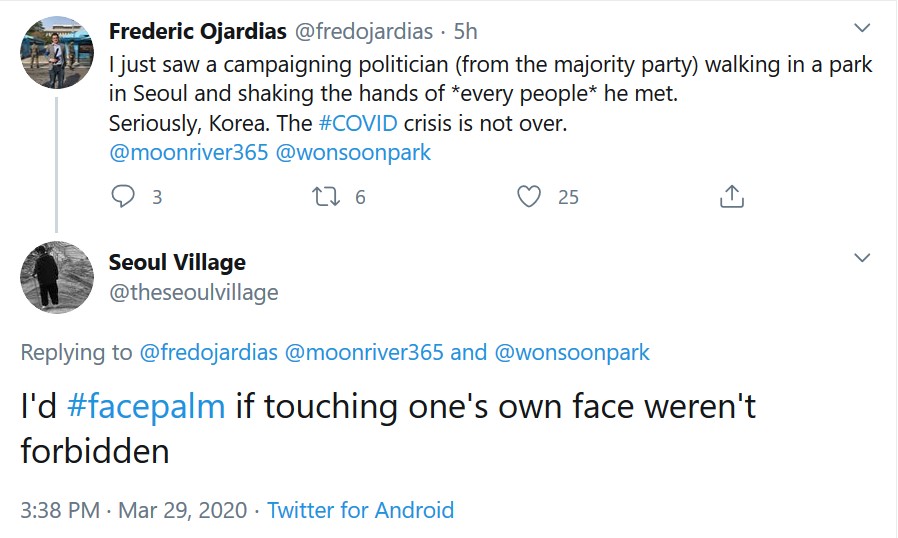
Furthermore, Koreans already know how quickly and dramatically situations can evolve for the better and for the worse with this pandemic. And like everybody else, they are not out of the woods yet. Particularly with these recurring stories of churches holding services in spite of the ban, or this handshake-happy covidiot of a politician on the campaign trail:


"If #Korea govt locked up 'religious' leaders who persist in organizing mass 'services', prisons would be packed. Particularly their mass murderer sections." (Quote Tweet Raphael Rashid / @koryodynasty "This at the Yonsei Central Baptist Church today. I wonder how far spit particles can travel.") (20200329)
 
Frederic Ojardias / @fredojardias: "I just saw a campaigning politician (from the majority party) walking in a park in Seoul and shaking the hands of *every people* he met. Seriously, Korea. The #COVID crisis is not over. @moonriver365  @wonsoonpark Seoul Village / @theseoulvillage: "I'd #facepalm if touching one's own face weren't forbidden" (20200329)
So don't count on me to feed the ambient complacency. Or to complain about systematic screenings and tests upon arrival in the country.

One can only be impressed by the attention given to each and every one of us ever since we landed, from the welcome pack (masks, hand sanitizer, disinfectant, disposable thermometers, special trash bags...) to the daily calls from the district office, the neighborhood health center, and even the psychological support provided to anyone in need. Yes, during this quarantine, we're tracked by GPS, we have to report on two different self-quarantine apps every day (ministries of Health and Interior), we have to take our temperature twice a day for good measure, even if we tested negative to the coronavirus after arrival. But in too many countries, too many people would die for - and sadly too many people will die without - such attention.
"Free #protectionMasks, hand gel, disinfection spray, special trash bags for contaminated materials and instructions to handle them... dropped at your home. #Seoul welcomes you back in a country that copes seriously with #covid19." (20200326)
These days, Korea manages to maintain a significant level of economic activity, but that's a very delicate balancing act, and I'd settle for a trade-off where the economy is steadily running at around 85%, instead of 90% for the first week, but 70% afterwards. If we want most restaurants to remain open much longer, maybe limiting their activity (e.g. to take out) could make that more likely.

Avoiding complacency and relapses should be consistent at all levels. And if MOON Jae-in is enjoying a well deserved boost in the polls because of the way he handled the outbreak, that shouldn't be a green light for bringing back such rotten apples as CHO Kuk or SOHN Hye-won.

Seoul Village 2020Welcome to our Korean Errlines! Follow Seoul Village on Facebook and Twitter, follow me on Instagram.
Bookmark and Share


* see this 20200328 tweet:


** as usual I make clear differences between Japan, Imperial Japan, and the politicians that are now ruining this great nation, betraying this great people.

Monday, April 15, 2019

Notre Drame bringing back the Namdaemonium trauma

I woke up this morning to the terrifying sight of Notre Dame engulfed in flames by night. It instantly brought back the Namdaemonium trauma, when Sungnyemun burned down (11 years ago, see "Namdaemunium").

Notre Drame 2019 (left), Namdaemonium 2008 (right)

As a Parisian walking by the monument every day when in my hometown, I feared for the worst, but hopefully the cathedral shall not collapse entirely, as Seoul's last original gate did. The damage remains considerable, starting with that amazing 'foret' of original giant beams, gone for good.

Both 'Namdaemun' and Notre Dame had survived centuries, and wars, both were somehow victims of negligence. If an arsonist did ignite Sungnyemun, the site had recently been deprived of human surveillance in favor of CCTVs. We can't tell yet what caused the fire in Paris, it has probably something to do with the restoration under way around the spire (a XIXth century add on). Walking by the scaffolding on the northern side last month, I was surprised to see how vulnerable the working site looked, but how to keep such an architectural marvel behind wraps? 

Ever since the foiled terror attempt to destroy the Eiffel Tower in 1994 (the one that inspired 9/11), I don't look the same way at landmarks I used to take for granted.

More than in our cityscapes, some landmarks are true anchors in our hearts. You know it when they beat faster each time you see them.


Caught in the Seoul traffic with Sungnyemun. That's not a k-pop star: she's much cuter, has better conversation  - twitter.com/theseoulvillage/status/329023620355596289


Seoul Village 2019
Welcome to our Korean Errlines! Follow Seoul Village on Facebook and Twitter, follow me on Instagram.
Bookmark and Share
Add this page to your favorites
.