Interesting to draw a parallel between OH Se-hoon's last two urban concepts: 'Human Town', which he didn't have time to fully roll out and scale up before the abrupt end of his previous mandate (see " OH Se-hoon launches the "Seoul Human Town" concept"), and 'Gather Town' ('Moa Town'), which has just been announced, less than a year after his return to office.
Both concepts rely on a common goal: revitalizing neighborhoods without destroying them with the usual 'New Town' model, offering community services usually found in big projects while preserving a nuclear, lower rise structure.
Seoul notes that 87% of low-rise neighborhoods don't meet requirements for redevelopment, often because they are not derelict or old enough. Yet many are poorly maintained because they stretch without a common purpose, and their dwellers already struggle to maintain shared spaces within their own buildings.
Where Human Town proposed a smart and light cosmetic revamping, Gather
Town hybrid formula
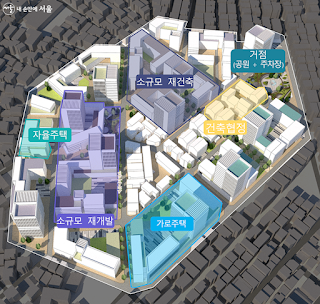
includes partial redevelopment to replace shared houses and 'villas' with low-to-mid-rise apartments, while preserving the street structure. Key regulations will be eased, for example the threshold for the proportion of deteriorated units, the type of buildings included. Where big projects cover over 100k square meters and take 8 to 10 years to complete, Moa Towns will start from 1,500m2 and only require 2 to 4 years. Seoul aims at 20 projects every year, and 2,404 units by 2025.
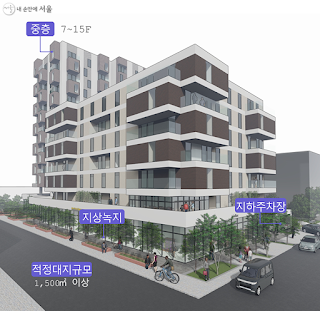
So unlike with Human Town, where individual units keep evolving at their own pace, it won't really the same neighborhood. But shared infrastructures can go much further, for instance a big underground parking that will fully liberate street level, and allow the removal of all these ugly ground floors on pilotis in favor of actual life spaces (shops, terraces, plants and parks, community services like libraries or day care centers...).
Provided the design is up to the ambition, lively pockets can emerge in the middle of forsaken neighborhoods, and radiate across them.
I like the notion that pragmatism allows the combination of several techniques (certain sections can be redeveloped, other maintained, see schema below), but I wouldn't want it to become just a shortcut to build quickly something that lacks consistence and soul. You want a village where citizens breathe and enjoy walking.
If this rendering of a street (below) doesn't seem very exotic to Western eyes, 80s zoning sure beats the 50s Grands Ensembles that have kept popping up across Seoul ever since the sixties. And this looks much more welcoming than dense, tree-less 'villa' clusters. Provided of course these mid-rise sections conveniently hidden in the background remain a tiny part of the program. Note the post-covid architecture with individual balconies and on the second floor a shared outdoor space running along what must be community services or shops.
The first two projects mentioned on January 13th are Myeonmok-dong, Jungnang-gu, a vast low-rise neighborhood at the feet of Achasan, and Beon-dong in Gangbuk-gu, around Dream Forest and Odong Park, between Suyu-dong, Mia-dong, and Chang-dong, close to the Ssangmun-dong of Seong Gi-hun and Cho Sang-woo (both fictional characters sharing a lot with their author HWANG Dong-hyuk, a true local*).
The Beon-dong project is not small at all (50,000 m2), and the one in Myeonmok-dong is almost twice bigger (97,000 m2). Sorry, but to me, this looks much more like a mini-New Town that to an improved old-town:
 |
| Beon-dong's 'Gather Town' |
Obviously, 'Gather Town' is less human centric than 'Human Town'. More top down than bottom up, with a top that rises a bit too high above 'low rise' levels...
Seoul Village 2022
Welcome to our Korean Errlines! Follow Seoul Village on Facebook and Twitter, follow me on Instagram.
Download 'Seoul VillageS', the free ebook.

* BTW ICYMI I was mentioned in Charlie Usher's article on not so glamorous Seoul neighborhoods ("The heart of Seoul – the working-class neighbourhoods captured by Squid Game and Parasite"). Of course, less glamorous doesn't mean less valuable, to the contrary. And if you haven't watched it yet, go binge "Squid Game - an addictive slap in the face".


 Visitors (