NEW - download 'Seoul VillageS (서울 마을들)', my collection of 12 short fictions now adapted into short films! Get your free copy of the ebook (4 editions: English, French, Korean, Bilingual English-Korean)!

Showing posts with label Seoul Biennale. Show all posts

Thursday, September 14, 2023

Seoul center stage

Earlier this month, Seoul became the world capital of art for a week with the conjunction of Seoul Art Week, KIAF + Frieze Seoul, Seoul Biennale of Architecture and Urbanism, Seoul Fashion Week, Crypto Art Seoul / Korea Blockchain Week, and a myriad of events, shows, and gallery openings.

(If you wonder what Mitch McConnell was doing on my Instagram timeline during Frieze Seoul 2023, I found this very realistic statue of him on sale at a discount price at Freeze D.C. 2023) Hopping from Hyoja-dong (Arumjigi) to Samseong-dong (Frieze-KIAF @ COEX) via Huam-dong (M+ and Doryun CHONG's homecoming, Whitestone's opening), Sinsa-dong (White Cube and LEE Jinju), Euljiro (Dan Archer and LG OLED at the DDP, Seongsu-dong (Beeple at The Gateway in S Factory), Songhyeon-dong (Kimchi and Chips' RE:WORLD), Taepyeongno (SBAU in Seoul HOUR)...

A lot of hype of course (boy did that crypto party remind me of internet extravaganza circa 2000), but also genuine gems and emotions. Good to see KIAF alive and kicking, many galleries coming from new horizons (even Accra), Doryun CHONG's emotional return to Seoul, or of course the themes of the (already!) fourth Seoul Biennale (waterways and mountains*, 2123 Seoul).

The return of visitors from China fueled the coopetition between Seoul and Hong Kong, and September here can counterbalance March madness there beyond the Frieze-Art Basel war. Interesting to see how Art Busan, now backed by web3 players, will fare / fair in early November with DEFINE (for DEsign and FINE arts in Seongsu-dong).

Seoul Village 2023
Welcome to our Korean Errlines! Follow Seoul Village on Facebook and Twitter, follow me on Instagram.
Download 'Seoul VillageS', the free ebook.
Bookmark and Share

* ICYMI: "Seoul waterways and urbanism - the full story"

Wednesday, January 26, 2022

More Gwanghwamun Square previews

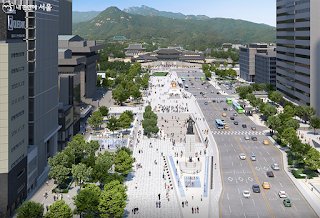
Seoul revealed new visuals of Gwanghwamun Square 3.0, which shall be inaugurated in July.

They prolong the last major iteration presented in 2019 ("Gwanghwamun Square 3.0 re-Deep-Surfaces"), which corrected one of the worst urbanistic blunders  of the initial version ("Gwanghwamun Square Enters Third Dimension"). PARK Won-soon's team rushed the construction a few months before the elections without conducting any decent impact survey, and work started late 2020. As soon as OH Se-hoon returned as mayor, he paused the site to assess the situation, but the changes could only be cosmetic.

The Woldae extension in front of the palace gate will only be created next year, so we have yet to see how vehicles flow around Yulgok-ro's future curve. Adjusting to the modifications already in place is not always easy. As expected, the intersection in front of Sajik-dan helps reconnect both sides of Sajik-dong, but the impossible new U-turn just North of the Government building stops functioning as soon as traffic slows down (too close before a major traffic light, unlike the old one heading for Sajik tunnel).

Most important, Seoul's defining axis is preserved, with its iconic Gwanghwamun-Gyeongbokgung-Bugaksan perspective, and pedestrians will enjoy a 20 m-wide park with a vast selection of tree species, guaranteeing natural shade and oxygen as they grow. That's where most of the extension (from 18 to 40,000 square meters) comes from. People will be able to sit on benches and along the Haechi Madang ramp, where street animations may bloom next to the new media wall.

Sejong-daero's pedestrian and cycling experience has already been improved with the new green walks and bike lanes added on the way to Namdaemun (see "Lower Sejongdaero's turn"). With its fountain tunnel and pavement fountain, the 'Gwanghwamun' Lounge section is likely to welcome kids and keep them fresh during the Summer. If some artifacts found during the renovation shall be on display in the cultural section, most of the Joseon era infrastructures (see timeline*) shall be covered again. I hope the tribute to Yukjo street will not look to corny. 


On the Eastern side, Junghak-dong will not host a simple reconstitution of the old Uijeongbu site, but a fusion hanok exhibition space. I wish there were more trees in that section, but that can (and probably will, if they want the spot to be successful) be fixed later.

This Uijeongbu project was on display at the Seoul Hall Of Urbanism (see again timeline below*) during the low key, pandemic-plagued 3rd edition of the Seoul Biennale of Architecture and Urbanism. SBAU will return in September 2023, with CHO Byung-soo (BCHO Architects) as its Director. This architects knows a bit about dao, and Seoul could do with some more harmony...

Ganghwamun Square reopening in the heat of the Summer will be a perfect crash test. I'm pretty sure Seoulites will quickly make it their own. At least during the evenings. And as much as that damned coronavirus will allow.


Seoul Village 2022
Welcome to our Korean Errlines! Follow Seoul Village on Facebook and Twitter, follow me on Instagram.
Download 'Seoul VillageS', the free ebook.
Bookmark and Share


* From @theSeoulVillage timeline: 


"Gwanghwamun Square last week. Seoul started controversial revamping without a proper impact survey..." (20201220 - twitter.com/theseoulvillage/status/1336888158437265408)


"The few changes since the initial plan won't prevent the expected traffic pandemonium. Tragic lack of urban planning, urbanism vision from Seoul... Sejong-daero Gwanghwamun" (20210221 - twitter.com/theseoulvillage/status/1364019424752115720)


"Western side of Sejong-daero / Gwanghwamun Square to close tomorrow for the controversial revamping (future Jeokseon-dong loop in the foreground)" (20210305 - twitter.com/theseoulvillage/status/1367760419218018306)

"As expected, works on the Western side of Gwanghwamun Square for its extension reveal Joseon time artifacts and structures related to former ministries. Here, a waterway in Jeokseon-dong (between Baekundongcheon & Junghakcheon - see seoulvillage.blogspot.com/2009/08/baekun #urbanism)." (20210319 - twitter.com/theseoulvillage/status/1372721209939431427)

"I guess mainly to evacuate overflows towards Baekundongcheon, to contain water damage in case of heavy rains. Gwanghwamun Square urbanism Jeokseon-dong Photo Chosun Ilbo" (20210319 - twitter.com/theseoulvillage/status/1372721211789037583)
"OH Se-hoon hits pause button on controversial Gwanghwamun Square revamping. Also asks AHN Cheol-soo to suggest talents for Seoul." (20210410 - twitter.com/theseoulvillage/status/1380664510638264322)


"Seoul's unearthed Yukjogeori during Gwanghwamun Square revamping:" (20210511 - twitter.com/theseoulvillage/status/1391895161337090049)


"Gwanghwamun's future Uijeongbu site at Seoul HOUR (Seoul Biennale / SBAU):" (20211028 - twitter.com/theseoulvillage/status/1453500318226935809)


Wednesday, September 22, 2021

Seoul 2030 - a software update

Mayor OH Se-hoon unveiled the 'Seoul Vision 2030' he announced on his inaugural address last April*, an occasion to highlight differences with his 'predesuccessor' PARK Won-soon.

By picking the slogan 'Seoul, a fair city that runs again', ever the ambitious OH delivers two not so subliminal political messages:

  • I want to rally all citizens who want an end to the unfair system that's controlling local and national politics, and 
  • it's not just Seoul that's moving again: I'm running again, with 2027 in sight.

The goal remains the same as a few months before he left office: to lift the capital into the World's top 5 cities. The difference is that since then, under PARK, Seoul has lost its momentum and regressed from 10th in 2010 to 17th last year, which makes the task all the more daunting. To foot the KRW 48 tn bill (USD 41 bn), OH bets on a surge in real estate revenues as well as on undisclosed budget trade-offs. Not sure the equation stands, but Seoul must do something to stop the bleeding as its population shrinks and its businesses struggle.

This 'Seoul Vision 2030' is more about software than about hardware. Typically, it doesn't challenge the urban planning part of 'Seoul Master Plan 2030' laid out in 2015, with its triangle of international hubs (historic center / Yeouido-Yeungdeungpo / Gangnam) and its 7 metropolitan hubs (Yongsan, Sangam-DMC-Susaek, Cheongnyangni-Wangsimni, Jamsil, Magok, Gasan-Daerim, Changdong-Sanggye). Such macro projects are freight trains that can't be rerouted at will. OH can't even stop lighter projects such as the controversial Gwanghwamun Square revamping**; only pause to adjust and adapt in order to limit the negative impacts and to improve urban continuity.

But of course, this being Seoul, a lot of real estate remains on the menu. And hundreds of thousands of new dwellings will be added to the existing oversupply.

The bad news is that redevelopment is unleashed on a large scale, with significant deregulation and the removal of key constraints (F.A.R.), and that a lot of the few remaining Seoul villages could suffer.

"Old #Seoul neighborhoods potentially open for redevelopment jumps from 14 to 50% through #Seoul's new #urbanism guidelines... brace for the worst." (20210527 - twitter.com/theseoulvillage/status/1397728062775513090)

Focusing around certain subway stations may help spare some of them, and result in Hapjeong-izing more neighborhoods (no mentions about new subway projects, but that could come, as usual, closer to next year's elections...):

"#Seoul confirms plan to 'revitalize' #subway station areas (250m radius around stations), starting with 13 pilot projects. Higher rise allowed, mixed uses residential / commercial / offices / services. Will #Hapjeong-style clusters multiply? I'd prefer more stations. #urbanism" (20210705 - twitter.com/theseoulvillage/status/1411963191089721346)
On the upside (literally), new neighborhood parks are planned in proto-urban limbos around Seoul mountains. If done properly (that's a big if), it could paradoxically protect the mountains themselves by creating sanitized but green buffer leisure spaces in stead of unlimited, littered gateways that push unruly crowds deeper into the wild. Most visitors would enjoy a pleasant moment without needing to reach any further, leaving more space to wildlife and respectful mountain lovers.
"#Seoul creates new neighborhood parks in decrepit mountainous areas where development projects have failed for 20 years, starting this year in #Cheonwangsan (#Cheongwandong and #Hangdong, #Gurogu) and #Choasan (#Changdong, #Dobonggu and later #Wolgyedong, #Nowongu). #urbanism"
(@theSeoulVillage 20210910 - twitter.com/theseoulvillage/status/1436132137258795017)

Seoul targets a 40% greenhouse gas reduction by 2030 and carbon neutrality by 2050, but to achieve that, will it continue to outsource part of the dirty job to Gyeonggi-do (see "Seoul Power Play: One Less Nuclear Plant, One More Coal Plant")?

Obsessed with Seoul's business competitiveness, OH Se-hoon wants to seize a momentum and snatch as much of the Hong Kong exodus away from Singapore as possible, and to attract FDIs getting cautious about Korea's neighbors Japan (who wants to be the next Carlos GHOSN?) and China (hard-soft power supremacy challenged worldwide, investors wary of XI Jinping's authoritarian moves). Foreign media were already flocking in before South Korea's government pushed its own laws stiffling press freedom.  In that context, the creation of an agency modeled after Singapore's EDB makes perfect sense. How it articulates with existing entities (SBA etc) remains to be seen.

How Yeouido can turn into an international finance magnet without structural reforms at the national level also puzzles me.

Like during his first mandate, OH wants to boost international tourism, this time up to 20M visitors a year. He insists on culture which is of course essential, but that will take more than a 'Seoul Festa' and kpop events.

I'm more interested in how Seoul intends to nurture and boost the local startup ecosystem, deep and wide. Hosting 40 unicorns by 2030? that's mostly for the show. Building new clusters? as if there weren't enough already... I prefer the concept of mentoring programs for seniors: recent trends already show more 50-year+ executives joining previously almost exclusively young crews, but there's a need for a much broader-reaching, more inclusive approach. 

The 5 pillars of 'Seoul Vision 2030' are "fairness, coexistence, safety***, future sensitivity, global leadership", and 'future sensitivity' is a nice way of saying the whole population should be involved, innovation requires pedagogy and respect for everyone.

"Fairness", and "coexistence" are the most beautiful and difficult challenges. Seoul aims at equal opportunity, fostering women activity and youth employment, seniors access to lifelong learning programs, Seoul Learn online education platform for underprivileged students... Basic income will even be tested. Ending the gender war among younger generations should be added as a core Seoul Development Goal.

By the way, on Thursday, the 3rd SBAU (Seoul Biennale of Architecture and Urbanism) kicked off. An anticlimatic event in a most complex climate, but always the opportunity to connect a few new dots and to confront different visions of different cities:


Seoul Village 2021
Welcome to our Korean Errlines! Follow Seoul Village on Facebook and Twitter, follow me on Instagram.
Download 'Seoul VillageS', the free ebook.
Bookmark and Share

* The launch of a Seoul Vision 2030 Committee was the 5th pledged made by the new Seoul Mayor:

"
The 5 pledges of #Seoul mayor #OhSehoon (NB: good luck with that):" (@theSeoulVillage 20210428 - twitter.com/theseoulvillage/status/1387308187209015300)


** see among others "Gwanghwamun Square 3.0 re-Deep-Surfaces"

*** mostly in a pandemic context.

Thursday, October 24, 2019

Seoul Biennale of Architecture and Urbanism 2019 - Collective City (also resilient and walkable)

Seoul is infinitely more walkable and pedestrian friendly than a few decades ago, but during the Seoul Biennale of Architecture and Urbanism, you can even hop from one World capital to the other* without leaving its center. For this second edition, two main venues have been added to the Biennale's horizontal axis, Seoul HOUR and the Seoul Museum of History joining the DDP, Sewoon Sangga, and Donuimun Museum Village.

Six months after the pre-biennale symposium and the Seoul HOUR inauguration (see "Seoul Hall of Urbanism and Architecture, Seoul Biennale 2019 Symposium"), the usual suspects showed up on opening day at Dongdaemun Design Plaza:


"Seoul Biennale of Architecture and Urbanism opening ceremony @ DDP Seoul.
Park Won-soon, Dominique Perrault, Seung Hyosang, Francisco Sanin" (@theseoulvillage - 20190907 - https://twitter.com/theseoulvillage/status/1170224195533279232)
The whole Barnum was supposed to move a few hours later to Donuimun Museum Village, but a last minute guest star crashed the party: because of Typhoon Lingling, all opening day festivities were eventually held in Zaha's landmark. Still, I decided to visit the Cities Exhibition on the same day, even as Lingling kept clearing her throat:


I had a great time exploring the whole show without the crowd, and intended to finish with Ulaanbaatar, a city that moved me so much three years ago (see "Welcome to Ulaanbaatar Village"). Unfortunately, when I arrived, its 'ger' was being dismantled at the last moment: located on the main building's rooftop, it could have been blown away. If this precaution turned out to be unnecessary, it somehow hammered down even harder (without any nails) the core messages from a city facing tremendous challenges, but at the same time able to leverage the amazing flexibility of its architecture. This could well be the poster image of a resilient city:

"Ulanbaatar's ger at Seoul Biennale Cities Exhibition unfortunately had to be temporarily folded yesterday because of Typhoon Lingling. If the typhoon failed to deliver its expected punches, this episode illustrates at the same time the flexibility of Mongolia's iconic architecture marvel, and urbanism challenges faced by its sprawling capital.
#SBAU #DonuimunMuseumVillage #gerhub" (@stephanemot 20190908 - https://www.instagram.com/p/B2I17q3p6qi/)
Go enjoy the countless shows, conferences, and other events (including the parallel ones) across the capital, and don't forget to pass by Seoul Museum of History, with its excellent 'Collective Market City' exhibition highlighting the key role markets played in the city's evolution from its very beginning:

"Collective Market City exhibition at Seoul Museum Of History. SBAU Live Projects with Jang Youngchul, Tomaz Hipolito, Young Wookoh, 000간, Roh Kyung, Oh Jaewon, Bang Jeongin" (@stephanemot - 20190909 - https://www.instagram.com/p/B2MBHqYJYS0)

Hurry up - you only have a couple of weeks left to enjoy SBAU 2019 (until November 10):

SBAU 2019: seoulbiennale.org


Seoul Village 2019
Welcome to our Korean Errlines! Follow Seoul Village on Facebook and Twitter, follow me on Instagram.
Bookmark and Share

* yes, like last time, Pyongyang is there (this time at the Seoul Hall Of Urbanism and Architecture):

"North Korea meets South Korea at Seoul Biennale Pyongyang expo. Seoul Madang, Seoul HOUR. SBAU" (20190910 - https://twitter.com/theseoulvillage/status/1171319358485712896)

Sunday, April 14, 2019

Seoul Hall of Urbanism and Architecture, Seoul Biennale 2019 Symposium

The day before Mayor PARK Won-soon cut the ribbon with a dozen VIPs (see below), the new Seoul Hall Of URbanism and Architecture hosted a pre-Seoul Biennale Symposium. A perfect occasion to roam the venue, to the notable exception of the exhibition spaces, and key connections to the neighborhood's underground system, which only opened for the official inauguration.

Yes, I'm talking about the 'Sejongdaero' project we followed from its earliest stages, back in 2015, where the old Japanese tax office used to stand:
. "Tear down that tax office" (20150506)
. "Sejongdaero" competition officially started' (20150727)
. "Sejong-daero winner announced" (20151012)

But before exploring this Seoul HOUR, how about a focus on the Biennale and its symposium?


***

2019 Seoul Biennale and Pre-Biennale Symposium

If the first symposium, held at the Seoul Museum of History in October 2015, questioned even the principle of a biennale (why not a triennale?), this one went as far as presenting the material used to build the stands. A sharp contrast between an exploratory discussion two years before a first edition, and an operational briefing six months ahead of the second.

", , , , , on stage of Symposium " (20151027 - https://twitter.com/theseoulvillage/status/658845140505653248)

A new tandem, LIM Jaeyong and Francisco SANIN, replaced PAI Hyungmin and Alejandro ZAERA-POLO at the heads of the bicephale biennale, knowing that, of course, SEUNG H. Sang remains close by, even if this time, he didn't take the mike (cameo apparitions on a few slides, though).

"#Seoul Biennale 2019 Symposium 20190327.
Between #Francisco Sanin and #Lim Jaeyong: #Cho Minsuk, #Armando Hashimoto, #Peter Wilson, #Noura Al Sayeh, #Chon Jaesun, #Alicia Lazzaroni... #Seoul Biennale of Architecture and Urbanism #architecture #urbanism #seoulhour" (20190412 - https://www.instagram.com/p/BwI7PM9JFsL/)

After 'Imminent Commons', Seoul went for the theme 'Collective City' (announced last December), around the same 4 main axes:
  • Thematic exhibition (curator Beth Hugues): research and propositions around the 'collective city' notion, held in the DDP (Design Exhibition Hall, Design Pathway). Let's see what comes up from the various topics (typology, post-domestic city, mediation, heritage, infrastructures, ecology...).
  • Cities exhibition (curators YIM Dongwoo, Rafael LUNA): I'm excited by the choice of Donuimun Museum Village and its Seoul Center for Architecture and Urbanism for the venue instead of the DDP, where the first edition took place. Mind you, that was a terrific exhibition, and they managed to make it not look like a fair, in spite of the site, but Sinmunno provides the perfect - if challenging - backdrop for a genuine global village, with actual alleyways. Dongwoo already researched innovative mapping axes for the 80 cities.
  • Global studio (curator CHOE Sanki): note the semantic shift from the 'international studios' of the first edition (curated by John HONG, who presented his return on experience). All events shall be concentrated around Seun Sangga (Sewoon Plaza, Sewoon Hall).
  • Live Projects (curator JANG Young-chul): articulated around the concept of market, very relevant in the context of a collective city, particularly since, as JANG reminded us, the '시' in '도시' (city) means 'market'. Two venues: Seun Sangga (Sewoon Plaza, Daelim Sangga), and the Seoul Museum of History.

I presume Seoul HOUR shall also serve as a venue, if not a hub. Anyway, Sadaemun's Jong-ro - Saemunan-ro horizontal remains the biennale's urban backbone. And if you forgot what I'm referring to, I shalt forgive thee, but here's the animated map:


If I'm looking forward this second biennale (September 7 - November 10), this symposium was already worth attending, with stimulating presentations, moments and chats. Special mentions to:
  • Jae-sung CHON's ode to the collective mess (he had me from the start by mentioning Kowloon Walled City and Seoul markets), and his fake news journal to project the reader in the future... that's my vision of urbanism, where you shouldn't sanitize everything, but leave room for organisms to evolve, grow, mutate by themselves. 
  • Peter Ferretto's respect for China's threatened wonders (beautiful project in Gao Bu, Hunan). 
  • CHO Minsuk's updates on Danginri and Bamseom, the rooftop theater of his Seoul Cinematheque. 
  • Alicia Lazzaroni's 'vulnerability as a design' 
  • KIM So-young's 'negociated city' 
  • Erik L'Heureux's lyricism about HCMC's forgotten gems. He saw no connections to Seoul, but I couldn't stop thinking about my dear "Hoehyeon Apt, Chungjeong Apt, Dongdaemun Apt, Ogin Apt..." 
  • John HONG reclaiming preservation as radical, 'Citizen Jane'-style, and LIM Jaeyong musing 'but if it's us vs them, who are we, who are they?'


On the eve of its inauguration, at the new #Seoul Hall Of Urbanism And Architecture for the Pre-Biennale Symposium
Workshop featuring (left to right): #Peter Tagiuri #Alicia Lazzaroni #Klaas Kresse #Kim Soy-oung #Patrick Weber #John Hong #Choe Sanki #Erik L'Heureux #Chon Jaesung #Peter Ferretto #Rafael Luna #Yim Dongwoo
#Seoul Biennale #Seoul Biennale of Architecture and Urbanism #서울도시건축프리비엔날레 #SBAU
#서울도시건축전시관 #seoulhour
(SeoulVillage Facebook page - 20190327)


***

Seoul Hall of Urbanism and Architecture


So we now know how this 'Seoul Chronicle' works, and what its purpose is. From the beginning, I liked the minimalist approach with a focus on connectivity over and underground, the new building subliming surrounding structures: Deoksugung walls, the Seoul Anglican Cathedral, and even the less gracious Seoul Metropolitan Council, whose campanile almost ends up making sense. 


You can reach Seoul HOUR's rooftop from all sides, and face the stream of Sejongdaero as if from a non-scary diving board, with the bulging side of Seoul City Hall in front of you, Gwanghwamun to your left, and Seoul Plaza to your right. If you return to street level, you can also enjoy a panoramic view while sipping a cup of - what else* - coffee.


"Of course, also has a cafe (ground level), and a rooftop view on and (just-above-ground-level rooftop) " (201903 https://twitter.com/theseoulvillage/status/1110894852370161664)

Now in this kind of iceberg structures, you need to dive well below the surface, through 3 underground levels with relatively low ceilings, except in strategic places, and of course for 'VIUM Hall', the huge parallepiped going through all four levels. Frankly, the first impression of this main exhibition space is a bit disappointing: you can reach it directly through a central, monumental staircase that feels somehow like a Seoul subway entrance (yes, as advertised, Seoul HOUR is connected to the Sejongno underground network, which means among others City Hall, and the subway). Furthermore, halfway down, your first glance at the inaugural exhibition (about Vienna public housing) is from above, which makes it look smaller and weaker behind its scaffoldings. Video projections on the wall to your right don't quite make for the big dark void in front of you. I understand the architectural logic to prolong Deoksugung's walls, but from this angle, this corner is really too dark, and not exactly awe inspiring.

But that can be fixed easily; a towering exhibit, or why not an ethereal SUH Do-ho fabric house?

To truly appreciate the hall's volume, this is the best angle, facing lighter structures, the glass connections to the other floors and exhibition spaces, the window towards the street:

" Inauguration with mayor :" (20190328 https://twitter.com/theseoulvillage/status/1111134424853184514)

Here are the 4 inaugural exhibitions: 
  • 'Vienna Model - the past, present, and future of public housing', with a resolutely no-frills museography
  • 'The social role of architecture' (starting with Seoullo 7017, just to make the mayor happy, I presume)
  • 'An-other Seoul', with a 3D map of the capital city reminiscent of the bigger one at the Seoul Museum of History, and an interesting scenario: what if, instead of reducing every year greenbelt areas (see "Land mining Seoul"), urban planners made better use of the sites related to infrastructure, which represent almost two thirds of Seoul's total surfce?
  • 'Documenting the city', curated by LEE Sang-koo, with a focus on familiar lost villages (Sinwol-dong, Sanggye-dong, Geoyeo-dong).


" at () one day before its inauguration, for Symposium. Expo on in , (reminiscent of )... " (20190327 https://twitter.com/theseoulvillage/status/1110892328120508416)


Seoul Village 2019
Welcome to our Korean Errlines! Follow Seoul Village on Facebook and Twitter
Bookmark and Share
Add this page to your favorites

* for instance City Hall in 2012 ("Seoul Tsunami City Hall, The Other Korean Wave"), the DDP in 2013 (see "Sneak peek inside Dongdaemun Design Plaza & Park")
** see "500 m, 80%, 100% urban crappuccino"