NEW - download 'Seoul VillageS (서울 마을들)', my collection of 12 short fictions now adapted into short films! Get your free copy of the ebook (4 editions: English, French, Korean, Bilingual English-Korean)!

Showing posts with label Chosun Ilbo. Show all posts

Sunday, March 2, 2014

W. at The Shilla for Chosun

You know you're entering POTUS territory when your mobile phone plays dead. Even when said POTUS is, in his own terms, "retired" and "out of the loop". For good measure, George W. Bush started oil painting a couple of years ago, but so far, his teacher has failed to bring out the "Rembrandt trapped in (his) body". Laura convinced him to expose at his Presidential Library the portraits of 27 heads of state, and I really wonder if Jacques Chirac is a member of this new "Axis of Easel".

When it comes to collecting former heads of state, you can trust Chosun Ilbo's prestigious Asian Leadership Conference. If we solely consider the host nation and the US of A, the conference started last year* with the Prime Minister and a former Secretary of State, and for this 5th edition, with President Park Geun-hye and "43". Whom do they have in store for 2015? 


This morning at The Shilla, Chosun Media also delivered 4 former Prime Ministers: Yukio HATOYAMA (who strongly condemned Shinzo ABE for his infamous Yasukuni visit), Julia GILLARD (still not much into foreign affairs, I reckon), Lothar de MAIZIÈRE (who signed the reunification treaty for East Germany), and Goh Chok Tong (who succeeded Lee Kuan Yew in Singapore). The first 3 were on stage with Leon PANETTA, the former Secretary of Defense of the United States / Director of the CIA / Chief of Staff, and RYOO Kihl-Jae, South Korea's Minister of Unification... or shall I say "Minister of Bonanza"?


James Pearson (‏@pearswick): "The Blue House says 대박's official translation is now 'bonanza', not 'jackpot'. So roll on the 'unification bonanza'". Seoul Village (‏@theseoulvillage) " @pearswick meet the new Ministry of Unification" twitter.com/theseoulvillage/status/436387918056128514
Note that Chosun Ilbo CEO BANG Sang-hoon used the English word 'jackpot' in his opening remarks. And that both he and PARK Geun-hye elaborated on the satellite night view of North Korea recently published by the ISS (see "Superpower failures").

Difficult to think of a better image to measure the challenge ahead for the theme this year: "One Korea, New Asia". But the two videos aired during the Opening Ceremony were much more positive: spectacular series of pristine DMZ landscapes (okay, a few military here and there), followed by an animated movie showing two railways reach across the Korean peninsula and, beyond, Eurasia: one via Beijing, the other via Moscow.

But so far, we've heard little about Russia, in spite of Vladimir Putin's efforts to steal some of the spotlights a priori devoted to KIM Jong-un.  


"Curious to hear what G. W. Bush will say about "Ukrainia" at ALC Chosun. An "Axis of Anvil" with Russia's resurrected hammer and sickle?"
twitter.com/theseoulvillage/status/440232628977799170
We also owe that to Dr. HAHM Chaibong. The President of ASAN Institute was moderating W's keynote speech, which turned out to be a friendly discussion that did venture into unexpected territories (that's where we learned about Dubya's artistic ambitions), but always remained focused on the topic of the day. 

The cameras focused on various parts of the audience while the two notoriously cool dudes chatted pleasantly on stage: are they talking about human rights in North Korea? here's a close-up of CHUNG Mong-joon on the giant screens; is Bush's recalling how Samsung invested in Texas when he was the Governor? here's LEE Jay-yong's face...

Let's be very clear: I'm not a Bush fan, and that's an outrageous understatement. Typically, I was not so convinced when this man tearfully recalled how "appalled" he was to see a government deny all justice to prisoners kept in the camps depicted in "The Aquariums of Pyongyang" or "Escape from Camp 14"**: Guantanamo or Abu Ghraib were not precisely the finest moments of his own Administration.

But give him that: George W. Bush remains the heckuvan entertainer, and I couldn't repress smiles at his incessant wisecracks, for example when he told the story of that lost phone call to Jiang Zemin. Dubya the pseudo-Texan also remains at his swaggering best: look at him dismiss the risk of seeing China eclipse America ("forget it! it's not gonna happen!"), or the risk of himself coming out of retirement ("I had all the fame and power, I don't want anymore!").


"W" at The Shilla for Chosun - Today, I learned that in the George W. Bush Presidential Library, you're likely to find not only bibles and rare editions of My Pet Goat, but also great books about North Korean prison camps.


The former POTUS gracefully praised all the Chinese and Korean leaders he served with, ROH Moo-hyun as well as his friend LEE Myung-bak (after all, The Attorney was the partner at the origin of the FTA).


And when he left the room, my mobile phone miraculously resurrected.


Seoul Village 2014
Welcome to our Korean Errlines! Follow Seoul Village on Facebook and Twitter
Bookmark and Share
Add this page to your favorites

* see "Asian Leadership Conference 2013"
** GWB will again meet with KANG Chol-hwan and SHIN Dong-hyuk this afternoon

Friday, July 26, 2013

Armistice, Amnesia, Apostasy

60 years ago, the Korean Armistice Agreement enabled a ceasefire in a Korean War that has yet to be formally ended. The document was signed in Kaesong, a city that still today remains in the headlines (for different reasons? go figure).

If both Koreas are closer than ever, that's only because the DMZ has dramatically shrunk since the Armisitice: from 992 to 570 sqkm, the supposedly 4 km-wide stretch on each side of the line measuring less than 2 km in various spots*.


@theseoulvillage tweet 20130725
Both Koreas closer than ever! The incredible shrinking lost 43% since  bit.ly/147AoPS
twitter.com/theseoulvillage/status/360300435300548609
 
Hell, a truce has yet to be found between the two South Koreas, still very much politically divided, and not only because of another "mobile" frontier (see the NLL saga, and the elusive transcripts of the 2007 ROH Moo-hyun - KIM Jong-il meeting).

On a brighter note, South Korea and China are more successfully burying the hatchet. Beyond the touching meeting of Chinese and Korean veterans, or PARK Geun-hye's offer to return the remains of Chinese troops fallen in Korea, the simple fact that for the first time, the Beijing Regime refered to the conflict as the "Korean War" and not the "war against the US and to help the DPRK" signals that the reconciliation can also reach all the way to America, where Barack Obama just proclaimed July 27 Korean War Veterans Armistice Day.

The conflict is not over, but the world starts moving on. With notable exceptions, and not only in the Strange Kimdom up North.

Of course, Japan is moving in the wrong direction. Shinzo Abe didn't wait long after his electoral success to confirm its warmongering stance: he already added drones and amphibious units to his suicidal wishlist**.

But let's not forget that South Korea too can move in the wrong direction. Under Lee Myung-bak, the Truth and Reconciliation Commission was torpedoed, and the teaching of History at school undermined, contributing to an already acute education crisis***. Park Geun-hye does intend to fix this, and she recently declared "The history of a country is like the soul of the people. If a person grows to be a citizen without proper knowledge of history, that person could be left without a soul".

@theseoulvillage tweet 20130727
Shame on : can't celebrate , criticize & stop teaching  
twitter.com/theseoulvillage/status/360904693637054467

But this is not just about the soul of the people as individuals: it's about the people as a nation, at the very fundamentals of democracy. Remember that you'll always find a minority who'd love to see Korea follow Japan's path and submit its whole political system to a tiny yet almighty anti-democratic force, to the risk of renouncing democracy altogether.

So this is not just about teaching History, but about doing it fairly. Korea doesn't need more twisted and biases takes at history, and we regularly come across these, be it in MB's Museum of Contemporary History, or in recent commemorations of the June Uprising.

Again, this President of the Republic of Korea has a historic opportunity to lead the region by example, and to expose impostors from all horizons starting by the ones who are undermining the nation from within. For that to happen, she must make sure her own familial history is properly and fairly taught at school.

Then she can ask the same to Mr. Abe with a resounding legitimacy, and ask the Korean people to resume its indispensable truth and reconciliation effort.


Seoul Village 2013
Welcome to our Korean Errlines! Follow Seoul Village on Facebook and Twitter
Bookmark and Share
Add this page to your favorites

* see "Report: since armistice signing, DMZ has shrunk by 43%" (he Hankyoreh - 130725)
** see previous episodes: "Shinzo Abe: an offensive Defense White Paper ahead of the elections... and Constitutional Revolution", followed by "To better bridge the gap between Japan, Korea, and China, let's measure the gap within Japan". And now "Japan Defense Paper Calls for Strengthened Military" (Chosun Ilbo 20130727)
*** a recurent theme on this excuse for a blog, see latest mention in the final paragraphs of "Teaching Geography - Dokdo Inside" (March 20, 2013), which allows me not to mention here that even more embarrassing pro-creationism episode... Not to mention today's news ("History ignored in classrooms" - Korean Times 20130726).

Wednesday, May 15, 2013

ABE forced to back down a bit. For the moment. Next PR stunt: KIM Jong-un

At long last, Shinzo Abe marked a pause in his outrageous streak of provocations by backpedaling a bit and very evasively on recent comments*:
  • "No apology": Abe said that after all, he would not dump Tomiichi Murayama's 1995 statement, the first embryo of official apologies from a Japanese government for the atrocities committed under Imperial Japanese rule. That's a good thing, but not a major surprise: that statement was a red line that many even within his own party thought too risky to cross**.
  • "Invasion": Abe said "I never said Japan did not invade other countries". Which is technically true, but technically as well, this man is still refusing to confirm that Japan invaded other countries!
  • "Necessary": Abe said that neither he nor his party shared Toru Hashimoto's views on Comfort Women (see "So you want to know what is 'necessary', Mr Hashimoto?"). Here too, Abe doesn't state clearly what his own views are.***

So let's not rejoice too soon. Here, Shinzo Abe is just aknowledging his limits of the day after testing how far he could go without facing any resistance. We've watched him grow bolder and bolder, and now he's simply redeeming a few Godwin Points from his Imperial Japan Airlines mileage program, after collecting a record bonus in his recent infamous Flight 731 (see "Can't top that? Shinzo Abe posing as Shiro Ishii, the Josef Mengele of Imperial Japan").

International pressure definitely played a role, and the Unit 731 provocation backfired, triggering many articles on the very atrocities Abe and his friends try to obliterate from memories, just like the lobby of Japanese lawmakers against memorials for Comfort Women erected in the US backfired last year (see "We reject as false the choice between revisionism and nationalism - for a Global Truth and Reconciliation Network").

But Shinzo Abe doesn't care much about international pressure: I think he was forced to back down a bit by members from his own party, who probably reminded him that the most important for them was to pass the modification of the Article 96 of the Constitution, which makes it difficult to change the Constitution itself. Right now, you need each of the 2 houses to get 2/3 of their members vote the change, then ratify it through a popular vote (referendum). If Shinzo Abe's LDP doesn't have a majority by itself, fellow hardliners Your Party and Hashimoto's Restoration Party share the same goal of destroying the safeguards of Japanese democracy, starting with the fundamental Article 9, which clearly states that Japan is a peaceful nation ("Aspiring sincerely to an international peace based on justice and order, the Japanese people forever renounce war as a sovereign right of the nation and the threat or use of force as means of settling international disputes").

So nothing has changed yesterday. Shinzo Abe has only be reminded by fellow warmongers that he should keep his eyes on the ball: we must first destroy Japan as a democracy.

Yesterday, Shinzo Abe also confirmed that he considered meeting Kim Jong-un. His government sent an envoy to Pyongyang against the strict recommendations of Japan's allies... but maybe Mr Abe sees more kinship in such democracies as North Korea, Russia or Iran, who knows?

Anyway, both "Kim The Third" and "Shiro Abe" badly need a PR stunt to raise their profiles as East Asia's top "diplomats"...


Seoul Village 2013
Welcome to our Korean Errlines! Follow Seoul Village on Facebook and Twitter
Bookmark and Share
Add this page to your favorites

* see "Abe Bows to Int'l Pressure Over WWII Apology" (Chosun Ilbo 20130516)
** see "Interpretations of Japan's wartime history causing rift in ruling LDP" (Asahi Shimbun 20130514)
*** Note that Japanese voices rose loudly to condemned Hashimoto: Okinawa women's associations (see "Okinawa women’s groups condemn Hashimoto justification of sex slaves" - Japan Times 20130516)... but some may say Okinawa itself is not completely Japan...
*** I wrote something about that episode on my French blog ("L'extreme-droite Japonaise invite Le Pen... et les projecteurs"), and later on Rue89 ("La visite de Le Pen au Japon, coup de com pour l'extrême droite nippone")
*** see "Abe Hints at Meeting Kim Jong-un" (Chosun Ilbo 20130516)


Monday, April 8, 2013

Air Pollution: New Measures, Please

Whether North Korea detonates a fourth nuclear device or not, we'll have other fallouts to worry about. Fukushima keeps making the headlines every now and then (lately, a small leak of contaminated water - barely 120 tons), and Korea has had its share of leathal gas incidents over the past few months, but I'm talking even bigger stuff.

In China alone, air pollution killed more than 1.2 million people in 2010. That's five times as much as Hiroshima and Nagasaki combined. And back in 2010, "airpocalypse" was far from last winter's records in Beijing (40 times the levels considered as dangerous by the WHO)...

Everybody is aware of Beijing's alarming pollution, starting with Chinese authorities, who can't contain anymore its economic, political, and social cost. And at this stage, sweeping the data under the rug is not an option: the US Embassy in Beijing are doing and publishing their own measures, which replaced the official statistics as the reference for Chinese netizens. Bonus, the website of the Institute of Public and Environmental Affairs (IPE) does look less sexy than its American rival:


IPE pollution map for Beijing
IPE's website (April 8, 2013)


US Embassy pollution charts for Beijing
US Embassy in Beijing: a pretty good score today (April 8, 2013):
beijing.usembassy-china.org.cn/aqirecent3.html

How about Korea?

If significant progresses were made at certain levels, and if the country can blame its giant neighbor for recurrent yellow sand and polluted winds (e. g. 30 to 40% of sulfur and nitrogen oxide pollution comes from China*), a lot remains to be done. And the information is - to say the least - not up to the mark.

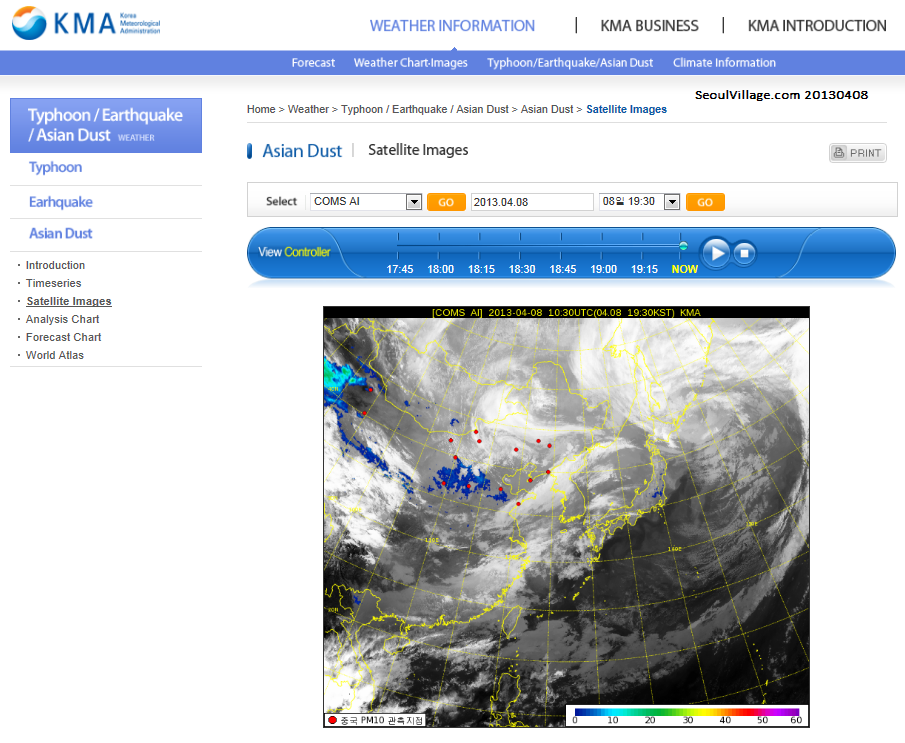
We do enjoy a relatively good level of information and alert for major yellow sand episodes...


March 19 @theseoulvillage tweet
Don't bite the dust (my tweet last month with KMA link below - web.kma.go.kr/eng/weather/asiandust/satellite.jsp)


satellite view of yellow sand on Korea
KMA satellite view of Asian dust (20130408)

... and we do have a lot of sources for the overall quality of air, from the electric signs on major streets in Seoul, to the following sites:


pollution map of Korea
CAPMOS-NIER - National Institute of Environmental Research, Clean Air Policy Modeling System (20130408 - capmos.nier.go.kr)


map: quality of air in Korea
Air Korea (20130408): airkorea.or.kr


map: air quality in Seoul
Clean Air Seoul (20130408): cleanair.seoul.go.kr

And we're receiving positive signals:
- The National Institute of Environmental Research (NIER) will improve its Clean Air Policy MOdeling System (CAPMOS)**, and "the ministry plans to introduce a fine particle warning system for Seoul and the metropolitan area in the first half of this year, and the system will be expanded to ultrafine particles next year"*. NB: that's for the most damaging microparticles, the ones that reach the deepest parts of our lungs (Particle Matter under 2.5 microgram).
- Environmental pollution will be more severely fined***

But of course, this accumulation of "measures" shows that there's a sense of emergency. From the start (see "Clean Air @ Seoul"), information websites showed some limits. And "tough penalties" only happen once you've caused three environmental incidents! Imagine the Japanese government telling to TEPCO: "okay, you've been allowed one strike at Fukushima, but two more and you're out"... Wait a sec'... Um, yup, that's exactly what happened... but Korea can do better than that!

Cleaning the air will take time, but transparency will do more good than denial and procrastination, which only make things worse.

Seoul Village 2013
Welcome to our Korean Errlines! Follow Seoul Village on Facebook and Twitter
Bookmark and Share
Add this page to your favorites

* "Ultrafine Particle Pollution Reaches Dangerous Levels" - The Chosun Ilbo (20130408)
** "NIER to improve 'Clean Air Policy Modeling System'" - Ministry of Environment (20130405) *** "S. Korea aims to toughen penalties for environmental pollution" - Yonhap News (20130404)

Tuesday, April 2, 2013

Asian Leadership Conference 2013

For its 4th Asian Leadership Conference, Chosun Ilbo gathered an impressive line-up of power hitters around the theme "Asia's Next Challenge: Good Growth and Smart Welfare" (see agenda and program below*).

The simple fact that organizers sped up the process - the previous editions were held in 2005, 2008, and 2012 - tells a lot about the success and the relevance of the event. And this time, there was almost a vintage G8 flavor as a collection of former heads of state joined the usual mix of CEOs, gurus, innovators, and scholars.

But the point was not to impress with hard power. Yes, there was at times testosterone in the air (thank you Jim), but even in this male dominated environment and even in these sabre-rattling times, a clear consensus emerged on the need to emphasize on collaboration vs competition, and on the evidence that empowering women was as the most efficient way of reviving at the same time economies, societies, and politics across the region and beyond.

I couldn't resist, instants before the opening ceremony, taking this "Power to the Women (Fleur Power?)" picture, where even French deputy minister Fleur PELLERIN seems overshadowed in this "man's world":


Fleur Pellerin


Random memos 1 - Special mentions and special thanks

Of course, in this kind of events, you can't expect all 150 speakers to deliver life changing speeches, but there were good moments, particularly when heavyweight moderators went out of their way to spur the debate.

So I'll start with a special mention to Sir Martin SORRELL (WPP) and Jim CLANCY (CNN):


Sir Martin Sorrell
Studious Sir Martin
  • The Ad Man - who proved he could negociate more airtime - forced the former PM of Netherlands to declare his personal views about where the UK should stand vs the EU (better in than out, but only if the UK accepts full membership). I also enjoyed his no-nonsensical lecture later in the day: SORRELL may not be the most inspiring and visionary leader, he may have too financial a focus for my taste, but he has an acute sense of strategy, he always keeps an eye on the big picture, and he knows how to map his environment. The kind of CEOs who won't panic behind the wheel in times of trouble, and who doesn't consider his 165,000 employee company as a supertanker. When I asked him if it the challenge was not greater now that technologies, know-hows, and business models evolve constantly, he answered that it was much easier for a big company.
Jim Clancy
Battling Jim CLANCY just left the ring: danced like an elephant, stung like a rhino, roared like a lion, won by K.O.

  • The Anchorman - who proved he could boost an audience - roared like a lion each time a debater tried to dodge certain questions that are not often asked in public in Korea ("So tell me: those Korean chaebols, are they too big to fail or too big to jail?").
I must also give special thanks to Tarja HALONEN and Steve CHEN:

  • Since we were seating next to each other, I could enjoy a short one-on-one chat with the former President of Finland about European and Asian politics. I wish all top politicians were as kind, modest and straightforward on stage and backstage.


Tarja Halonen
HALONEN was smiling on every other picture I took, but you don't reach 88% approval rates just because you're a nice person: ever the activist, she also knows how to fight for ideals


  • Note that in general, the atmosphere was very friendly and open, not just thanks to gurus who make a living out of it (Google's very friendly "Jolly Good Fellow" Chade Meng TAN, or the more money-driven coach Marshall GOLDSMITH).

Random memos 2 - To Change? Yes, but you don't kick habits that easily

It was all about the end of ideology, the need for pragmatism, openness, sustainable approaches... and yet a few die-hard ideologues kept playing the same old tunes. The audience didn't seem to mind: judging by their conversations as well as by their votes on the brand new Galaxy tablets offered by the organizers, visitors seemed mainly conservative. Except, at the other end of the spectrum, a male Lee Jung-hee who made everybody laugh with his more than passionate interventions from the floor.

I don't know how many times Adam Smith was quoted over the two days, but even the 2011 Nobel Prize laureate in economics couldn't find a more recent reference to justify his opposition to government intervention in the youth unemployment crisis. At least Thomas SARGENT reminded the audience that Smith himself would have been revolted by the excesses and total lack of ethics in today's capitalism. For SARGENT, unemployment is a natural situation, and regulations artificially pollute this perfect environment that only needs time to adjust. Unfortunately, he was only opposed by Gunther SCHMID, who rolled out without much passion his usual pitch on transitional labor markets. The moderator himself seemed more in a lecturing than an animating mood.

The audience was still recovering from Battling Jim CLANCY's victory by K.O. in the previous bout: "Chaebol: to regulate or not?", featured Raffi AMIT (author of 's WSJ piece "Korea's Costly War on Conglomerates") and JWA Sung-hu (Korea University, author of "The evolution of large corporations in korea") in the "deregulation" team, and JANG Ha-sung (SNU, ever the corporate crusader) and Yishay YAFEH (Hebrew University, author of "Business Groups and Risk Sharing around the World") on the "pro-regulation" side.

AMIT all but disclosed the names of his sponsors in a textbook defense of chaebols started by the usual "don't kill the goose that lays the golden eggs". I do think that Korean conglomerates invested massively in innovation and jobs at the right moment, and that they should be praised for that, but when AMIT noted that chaebols grew more than the rest after the crisis, he forgot to mention that precisely, they sucked way too much value out of the market, phagocytizing new fields they had no business venturing into. Smaller players usually do the bulk of the job in times of crisis, and even in good times, SMEs create 40 jobs with USD 10 M compared to 10 for chaebols.

JWA believes that SMEs have the same chances as chaebols to grow into big fishes, and that the only things that block this perfect system are critics from the outside. He says "we don't need government regulation but stronger competitors", but we can't achieve the latter without the former. In a soft-spoken yet implacable prosecution speech, YAFEH pointed out the fundamental flaws of the system, the collusion, the regulatory capture also achieved by mass hirings of former regulators and judges (at which point CLANCY mentioned the usual "Republic of Samsung" - "chaebols become the government" arguments)... and the indecence of it all: when to intervene?"It's like pornography: you know it when you see it". JANG Ha-sung delivered hard facts, figures, and punches, showing pervasive subsidiary charts. He also drew a comparison with a small village: if a farmer behaved like that, controling the whole value chain from the land and fertilizers to the retailers, what do you believe other villagers would think of him?

NB: images work even better when you actually draw what you're talking about, and Peter SCHREYER did just that during his lecture. Kia-Hyundai's Chief Design Officer drew us a plane, but no lamb. He positions Hyundai as a fluid water drop, and Kia as a more architectural snow flake... which doesn't leave much to competitors (vaporized?).

Random memos 3 - A few pieces of advice to Park Geun-hye

Direct advice to the new president:
. From Dominic BARTON: the first year is key, be aggressive, promote vocational jobs like Germany, make them more highly regarded and better paid
. From John RICE: focus on infrastructure and immigration to draw foreign investors, promote transnational collaboration.
. From Tarja HALONEN: keep your promises, say what your predecessor did well, try to avoir situations where people are unhappy, talk to female students and empower them, strengthten bridges between universities and enterprises, train students for self-entrepreneurship
. From Jan Peter BALKENENDE: new deal between chaebols and SMEs, have chaebols be evaluated by their partners like Unilever does, look for values (happiness is not just wellness), work on innovation and trust
. From Albert KOCH: go for restructuration, let the private sector take care of business (NB: and if you want a long term vision, don't listen to people like me who make a living out of turnarounds)

Advice to Korean leaders and managers in general:
. From Martin SORRELL: don't forget internal communication, explain strategic changes internally, don't let financial procurement claim too much power, doing good is good business.
. From Charles DUHIGG: acknowledge complaints, learn from them, teach life skills, turn willpower into training and positive habits
. From Peter SCHREYER: no guts no glory, the biggest risk is to take no risks
. From Steve CHEN: measure your risks, but if you want to go far, you have to take the plunge, opportunities never last long
. From Chade Meng TAN: don't pursuit happiness, it's already there, kindness is powerful.
. From Marshall GOLDSMITH: thank people for telling you the truth, don't let other people's craziness become your own, don't say "I'll be happy when" - be happy now
. ...

Random memos 4 - The Northeast Asian Reshuffle

This conference wasn't meant as a political tribune, but Michael Powell confirmed the messages he previously delivered to the press. The former Secretary of State hammered that the days the North Korean regime could scare everybody at no cost were over, that THEY should be scared now, and that the time had come to show positive and constructive attitudes. Kevin RUDD, a connoisseur of Chinese arcanes, confirmed that the days China forgave every provocation from the North were over, that the country wanted to be respected as a diplomatic force, and that para-imperialism (ie Northeast Project - "Hanschluss") was putting security at stake. For China, having this unruly regime at the door is much worse than having the US at the door.
 
 
Colin Powell and Kevin Rudd
 
 
It may not show on his face, but former Foreign Minister HAN Sung-joo is very happy that the KOR-US partnership is stronger than ever, that China is evolving in the right direction, and that the rest of the world is unanimously condemning North Korea's dangerous antics.
 
 
HAN Sung-joo
 
 
Yasuo FUKUDA failed as a Prime Minister because he promoted pragmatism, reconciliation in the region, environmental reforms, and "worst of all", because he didn't play the ultra-nationalist game - his surprise resignation, not even one year into the job, happened just weeks after his refusal to visit the infamous Yasukuni shrine. FUKUDA remains the peaceful and soft spoken moderate leader Japan needs right now, and he already succeeded Shinzo ABE once... but this time, he's really too old.
 
Yasuo Fukuda
 
 
She's the first female president of her country, she's the daughter of a president who ruled with a strong fist, but also carried major reforms... but Megawati SUKARNOPUTRI didn't achieve much else, and at the ALC, she embarrassed the audience by refusing to be treated as a non-keynote speaker, and by reading texts from daddy SUKARNO. Definitely not a model to follow for PARK Geun-hye.
 
Megawati Sukarnoputri
 
A few portraits to wrap it up:
 
Bang Sang-hoon
Chosun Ilbo CEO BANG Sang-hoon, a perfect host


JUNG Hong-won
The kind and not so charismatic new Prime Minister, JUNG Hong-won


Fleur Pellerin
Fleur PELLERIN again. She may be a fellow French citizen and a fellow ESSEC alumni, I must say I expected something more than her standard sales pitch for FDI in France


Jan Peter Balkenende
Former PM Jan Peter BALKENENDE (Netherlands) has learned the importance of being Ernst and Young, but we did share a laugh after his speech.

Looking forward to the next edition, I presume next year.


Seoul Village 2013
Welcome to our Korean Errlines! Follow Seoul Village on Facebook and Twitter
Bookmark and Share
Add this page to your favorites


* 4th Asian Leadership Conference, the Agenda:
  • Agenda 1: Asia as the Next Solution
  • Agenda 2: Shaping Asia's New Paradigm - Korea's Case
  • Agenda 3: Paths To Good Growth
  • Agenda 4: Future of the Asian Century
The Program:

SESSIONS DAY 1:

Opening Ceremony:
. BANG Sang-hoon (Chosun Ilbo CEO)
. JUNG Hong-won (Prime Minister of South Korea)

Session 1: Challenges and Tasks of New Asian Leadership
Moderator: Martin SORRELL (CEO, WPP Group)
. Tarja HALONEN (Former President of Finland)
. Fleur PELLERIN (Cabinet Minister of France)
. Megawati SOEKARNOPUTRI (Former President of Indonesia)
. Yasuo FUKUDA (Former Prime Minister of Japan)
. Colin POWELL (Former Secretary of State of the United States)
. Jan Peter BALKENENDE (Former Prime Minister of the Netherlands)
. Kevin RUDD (Former Prime Minister of Australia)

Session 2: Diplomatic Strategy for Peace and Prosperity in Northeast Asia
Moderator: Zeb ECKERT (Reporter, Bloomberg TV)
. Colin POWELL (Former Secretary of State of the United States)
. Kevin RUDD (Former Prime Minister of Australia)
. Sung Joo HAN (Former Foreign Minister of Korea)

Session 3: How to Design Korea’s New Normal
Moderator: Jong Nam OH (Professor, Seoul National University)
. Tarja HALONEN (Former President of Finland)
. Jan Peter BALKENENDE (Former Prime Minister of the Netherlands)
. Dominic BARTON (Global Managing Director, McKinsey and Company)
. John RICE (Vice Chairman, GE)
. Albert KOCH (Vice Chairman and Managing Director, AlixPartners)

Session 4: Chaebol, to Regulate or Not?
Moderator: Jim CLANCY (Anchor, CNN)
. Raphael AMIT (Professor, Wharton School of Business)
. Yishay YAFEH (Dean of School of Business Administration, Hebrew University)
. Hasung JANG (Professor, Korea University)
. Sung Hee JWA (Former Professor, Seoul National University)

Session 5: Youth Unemployment: Can Government Solve it?
Moderator: Dong Sung CHO (Professor, Seoul National University)
. Thomas SARGENT (2011 laureate, Nobel Prize in Economics)
. Gunther SCHMID (Professor Emeritus, WZB - Wissenschaftszentrum Berlin fur Sozialforschung, Freie Universitat Berlin)

LECTURES DAY 1:

. Steve CHEN (Co-founder, YouTube): chat over lunch
. Martin SORRELL (CEO, WPP Group): ‘Global Insights and Branding'
. Shigetaka KOMORI (Chairman and CEO, FUJIFILM Holdings Corporation): ‘Winner of the Digital Age’ - moderated by Ji Pyeong LEE (Senior Research Fellow, LG Economic Research Institute)
. John RICE (Vice Chairman, GE): ‘The Global Innovator’ - moderated by Sunny YI (Partner, Bain and Company Korea)
. Hary TANOESOEDIBJO (President and CEO, MNC Group): ‘The Media Mogul of Indonesia’
. Yigal ERLICH (Founder and Managing Partner, The Yozma Group): ‘Father of the Start-up Nation’

SESSIONS DAY 2:

Special speech:
. Jan Peter BALKENENDE (Former Prime Minister of the Netherlands)
. Je-yoon SHIN (Chairman of the Financial Services Commission)

Session 6: Finance and the Good Society
Moderator: Zeb ECKERT (Reporter, Bloomberg TV)
. Douglas FLINT (Group Chairman, HSBC Holdings plc)
. David RUBENSTEIN (Co-founder and Co-CEO, Carlyle Group)
. Ronald O'HANLEY (President of Asset Mgt. and Corporate Services, Fidelity)
. Kwang-woo JUN (Chairman and CEO, National Pension Service of Korea)

Session 7: Job-boosting Entrepreneurship
Moderator: Jaeyoung LEE (Congressman of National Assembly, Saenuri Party)
. Steve CHEN (Co-founder, YouTube)
. Brad HUNSTABLE (Founder and CEO, Ustream)
. Suk-Chae LEE (CEO, KT)
. Yigal ERLICH (Founder and Managing Partner, The Yozma Group)

Session 8: Economic Cooperation beyond Regional Conflicts
Moderator: Yung Chul PARK (Professor, Korea University)
. Kiyohiko NISHIMURA (Former Deputy Governor, Bank of Japan)
. Fan HE (Deputy Director, IWEP)
. Barry BOSWORTH (Senior Fellow, Brookings Institution)

Session 9: The Future of Xi Jinping's Economic Reform
Moderator: Duck-Koo CHUNG (Chairman, NEAR Foundation)
. Barry EICHENGREEN (Professor of Economics and Political Science, UC Berkeley)
. Yongding YU (Former Director-General, IWEP)

Session 10: Smart Ways to Good Growth
Moderator: Jihyun Julianne LEE (CEO, Julianne Lee and Company)
. Christian LOUCQ (Director General, International Vaccine Institute)
. Masahiro KAWAI (Dean and CEO, Asian Development Bank Institute)
. Kamal AHMAD (Founder, Asian University for Women)
. Ho-Seung YANG (Chairman, World Vision Korea)

LECTURES DAY 2:

. Charles DUHIGG (Reporter, New York Times, Author of ‘The Power of Habit’): 'Habits That Change the World'
. Peter SCHREYER (Chief Design Officer, Hyundai Motor Group): 'The Legendary Car Designer'
. Chade Meng TAN (Jolly Good Fellow, Google, Author of ‘Search Inside Yourself’): ‘The Most Popular Fellow of Google’ - moderated by Jihyun Julianne LEE (CEO of Julianne Lee and Company)
. Bing XIANG (Dean, Cheung Kong Graduate School of Business): 'Mentor of the Chinese CEOs'
. Marshall GOLDSMITH (Leadership thinker, Author of ‘Mojo’): 'Guru of the positive attitude'
. Albert KOCH (Vice Chairman and Managing Director, AlixPartners): 'The Art of Corporate Turnaround'
. Heyi XU (Chairman, Beijing Automotive Group), and
 Jianwei ZHANG (President, Sinotrans Limited): 'Special Session with Chinese CEOs' - moderated by Sungjoon PARK (Visiting Professor, Incheon National University)