NEW - download 'Seoul VillageS (서울 마을들)', my collection of 12 short fictions now adapted into short films! Get your free copy of the ebook (4 editions: English, French, Korean, Bilingual English-Korean)!

Showing posts with label Yeonhui-dong. Show all posts

Sunday, April 27, 2025

A Fade Out - Not 'The End'

Missing all Cannes Festival selections for the first time in 26 years came as a brutal yet necessary wake up call for Korean cinema.

Everybody knew the figures were bad, but there was always an opportunity to cheer up on the creative side. This year, no one passed the cut for the Croisette.

And business-wise, the maths don't look good:

  • Ticket sales nosedived by 46% between 2019 and 2024, from 226.9 to 123.1M. And Korea was not hit as hard by COVID as France, who shrunk by only 16% (from 213.3 to 181M).
  • Premium experiences (4D, norebang-style individual projection rooms, k-pop corn, or high tech retailtainment) don't make up for the decline in the average ticket price (8% last year according to KOFIC). More coupons, more promotions for more budget-conscious viewers.

Don't blame only the usual streaming suspects; the local context clearly didn't help: 

  • Koreans have been busy worrying about democracy and demonstrating en masse on the streets 
  • Koreans don't go and stay out as often and as late as they used to. Even before COVID, the nation's nightlife declined sharply due to abrupt labor reforms - now most restaurants close early, and formerly buzzing areas have become eerily quiet

The near future doesn't look bright because there will be a shortage of new films in 2026: the well of COVID-delayed movies is drying up, and risk-adverse Korean majors have divided by two their number of yearly releases.

Of course, Korea wouldn't be this vulnerable if it weren't that blockbuster-dependent. France's resilience is in great part linked to the diversity of movies and documentaries screened nationwide, and I have already stressed the importance of indie cinema to save Korean cinema as a whole for decades (i.e. 'Saving Korean cinema... and even Chaebolplex').

One of Korean cinema's fundamental problems is that, in this country, most movie theaters are not about culture but about real estate. And like with residential or office real estate, diversity and obvious demographics trends are not really taken into account. Worse, when a movie theater has a unique cultural value, authorities destroy it to make room for a parking lot - yes, our dear Wonju landmark ('Wonju's Academy Theater') was eventually obliterated last October.

Yet. The widening gap between these huge pipes and thinning streams might be the kick in the butt multiplex operators needed. If they don't diversify their offer now, they never will, and they will never survive. They can't wait for Korean majors to de-hibernate. They must leverage their assets to act as cultural leaders, like MK2 in France, with weekly events like encounters with players in the film industry or stimulating lectures on science or culture.

We also see new venues searching for the essence of cinema. From CHO Minsuk's new Seoul Cinematheque, which fosters a dialog with film archives and even provides an outdoor venue to Laika Cinema in Yeonhui-dong, a young, well curated, intimate and cosy boutique theater giving meaningful movies the place they deserve.

And by the way, Korean majors must also seize this kick in the butt as an opportunity to improve their failing business model and to leave their comfort zone without risking much: instead of doing business as usual and betting everything on elusive blockbusters, they should devote a greater share of their budgets to small films, to source the new blood Hallyuwood needs. If you invest in startups, you know most of the time you won't hit the jackpot, but taking more small risks allows you to give disruptors and game changers a chance, to nurture the whole ecosystem. And spotting new talents will become even more vital for Korean majors now that technology enables every creator to make a film. Look how an unknown Latvian creator could claim an Academy Award (Gints Zilbalodis with his lovely 'Flow').

Beyond the movie industry, Korea Inc as a whole can play a role by financing original creations. Hyundai had the brilliant idea to sponsor 'Night Fishing', a short film by MOON Byounggon's 'Night Fishing' starring SON Suk-ku and of course one of its electric cars. The short was screened in 15 CGV theaters for a symbolic price of KRW 1,000. That's not just smart advertising and PPL, that's true cultural leadership contributing to the pedagogy of an audience formatted for blockbusters.

All stakeholders can make a positive difference, even local and national authorities. For instance by subsidizing or offering incentives only to venues devoting a significant share of independent films.

Remember that movie theaters are all about projection. Not only about projecting stuff to consumers, but about projecting people into different contexts and mindsets. We're not entering a dark bubble, we're disconnected from our phones and ambient noise, with unknown people focusing at the same time on the same brain stimulators. And when these stimulators are not the usual formatted algorhythms but creative works of art, each member of the audience sees, remembers, imagines something different, almost like we do by reading a good book. 

Don't worry, this is not The End: after this welcome kick in the ass, Korean cinema will kick ass again. 


Seoul Village 2025
Welcome to our Korean Errlines! Follow Seoul Village on Facebook, Bluesky, Threads, and X/Twitter, follow me on Instagram.
Download 'Seoul VillageS', the free ebook.



Thursday, February 2, 2017

Moving matter and hearts - Choe U-ram in Daegu

If you happen to pass by Daegu, you may witness a very rare gathering of elusive creatures, but be quick, they're about to take off very soon: only a few days left for CHOE U Ram's exhibition at the Daegu Art Museum!

CHOE himself is a very rare creature: at the same time a brilliant artist producing spectacular works, and an extremely modest human being, who sometimes refers to himself as a 'Cheonggyecheon dog', because according to him, even a dog would have learned all these techniques by just roaming the workshop neighborhoods the way he did as he grew up. A poet, a dreamer, and a maker, U-ram also happens to be one of the kindest people I ever met.

This robot hero he painted when he was 7, and the story that came with it were already very touching.


If nowadays, his 'anima machines' use more complex mechanisms and technologies, they are still about turning his fertile imagination into reality.

  URC-1, 2014 by Choe U-Ram from U-Ram Choe on Vimeo.

It was really moving to see all generations of visitors mesmerized by U-ram's poetic wonders.

In front of Choe U-ram's Scarecrow (www.instagram.com/p/BPHnOKHjdhr/)
And I can't wait to discover what will come next from his Yeonhui-dong workshop.

'Choe U-Ram: [Stil laif]'
1 Nov 2016 – 12 Feb 2017
Daegu Art Museum, Daegu, Korea
40 Misulgwan-ro, Suseong-gu, Daegu 42250, Korea
T +82 (0)53 790 3000

DaeguArtMuseum.org


Seoul Village 2017
Welcome to our Korean Errlines! Follow Seoul Village on Facebook and Twitter
Bookmark and Share
Add this page to your favorites

PS: also from last month's trip to Daegu:
Modern art or carwash? (www.instagram.com/p/BO_N9TFDjvF/)

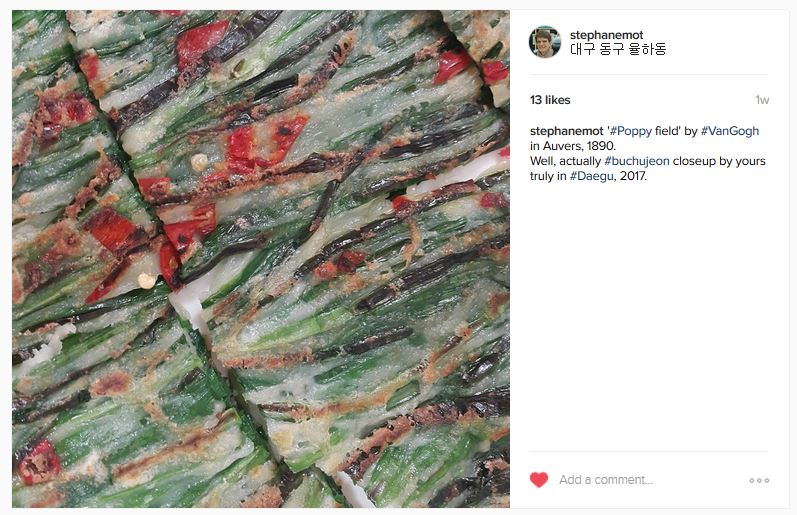
Vincent Van Gogh's poppy field, or buchujeon? (www.instagram.com/p/BO_j2BejYdL/)

Tuesday, November 25, 2014

Yeonhuigung - quintessentially Joseon

As you may know, the founder of the Joseon dynasty wanted to build his new capital city in the Yeonhui-Sinchon area. King Taejo loved the place, but his teams wanted to go further afield, to a bigger site beyond Muaksan / Asan, in the nest guarded by Bugaksan / Inwangsan. Taejo eventually gave in, but built a palace for his father where he wished he could have created his own.

The name of the future 'new town' capital city remained until now: Sinchon means 'new village'. The name of the palace also survived, but more indirectly: Yeonhuigung (연희궁-延禧宮) gave its name to the neighborhood, now known as Yeonhui-dong, and later to Yonsei University - for the 'Yon' part ('Sei' came from 'Severance' hospital).

Yeonhuigung was said to be made for future kings, and people around here often joke that the tradition perdured into the next millenium, because 4 South Korean presidents lived in the area (CHOI Kyu-hah, Chun Doo-hwan, ROH Tae-woo, KIM Dae-jung). But when they ruled, Yeonhuigung was already gone for decades.

It's interesting to note how this palace shared his fate with the Joseon Dynasty: created by its founder, blessed by King Sejong The Great (Taejo's grandson renovated it during the second year of his rule), and disgraced by King Sejo's bloodline. Sejo was the man who destroyed Sejong's heritage and the nation's momentum (see "King Danjong and Korea's Curse"), and his descendant Yeonsangun, another one of Korea's worst rulers ever,  basically turned Yeonhuigung into one of his lust spaces. The palace didn't survive the Japanese occupation.

So where would be this palace nowadays? On Yonsei campus, not far from the soccer field where I use to play, around where they built that new exit on Songsan-ro (to pave the way for a pedestrian Yonsei-ro).

Inaugurated Yonsei's new sw gate on my bike after the game (4 goals, 6 assists). Felt like king of Zlatanistan. (20131023 - twitter.com/theseoulvillage/status/393912711299342336)
NB: to reach "Ventouxsan" (see "A bump on the road (Ventoux-san)")
, follow that bike to the right
Local authorities have only recently sold the land - at a very low price - to the university, which had been using it for decades. Maybe something could be done to mark more visibly - not too eyesorely visibly, if possible - the former location of such a royal landmark.


Seoul Village 2014
Welcome to our Korean Errlines! Follow Seoul Village on Facebook and Twitter
Bookmark and Share
Add this page to your favorites

-

Thursday, November 13, 2014

China Dependence

If XI Jinping doesn't eat himself to death, he'll be leading China well into the next decade. And as he hosted the APEC meeting, he already tried to pose as a new breed of World leader, some kind of a super-blob absorbing every disturbance:
- Airpocalypse? Suspended for the occasion. It came back with a vengeance afterwards, and Seoul got a mean whiff of it for Suneung.
- Democracy? Distant umbrella clicking sounds muffled by thick red padded walls. Even the World's supposedly ultimate Democratic leader came bruised up (a red-painted America for Obama's last Midterm Elections).
- TPP? Sorry to hear about your China-free Trans-Pacific Partnership struggle. Here's our China-led Free Trade Area of the Asia Pacific (FTAAP). And Vladimir? I'm not forgetting our Shanghai Cooperation Organisation, we'll invite Modi and India soon. Meanwhile, here's another big contract for you...
- Shinzo Abe? The Imperial Japan revivalist thought their handshake would mark a diplomatic victory for him, Xi turned it into a public humiliation (a red face as visible as the dot on the flag for Abe, once again shaming the nation).

Meanwhile, South Korea and Park Geun-hye confirmed their honeymoon with China and Xi Jinping by concluding their FTA deal, a few days after the official launch of clearinghouse services by China’s Bank of Communications branch in Seoul (November 6).


I need a pull
We got a deal
Do you think Vlad the Impaler is coming our way?
Asia Pacific leaders beamed down to the size of blue cells.
If you remember the survey recently led by the Asan Institute on "South Korean Attitudes on China" (20140703) and "South Korean Attitudes on the Korea-US Alliance and Northeast Asia" (20140424), Koreans seem to consider their growing dependence on China as ineluctable, and they don't feel so comfortable about it.

But Koreans are not so comfortable with their economic situation and gloomy demographics either, and many are ready to make a quick buck, whatever the long term consequences. 

Jeju illustrates perfectly the double-edged sword of Korea's growing dependence on China. Local authorities opened Pandora's box in February 2010 by offering F-2 visas to anyone who invests at least KRW 500 m in real estate, and the Chinese jumped in. Mind you: not just as political risk management tools or evasion tactics. As of June 2014, they owned 5.92 million sqm of land worth KRW 580.7 bn, up from 20,000 sqm worth KRW 0.4 bn in 2009. Over the same period, US citizens gained only 4% more land, and Japanese citizens even lost 2% of their total.*

This year, Jeju will welcome over 5M visitors from China. But beyond the construction of hotels and resorts, China doesn't boost local jobs or consumption**. And at this pace, the island could become a Costa del Sol - style environmental + real estate mess. Local authorities are starting to realize the unsoundness of the equation, but Korea opens other regions to similar schemes, to the risk of creating bubbles, and of sucking much needed steam out of nearby projects that are already struggling.

Otherwise, for places like Songdo, bringing China in the equation helps fill existing towers. And speaking of Incheon: look how the city revived its Chinese heritage over the past decades, from one extreme (a community below the radar) to another (a brand new, colorful Chinatown).

In Seoul, Yeonnam-dong (the southern half of Yeonhui-dong until it joined Mapo-gu) enjoys a long history with China too, and it still shows in the architecture, even if you have to dig deeper and deeper to find one of these 'fusion hanok':
Yeonnam-dong hanok tended to have higher ceilings. Fusion architecture for people from Taiwan. (@theseoulvillage 20140815) - twitter.com/theseoulvillage/status/500156842874380288
Restaurant-wise, there are still a few great Chinese institutions in the neighborhood, but for how long? If flocks of Chinese tourists have recently started pouring in, that's to visit the new duty free shops operated by their compatriots in closed touristic circuits that obviously generate a lot of business, but not much for the local economy. Seoulites won't keep coming if they see Yeonnam-dong's charming streets packed with jay-parked tourist buses. Next thing you know, these closed circuits will include big buffets that will further degrade the neighborhood.

Don't get me wrong: of course China is a chance for Korea at all levels, I'm really happy to see two countries I love develop friendly and fruitful relations, and that's perfectly normal that a big chunk of China's touristic bonanza ends up in Chinese hands. 

I'm just worried about the pace and reach of change, and its impacts on Korea's economy, society, and politics.

Not because China's influence is bad in itself, but because massive and rapid changes could trigger anti-Chinese reactions which could not only damage the relations between both nations, but the multicultural fabric of Korea itself.

Likewise, when I mention political issues, that's not only at the national level (typically: okay for outsourcing part of  North Korea control, not okay to subscribe to the Northeast Project's 'Hanschluss' agenda): who and what will certain local authorities ultimately run for?

We're probably not at that stage yet, but I believe that Korean leaders should keep these risks in mind to work on a sustainable partnership. And that since this partnership cannot be balanced, to strengthen other partnerships in parallel.

*
See also:

Seoul Village 2014
Welcome to our Korean Errlines! Follow Seoul Village on Facebook and Twitter
Bookmark and Share
Add this page to your favorites
.
* "Chinese snap up real estate on Jeju" (Korea JoongAng Daily - 20141103), "Surge in Chinese investors in South Korea’s Jeju Island since 2009 may be to secure residency" (South China Morning Post - 20140903), "Chinese investment is taking over Jeju Island" (The Hankyoreh - 20141004)
** "Chinese Investment in Jeju Not Bringing Consumption, Employment to Region" (Business Korea - 20140829)

Tuesday, October 15, 2013

Yeonnam-dong, a new Human Town or a new Old Town, but mercifully not that old New Town

I found rather comical recent articles presenting Yeonnam-dong's rehabilitation as a success for PARK Won-soon vision*: Yeonnam was the pilot neighborhood at the core of the Human Town vision, a voter-friendly project ignited by PARK's predecessor ahead of the 2010 mayoral elections (actually, the first sentence in my post "OH Se-hoon launches the "Seoul Human Town" concept" was "the campaign for Seoul City Hall is definitely on"). This following the LRT episode where PARK, already running for a second term next year, revived OH's subway projects years after criticizing them as pork barrel**... Of course, PARK didn't write these articles, but I had to smile.

Anyway, whether you call it "Human Town" or "Old Town" (as the metropolitan government rebranded it last year to mark a disruption with the "New Town" model - see "Seoul Old Towns or New Human Towns? New City Hall or Tsunamheat Wave?"***), the concept had to be given a chance. In case you skipped the Human Town beat, here are a few bits from my 3-year-old post:
"(...) an alternative to Seoul's tragic base case scenario : instead of letting a whole neighborhood grow old and derelict until it's ripe for redevelopment, then destroy everything, and finally plant a big "apateu" block, the idea is to improve a neighborhood, make it a better place for everyone, with a special care for young couples and silver heads... core targets in OH's 2010 campaign. (...)
"Seoul Human Town" intends to combine the best of both worlds :
- from apartment blocks : joint management, economies of scale, maintenance, security, parking space, (some) green areas, a playground, consistence and sustainability
- from your friendly neighborhood : low-rise architecture, the human touch, the sense of belonging, the memory, the soul, the identity of Seoul villages.
- bonus : community services, senior and daycare centers. Ultimately, many parts of the city shall enjoy facilities more adapted to their population densities, but previously unaffordable (...).
Don't imagine a complete renovation, more a rehabilitation of the environment : the idea is to let the area breathe, to get rid of one building here and there, to convert another one into a community center, to make room for pavements and plants, to add lights and CCTVs, to bury those cable / electricity snake nests hanging up between buildings (...)".
Again, the before/after rendering
Low-rise, low-key, but still high electoral stakes
I put a marker at the center of Yeonnam-dong Human Town on Seoul Village map - that's at the Gyeongui Line fork (at the beginning of the "Gyeongui Line Forest Trail - An Urban Lifeline"), north of Donggyo-ro:


View Seoul Village in a larger map

Now the most important: is it working?

I often ride my bike in the neighborhood on my way between Yeonhui and Hongdae, and the urban change is not very spectacular at the macro level - except of course for the new forest trail, which also contribute to the village atmosphere, and to drawing shop and cafe customers from the outside. Still, you can tell that this neighborhood has evolved into a much more open life space and community thanks to the small scale changes at the street level (e.g. fewer walls, more walkways and green areas, fewer visible electric lines...) as well as well as thanks to the new community services (which also translate in more open or shared spaces).

Residents are feeling optimistic for the future, and not only regarding the value of their properties (the usual barometer in Seoul-upon-Han, I'm afraid). Rents are up, and maybe the fact that Hongdae's spike in retail rents pushed many small entrepreneurs further from the commercial center doesn't explain everything.


Yeonnam-dong does look and feel more like a village...

... and anyway, so much better than this "old New Town" project!


Old new town project for Yeonnam - not exactly a Seoul village
Phew! This "well being" apocalypse was canceled


Seoul Village 2013
Welcome to our Korean Errlines! Follow Seoul Village on Facebook and Twitter
Bookmark and Share
Add this page to your favorites

* e.g. "박원순式 재개발 1호 ‘마포 연남동’… 주거정비 마무리" (Asia Economy - 20130925), "'박원순표 재개발' 저층주거지 정비 마친 연남동 일대" (Financial News - 20131004)
** see "If you ain't broke, fix it: Seoul, Welfare and Railways Deficits" (20130801)
*** again, have also a peek at my essay "Inhuman, all too human Seoul" - "Seoul: inhumaine, trop humaine" (2011-2012), and its final section: "De la New Town à l’Human Town, le retour en grâce des villages" ("From New Towns to Human Towns, villages are back in good favors")

Monday, October 7, 2013

Seobu Line confirmed as Seoul's LRT top priority

Among the 10+ Light Railway Transit lines considered by Seoul Metropolitan Government last summer, I singled out the Seobu Line / Seobuseon as the logical priority to fill the biggest gap in Seoul subway system (see "Seoul LRT Projects Update (Part 1/2)" - following "If you ain't broke, fix it: Seoul, Welfare and Railways Deficits", and preceding "Seoul LRT Projects Update (Part 2/2)"). It seems that the final recommendations for "Seoul Metropolitan Rapid Transit Master Plan", to be disclosed on October 24*, will confirm this priority.

Reminder: Seoul's LRT plans
Here's a more detailed map zooming on the Seobu Line, including the extention to Seoul National University Station (see my focus for all details regarding the expected stations and scenarii):


Note that:
  • After all, Seobu Line could be connected with Subway Line 5 on Yeouido. Maybe my shout out helped...
  • Nothing about a potential connection between the future Yonsei U Station and the Sinchon train station. Works have started on Yonsei-ro, Seongsan-ro, and in front of Yonsei University (reminder: "Yonsei-ro the first street in Seoul to ban cars in its transportation mix"):
    • Until the end of this year, Maeul Bus Line 3 doesn't pass by Yonsei-ro, but draws a larger loop, near Ehwa University.
    • The green island created a couple of years ago on Seongsan-ro in front of Severance has been removed, probably to make room for the new major crossroads: since Yonsei-ro is to become car-free, more traffic will come not only to but from Sinchonyeok-ro (and via Yeonhui I.C., further to the West). I really wonder how they'll deal with bottlenecks when a big fish passes away in Severance Hospital.
    • Yonsei University seems to be opening a new gate between its soccer and baseball fields, which will relieve foot traffic at the main gate and towards the future LRT station... Bonus: I'll be spared a sweat when I come play soccer on week-ends (right now I have to carry my bike on a small staircase).  
  • Mayor PARK Won-soon plans to visit Gwanak-gu this week-end to show his support for a project that happens to be the most profitable both economically and politically... Again, upcoming elections have a lot to do with the revival of a program he lambasted his predecessor for.

Seoul Village 2013
Welcome to our Korean Errlines! Follow Seoul Village on Facebook and Twitter
Bookmark and Share
Add this page to your favorites

* see among other sources "경전철 서부선 연장" 17일 발표... 민자유치 필요" and "서울 철도 중심시대]서부선 '새절역-서울대입구역'" (Money Today 20131017)

Tuesday, August 6, 2013

Gyeongui Line Forest Trail - An Urban Lifeline

Recent news confirmed my hopes and fears regarding the new park stretching along Gyeongui Line (see "Busan Corner on Taxi-daero").

Don't worry, this is not another post about subway line extensions (even I grew tired of them!), but about the forest trail planted over the southern branch of the Gyeongui Line, the 107-year-old railway that used to connect Seoul with Pyongyang. Seoul city just announced that the 6.3 km-long linear park between Hongjecheon and Munbae-dong would be completed by the end of 2014.


Gyeongui Line Forest Trail
Overall, 6.3 km via Hongdae, Seogang, Gongdeok, and Hyochang stations
Nowadays, what you see in the unfinished sections often looks a bit like this...


... but ultimately, we shall see this thin "coulee verte" from above:

  • Here, we're at the beginning of the park, where the Gyeongui Line splits in two (after Gajwa Station): aboveground along Seongsan-ro towards Seoul Station, underground along Yeonnam-ro towards Yongsan Station. You can clearly see at the top of the picture the elevated Naebu Expressway covering Hongjecheon (about that, see "Along Hongjecheon, my way or the highway"), and the hills of Yeonhui-dong's Gungdong Park. The park cuts through Yeonnam-dong, with Gyeongseong school to the left:


Gyeongui Line forest trail at Yeonnam-dong
  • Now we're at the other end of the park, or rather the head of the dragon ("yong"), in Yongsan-gu. Actually, the street that passes between two apartment blocks on the bottom right of this picture separates Mapo-gu from Yongsan-gu. The main avenue bordering the park is now Baekbom-ro, here between Gongdeok and Hyochang stations. Note that Gyeongui Line's Hyochang and Yongsan stations will also open next year.


Some sections of the park have already been inaugurated, but it takes time for the vegetation to grow, and there are not many places to seat in the shade. So the 1.310 m-long initial stretch (Yeonnam-Hongdae) is not very crowded during daytime. Lined with cherry trees, the 630 m-long section between Sogang and Gongdok stations, not far from Sogang University, looks more welcoming and decorated for the moment... but 'sullae-gil' style (expect a lot of signs and storytelling).

For the moment, the most exciting parts may be around Wau Bridge / Wausan / Donggyo-dong / Changjeon-dong, precisely because they have not been fully 'edited' yet. Don't get there if you're the Cheongdam-dong kind of Seoulite.

  • Once you've passed the airport line exits, you can enjoy some really creative graffitis along the fences (unfortunately, also less enjoyable and creative tags on private homes):

Walls have eyes too. near ,
 - twitter.com/theseoulvillage/status/347677211379261441

  • On the other side of Wau Bridge lies a very unique Hongdae neighborhood. Of course it's evolving very quickly, but not as quickly as the rest of Hongdae: here, time seems more suspended. Like in Kim Jin-hwan's cult bakery, where you must not expect bread to be available every time you pass by. Like in these tiny houses, in front of which old timers wash their baechu for the gimchi. Like in this lost field, by the small street that crosses the path of the Gyeongui Line, where Seoul city grows the flowers that will decorate less forsaken neighborhood:

The line near . Here, flowers are grown for the rest of
 - twitter.com/theseoulvillage/status/347676715432161281

What will it look like one year, two years from now? Probably sanitized, gentrified. Hopefully more open to other neighborhoods, and full of life, kids, and bicycles. I come there on bicycle, but both sides are hilly and that's not very convenient. On the other hand and as you can see, the path of the covered line is very flat, so once the trail is opened, people can join from far away, breeze from one neighborhood to the other. Life will completely change for people who are used to live in the middle of nowhere. 


If my wishes have been fulfilled, so have my fears of seeing more soulful parts of Seoul disappear. As expected, my Busan Corner is closed, and my "Taxi-daero" is already starting to morph into something different. I'm mourning that beautiful Chinese restaurant on Baekbom-ro, next to Hyochang Park Station; an exceptional building, and an architectural heritage that would have added something very special to the trail...

But don't get me wrong. Above all else, Seoul is reclaiming wastelands and barren areas for the enjoyment of all its citizens, and that's fantastic. Just like for Cheonggyecheon or Gwanghwamun Plaza, planners won't get it right from day one, and they'll have to fix bugs that could have been avoided in the first place, but Seoulites will come to love a place they didn't know existed.


Seoul Village 2013
Welcome to our Korean Errlines! Follow Seoul Village on Facebook and Twitter
Bookmark and Share
Add this page to your favorites

Wednesday, July 17, 2013

CHUN Doo-hwan for the record

The other day, my dictator neighbor received a visit from prosecutors who, beyond his Yeonhui-dong house, raided several homes and companies belonging to his relatives. CHUN Doo-hwan was said to be relaxed and polite while they searched his house. For show, he did leave them a little bit more petty cash than usual for their pain (provided they can link him to the over two hundred artworks collected, including some from famous painters such as Park Soo-keun), but nothing close to the KRW 167.5 bn he still owes to the nation.

I'm surprised to learn that prosecutors were surprised to find his safe empty*:
  • Arguably Korea's most hated politician (NB: no small feat, particularly across the aisle these days), CHUN had probably been tipped off thanks to his pervasive network. Judging by his impunity and the frequent visits of V.I.P.s to his place, the man still knows how to pull the strings - if not call the shots (no sick pun intended for the victims of the Gwangju Massacre).
  • But you don't need to be a crime genius to know something was coming: lawmakers had just voted an extension of the search for his illegal funds in time (until 2020), and in reach (to the relatives). Even if several members of CHUN's family are now under interdiction to leave the national territory, many suspect that significant slush funds have already traveled to friendlier destinations.


Among Monday tweets: "This time, media don't come to #Yeonhuidong to shoot a drama. Prosecutors raid my neighbor dictator #ChunDoohwan" (http://twitter.com/theseoulvillage/status/357023321507889153) / "Reminder: #ChunDoohwan got not only a "Get out of jail free" card, but his hands deep into the Community Chest" (http://twitter.com/theseoulvillage/status/357044770637492226)
Anyway, Korea needs to recover more than the money still owed by its former strongman**, and even more than the undisclosed total of additional public or private assets rumored to have been offered to his friends.

Korea must recover its credibility as a democracy where justice is not only independent, but respected. Where being a top politician or a top businessman shouldn't mean being granted an unlimited supply of "get out of jail free cards".

I'm not a supporter of death penalty, and I'm glad CHUN's death sentence was commuted to life imprisonment. I also understand some of the reasons why KIM Yong-sam and KIM Dae-jung pardoned him, but still, putting him out of jail sent a very wrong message to the nation and to the world, and every episode of the saga that followed confirmed the nuisance**.  Now I hope that this time, the record is set right, and that all culprits pay, including in terms of prison time.

Now I guess I've made my point: I'm not exactly a fan of this convicted criminal.

But since CHUN Doo-hwan's record must be set straight, I'd like to mention a lesser known part of his legacy. He banned private tutoring and hagwon the way dictators do (the ugly way, leveraging on coercion and squealers), but towards the end of his rule, students could reach top universities on a merit basis unseen ever since.

I don't know if this can explain a boom in successful independent entrepreneurs one decade later. I don't know the backgrounds of people like the founders of Naver, NCSoft, or Daum (LEE Hae-jin, KIM Tae-jin, or LEE Jae-woong, respectively SNU, SNU, Yonsei U), and I know that anyway, the internet boom offered a unique opportunity for non-chaebol players to emerge in brand new arenas, just one click away from endusers.

But maybe, in his own wicked way, the dictator ironically*** helped rise to the top some of the university leaders who accelerated his fall. Who knows?

Seoul Village 2013
Welcome to our Korean Errlines! Follow Seoul Village on Facebook and Twitter
Bookmark and Share
Add this page to your favorites

* "Prosecutors Find Empty Safe in Ex-President's House" (Chosun Daily 20130718)
** see previous raids, or last year's episode of "Neighborhood watch"
*** irony: Chung used to be basically Park Geun-hye's bodyguard, and in charge of the security of the predecessor he removed from power

Friday, July 12, 2013

Seoul Light Rapid Transit Back On Tracks

Seoul Mayor PARK Won-soon, who earlier during his term shelved some of his predecessor's Light Rapid Transit projects, decided not only to revive them, but to push even further, adding more than a few stations. As a matter of fact, these lines often fill major gaps in the capital's railway system, and should spectacularly improve public transportations... not to mention the Mayor ratings in a still depressed real estate market.


Seoul 7 LRT projects (난곡선 추가..서울 경전철 7개 노선 가닥" - 아시아경제 20130712)
Seoul's 7 LRT projects
Of course, there are other  LRT lines or projects in the greater Seoul region, like Uijeongbu's U-Line, or the EverLine (a.k.a. the "Samsung Line" between Yongin and Everland).

So what has changed since our February 2010 focus ("Subway news : Sillim line, Line 3...")?
  • Already well under way, the Ui Line (Ui-dong to Sinseol-dong) will be prolonged by the Banghak-Sinseol Line. Instead of ending at the feet of Dobongsan, it will reach Subway Line 1 in front of Dobong-gu Office.
  • The Sillim Line will be prolonged to Seoul National University, and will now connect Yeouido to Seoul Dae. NB: that's the first line inside the university, who will pay for half of the extension.
  • The Seobu Line (West) will connect Saejeol Station in Eunpyeong-gu to Seoul National University Station in Gwanak-gu via Yeouido, Sangdo, and Jangseungbaegi Station in Dongjak-gu). NB: this time, CHUN Doo-hwan will not prevent the subway from passing by Yeonhui-dong!
  • The Dongbuk Line (Northeast) will connect Wangsimni to Eunhaeng Sageori, the 'Bank Crossroads' in Junggye-dong, Nowon-gu. NB: ideal to reach Baeksa maeul!
  • The Myeonmok Line will connect Cheongnyangni to Sinnae-dong, across Jungnangcheon.
  • The Mok-dong Line will connect Dangsan to Sinwol Sageori, and feature a new rail yard
  • The DMC Sunhwa Line / DMC Circular Line would have given yet another boost to the Digital Media City, but that's neither a priority nor economically viable NB: definitely a plus for its "Connectivity, continuity, and consistence" (see "Songdo, DMC: sequence is of the essence (Part II)")!

Fine, but who'll foot the KRW 2 tn bill? The BTO (Build-Transfer-Operate) system is supposed to split the cost between local authorities and constructors, but Line 9 proved that you'd better always keep an eye on all the elements of the equation.

Theoretically, in a not too distant future, your admission to Seoul Dae should only cost you about KRW 1,400.

Seoul Village 2013
Welcome to our Korean Errlines! Follow Seoul Village on Facebook and Twitter
Bookmark and Share
Add this page to your favorites

20130712 Edit - DMC line

Monday, May 28, 2012

A bump on the road (Ventoux-san)

Saying that Seoul is hilly is a bit like saying that Chicago is windy, but it doesn't show as much as it used to: over the past decades, the city has been carpeted with high rise "apateu" blocks, and hungry caterpilars have bitten off most hilltops.

In many cases, new roads simply cut through the highest hills that used to separate villages nesting on each flank. Picture a hot metal bar lowered on a butter mound: it doesn't cost as much as a tunnel, but leaves disgracious concrete walls on both sides of the road - barren Gaussian curves where the city ceases to exist. Sometimes a bridge connects the former halves of a same neighborhood but only the few people living on the very top use them, and you have to go down at least 500 m on either direction to find a pedestrian crosswalk and risk your life through six lanes of traffic. Final score? Cars 1-0 Humans.

Down in the valleys, you often see much smaller versions of these Gaussian curves (or, on a more poetic note, the bowl hat version of the snake that swallowed an elephant in Saint Exupery's "Le Petit Prince"). And these big bumps on the road can be really annoying when you're a pedestrian: you're on the sidewalk at street level, and suddenly you have to go up and downhill while the road remains flat. For no reason, except of course to reach the few houses remaining at that old street level, as pictured here:


But don't imagine that the guy on the bottom left of this drawing can reach the door on the bottom right without passing by the guy on the top of the hill. That would be too easy. Most of the time, local planners considered that one sidewalk was enough. After all, for many of them, cars seem to be the most important beings in the city.

Every week-end, I ride my bicycle to Yonsei University where I play soccer... or rather a sport that vaguely ressembles soccer when I'm on a good day. From Yeonhui-dong, I have no choice but to use the Northern sidewalk along Seongsan-ro. And if I survive the dangerous entrance to Dongseo Oriental Hospital (see "medical tourism"), I have to face not one but two of those bumps before reaching the stadium.

The second bump is no biggie (even if elder citizens would not agree with the statement): its highest point must reach about 2.5 m over street level. Furthermore, the elevation makes possible the connection between a minor tributary and main street, and fluidifies both foot and car traffic. But the first bump... that mean, steep, 75 m long nightmare shouldn't even exist anymore.

The houses that used to top the hill have merged into a big building which can only be reached from a back street, and the whole thing was elevated even higher, protected by a plain wall without any opening. So basically, to get from the door to the bottom left to the door to the bottom right, you have to go up a very abrupt and absurd hill that leads to nowhere:


If I've climbed much steeper slopes in Seoul, this one makes me very very angry. Granted, it gives me a perfect alibi for my poor performance later at Yonsei, but I'm sure everybody in the area would love to see it disappear.

Of course, the obvious thing to do would be to get rid of the hill altogether and to prolong the mansion's walls to street level. That wouldn't cost much, and would change the lives of many citizens.

So last year, when I saw a group of workers studying the hill, I thought that, at long last, change was coming.

All they did was to put a metal handrail along the mansion wall.

Yes they can.

I'm sure Seodaemun citizens felt offended and said something because a few months later, more workers came. That's it, I thought, they're really going to fix it.

They erected a staircase on both sides of the hill. More concrete, yeah!

And to sign their masterpiece, they've just put a brand new layer of asphalt. A cherry on an unedible cake.


Here's the new and improved mess, complete with its railing, staircases, and asphalt:


How much for these three brilliant interventions? For the same price, I bet they could have sliced at least half of the monster, and that would have made a lot more difference.

I can't wait for the next touch: a marquee to protect sweating bikers from the baking sun during their ascent of Seoul's Mont Ventoux?

Seoul Village 2012
NEW : follow Seoul Village on
Facebook and Twitter