NEW - download 'Seoul VillageS (서울 마을들)', my collection of 12 short fictions now adapted into short films! Get your free copy of the ebook (4 editions: English, French, Korean, Bilingual English-Korean)!

Thursday, March 12, 2015

Burying Seobu Expressway (not all car traffic, though)

Seoul eventually confirmed the completion of the transformation of the 10.33 km section of the Seobu Expressway into a 4-lane underground tunnel by 2019, between Seongsan Bridge (Yangpyeong-dong, Yeongdeungpo-gu) and Geumcheon I.C. (Doksan-dong, Guro-gu)*. 


A standard road will double it at ground level, to - hopefully - take care of the local traffic, and to propose a more pleasant experience for residents and visitors: Anyangcheon will at long last be accessible through simple pedestrian crossings (from the Seoul side, Gwangmyeong residents being connected to the eastern side by footbridges), and new parks will be created, including a big one if Seoul manages to move that big, ugly garbage treatment unit. 

Overall, a greener look and feel (particularly with with these before-after pictures comparing winter and summer views!):

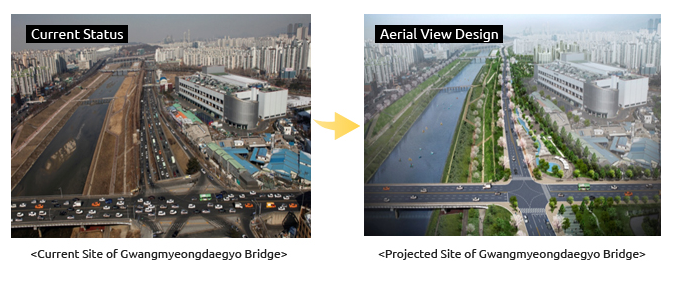


This clearly marks an improvement of the cityscape and quality of life in this part of the city, but not a disruption from the car-centric view. And don't expect to totally get rid of traffic noise: "vertical soundproof walls, currently installed between the Seobu Expressway and Gyeongbu Railroad Line, will be replaced with twice the amount of folded soundproof walls to reduce noise levels".

It may look a bit like Yangjaecheon, but a big part of this stretch is occupied by the Guro Digital Complex, not by mid-rise residences. In any case, good news for the district and for people working there. If sure the landowners in front of one of these crossings will find a better use of their ground levels...

Now if your start-up can't afford a Google-size campus for its staff, you can at least offer them a waterfront experience without the disgracious expressway a la Facebook (see "Zee Talk of Zee Town", "Google's Gtown wins over ZeeTown and the Large Apple Collider").


Seoul Village 2015
Welcome to our Korean Errlines! Follow Seoul Village on Facebook and Twitter
Bookmark and Share
Add this page to your favorites

* a Public Private Project on a Build Transfer Operate mode: "Seobu Underground Road To Be Constructed Through Private and Public Joint Agreement".

Fed up with 'Gangnam Style'? Try Paik and Park's acoustic version

You're allergic to 'Gangnam Style', and I'm with you. 

Let's unplug him. And just once, listen to this acoustic take, more on the yellow-mellow-ish, fake blues-ish side of K-pop. Also irritating at high doses, but less damaging for your eardrums:


Over 300,000 YouTube views so far

Seoul Village 2015
Welcome to our Korean Errlines! Follow Seoul Village on Facebook and Twitter
Bookmark and Share
Add this page to your favorites

Monday, March 9, 2015

Urban Regeneration: 27 Projects For Seoul

Yesterday, Seoul city listed 27 areas subject to 'urban regeneration', the latest portmanteau buzzword to regroup many projects introduced over the past months and years. Of course the list includes the not always magnificent seven mentioned earlier this year (see "Diagonal crossings, High Lines, and Business Verticals (how pedestrians and businesses remodel Seoul... and vice-versa)"), and the most spectacular industrial sites already programmed to be converted into cultural spaces.

On paper, I can only subscribe to the five principles supporting this vast plan, in particular because they confirm the intention to dump the old 'Korean new town' model:
1) Humans are now at the center of the city.
2) Abandon the uniform destruction / redevelopment process for a customized approach.
3) Involve residents in the process from the early planning stages to the completion.
4) Abandon short-termism for an evolutive, sustainable approach.
5) Seoul focuses its investments on the community and regional vitality.

These 27 projects have been listed in 4 categories:


twitter.com/theseoulvillage/status/571091284665856000


    • 5) Mapo Oil Depot in Mapo-gu (this magical industrial site covering 100,000 sqm in Seongsan-dong will become a Cultural Depot Park)


    • 6) Hangang-Nodeulseom in Dongjak-gu: at last an end to the drama? this part of the riverside and Nodeul Island have seen so many projects pass by, including with Jean Nouvel...
    • 7) Namsan Cablecar area in Jung-gu / Yongsan-gu - not far from the cult Hoehyeon Apartment (see "Hoehyeon Apt, Chungjeong Apt, Dongdaemun Apt, Ogin Apt...")
    • 8) Danginri cultural project in Mapo-gu (the Danginri Power Station becomes a park and a cultural space, and Sangsu-Hapjeong has already been colonized by Hongdae refugees fleeing rent hikes)
    • 9) Nagwon Sangga - Donhwamun-ro in Jongno-gu: we last mentioned the case of Donhwamun-ro in an October focus, and Nagwon Sangga remains a crux between the Insadong-Anguk-Donhwamun-Tapgol clusters. Over the past decade, the time capsule has shrunk to the underground market, but I love that small guitar shop at the feet of the concrete giant:


twitter.com/theseoulvillage/status/572932036878454785


  • Old residential zones:
     
    • 16) Seonggwak Maeul (Fortress Village) in Seongbuk-gu: the idea is to preserve and maintain this special Seoul village by the fortress walls. Does it mean that the maeul bus won't be anymore the only coach touring this charming ring on the top of a hill overlooking the valley? Seonggwak Maeul has already become more touristic lately, but in the first place, it was not very animated, with quite a few NIMBY-ish residences.


    • 17) Baeksa Village in Nowon-gu - an all time fave, and a perfect spot for Seoul's favorite marmot (see "Over the moon")
    • 18) Haebangchon in Yongsan-gu: as if HBC's bobo-ization needed a boost from the city...
    • 19) Amsa-dong Seoul-type Urban Regeneration Pilot Project in Gangdong-gu: 635,000 sqm themed after history and prehistory
    • 20) Seongsu-dong Seoul-type Urban Regeneration Pilot Project in Seongdong-gu: 211,000 sqm themed after the local industries (shoes, leather, printing...). Already a trendy spot. BTW time for a shout-out for the Place SAI team:
SAI Festival 2015 (March 20-22 in Seongsu): saifest.co.kr


    • 21) Sinchon-dong Seoul-type Urban Regeneration Pilot Project in Seodaemun-gu: themed after the integration of university students and residents.
    • 22) Sangdo-dong Seoul-type Urban Regeneration Pilot Project in Dongjak-gu: 750,000 sqm themed after inter-generation love.
    • 23) Jangwi-dong Seoul-type Urban Regeneration Pilot Project in Seongbuk-gu: 318,000 sqm themed after alleyway communities
    • 24) Settlements around Bukhansan in Dobong-gu: let's hope that won't spoil the quietest and cutest spots.
    • 25) Seochon in Jongno-gu: now almost completely gentrified, the neighborhood doesn't taste the same.
    • 26) Changsin-dong and Sungin-dong in Jongno-gu: on each side of Jibong-ro, two neighborhoods with a rich yet humble history (e.g. Changsin's sweatshops...). Seoul wants to make an example of their regeneration...
    • 27) Garibong-dong in Guro-gu: the first plans to redevelop the village date from 2003. A couple of years ago, 5 sections were defined for either destruction or rehabilitation, with a few landmarks for the Chinese community. Given security issues in the neighborhood, the multiplication of CCTV is a given, but hopefully, it seems that the focus is now on reviving street life through softer means.

Seoul Village 2015
Welcome to our Korean Errlines! Follow Seoul Village on Facebook and Twitter
Bookmark and Share
Add this page to your favorites
.

Monday, March 2, 2015

The USA And Shinzo Abe: From Ostrich Policy To Complicity?

Undersecretary of State Windy Sherman caused an uproar in Korea because of the way she presented East Asia tensions in a speech at the Carnegie Endowment for International Peace last Friday (see full transcript*). 


I'd like to add my two cents on the issue but first, know that in spite of her name, Sherman is not much of a panzer on foreign issues, and that typically, she was blamed by hawks for advocating diplomacy towards Kim Jong-il at the turn of the millennium. She also seems to be very much aware of the mine-fieldness of East Asian issues, that 'there are disagreements about the content of history books and even the names given to various bodies of water'. She even started with remarks on how, 'in addition to humility, it’s also necessary to approach Asia with an appreciation of the past', a past that 'affects the temperatures of relations between countries and helps determine how every gesture is interpreted'. This should mean that every word she read had been carefully weighed before.

The part of Windy Sherman's speech that most infuriated Koreans was: "Of course, nationalist feelings can still be exploited, and it’s not hard for a political leader anywhere to earn cheap applause by vilifying a former enemy. But such provocations produce paralysis, not progress."
 
I fully agree with the core message against nationalism, but as far as 'provocations' in East Asia are concerned, the first 'political leaders' that come to mind are Kim Jong-un, Shinzo Abe and his Nippon Kaigi friends, and here, China and South Korea appear as the main culprits (even if it could theoretically be any of the nations listed right before - "There can be no question that the world would be safer, richer, and more stable if the United States, Japan, China, and South Korea were consistently pulling in the same direction, and that’s definitely what the majority of the people in the region want").

Korean medias didn't distinguish Chinese/Korean nationalists from Chinese/Koreans and missed the core message. But they got something right: Sherman seems to have sided with Japan.

For instance, the sentence "The Koreans and Chinese have quarreled with Tokyo over so-called comfort women from World War II" not only poses victims as aggressors, but suggests that the issue, which only became a public one in the early 1990s, has long been settled.

By saying "Japan as a nation is working to reconcile modern demands with hard-won lessons from the past", she not only supports collective self defense, but gives an A+ in History to Revisionist In Chief Shinzo Abe. Again, I understand that the US is willing to share military costs in Asia with Japan, but as I wrote in the Asia Pacific Bulletin, "the United States must reassure Asia that it will not condone Japanese historical revisionism, nor will it support an expanded Japanese military without providing wider safeguards to the region".

The Undersecretary of State also completely bought into Abe's imposture around the tragic murders of Haruna Yukawa and Kenji Goto by Daesh. Apparently oblivious of the fact that the PM had been accused of shamelessly promoting his militarist agenda by instrumentalizing the crisis and undermining efforts to save the hostages, she concluded that "the horror of the executions was deeply felt, and the threat to Japanese citizens worldwide has fed an internal discussion that has been ongoing about the appropriate role of the country’s self-defense force".

In no instance does Wendy Sherman counterbalance any of Abe's controversial positions. Which explains why the US' usual 'ostrich policy' regarding this outspoken neofascist revisionist seemed to have drifted all the way to 'pure complicity'.

At one stage, I had the short-lived hope that she could redeem herself when she said "we don’t have to look far for a cautionary tale of a country that has allowed itself to be trapped by its own history"..., but she was referring to North Korea.


*

So I'll repeat the 3 parts of my latest focus "Comfort Women': No Resolution Without Resoluteness. From Everyone, Please."
1) more than ever, justice must win, not nationalism 2) undeterred by an evasive US, Shinzo Abe's pushing his revisionist agenda harder than ever 3) South Korea at long last forced to give up its own inaction

And I'll repeat my tiple call:
- to the US government: stop dodging the 'Comfort Women' issue, don't let Abe get his collective self defense without a clear rejection of Imperial Japan crimes (and please prevent an outrageous Abe Statement on August 15, 2015)
- to the South Korean government: stop feeding Abe and Nippon Kaigi by fueling nationalist feelings, show the world the right example by facing your own past.
- to both: this is not about standing against Japan but about standing for post-war, pacifist Japan against Imperial Japan

Seoul Village 2015
Welcome to our Korean Errlines! Follow Seoul Village on Facebook and Twitter
Bookmark and Share
Add this page to your favorites
.

* Wendy R. Sherman, Under Secretary for Political Affairs - Carnegie Endowment for International Peace, Washington, DC - February 27, 2015 (see full transcript, which of course also covers China, North Korea, the TPP,...)

Tuesday, February 24, 2015

Revamping Seun Sangga - If Possible Without Vampirizing The Area

Seoul city presented yesterday* more details about the revamping of Seun Sangga I recently mentioned in a focus on Seoul urban revitalization projects (see the 'reviving neighborhood' section of "Diagonal crossings, High Lines, and Business Verticals (how pedestrians and businesses remodel Seoul... and vice-versa)").

Spared from total destruction in 2009, when only its Northernmost section (facing Jongmyo) was cut to build the Seun Greenway Park**, Kim Swoo-geun's liner shall undergo two waves of renovation by 2016:
  • The Northern half first between Jong-ro and Eulji-ro: the Seun Sangga building proper (Jongno 3-ga, Jongno 4-ga, Jangsa-dong), and on the other side of Cheonggyecheon, Cheonggye Sangga and Daelim Sangga (Sallim-dong, Euljiro 4-ga)
  • Then the Southern half, between Eulji-ro and Toegye-ro (Euljiro 4-ga, Inhyeondong 2-ga, Chungmuro 4-ga)


The most spectacular modification is the prolongation of the cruise ship's upper deck all along the bar, meaning new structures over the streets, including here over Cheonggyecheon:


I understand the logic, restoring the original bridge with a continuous promenade very much like the Seoul Skyway (that's the latest name of Seoul Station 7017 Project - see "Seoul Station Elevated Park (Seoul Station Project 7017? The Seoul Vine?) - An Update", and the 7 consortia selected on seoul.go.kr/story2015/skyway).

But this elevated walkway's a bit bulky. Do we have to sacrifice street levels all the time? And of all places, over Cheonggyecheon, the symbol of the removal of massive elevated structures?

I'm less interested in this crystallization of Kim Swoo-geun's bar than in its integration in a revitalized urbanscape. The project pays, as it should, a lot of importance to the building's sides... even if, of course, that is just an alibi to relaunch the profitable redevelopment of the low-rise maze surrounding Seun Sangga. 


Well. I neither expected nor wanted that area to be totally preserved, because it is neither sustainable, nor safe (industrial pollution, poor fire protection...).

And I'm okay with the principle of docking the ship to its neighborhood with much lighter footbridges. Yet in this rendering, it looks as if Seun Sangga will be flanked by two canal-less Songdo Canal Walk:


Hardly better than the New York High Line at Chelsea Market, where I was the other day:


I believe there is room for improvement from this project. For instance, I would ban cars from the lower level, and ask for a mandatory 'slope' in the future adjacent buildings, for example through terraced buildings, thus preventing the creation of dark 'canyons' similar to Cheonggyecheon before its renovation:


The slopes would also contrast with the Seun Sangga's verticality, highlighting the landmark instead of mirroring it, but flattening it at the same time to reduce its towering effect.

Good to know the New Town-ish project of the mid noughties has been dumped. I didn't want the neighborhood to be just filled with new towers, like what's happening around Sejongno. We already lost Pimatgol's alleyways, now we must keep some of the charm of this messy maze. It will certainly make the promenade more enjoyable.

And if we could avoid another giant leap for the gentrification of Jongno-gu...


Seoul Village 2015
Welcome to our Korean Errlines! Follow Seoul Village on Facebook and Twitter
Bookmark and Share
Add this page to your favorites

* see on YouTube "세운상가 재생계획 기자설명회":  
** see "No cars on Gwanghwamun Square for New Year's Day"

Sunday, February 8, 2015

Seoul to tap into vacant homes pool

If there's no shortage of residences in Seoul, the city wants to make rents more affordable for low income households, and to reduce the number of vacant homes.

Seoul is full of 'villas' on the verge of collapse. Landlords don't want to invest in renovations for residences that have little potential, and they are afraid to take tenants, because the only ones who'll accept to move in are the weakest and the most likely to fail.

The city proposes to intervene at both ends by supporting the renovation, and by taking part in the recruitment of residents. Tenants will pay 80% of the market price, and enjoy stability through a 6 year contract, landlords will have their tenants vetted by the district office, and receive money for 50% of the remodeling cost, up to KRW 20M (homes have to have been vacant for more than 6 month). At the core of the system, dedicated social enterprises, cooperatives, and non-profit organizations - light structures Seoul has been advocating for years. Korea Social Investment will also provide affordable loans to landlords.


Beyond these one-to-one measures, I think Korea should promote housing cooperatives through regulations that ensure their sustainability. If France's 'co-propriete' system is far from perfect, coops are bound to maintain and to renovate on a regular basis, which also encourages sounder building practices in the first place. Authorities and watchdogs try to help the system remains transparent and fair, and bad management less pervasive.

There's a fantastic room for improvement for many Seoul neighborhoods covered with 3-to-5-story condos that are more affordable than apartments, but often very poorly maintained. 

Seoul Village 2015
Welcome to our Korean Errlines! Follow Seoul Village on Facebook and Twitter
Bookmark and Share
Add this page to your favorites
.

Sunday, February 1, 2015

'Guisin-dong' (free ebook)

Here's a small gift for you: 'Guisin-dong', a short fiction I wrote a couple of years ago (part of my collection of  Seoul 'dragedies' in English).

Guisin-dong is not the kind of Seoul neighborhood you want to visit, but now you can download it for free, by clicking right here: Guisindong2012StephaneMOT.


Any comments and critics are welcome (e.g. on this site, on the Facebook page, on Amazon...).

NEW - now also free on Google Play Books.

Seoul Village 2015
Welcome to our Korean Errlines! Follow Seoul Village on Facebook and Twitter
Bookmark and Share
Add this page to your favorites

NB: also on dragedies, stephanemot.com.