NEW - download 'Seoul VillageS (서울 마을들)', my collection of 12 short fictions now adapted into short films! Get your free copy of the ebook (4 editions: English, French, Korean, Bilingual English-Korean)!

Friday, September 5, 2014

Freeways as Dividers, Connectors, and Destinations

On Chuseok, I have a special thought for Korea Expressway teams. This is their busiest moment of the year, and they have no time to spend with their families because they want to make sure you do it safely.

Last spring, I visited their facilities in Gungnae-dong, Bundang-gu, Seongnam-si, Gyeonggi-do. A great moment! That's where they monitor the traffic for the whole nation, and where they broadcast 176 updates every day.


And live from Korea expressways main broadcasting station
twitter.com/theseoulvillage/status/482092363821481984
From Korea Expressway's control room
twitter.com/theseoulvillage/status/488670603504005120


They're also right at Seoul's main gateway. You know how much I love to wander along Seoul alleyways, but I must confess that I enjoyed overlooking tens of lines of traffic from the rooftop of that tollgate:


This four-decade-old structure stretches for 400-500 m over Korea's main backbone: Gyeongbu Expressway, a.k.a. Expressway No. 1. The site reminded me how freeways can be at the same time fantastic connectors, great dividers, and awesome destinations.


*** HIGHWAYS AS CONNECTORS ***


Korean regions are much better interconnected than they were a couple of decades ago, and from 3,762 km in 2013, the national expressway network will grow to 6,160 km by the end of the decade. If the old Seoul-Busan diagonal remains clearly visible, the grid will be more balanced, with 7 North/South and 9 East/West axes. All points on mainland shall be within only 30 mn from an exit.


The network now and tomorrow (Korea Expressway Corporation - ex.co.kr)


When Beijing's building its 7th ring road (940 km), Korea's capital region is still working on its 2nd belt: after the "100", Sudogwon's "400" will connect Incheon, Ansan, Songsan, Bongdam, Osan, Ichon, Gangsang, Yangpyeong, Hwado, Pocheon, Paju, and Gimpo.


*** HIGHWAYS AS DIVIDERS ***


Of course, highways are not necessarily a sign of progress, and many in Korea still believe that adding roads is the only solution to all traffic problems. And even before talking about induced demand: how many times did we see public transportation systems be considered only after the construction of a New Town?

Cities and highways are mutually exclusive, that's why everything must be made to prevent them from meeting. That's also why Los Angeles cannot be considered a city, and Seoul is struggling to survive. And don't try to limit direct contacts at ground level by elevating the roads: it only worsens the situation (see for instance "Along Hongjecheon, my way or the highway").

Beltways that actually relieve urban centers can be a lesser evil, but even they can increase traffic and environmental damage (see for example the not really discreet Incheon-Ansan section of Seoul's second belt in the 2nd part "Connectivity, Continuity and Consistence" of my "Songdo, DMC: sequence is of the essence" trilogy).

Now back to that tollgate and Expressway No. 1. The view below illustrates how that Amazon of concrete divides the landscape even more dramatically than a natural or political border - hard to tell if the odds for a pedestrian to survive a crossing are better than at the DMZ: 
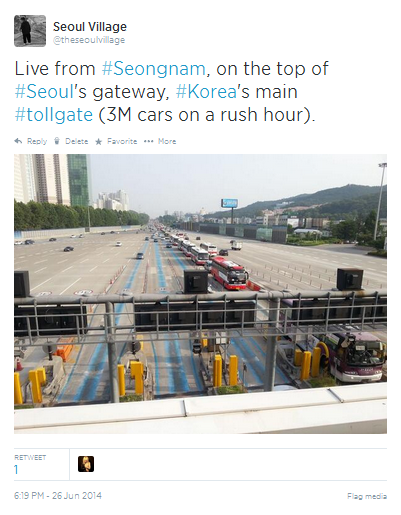

Live from Seongnam, on the top of Seoul's gateway, Korea's main tollgate (3M cars on a rush hour).
twitter.com/theseoulvillage/status/482090698359832576

(NB: West to the right, East to the left)
The contrast is even more spectacular on Google Maps:
  • To the East, Bundang stretches its 'apateu' blocks around Tancheon stream.
  • To the much West, from the green slopes of Gwanggyosan, the narrow valleys of Gungnae-dong and Geumgok-dong join Daewangpangyo-ro, a road parallel to the freeway from Geumgok I.C. (South) to Seoul beltway #100 via Pangyo New Town (North). 
  • In the center, Expressway No. 1 and its tollgate bulge (reminds me of the boa that swallowed an elephant in 'Le Petit Prince'):


The tollgate from above (NB: West to the left, East to the right)

I clearly remember watching, during the nineties, Bundang New Town rise from a sea of cranes, while the suburbs on the Western side remained stuck in time - and the mountains relatively spared.

I also remember wondering why natural embankments were not included in the New Town's original master plan: instead of the usual sinister noise barriers, green slopes would have made that side of the freeway much more pleasant. I knew that it took more space, but when you build a town from scratch, you shouldn't compromise on key elements that impact its sustainability and its perception both from the inside and from the outside...

Pangyo New Town didn't fare much better a couple of years later (see "Pangyo from scratch to crash"): noise barriers? checked - elevated highway? checked... Of course urban planners didn't seize the opportunity to cover a wide section of the highway between Bundang and Pangyo...

But I've already spilled way too much venom on Korea's New Towns here and there, and they're not the topic of the day. Furthermore, 'greenfield new towns' like Bundang now belong to the past (see "New Town out, Redevelopment in, back to the Urban Jungle").


*** HIGHWAYS AS DESTINATIONS ***


Many people see highways as tunnels in time, a moment when life is suspended between a departure and a destination, a lost moment. But the path is a destination in itself, and freeways remain an eternal source of inspiration - beyond the vast 'road movie' culture.

Smooth roads, green rest areas equipped with showers, lounges, and free wi-fi... the freeway experience in Korea has nothing to do with the nightmare of yore, and the people in charge are fully aware of importance of always improving safety and quality, of making the most of existing infrastructures (e.g. solar energy production on abandoned roads). They truly care about - yes - your happiness.

So if you drive during this Chuseok break, even if you are stuck in thick traffic, relax.

And don't hesitate to stretch time. Don't forget to take a break every two hours, the rest areas are also here for that. Why not opt out and back in, seize the opportunity and discover a part of Korea you didn't plan to see?


With my new friend in Gangwon-do. Her potatoes were fantastic, and her joy illuminated our day.
twitter.com/theseoulvillage/status/483117975265087488
(Last June, during a trip in Gangwon-do, we were invited to Gwirae-myeon, Wonju-si. Now bypassed by a bigger road, the village has seen many shops and restaurant close, which gives it a very special atmosphere)


Seoul Village 2014
Welcome to our Korean Errlines! Follow Seoul Village on Facebook and Twitter
Bookmark and Share
Add this page to your favorites


Tuesday, September 2, 2014

New Town out, Redevelopment in, back to the Urban Jungle

Korean economy badly needs a boost, and the government opted for a quick fix with long lasting effects: in "the republic of apartments", easing apartment regulations always sounds like giving junkies one massive free shot (about this most typical Korean addiction, see for instance "The Republic Of Apartments", or "Inhuman, all too human Seoul").

This at a moment when the real estate market got a bit sounder, many empty apartments created by new town bubbles eventually finding tenants. And what to say of the recent easing of DTI (Debt To Income) and LTV (Loan To Value) ratios as household debt keeps skyrocketing (over 8% last year)... 

But this is less about supply and demand rationale than about giving work to construction conglomerates, and a boost to voters' morale. I don't have the details of the 30% of the 2,400 regulations that shall be dumped by 2017, but social welfare is unlikely to gain ground to short term profits. Typically, the proportion of apartments reserved for rentals in any given block will be reduced, and there will be fewer constraints on unit sizes. LH Corporation's key assets will be sold to private developers, who really seem to be the ones calling the shots here.

Not very P.C. for an administration supposed to fight speculation and defend the interest of the weakest citizens. Interestingly, the very day the set of measures were announced, Seoul Mayor Park Won-soon met with Deputy PM Choi Kyung-hwan, a first meeting at such level since 2006, to discuss collaboration on infrastructures, including facilities along Hangang riverside, and a second cable car on Namsan*.

The best measure in the package is the end of what I call the 'greenfield new towns' (see "Wet eyes for wetlands and urban mirages"): instead of improving existing neighborhoods, authorities prefer to create artificial cities ex nihilo and extra muros because land is cheaper. Now hopefully, Korea shall significantly reduce the risk of urban nonsenses.

The most anticipated measure is the reduction of minimum age requirements by up to ten years for the reconstruction of apartment buildings, which means that the bed towns erected around the Olympics in the late eighties shall be replaced much earlier.
 
Korea to cut construction regulations: no more satellite New Town, but apartment redevelopment accelerated / Urbanism deregulation means that apartment blocks in Sanggye, Mokdong or Jamsil will be redeveloped much sooner - twitter.com/theseoulvillage/status/506611541722935296
This set of maps shows the chronology of the development of habitations in Seoul (before 1980, during the 80s, 90s, and noughties).

Among the 1987 projects that could be up for reconstruction in 2017: Sanggye-dong (Jugong 3 blocks), Gaepo-dong (Useong 3 blocks), Mok-dong (5 blocks), or Apgujeong-dong (Hyundai 3 blocks). I wouldn't be surprised if the upscale Apgujeong moved first, and made the most of these tailor-suited gifts. Nowon seems also ripe, and there's a shortage of big apartments in this former bed town gone middle class. Some apartment blocks will grow taller and more exclusive, others will struggle to find investors. 

What bugs me most is what will happen to the rest of Seoul. This remains a non-zero sum where even winners in the short term can lose in the long run. Giving free reins to private developers could help speculation return to LEE Myung-bak-era levels, and torpedo the nascent efforts to develop a more consistent and sustainable urban planning. 

The risks are well known, and the cases of urban failures across Seoul already well documented. This is the last opportunity to apply a sustainable vision for urbanism in Seoul, and certainly not the moment to let anyone do anything anywhere. 

Good or bad, the years that come will define Seoul's cityscape for good, and local authorities cannot wash their hands of the future of the capital and its citizens.

Seoul Village 2014
Welcome to our Korean Errlines! Follow Seoul Village on Facebook and Twitter
Bookmark and Share
Add this page to your favorites

* e.g. Korea JoongAng Daily 20140902: "Apartments to be rebuilt sooner" and "Deputy prime minister, mayor talk cooperation"

Wednesday, August 27, 2014

The Bigger, The Bitter

Yesterday, Daum and Kakao Corp announced that they would merge on October 1st, and Google that its first Google Campus in Asia would be located in Seoul.

The Daum Kakao merger looks rather defensive: before everything, it creates a stronger competitor to NHN, the leader operating among others the main rivals to Daum and Kakao Talk: Naver and LINE.


NHN and Daum are rare exceptions as successful newcomers in a country where start-ups struggle to survive in an ecosystem dominated by chaebols: as soon as a new gem shows some potential, the big fishes try to eat it, or to destroy it with me-toos leveraging on in-house countless entry points, or to control it by becoming its sole 'partner'. 

NHN and Daum could storm the web at the turn of the millennium, when mobile operators where busy building proprietary environments, and other chaebol focusing as usual on hardware. They built competitive platforms that even resisted Google, who only managed to gain strongholds in Korea thanks to Android. Typically, even if Naver maintains its leadership in web searches, Google could 'crowd-boost' Google Maps or Google Translate, with the help of smartphone manufacturers who were too happy to have a platform rivaling Apple to care about the hidden costs.

As we've said before, Samsung and LG helped Google BtoB (OEM) succeed where Google BtoC (portal) failed, and all they can do now is send a Tizen to nibble at the heavyweight champion's ears. 

There's a finite space for major value aggregators in Korea, and as Samsung's latest attempt to build a sustainable platform beyond hardware, Tizen probably accelerated the need for rivals to stretch their reach.

Big G needed to beef up its Asian ecosystem and Korea seems the perfect choice: Android rules, start-ups need competitive platforms to survive chaebol bullies, and Mountain View has the opportunity to weaken some of its most serious competitors on their own turf. Bonus: by supporting Korea's SME and creative ecosystem, you gain the favors of local authorities and regulators.


Anyway, good news for Korea's attractiveness... but yet higher entry barriers for potential major newcomers.


(initially published on my innovation blog as "Daum Kakao, Google Campus... Korean platforms on steroids" - see all posts related to Korea)


ADDENDUM 20140828: let's guess which 'independent' whistleblower suggested Korean watchdog to investigate Kakao Corp in the wake of the merger ("Kakao under probe for allegedly abusing market power: sources")


Seoul Village 2014
Welcome to our Korean Errlines! Follow Seoul Village on Facebook and Twitter
Bookmark and Share
Add this page to your favorites

Sunday, August 24, 2014

Jaws

This Summer's blockbuster in North Korea:


In case you missed the recent Jawgate, North Korea launched a series of insults at John Kerry, including a mention of his 'hideous lantern jaw' / 'spatula jaw' that ignited a fierce debate about the translation:


twitter.com/theseoulvillage/status/502278033621790721

The DPRK is so creative in its insult that The Guardian proposes a test to see if Baekduologists remember correctly which slur is targeting whom ("When North Korea attacks: can you match the insult to the person?"). Turns out I'm a 'capitalist swine' because I scored only 7/10:
twitter.com/theseoulvillage/status/502697844206096384


Seoul Village 2014
Welcome to our Korean Errlines! Follow Seoul Village on Facebook and Twitter
Bookmark and Share
Add this page to your favorites
.

Tuesday, August 19, 2014

... Et Spiritu Sanctiones

Pope Francis* gone, Korea is left with its multiple divisions: North v. South, Right v. Left, East v. West, Gangnam v. Gangbuk, Have mores v. Have nots, Tradition v. Blingbling, Kennip/ddeok v. Nip/tuck...

Starting from the most obvious divide, could inter-Korean relations be revived?

As we've seen before, PARK Geun-hye is definitely more open to engagement than her predecessor LEE Myung-bak, who all but offered North Korea to the advocates of 'Hanschluss'** in Beijing. On Liberation Day***, she renewed her proposal to collaborate on the protection of DMZ ecosystems, but her government is considering taking part to more ambitious projects, particularly in transport infrastructure (see "Seoul mulls helping NK transport system" - Korea Times 20140818).

Seoul decently couldn't let much longer China, Russia, or even Japan**** control all key entry points to the northern half of the peninsula. Particularly along that most vital Kaesong-Pyongyang-Sinuiju backbone, about which China and the DPRK signed a railway MOU a couple of months ago (see "China reaches high speed into North Korea... and post-Juche East Asia").

But Seoul decently can't appear to support the North Korean regime either. Even neutered by China (no more nuclear trials, we tolerate your series of rocket launches as long as they remain C.P.C.-P.C.), DPRK remains an abominable dictatorship with an awful human rights record*****. And now, only brain dead NBA / JWA veterans like Dennis Rodman or Antonio Inoki accept to pose all smiles with local leaders.

Hard to develop activities without some level of cooperation, a word that immediately brings to certain minds the spectre of LEE Seok-ki-style, hardcore collabos. And the legal framework makes it even harder, with an increasing number of sanctions. The U.N. Security Council passed series of them, the latest batch in 2013 (UNSCR 2087), but South Korea is even more blocked by its own 'May 24 Sanctions' implemented in the wake of the Cheonan sinking in 2010, and the US may well pass their "North Korea Sanctions Enforcement Act of 2013" by the end of this year. It passed the Senate and should get a nod from the House (see below House Resolution 1771 below, the full text submitted last April).


As we go to e-print, HR 1771 only passed the first hurdle (Senate)
beta.congress.gov/bill/113th-congress/house-bill/1771
(full text at the end of this post)
Sanctions against North Korea are typically the kind of issues a divided Congress can easily agree upon, and for the House an opportunity to prove it can pass something. Even if the DPRK dropped beneath US radar over the past few months (courtesy ISIS and friends), it remains a prestigious trophy for the bill sponsors, starting with Rep. Edward R. Royce (R-CA), chair of the Committee on Foreign Affairs.

The bill was drafted by Joshua Stanton, founder of OneFreeKorea, and heralded by NK pundit Lee Sung-yoon, who was invited to present HR 1771 last week at the ASAN Institute ("To change Pyongyang: North Korea Sanctions Enforcement Act 2013") where, the day before, John S. Park. Lee exposed his new research on the secondary effects of sanctions ("Targeted Sanctions and the Counterproliferation Puzzle: The Case of North Korea"). 

Stimulating talks. If Sung-yoon Lee implacably defends sanctions, John S. Park wants to make sure we know what we're doing:
  • Lee advocates targeted sanctions to limit collateral damage, but accepts them as inevitable. If the regime collapses brutally, 'so be it'. Gaesong Industrial Complex? 'Futile'. Let's put back DPRK on the list of terror-sponsoring states, and let's force the POTUS to enforce sanctions that may not all bear fruits, but can't work at all as long as there's no mechanism to implement them. No compromise, except maybe to preserve useful contacts between the Superhermit Kingdom and the outside - typically, I asked him if tourism, a field connected to luxury goods, could become a target at the service level, and he answered that no, tourism has to remain an exception (as long as the luxury goods line is not crossed, but where to draw it? ask Kempinski for Ryugyong, or the Swiss manufacturers of ski equipments for Masikryong). Even NGOs are expected to put more pressure on Pyongyang, to ask for more transparency if they want to keep operating.
  • Park compares sanctions to antibiotics, which can cure but also help an organism develop some resistance. He wants to know more about the unintended consequences of sanctions, particularly by interviewing refugees and defectors who have worked in State corporations. What kind of Plan Bs were designed? What kind of legal loopholes were explored? What kind of illegal routes were taken? For instance, he knows that takes 15 mn to wire money to North Korea via China (the cash is ready, and the middlemen take a 25% cut), but he'd love to know how DPRK manages to 'hide in the open', how it can apparently reduce its energy shortages and at the same time receive officially less oil from China. I asked him about potential new players. From a Darwinian point of view, we are helping a dinosaur evolve into a much more complex, diverse, agile, and somehow future-proof creature. We may be at the same time weakening the regime as a monolith, and strengthening North Korea as an ecosystem (does what doesn't kill Kim Jong-un make DPRK stronger?). And like we've been training terrorists during our wars in the Middle East, aren't we training a new breed of 'guerilla capitalists', thriving in the underground DPRK-China trade, but eager to explore new territories? For the moment, Park answered, we see the same faces on the North Korean side. But he fears some sanctions may maximize risks of proliferation or illegal trade by generating more entry points, more sophisticated, and less detectable.
By nature, I'm drawn to non-black-v.-white positions, and North Korea happens to be all about grey zones, so I felt more comfortable with John S. Park's approach. On the other hand, passing a bill in DC will certainly make existing sanctions more efficient, particularly as a deterrent for third parties: no one wants to be the next BNP Paribas - the French bank was fined $8.9 bn for dealing with nations blacklisted by the US.

Since it's all about securing entry points to North Korea and building legal frameworks, working on including new entry points to new legal frameworks seems to make sense. Not as in making pacts with the Devil, but as in monitoring the Gateways to Hell.

Seoul Village 2014
Welcome to our Korean Errlines! Follow Seoul Village on Facebook and Twitter
Bookmark and Share
Add this page to your favorites

* see "K-Pope mania hits Seoul, Jongno-style"
** on the 'Hanschluss Scenario', see among others "Game over for the 'Hanschluss' scenario?" and "Re-engaging North Korea - A Four Party Talk"
*** BTW since last year ("The Elusive Independence Day - When will Japan officially proclaim its Independence from Imperial Japan?"), Japan is still not liberated from Imperial Japan: 80 MPs and cabinet members visited Yasukuni on August 15th. Note that Summus pontifex eventually met with 7 survivors of Imperial Japan sexual slavery system for his final mass in Myeongdong Cathedral yesterday.
**** if Shinzo Abe keeps palling around with Kim Jong-un: "Abductors talking abductions - Revisionists talking revisions"
***** see "North Korea, Beware - Rest Of The World, Be Aware"


--- HR 1771 at this stage ---

H.R.1771 - North Korea Sanctions Enforcement Act of 2013113th Congress (2013-2014)
Sponsor: Rep. Royce, Edward R. [R-CA-39] (Introduced 04/26/2013)
Committees: House - Financial Services; Foreign Affairs; Homeland Security; Judiciary; Oversight and Government Reform; Ways and Means | Senate - Foreign Relations
Committee Reports: H. Rept. 113-560
Latest Action: 07/29/2014 Received in the Senate and Read twice and referred to the Committee on Foreign Relations.
Summary (as introduced in House 04/26/2013):
North Korea Sanctions Enforcement Act of 2013 - Directs the President to investigate credible information of sanctionable activities involving North Korea and to designate and apply sanctions with respect to any person (referred to as a "designated person" and includes business entities, nongovernmental organizations, and governmental entities operating as business enterprises) the President determines is knowingly:
. contributing, through the export to or import from North Korea of any goods or technology, to the use, development, production, stockpiling, or acquisition of nuclear, radiological, chemical, or biological weapons, or any device or system designed to deliver such weapons;
. exporting, or facilitating the export of, defense articles and services to North Korea, or from North Korea to any other country;
. exporting, or facilitating the export of, any luxury goods to North Korea;
. providing, selling, leasing, registering, or reflagging a vessel, aircraft, or other conveyance, or providing insurance or any other shipping or transportation service used to transport goods to or from North Korea, for purposes of facilitating a specified unlawful activity or evading a regulation established under this Act or the International Emergency Economic Powers Act (IEEPA);
. transferring, paying, exporting, withdrawing, or otherwise dealing with any property or interest in property of the government of North Korea for purposes of facilitating such unlawful activity or evading such regulations;
. engaging in or facilitating censorship by North Korea; or
. committing or facilitating a serious human rights abuse by North Korea.
 
Directs the President to designate and exercise IEEPA authorities with respect to the government of North Korea as well as any person or foreign government the President determines has been:
. listed or sanctioned under any regulation, specified executive order, or the IEEPA for illicit activities or activities concerning North Korea's proliferation of weapons of mass destruction;
. sanctioned under U.N. Security Council resolutions concerning North Korea's proliferation of weapons of mass destruction; or
. convicted of a criminal offense for engaging in sanctionable activities.
 
Authorizes the President to exercise IEEPA authorities with respect to any foreign government or financial institution the President determines to be:
. engaging in sanctionable activities involving North Korea;
. failing to freeze funds, assets, or economic resources of a person designated pursuant to the requirements above or that could be used to facilitate sanctionable activities relating to imports or exports;
. failing to monitor import and export transactions appropriately;
. permitting any North Korean financial institution to open any new branches, offices, or joint ventures within its jurisdiction, or to take an ownership interest in, or establish or maintain a correspondent relationship with any bank in its jurisdiction, if it could be used to facilitate sanctionable import or export activities;
. failing to prohibit transfers of bulk cash to and from North Korea in facilitation of sanctionable import or export activities;
. providing public financial support for trade with North Korea to facilitate such import or export activities; or
. facilitating the use of any proceeds of the bribery of North Korean government officials, or the misappropriation, theft, or embezzlement of public funds by, or for the benefit of, such officials.
Sets forth civil and criminal penalties under the IEEPA.
Establishes the North Korea Enforcement and Humanitarian Fund in which assets subject to criminal, civil, or administrative forfeiture or penalties are to be deposited for the enforcement of this Act and to carry out humanitarian activities under the North Korea Human Rights Act of 2004.
Expresses the sense of Congress that the government of North Korea should be treated as a primary money laundering concern that may be required to undertake special measures with respect to the recordkeeping and reporting of certain financial transactions as well as the identification of customers or retention of information relating to certain beneficial ownership, payable-through, or correspondent accounts. Directs the Secretary of the Treasury to require domestic financial institutions to apply special measures to certain designated entities. 
Directs domestic financial institutions to terminate various accounts maintained for persons, foreign governments, or financial institutions required to be designated as engaging in sanctionable activity under this Act and for foreign financial institutions providing services to such designated entities.
Prohibits a designated person that is a domestic financial institution from serving as a primary dealer in U.S. debt instruments or as a repository for U.S. funds.
 
Sets forth authority for the President to prohibit certain foreign exchange and banking transactions, revoke transaction licenses, and direct the Secretary of State to deny visas to designated aliens.
Permits the President to impose sanctions against persons providing specialized financial messaging services to designated North Korean financial institutions.
 
Requires a validated license for exports to North Korea under the Export Administration Act of 1979. Prohibits munitions and defense articles from being provided to North Korea under the Arms Export Control Act regardless of whether it is designated as a state sponsor of terrorism. 
Bars U.S. government contracts from being provided to designated persons. 
Authorizes the seizure or forfeiture of vessels or aircraft used to facilitate sanctionable activities. 
Directs the President to withhold assistance to the governments of countries providing defense articles or services to North Korea or receiving such articles or services from North Korea. 
Sets forth exceptions to designations under this Act and authorizes the President to waive designations and sanctions, for a period of up to one year, upon the President's submission to Congress of a determination that the waiver:
. protects vital U.S. economic and national security interests,
. benefits entities cooperating with investigations, and
. addresses humanitarian aid considerations while meeting other specified standards. Permits the President to temporarily suspend sanctions with a certification to Congress under specified circumstances and to prescribe rules for removing sanctions.
 
Directs issuers of financial securities regulated by the Securities and Exchange Commission (SEC) to disclose activities relating to North Korea in annual and quarterly reports. 
Authorizes state and local governments to divest assets and prohibit investments in companies that invest in North Korea. 
Exempts North Korea from the jurisdictional immunity of foreign states, thereby enabling plaintiffs to seek certain damages against North Korea regardless of whether it is designated as a state sponsor of terrorism.

Wednesday, August 13, 2014

K-Pope mania hits Seoul, Jongno-style

So Pope Francis landed in South Korea, welcomed by the traditional gun salute from the North...
Stalin asked 'The Pope! How many divisions has he got?" North Korea's suggested answer: Pope Francis is worth 5 rockets
twitter.com/theseoulvillage/status/499808764644429825

... and in the advertised set of wheels - only in a darker color than expected:

(July 28) In Seoul, Pope Francis' Soul will be white. And branded Kia.
twitter.com/theseoulvillage/status/493663654928474113
(August 14) Pope Francis' Soul is greyer than scheduled
twitter.com/theseoulvillage/status/499735563646169090

The Pope's program comprises at least 10 stations, from the Blue House today to Myeongdong Cathedral on August 18, with an Assumption mass in Daejeon World Cup Stadium tomorrow, and a mass for the beatification of Korea's 124 martyrs on Gwanghwamun Square the 16th, which requires extra security around Sejongno:

(@pearswick: Korean police to build huge wall inside Seoul for Pope visit - only those registered can enter)
Meet Seoul's inner fortress wall: the one erected downtown for Pope Francis' visit
twitter.com/theseoulvillage/status/495858701853396992
But everything seems ready for the big day:
Gwanghwamun more than ever a cross-road - Seoul's ready for Pope Francis' visit
twitter.com/theseoulvillage/status/499567502276300800
Even I am not taking any chances:
Do something, quick! I don't want to be stuck to 666 followers when Pope Francis visits
twitter.com/theseoulvillage/status/499432267295375361
(PS: thanks to the kind tweeters who lifted me away from that Number of the Beast - even if I won't be saved that easily)

The Pope will also visit several sites in Chungcheongnam-do: Solmoe Shrine in Dangjin, Haemi castle and shrine in Seosan. A stop at the martyr shrine in Seosomun Park is also planned. BTW here's the winning project in a recent competition for this historic site:


Speaking of Seosomun and Catholicism: just off Gwanghwamun, the Seoul Museum of History proposes an exhibition until October 31 on Seoul's East and West small gates (Seosomun and Dongsomun), and the - to say the least - not always festive history of Korean catholicism:
Kim Dae-geon, Korea's first Catholic priest. Among Saenamteo martyrs to be blessed by Pope Francis
twitter.com/theseoulvillage/status/499376326625595393

More


Seoul Village 2014
Welcome to our Korean Errlines! Follow Seoul Village on Facebook and Twitter
Bookmark and Share
Add this page to your favorites
.

Tuesday, August 5, 2014

Bukhansan Eunpyeong Hanok Maeul

Remember Eunpyeong New Town's Hanok Village? In case you missed that milestone project at the feet of Bukhansan and of the new town's towers, here are the main posts where they've been mentioned so far:
I'm inflicting you another update today because in this morning's mail, we received this leaflet for "Bukhansan Eunpyeong Hanok Maeul":


For this project, SH Corporation (Seoul public housing organization) must convince people who are interested in a different proposition, and won't fall with the classic hard selling techniques. Yet they're targeting first-time hanok buyers, not hanok ayatollahs (sorry to that loyal segment of Seoul Village readers; I don't mean to be mean, but you know what I mean!).

Note the absence of mention of the New Town in the branding, the green dominant, and the - relatively - high quality format. This leaflet has been printed on a much higher quality paper and in a more intimate size than the usual real estate ads.

Also significant marketing-wise, a specific 'hanok pedagogy' to lift worries commonly formulated by prospects: won't air conditioning be prohibitive? aren't hanok expensive to build? isn't their maintenance a constant headache? You can live in a hanok and enjoy modern comfort and community services.

On the site too, they did their best to differentiate the hanok village from the New Town:

- The expression 'model house' was replaced by a more respectful 'demonstrative hanok'...


- ... and traditional ceremonies were even performed for the show last year:


At least, as the construction continues, this part of the working site isn't a sea of cranes.

Seoul Village 2014
Welcome to our Korean Errlines! Follow Seoul Village on Facebook and Twitter
Bookmark and Share
Add this page to your favorites