NEW - download 'Seoul VillageS (서울 마을들)', my collection of 12 short fictions now adapted into short films! Get your free copy of the ebook (4 editions: English, French, Korean, Bilingual English-Korean)!

Showing posts with label Jongno-gu. Show all posts

Wednesday, July 8, 2026

Seoul Summer Beach and Swag

From July 20 to August 9, a giant, free water park will welcome Seoulites on Gwanghwamun Square and Sejongno Park. After drawing about 900k visitors in 2004 and 1.5M last year, Seoul Summer Beach could be even more popular with a 3rd edition featuring pools, slides, and a sand playground. 

Who knows? BTS 'could spend a lifetime watching you swim'

The sandy space will be under a 12 m wide dome that brings more to mind an igloo than a summer beach, and won't allow you to fully enjoy Seoul's most iconic scenery, but sand can be messy, particularly during the rainy season. And hygiene should be less an issue; as a Parisian, I've never dared basking in Paris Plage's sandy stretches. 


I remember chatting with PARK Won-soon about Paris Plage. 
First meant for Parisians who can't afford going on holidays, this yearly festival covers the expressway along the Seine (now reclaimed by pedestrians) with a beach anyone can enjoy for free. The former mayor was toying with the idea of adapting that other Parisian tradition (following Velib, La Nuit Blanche etc), but it wouldn't make much of a splash along the Han River (too wide a river, riversides more disconnected from the rest of the city, Hangang Park already boasting its own water activities...). 

Gwanghwmun Square and Sejongdaero are much more relevant and impactful for this kind of festivities.

Which doesn't mean that the rest of the city will remain dry: we've seen neighborhood parks transformed into water parks during the summer long before Seoul Summer Beach existed, and there are so many ways of having fun while getting soaked, from the Sinchon Water Gun Festival and its giant water slide along Yonsei-ro to PSY's torrential Summer Swag concerts.


My favorite drenched memory in Seoul remains the day I was caught by a sudden downpour in Jongno-gu. The time to run twenty meters to the closest shelter, I was already totally soaked. Because there was no way a bus or a taxi could accept me, I decided to just walk back home peacefully, simply enjoying the shower with a great smile. 

Of course, as Seoul and Korea well know*, too much water can be dangerous. So enjoy responsibly, and have a great summer.


Seoul Village 2026
Welcome to our Korean Errlines! Follow Seoul Village on Facebook, Bluesky, Threads, Substack, and X/Twitter, follow me on Instagram.
Download 'Seoul VillageS', the free ebook.

* and as PSY also knows now: he was once scolded for hosing his fans with 300 tons of water during a concert in the middle of a drought.

Thursday, December 4, 2025

Business as usual

As usual in Seoul, real estate and urbanism are never far from the headlines, but let's skip topical stuff and limit to mere footnotes recent controversies (this Seoul city erection in front of Jongmyo*? that measure from the national government**?).

Let's talk shop. 

You see in with those 'for rent' signs, you measure it with the speed at which new stores tend to close: small businesses are really feeling the pinch***. Part of it is conjunctural - the Korean economy as a whole is struggling, and demographics don't bode well for the future. Part of it is structural - more than COVID, the labor reforms that preceded changed fundamentally the street experience for Seoulites: used to a city that never slept, they're now coping with last orders at 9 pm or restaurants closing for dinner altogether.

And of course, more and more Koreans are now ordering everything online. Not just these GenZ who don't cook and limit their IRL shopping experiences to retailtainment or browsing Seongsu-dong's pop-up streets like their parents did with fashion magazines. Yes, Seoul's last mile equation is not sustainable (and as much as I appreciate last minute, early morning, ultra fresh deliveries, I'm glad their social costs are being investigated), but the trend is global, and all cities have to adapt.

It's harder to adapt when the urban hardware is obsolete. 

You're less inclined to contribute to your neighborhood's vitality when 'proximity' shops and services are not so close and in Seoul, apartment blocks tend to cut citizens from their city.

In the old gen 'apateu' blocks, a building devoted to businesses was generally included near the main entrance, sometimes in secondary entrances. This 'open ring' was seldom complete, but everybody walked or drove by these shops every day, particularly since few parking spaces were underground. These businesses belonged to the community.


Some housing complexes are more blended with their surroundings, their edges consisting of mixed use buildings. Even if there's less often greenery to compensate****, pedestrians enjoy (functionally speaking) a better street experience from the outside (urban continuity, diversity...). On the other hand, the inside may seem more exclusive. 
By nature mixed use buildings, officetels usually include shops and services. But when those take too big a share residents can easily feel overwhelmed. Many exclusive, high rise projects with only a couple of buildings have a mall on the lower floors, a 'vertical buffer' that's de facto a separate building with a devoted parking to preserve the residents' quality of life. But then, since it takes anyway 10 mn to leave your luxurious apartment and reach an entrance that's far from everything, many prefer to take their car and shop elsewhere, and this vertical city can turn into a tale of two cities. 

Another tricky model is what I call the 'captive cluster'; very common in greenfield 'new towns' across the capital region and around major cities. In the middle (in best cases) or at the edge (too often) of a group of apateu blocks that can involve different developer brands, urban planners insert a low rise block of mixed use buildings with all the shops and services on the ground floor. Some can be relatively well done, making the best of what's left of a natural landscape (e.g. waterways), and you can almost enjoy a village atmosphere that changes from the dull tombstone collections around, particularly since each lot owner build their own. But too often these clusters fail because there are not enough candidates to open shop*****, or because they've been poorly designed. 

Instead of an open grid, some of these clusters (particularly recent ones) propose only one or two car entrances and force visitors into a full round along a conveyor belt before exiting. On purpose, like a journey in an Ikea store makes you browse the whole catalogue. Except people move by car because these new towns are humongous, and the streets and parking spaces are seldom as entertaining, well drawn, and planned. Sometimes, these clusters are even split into two independent halves that don't communicate directly. And this 'captiveness' is actually a sales argument to recruit new businesses... Needless to say, not very sustainable.


If Seoul's 'MOA Town' concept signaled an evolution from massive tabula rasa to partial redevelopment, allowing more diverse cityscapes and ecosystems (see "From Human Town to Gather Town"), the market remains dominated by big projects, New Towns that obliterate real cities. 

It's not its big blocks but its remaining villages that make Seoul special. If we neuter them, if we destroy diversity, city centers will die. If we do nothing they'll die out, even if a few local markets miraculously manage to thrive and warm up whole neighborhoods.

I've been advocating pragmatic approaches to revive decaying city centers. They all involve bringing back inhabitants, even if that means designing exceptions to the rules, for example by allowing mixed uses in low rise business areas, or small scale revamps that involve shared facilities or obligations (e.g. elevators, parking spaces). Some may be implemented, stay tuned.


Seoul Village 2025
Welcome to our Korean Errlines! Follow Seoul Village on Facebook, Bluesky, Threads, Substack, and X/Twitter, follow me on Instagram.
Download 'Seoul VillageS', the free ebook.

* ICYMI Seoul city decided to replace Sewoon Sangga with a park between Jongmyo and Namsan, but also to 'compensate' by allowing much taller buildings in the vicinity, which of course doesn't fit preservation or UNESCO Heritage guidelines:


Adieu #SewoonSangga. #Seoul to replace #KimSwoogeun landmark with a park between #Jongmyo & #Namsan. But bdg heights raised to 71.9m on #Jongro (+16.9) & 141.9m on #Cheonggyecheon (+43.2). Will #UNESCO accept? #세운상가 #urbanism (20251104 SeoulVillage on X)

** ICYMI the government extended Seoul's speculative zone from the 3 usual districts (Gangnam, Songpa, Seocho) to the whole city, which resulted in a freeze in transactions (except in the 3 districts that became relatively more attractive), and a hike in rental costs. Like previous reforms, the aim seems to be crushing further the middle class and making first purchases impossible (the guy in charge of the reforms was driven by his idea that first time homeowners tended to vote more conservative)....

*** Big players are not spared, but if HomePlus will yet again change hands (Carrefour, HomeEver, Tesco... WhatEver?), its financial trouble have a lot to do with MBK Partners' disastrous management.

**** Wangsimni New Town's Majang-ro 19-gil sets a better example with dense trees on both sides,  

***** yes, these new towns also include new schools, so it's not just dwellings that are in oversupply nationwide
 

Thursday, February 23, 2023

KOTE Potluck Art Festival 2023

Between March 1 and 5,  Insadong’s cultural complex KOTE proposes an art festival rich in exhibitions, events, and performances featuring major as well as emerging artists.


About KOTE

Over the past few years, KOTE has become a vibrant symbol of Seoul’s creativity, resilience, and inclusiveness. At the crossroads of Insadong, Pimatgol, and contemporary art, a retro yet modern space to explore, connect, and inspire; a salon where, every day, cultures and citizens dialog and meet, where thinkers and creators from all horizons share and challenge each other; a unique ecosystem where visionary companies and embassies host meaningful events; a village where, in all seasons, new ideas and friendships bloom across generations, around its charming courtyard and iconic paulownia (the very name KOTE rings like both ‘court’ and ‘flower’). 


About KOTE POTLUCK ART FESTIVAL:

For five days (March 1st to 5th), the KOTE Potluck Art Festival will fill the whole complex from its courtyard to its rooftop with a rich program featuring over 150 artists from 12 countries: contemporary art, new media, installations, photography, films, music or dance performances…  a wide diversity to stimulate all senses.


Kote Potluck Art Festival 2023 (March 1-5)

Opening Ceremony: March 1st, 5 pm
Kote: Insadong-gil 7, Jongno-gu, Seoul
Tel: 02) 737-7977
email: artspacekote@gmail.com
website: kote.kr
Instagram: @kote.kr


---

ADDENDUM 20230226

A few shots from my series 'The People of Seoul' will be exhibited at KOTE's Joseon Salon during the festival:


Seoul Village 2023
Welcome to our Korean Errlines! Follow Seoul Village on Facebook and Twitter, follow me on Instagram.
Download 'Seoul VillageS', the free ebook.
Bookmark and Share

Wednesday, January 26, 2022

More Gwanghwamun Square previews

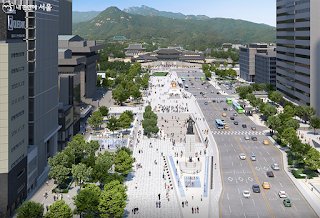
Seoul revealed new visuals of Gwanghwamun Square 3.0, which shall be inaugurated in July.

They prolong the last major iteration presented in 2019 ("Gwanghwamun Square 3.0 re-Deep-Surfaces"), which corrected one of the worst urbanistic blunders  of the initial version ("Gwanghwamun Square Enters Third Dimension"). PARK Won-soon's team rushed the construction a few months before the elections without conducting any decent impact survey, and work started late 2020. As soon as OH Se-hoon returned as mayor, he paused the site to assess the situation, but the changes could only be cosmetic.

The Woldae extension in front of the palace gate will only be created next year, so we have yet to see how vehicles flow around Yulgok-ro's future curve. Adjusting to the modifications already in place is not always easy. As expected, the intersection in front of Sajik-dan helps reconnect both sides of Sajik-dong, but the impossible new U-turn just North of the Government building stops functioning as soon as traffic slows down (too close before a major traffic light, unlike the old one heading for Sajik tunnel).

Most important, Seoul's defining axis is preserved, with its iconic Gwanghwamun-Gyeongbokgung-Bugaksan perspective, and pedestrians will enjoy a 20 m-wide park with a vast selection of tree species, guaranteeing natural shade and oxygen as they grow. That's where most of the extension (from 18 to 40,000 square meters) comes from. People will be able to sit on benches and along the Haechi Madang ramp, where street animations may bloom next to the new media wall.

Sejong-daero's pedestrian and cycling experience has already been improved with the new green walks and bike lanes added on the way to Namdaemun (see "Lower Sejongdaero's turn"). With its fountain tunnel and pavement fountain, the 'Gwanghwamun' Lounge section is likely to welcome kids and keep them fresh during the Summer. If some artifacts found during the renovation shall be on display in the cultural section, most of the Joseon era infrastructures (see timeline*) shall be covered again. I hope the tribute to Yukjo street will not look to corny. 


On the Eastern side, Junghak-dong will not host a simple reconstitution of the old Uijeongbu site, but a fusion hanok exhibition space. I wish there were more trees in that section, but that can (and probably will, if they want the spot to be successful) be fixed later.

This Uijeongbu project was on display at the Seoul Hall Of Urbanism (see again timeline below*) during the low key, pandemic-plagued 3rd edition of the Seoul Biennale of Architecture and Urbanism. SBAU will return in September 2023, with CHO Byung-soo (BCHO Architects) as its Director. This architects knows a bit about dao, and Seoul could do with some more harmony...

Ganghwamun Square reopening in the heat of the Summer will be a perfect crash test. I'm pretty sure Seoulites will quickly make it their own. At least during the evenings. And as much as that damned coronavirus will allow.


Seoul Village 2022
Welcome to our Korean Errlines! Follow Seoul Village on Facebook and Twitter, follow me on Instagram.
Download 'Seoul VillageS', the free ebook.
Bookmark and Share


* From @theSeoulVillage timeline: 


"Gwanghwamun Square last week. Seoul started controversial revamping without a proper impact survey..." (20201220 - twitter.com/theseoulvillage/status/1336888158437265408)


"The few changes since the initial plan won't prevent the expected traffic pandemonium. Tragic lack of urban planning, urbanism vision from Seoul... Sejong-daero Gwanghwamun" (20210221 - twitter.com/theseoulvillage/status/1364019424752115720)


"Western side of Sejong-daero / Gwanghwamun Square to close tomorrow for the controversial revamping (future Jeokseon-dong loop in the foreground)" (20210305 - twitter.com/theseoulvillage/status/1367760419218018306)

"As expected, works on the Western side of Gwanghwamun Square for its extension reveal Joseon time artifacts and structures related to former ministries. Here, a waterway in Jeokseon-dong (between Baekundongcheon & Junghakcheon - see seoulvillage.blogspot.com/2009/08/baekun #urbanism)." (20210319 - twitter.com/theseoulvillage/status/1372721209939431427)

"I guess mainly to evacuate overflows towards Baekundongcheon, to contain water damage in case of heavy rains. Gwanghwamun Square urbanism Jeokseon-dong Photo Chosun Ilbo" (20210319 - twitter.com/theseoulvillage/status/1372721211789037583)
"OH Se-hoon hits pause button on controversial Gwanghwamun Square revamping. Also asks AHN Cheol-soo to suggest talents for Seoul." (20210410 - twitter.com/theseoulvillage/status/1380664510638264322)


"Seoul's unearthed Yukjogeori during Gwanghwamun Square revamping:" (20210511 - twitter.com/theseoulvillage/status/1391895161337090049)


"Gwanghwamun's future Uijeongbu site at Seoul HOUR (Seoul Biennale / SBAU):" (20211028 - twitter.com/theseoulvillage/status/1453500318226935809)


Monday, June 22, 2020

Nine new museums in Seoul by 2023


Last Sunday*, Seoul announced nine new museums for the 3 years to come, after inaugurating five others over the past three years. As this map shows, downtown's dominance in cultural sites shall grow even stronger, but a few underserved neighborhoods will get their fair share:


The 5 museums inaugurated between 2017 and 2019 (NB this list doesn't count infrastructures that are not managed by the city, like the Seoul HOUR opened last year**:

The 9 museums to be inaugurated by 2023:

Melike Altinisik Architects' winning project for Robot Science Museum
As you can see, quantity doesn't always mean quality, but I'm looking forward to returning to neighborhoods I haven't roamed in a while... and I really can't wait to see that last one. Please, don't disappoint me!

Seoul Village 2020
Welcome to our Korean Errlines! Follow Seoul Village on Facebook and Twitter, follow me on Instagram.

Bookmark and Share


* see "사진·한식·로봇…서울시 '테마형 뮤지엄' 9개소 개관" (Seoul Metropolitan Government 20200622)
** see "Seoul Hall of Urbanism and Architecture, Seoul Biennale 2019 Symposium"

Thursday, May 16, 2019

Switzerland v. Gyonam-dong Alps

Nevermind that dull tower rising over Pyeong-dong, down the hill; the new Swiss Embassy truly was the last missing piece in Gyonam-dong's jigsaw puzzle. How does it fit? Can it add some soul to a lobotomized neighborhood? First impressions after a visit organized on May 15, just days before its inauguration.

***
In 1974, to build its Embassy, the Confederation purchased a land enjoying a spectacular view over the valley West of Sadaemun's fortress walls, all the way from Namsan to Inwangsan. Over the decades that followed, and particularly the past fifteen years, high rise buildings and apartment blocks have claimed big chunks of it, and 6 years ago the neighborhood was almost totally wiped out to make room for Gyonam / Donuimun New Town and its anonymous towers, destroying priceless wonders in the process (see "In memoriam Samdong Samgeori, Gyonam-dong" ).

The Swiss could have looked for another location, and maybe join such Embassy clusters as Seongbuk-dong or Itaewon / Hannam-dong, but they courageously decided to stay. Well they did move to Hannam-dong though, but only the time to avoid that apocalyptic mutation, and to replace their nondescript red brick lair with something new. Here it is, now facing Gyeonam-dong alps instead of Geumhwasan and Tongil-ro valley:

Photo Erae Architects - Swiss Embassy website

Halfway between Hong Lampa house in Hongpa-dong, and the sanitized* Donuimun Museum Village in Sinumunro 2-ga, the new landmark confirms this section of Songwol-gil as some kind of green and architecturally diverse oasis.

One roof, continuous wings, a central madang... the 2019 Swiss Embassy clearly honors the hanok style, but with a modern, deconstructed twist, and a broken version of the traditional 'ㅁ' or 'ㄷ' shapes:

The open spiral from above (mockup - Burckhardt Partner website)
Logo created for the Embassy inauguration
More an open keyring than a locked up Swiss bank vault, this Embassy wraps you up without cutting you from its environment, providing at the same time intimacy and transparency. The wide windowpanes facing the courtyard enable a dialog between the four wings (multipurpose, chancery, representation space, residence of Ambassador Linus von Castelmur), but the building is also open to its surrounding. Even the metal fence lets you see through. And if some semi-private spaces (cafeteria, living room) display some sort of ceramic moucharabieh, their lace is very wide. The biggest windows point to the sky or surrounding gardens, others direct your gaze to the greenest spots of the New Town, so that you never quite face its dead monoliths.

The outer concrete walls echo modern Swiss heritage, but wood is omnipresent, with epicea ceilings, staircases, slabs, and pilars. The lightness of the roof and structure, boosted by a gigantic sail cast over half the courtyard, could be achieved by the burial of most technical machinery in dedicated basement corridors. We also visited the nuclear shelter, compulsory for public structures of a certain size in Switzerland, but maybe not that irrelevant this side of the DMZ.


This environment-friendly building collects heat from the underground (30+ geothermal pumps), power from the sun, and water from the skies, sometimes in an artistic way, thanks to Lena Maria Thuring's 'Water connections' installation, where metal chains direct part of the flow from the rooftop to hanging stones and surface channels:


The visit was led by architects Nicolas Vaucher (Burckhardt Partner), and Lee In-ho (Erae Architects). Obviously, I followed the former:


Nicolas Vaucher in the madang, the staircase, the cafeteria, the nuclear shelter, the machinery, the residence's garden, the representation's dining room, the cultural section, the entrance.

Six years ago, I thought that all of Gyonam-dong's seven neighborhoods would disappear for good. They will never be brought back, but at least, somehow, part of Songwol-dong continues to exist under a new form.


Seoul Village 2019
Welcome to our Korean Errlines! Follow Seoul Village on Facebook and Twitter, follow me on Instagram.
Bookmark and Share
Add this page to your favorites

* see my lukewarm review in the "Seoul Biennale of Architecture and Urbanism 2017" focus

Thursday, January 24, 2019

Gwanghwamun Square 3.0 re-Deep-Surfaces

Seoul recently* unveiled the winning concept for Gwanghwamun Square renovation, and 'Deep Surface' confirmed the hopes and worries we shared in April last year (see "Gwanghwamun Square Enters Third Dimension"). As expected, things are also getting political. The good news is that the debate will continue more publicly until the end of this year. Work is still supposed to start next year, and the goods to be delivered in 2021, ahead of the 2022 presidential elections.


1) Everybody's happy...


'Deep Surface' was bound to please key members of the jury, starting with Dominique Perrault, who probably appreciated the major role played by underground structures... and maybe this new slope as an homage to his iconic Ewha ECC:


Landscape architect Adriaan Geuze (West8) certainly fell for this spectacularly lush Amazonian canopy, owed to a rendering artist who obviously projected us around year 2175, when the newly planted trees reach maturity:


If you miss already Gwanghwamun Square's vast stretches exposed to Seoul's merciless summers and winters, stand reassured, the same artist also offered this more realistic view:


Of course, SEUNG Hyo-sang and YOO Hong-jun remain key jurors when it comes to selecting a project suitable for both the Mayor and the President: the former City Architect is now heading the Presidential Commission on Architecture Policy, and the former Cultural Heritage Administration boss had earlier been mandated by MOON Jae-in to study the feasibility of his campaign pledge, eventually abandoned, to move the presidency out of Cheong Wa Dae.

SEUNG, who oversaw Seoul's shift from redevelopment to urban regeneration, must have enjoyed the focus on pedestrians and citizens, the historical continuum, and the respect of recent heritage. YOO can also be happy: if the Ministry of Culture and Tourism foots one third of the bill (Seoul Metropolitan Government the rest), the Historic Square covers 36,000 sqm compared to 24,000 for Citizen Square.

To better understand the big picture, I recommend to combine the first illustration above (perspective from Gyeongbokgung) with this project map: 


2) ... but not everybody's happy


From the start, this project's key challenges were only 10% about architecture and 90% about urbanism. As I explained before, more than the vertical alterations along Sejong-daero (extension of the square, reduction from 10 to 6 lanes), the main revolution is horizontal, what I called 'The Royal T' being transformed into a crooked Y as Sajik-ro plunges towards the South, suppressing the Western end of Sajik-ro 8-gil, and the tunnel that came with it. Sajik-ro now marks the frontier between two Gwanghwamun Squares: Historic Square (North), and Citizens Square (South).

Again, it's not just the gate that's brought closer to the center, but also the traffic. Again, merging Sajik-ro with Sajik-ro 8-gil means merging transit circuits with neighborhood circuits, and creating new unnecessary bottlenecks. And yet again, what about the bus and bicycle lanes? I'm afraid I have to stick to what I wrote last April: "Unfortunately, like with Seoullo, impact surveys have obviously been eluded in a race to meet electoral deadlines, and authorities chose to worsen traffic situations by not tackling them". Before heralding the future Gwanghwamun Square as the equivalent to the Arc de Triomphe in Paris, Mayor PARK Won-soon should have learned that for all Parisians, Place de l'Etoile is a symbol for extreme and messy traffic.

I'm not the only one to wonder if every impact is truly taken into account: as soon as the new blueprint was revealed, the authorities in charge of policing and traffic said that they had yet to agree with what's proposed, and a key administration wished it had been consulted for the road cutting through its premises.

If Seoul City is very unlikely to drop the piece de resistance from its master plan, it is also very unlikely that a satisfying solution can be found to the problems it generates. Before the end of this year? Impossible. I wish it could be compensated with public transportation, but even if the GTX A (Unjeong Paju to Dongtan) and Shinbundang Line eventually join Subway Lines 1, 2, 5 in the ambitious transportation hub envisioned, new bottlenecks will severely limit its multimodal potential.

I guess I made my point on this crucial issue, so we can move on. Now shall we further look into 'Deep Surface'?


3) Deep Surface Inside Out

Just a few elements from this very rich and complex project:


  • 2 squares instead of 1: that makes storytelling much more simple. Picture on one side the changing of the guards on Woldae (the ritual stage to be rebuilt in front of the gate), next to the hanok cluster already under reconstruction (next to the Museum of Contemporary History), and on the other side a k-pop concert at the feet of Sejong Cultural Center. Also, it's easier to contain a demonstration on the aptly named Citizens Square, while tourists claim their safer haven by the palace and its museums (not to mention pictures of the landmarks not photobombed by PARK Geun-hye supporters). Of course, there's still that humongous Government Complex ruining Historic Square's narrative and perspective, but you can always say it's a tribute to Sejongno's Yukjo tradition**.


  • In Jeokseon-dong, Jeokseon Hyundai Building seems to be turned into a 'Seoul Metro Museum'. I wonder what the tenants (e.g. Bloomberg, Korea's youth hostels association) think of it.
  • There's a lot of fuss about the potential moving of King Sejong and Yi Sun-shin statues (closer to Sejong Cultural Center), but I'm not a fan of these erections, and to me that's nothing compared to the road mess I mentioned earlier. Note that Haetae statues move back, closer to where they were in Joseon times, but nobody seems to care. 
  • Sejongno Park might at last find some purpose and relevance. 
  • I wonder why Terrace Lawn, the new slope connecting above with underground, doesn't have an actual  slope, accessible for wheelchairs or baby strollers. I hope they'll fix this ASAP.
  • ...

I'm curious to see how Seoulites will roam the space, rediscover Sejongno's Western sides, how 'Gwanghwamun Samgeori' will join 'Sejongno Sageori' in our vocabulary, how History will keep unfolding on Gwanghwamun Square 3.0.

Whatever happens, this will remain Seoul's political and cultural epicenter, and its most defining perspective (Sejongno-Gwanghwamun-Gyeongbokgung-(Cheong Wa Dae)-Bugaksan-Bukhansan).


Seoul Village 2019
Welcome to our Korean Errlines! Follow Seoul Village on Facebook and Twitter
Bookmark and Share
Add this page to your favorites


* ICYMI:


' announces new plans for . will eventually have a station, even if it slows the whole 'express' promise. The square itself will, as expected (), be on the side.' (20190121 - https://twitter.com/theseoulvillage/status/1087168047687753728) 'On the bright side, trees will make the new slope more enjoyable. (For the dark side, see )' (20190121 - https://twitter.com/theseoulvillage/status/1087169753074946049)


'Reminder: V.3.0 will cause traffic nightmares in downtown . Maybe that's what Mayor meant when he compared the project to ' Plaza...' (20190121 - https://twitter.com/theseoulvillage/status/1087470786531581952)
** the notorious six ministries. Note that the project still includes a Yukjo Street tribute and its restaurant tradition. Reminds me of that old joke with a mobster telling his staff he went to Sejong Cultural Center last night, only to be asked in return 'which restaurant?' by thugs for whom the name only refers to a foodies neighborhood.