NEW - download 'Seoul VillageS (서울 마을들)', my collection of 12 short fictions now adapted into short films! Get your free copy of the ebook (4 editions: English, French, Korean, Bilingual English-Korean)!

Showing posts with label Nuclear Security Summit. Show all posts

Thursday, March 27, 2014

The Tripartite Summitulacra

This trilateral meeting never happened:


All smiles: POTROK Park Geun-hye, POTUS Barack Obama, PMOJ Shinzo Abe

POTROK Park Geun-hye, POTUS Barack Obama, and PMOJ Shinzo Abe did shake hands, seat at the same table, and trade speeches at NSS 2014*, but that was only one notch higher on the below zero thermometer of KOR-JAP relations compared to the previous informal exchanges between Park and Abe.

This picture captures more clearly the tension and forced smiles (even the candle holder, in the background, fearfully expects sparks to fly):


The few words in Korean Shinzo prepared for Geun-hye fell flat (see twitter timeline below)
Of course, we'd love to believe in the first picture, that vintage, Oslo-1993-spirit, with Bill Obama, Yasser Park, and Yitzhak Abe working together to end the mess. But we're more in the Camp David 2000 body language, with Ehud refusing to enter when Yasser opens the door for him.

Park Geun-hye had the most to lose in a photo op that definitely allows Barack Obama the Peacemaker and Shinzo Abe the Pariah to score very useful points. North Korea and the Nuclear Security Summit 2014 provided the ideal alibi, but in order for something to happen, Shinzo Abe had to play to the gallery.

Japan's controversial Prime Minister did pledge not to touch to the Kono and Murayama Statements, but he already did that in the past, and there's no change whatsoever in his government's revisionist stance: the very day following this Tripartite Summitulacra, Education Minister Hakubun Shimomura confirmed his own rejection of the said statements**, and we know for sure these guys share the same views - Abe has always been an outspoken advocate of textbook revisionism.

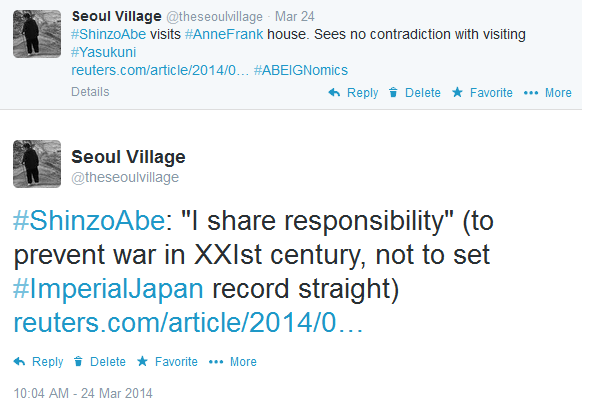
For good measure, Abe visited before the meeting Anne Frank's house, where he said "I share responsibility"... but in yet another one of his trademark, nose-thumbing references to history (see twitter timeline below). That visit happened a few weeks after hundreds of copies of Anne Frank's Diary were vandalized in bookstores and libraries across Tokyo Prefecture - a form of textbook revisionism as shocking as but more mediatized than the institutional one.

If the Tripartite Summitulacra resonates like a diplomatic victory for Abe, it must have come at a price. The one he's paid since his latest Yasukuni visit has already been already quite heavy for a nation where face-saving is paramount: first the US expressed their "disappointment", then Ambassador Caroline Kennedy canceled her NHK interview (following outrageous remarks from its governor), and then a Seoul stop was added to Obama's trip to Asia, conveniently shrinking the first three-day State Visit of a POTUS to Japan since Clinton into a less significant stay.

If historic issues were neatly put aside for the Summitulacra, they are at the center of the discussions held between Korea and Japan ahead of that trip - obviously a prerequisite for Korea to accept the Hague meeting. Korea focuses on "Comfort Women", Japan tries to throw in territorial disputes for confusion. Of course, the former issue is the priority because of its universal reach. Furthermore, it's not about Japan v. Korea, and not even about Japan v. all the nations victims to that institutionalized sexual slavery system, but it's about post-war, democratic and peaceful Japan v. Imperial Japan.

I cannot imagine one second Obama avoiding historic issues altogether, and I'd be more than "disappointed" if he didn't devote a highly meaningful moment to this particular issue.

I wish this trip could also solve the North Korea conundrum, but I wouldn't bet a Won on it. TPP, OPCON transfer, Okinawa moves? Technical details. If this man has a chance to deliver one speech for the ages in the region in 2014, that's it.


Seoul Village 2014
Welcome to our Korean Errlines! Follow Seoul Village on Facebook and Twitter
Bookmark and Share
Add this page to your favorites

* see "Remarks by President Obama, President Park of the Republic of Korea, and Prime Minister Abe of Japan" (US Embassy Seoul - 20140325)
** see "Japan’s rhetoric gets surly again" (Korea JoongAng Ilbo 20140328)

The twitter timeline around the Tripartite Summitulacra (excerpt):


Where we left things last time (see "KORUS chorus" - 20140318)
Now it's up to Park Geun-hye to accept summit with Obama and Shinzo Abe. Will she accept to put history issues aside? #ABEIGNomics (20140320)
twitter.com/theseoulvillage/status/446493174525984770


Japan and Korea discussing talks about Imperial Japan #sexslavery (NB: a condition for KOR-JAP-USA summit?) - 20140321
twitter.com/theseoulvillage/status/446940385177120768


First #ParkGeunhye-#ShinzoAbe meeting confirmed for The Hague next week. #Obama will hold the candle (20140321)
twitter.com/theseoulvillage/status/446803200482344960


#ShinzoAbe: "I share responsibility" (to prevent war in XXIst century, not to set #ImperialJapan record straight) - 20140324
twitter.com/theseoulvillage/status/447901746245816320


Even harder for #Obama to have #ParkGeunhye and #ShinzoAbe meet than to have #Israel and #Palestine meet. + the rockets are fired from #DPRK! (20140324)
twitter.com/theseoulvillage/status/448072415478697984
Historic handshake between war criminal grandson and dictator daughter (Nobel Prize winner observing) - 20140326
twitter.com/theseoulvillage/status/448630575683751937

#ParkGeunhye turned a deaf ear to #ShinzoAbe's "만나서 반갑습니다" ("nice to meet you") - 20140327
twitter.com/theseoulvillage/status/449049540348239872


Ahead of Obama's visit to Tokyo and Seoul, Japan and Korea to hold high level meetings in Washington next month
twitter.com/theseoulvillage/status/449377577962971136
  

Wednesday, March 21, 2012

NK and nukes: back to the (dolsot curling) stone age?

As expected, North Korea set the agenda ahead of the 2012 Seoul Nuclear Security Summit (see focus on Seoul Village), this time by announcing for April a 'satellite' launch in the general direction of (Japan, thank Kim The Third for small mercies) the East China Sea.

Shooting Southwards doesn't make sense if you want to optimize a satellite launch and leverage the Earth's rotation, or in the case of North Korea, if you want to minimize the risks of casualties, but of course, that's not the aim of the game. And speaking of games: sweeping such a big fat "dolsot" curling stone all the way down to the hottest spot of contention between Korea and Japan*... my oh my, what a smart way of piggybacking international conflicts! You know, like a M-VNO entering a market without rolling out its own wireless network? These guys are inventing low cost dictatorship!

As is often the case, this latest crisis can be interpreted as the North Korean idea of a private joke between what passes for the executive power there and the local army (I know, these days, distinguishing one from the other is the equivalent of a hairsplitting contest in a Buddhist monastery, particularly now that Kim Elvis has met his maker - not Kim Il-sung, the other one, if he?she?it? exists). The message? In a nutshell: swallow this bitter pill, willya? In extenso: Okaaay guys, we just reached an agreement with the Evil Empire of the United Rogue States of America about our nuclear activities, but look: we just needed the suckers to send us some more bags of rice for you, because there's only you in our lives - "Army first", remember? And to make sure we want to follow your "Juche Line"**, we'll make both the "Sunshine Line" and the "Beijing Line" angry by shooting our rocket (oops, 'launching our satellite') toward the East China Sea – heck, while we're at it, we could even crash Taiwan's party as well...

... Where was I?

In Gwonnong-dong, of course. This very morning. At the top floor of GCS International Building, enjoying a glorious view on Changdeokgung (to my left), and Jongmyo (to my right). What better location for a seminar on North Korean nukes than the headquarters of a peace-oriented NGO (GCS), with a view on two key symbols of power in 'Chosun' times: in peace and harmony on one side, with the deceased on the other...

With so much at stake, we have no choice but to try and be cautiously optimistic. And to keep humor alive. As Woody Allen put it during his intensive training of Kim Jong-un: "More than any time in history mankind faces a crossroads. One path leads to despair and utter hopelessness, the other to total extinction. Let us pray that we have the wisdom to choose correctly".

Among today's panelists, John E. ENDICOTT (President, Woosong University) was the closest to experience a near-death 'Dr Strangelove' situation: this US Air Force veteran told us how, at the peak of the Cuban missile crisis, he ended up in a bunker with the top brass announcing that doom was likely to be ignited in 20 minutes...

In these really tricky times, I'm looking forward to Obama's visit of the DMZ, a potential 'jeoneun Hanguk saram imnida' / 'Mr Kim, tear down that wall' moment. Not a game changer, but a simple message: the time of reconciliation will eventually come, and the sooner the better, but it takes a dialog between both Korean halves, starting right now.

Last year, South Korea was reconsidering its own tough-cop approach, which proved rather counter-productive... except maybe from the Chinese point of view (see "
Re-engaging North Korea - A Four Party Talk"). Today, our panelists were more interested in how far the North was ready to engage in collaboration.

Hosted by GCS International, this Asia Institute Seminar focused on "Revisiting Nuclear Safety and Nuclear Security in North Korea"***. Hard to expect full collaboration and transparency from the most secretive country on the touchiest of materials, with a nuclear industry globally in damage control mode ever since the tsunami hit the fan in Fukushima, and days after South Korea unveiled an embarrassing cover-up following an incident in its own nuclear facilities (see "
Twelve Minutes in Bballi-Bballiland"). And Sharon SQUASSONI, an expert in proliferation prevention who's visited the North several times, thinks that North Koreans themselves may be a bit too confident about how much they know about their own level of security.

You'd think the collaboration between Japan and its neighbors would have improved after last year's fiasco but it turns out that no, little or no progress has been made, and communication is already poor within an archipelago technically cut in two (electricity itself cannot circulate between West - 60 Hz - and East - 50 Hz!), and where private operators are not compelled to disclose key indicators as is the case in the US. If even close and friendly neighbors don't trust each other, no wonder the general public show doubt and defiance toward governments and the nuclear industry in general. Former Minister of the Environment KIM Myung-ja stressed the power of activists and the need for transparency.

After the Daichi mess, daily measurements of radioactivity from the Korea Institute of Nuclear Safety brought much needed clarity to the debate and today, I welcomed the precious insights from their principal researcher: a technical expert with a sound approach of the human and cultural factors, Dr KIM Sok-chul underlined the differences between security and safety, or between the perception of events, their comprehension, and their prevention. He also revealed that the risk of human errors was maximal with knowledge based behaviors (compared to ruled based or skilled based systems). The same could be said about finance and neural scoring systems but enough scary stories for today.

Actually, this very gloomy period could prove rich in opportunities. Instead of the usual blame game and finger pointing at one rogue state, both Koreas, China, and Japan could humbly seat at the same table with a simple task: we're all in this together, as neighbors and fellow (at least) civil nuclear powers, and we are all facing criticisms for various reasons. Let's share about it, and find ways to be more efficient for the next emergency. To make it simpler, let's keep Russia and the US out of this***. We won't judge each other, just make sure we handle things better than last year. Maybe, as trust and confidence grows, we'll share more information, but let's start this with modest yet vital objectives.

Since the audience was rather small, everybody could chime in, so I suggested this sort of a NEAR (North East Asia Response) task force. Earlier, Scott SNYDER, who deplored the US failure to prevent vertical proliferation, had proposed a more direct offer to North Korea: you want to launch a satellite? Great: we can do it for you, and safely. Of course they'll refuse (it's all about controlling the propeller, and not for satellites), but bringing the discussions to new planes may work better than - say - Sergey Labrov's basic reset button.


Seoul Village 2012
NEW : follow Seoul Village on
Facebook and Twitter

* see "Ieodo: I smell a fish", or the controversial construction of a US Navy base at the Southwestern tip of Jeju-do

** if you're a bit lost with the different characters, see the previous episodes of our NK drama, including "
Re-engaging North Korea - A Four Party Talk"

*** "Revisiting Nuclear Safety and Nuclear Security in North Korea" (Asia Institute Seminar) 2012/03/22:
- Introduction: CHO Cheol-je (Secretary General, GCS International)
- Opening remarks: John E. ENDICOTT (President, Woosong University)
- Panelists: Sharon SQUASSONI (Director, Proliferation Prevention Program, CSIS), Scott A. SNYDER (Senior Fellow for Korea Studies, Director of the Program on U.S.-Korea Policy, Council on Foreign Relations), KIM Sok-chul (Principal Researcher, Head, Radiological Emergency and Security Preparedness Department, KINS - Korea Institute of Nuclear Safety), KIM Myung-ja (Chairwoman, Green 21 Forum / Former Minister of the Environment)
- Moderator: Emanuel PASTREICH (Director, The Asia Institute / Professor, Humanitas College, Kyung Hee University)
On the picture, left to right: Ms. KIM, Mr. KIM, Ms. SQUASSONI, Mr. SNYDER

**** anyway, as Dr KIM pointed out, 20 years from now, 50% of the world's nuclear reactors will be located in the region.

Thursday, February 23, 2012

2012 Seoul Nuclear Security Summit

One year after the tsunami that triggered the Fukushima Daichi incident, and 16 month after the G20 Summit*, Korea will host the World's top heads of state and nuclear security experts at the 2012 Seoul Nuclear Security Summit**.

The event reaches beyond Non Proliferation Treaty signees but of course, neither North Korea nor Iran will attend (they already 'missed' the first edition - 2010 Washington Nuclear Security Summit). And of course, both will nonetheless manage to appear center stage.

At the top of the agenda (beyond Kim The Third and Ahmadinejad, that is):
- cooperative measures to combat the threat of nuclear terrorism
- protection of nuclear materials and related facilities
- prevention of illicit trafficking of nuclear materials

Threats are not limited to ill prepared facilities or 'Rogue States': nuclear materials are more than ever a prime target for terrorist groups, and even friendly countries collaborating with the IAEA are at risk (typically, Washington trusts Islamabad up to a certain point only). The presence of the INTERPOL tells a lot about the will to cooperate at a more operational level.

I bet they won't even allow one poktanju*** to detonate within a 50-mile radius during the conference.


Seoul Village
NEW : follow Seoul Village on
Facebook and Twitter

*see "G20 Seoul Summit 2010"
**2012 Seoul Nuclear Security Symposium (March 23)
2012 Seoul Nuclear Industry Summit (March 23-24)
***Korea's most proliferating WMDs: the infamous A and H bombs made with soju and beer or whisky