NEW - download 'Seoul VillageS (서울 마을들)', my collection of 12 short fictions now adapted into short films! Get your free copy of the ebook (4 editions: English, French, Korean, Bilingual English-Korean)!

Showing posts with label Junggye-dong. Show all posts

Sunday, April 26, 2026

SeMA's saemaeuldeul

SeMA's latest branch was inaugurated on March 12 in Siheung-dong, Geumcheon-gu. Between an elementary school, big apateu blocks, the huge district office and its namesake subway station, this long, low rise structure designed by KIM Chan-joong sits in a small park and dons a headband reflecting light like a screen, probably an echo to its dedication to new media art.

The new ship is docked to its neighborhood through an anchor outdoor installation (Yaloo's Shininho Landing), and an inaugural exhibition ('Mneme topos') honoring its own construction. Nothing revolutionary or pretentious; visitors are even entertained with fun signage from the parking lot to various outdoor spots. The idea seems to make families and newbies comfortable, contemporary art accessible to everyone. 

Seo-Seoul Museum of Art fills a cultural gap in southwest Seoul, and somehow combines Siheung-dong's nature dimension with Doksan-dong's industrial culture. Going to Geumnarae Central Park with the kids or to the district office for some administrative stuff? You can seize the opportunity and take a short cultural break. 

#SeoSeoulMuseumofArt in #Geumcheongu, #Seoul.#culture #architecture pic.twitter.com/DsmrQsiSbu

— Seoul Village 🇺🇦 (@theseoulvillage) April 24, 2026

Previously, SeMA only had one site south of the Hangang, in Gwanak-gu: the Nam-Seoul Museum of Art inaugurated in September 2004 in the former Belgian Consulate building relocated to Namhyeon-dong 21 years earlier.

Before Seo-Seoul, SeMA's last inauguration (in May 2025) was at the diagonal opposite in Chang-dong, Dobong-gu. A sliced dark cube - or should I say a camera obscura? - The Photography Seoul Museum of Art is a more daunting beast, with an edgier inaugural program featuring familiar names, but also experimental artists I'd never knew graced the Park Chung-hee era.


As it opens, step by step, new Seoul villages to art, SeMA welcomes as always visitors for free. In case you missed any, here are the other venues:

  • Seosomun Main Building: SeMA's Main Branch is located in Seosomun-dong, Jung-gu, in the original Supreme Court (built in 1928). Inaugurated in 1988, it moved in 2002 from Sinmunno-2-ga, Jongno-gu, within Gyeonghuigung grounds (now the site of the Seoul Museum of History).

  • Buk-Seoul Museum of Art: inaugurated in September 2013 in Junggye-dong, Nowon-gu, SeMA's second biggest branch filled a regional void and often proposes interesting exhibitions


  • Also:
    • Archives, Seoul Museum of Art (inaugurated in April 2023 on the main axis of Pyeongchang-dong, Jongno-gu).
    •  SeMA Storage (inaugurated in 2016 in the former Innovation Park in Nokbeon-dong, Eunpyeong-gu )
    • SeMA Bunker (inaugurated in October 2017 under the Yeouido park and former runway - in Yeouido-dong, Yeongdeungpo-gu)
    • Nanji Residency SeMA  (in Sangam-dong, Mapo-gu)
    • Paik Ground (formerly Nam Jun Paik memorial house, inaugurated on March 10, 2017 in Changsin-dong, Jeongno-gu)


Seoul Village 2026
Welcome to our Korean Errlines! Follow Seoul Village on Facebook, Bluesky, Threads, Substack, and X/Twitter, follow me on Instagram.
Download 'Seoul VillageS', the free ebook.

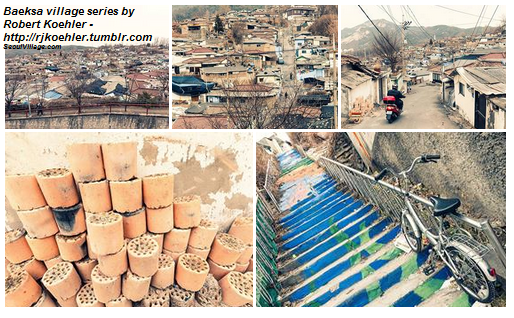
Tuesday, January 21, 2014

Over the moon

The day couldn't start any better: a beautiful series of pictures of Baeksa Village, one of my favorite 'moon villages'*. Thank you Robert Koehler!

On Robert Koehler Travel Photography site:
http://rjkoehler.tumblr.com/post/73834365491/located-in-northern-seoul-on-the-lower-flank-of
* see previous posts on Baeksa maeul:


Seoul Village 2014
Welcome to our Korean Errlines! Follow Seoul Village on Facebook and Twitter
Bookmark and Share
Add this page to your favorites
.

Wednesday, January 23, 2013

SeMA Nowon: better than Gauguin


Never say never again: one year ago, the Seoul Museum of Art announced that it would distance itself from big shows with big international names (see "SeMA to block blockbusters"), but 2012 ended with the Tim Burton extravaganza (talk about big fish), and yesterday*, The  Korea JoongAng Daily detailed SeMA's plans for the year to come, starring a major Paul Gauguin exhibition to be held June-September 2013 in Seosomun branch (talk about a summer blockbuster).

It's great, particularly for a large public who never had the occasion to see really significant works from an artist I love, but I was much more interested in updates regarding the future SeMA North Branch in Nowon-gu.

I always wondered what would come out of this site, still hidden by tall fences last time I passed by, last month. That's a very good location, between Junggye and Hagye stations, surrounded by massive apartment blocks and just in front of a key commercial hotspot: Outlet 2001 +, HomePlus (formerly HomEver, formerly Carrefour Junggye), the second one after Nowon Station, on the other side of Danghyeoncheon. Perfect to reach for new visitors, and to boost Northeast Seoul's cultural life. 

SeMA North Branch (SeMA Nowon? SeMA Junggye?) will be inaugurated in July 2013, and officials quoted in the article mentioned "crafts, design, and architecture" and "public art" as the main "verticals" for the new venue. We also received the confirmation that the Main Branch (SeMA Seosomun) would propose more international magnets. It is very important to couple each event with a more local one: I sincerely hope many visitors to the Tim Burton show stopped by the wonderful exhition of Seoul pictures on the ground floor (see "A thousand villages, a thousand memories - Seoul Photo Festival 2012"). Bonus: that expo was free. But of course, that's not the reason why I visited the Seoul photo festival expo three times, sharing twice very emotional moments with fellow visitors I'd never met before, but who had personal stories with certain pictures or photographers.

The potential repositioning of SeMA Nam Seoul (South Branch, near Sadang) is not very clear, but I guess the editorial line will remain focused on more intimate exhibitions.

What about SeMA Gyeonghuigung, that big space in the most prestigious of all locations, but an empty shell most of the time?

My dream would be a SeMA KIM Ki-chan, a living museum devoted to photography, built around the collection of Seoul's - and probably Korea's - all time greatest photographer, the man who captured the soul of the city, of its people, of its alleyways. Furthermore, Kim Ki-chan grew up just hectometers away from the site, in Sajik-dong.

That would be great: permanent collections of great Korean photographers, temporary exhibitions, and as tribute to the people of Seoul KIM Ki-chan revealed for generations to see in their daily lives, a large space devoted to photos taken by anonym citizens.

At a time when human relations grow virtual, at a time when the whole city is captured thousands of time a day by its citizens and visitors for the whole world to see on social networks, Seoul has a duty to get real and to make something of all its fantastic cultural assets.

Seoul Village 2013
Welcome to our Korean Errlines! Follow Seoul Village on Facebook and Twitter

* "Gauguin exhibition set for Seoul museum" (KJD 2013/01/23)

Monday, September 5, 2011

Junggye's "Baeksa Village" shall survive

Here's one of my favorite Seoul villages. If you take a Nowon-gu map, it's easily recognizable as the only area with a crooked shape in an ocean of neat appartment blocks. That's actually how I spotted it for the first time, and I wasn't disapointed by the place, one of Seoul's last typical "moon villages" ("달동네") with a soul of its own and an almost rural lifestyle. I took this picture* of kids playing there exactly seven years ago, and I remember the red peppers drying up on the streets, or the old people inviting us for a chat on their mat at a fork in the road.

Located on the Western slopes of Buramsan, "백사 마을" (Baeksa Maeul or Baeksa Village) doesn't owe its name to the fact that it hosts the 104-san beonji of Junggye-bun-dong (also spelled "baeksa"), but to a legendary "white snake" ("baeksa"). And "White Snake Village"'s serpentine main "street" leads you to the edge of a forest that didn't exist back in 1967, when the area first drew the attention of the media (and when Park Chung-hee's reforestation program hadn't turned Seoul's bald red hills into green lungs yet).

Last time I visited the place back in 2004, there were already talks of redevelopment. You could see many "budongsan" opening shop at the feet of the village, and in those new town crazy years, I wouldn't have bet any buck on a survival for this forsaken place.

Baeksa Maeul again made the (local) headlines not so long ago, when LH Corporation's new town plans were made public. Not very original, but at least we were spared the usual tombstone giants.


Today, the village makes national headlines because all plans have been dropped (in financial turmoil, LH has cancelled many programs over the past year), and local authorities have opted for a softer "remodelling" that partially preserves the shape, the streets, and hopefully the spirit of this very cute place. Among other sources, I recommend this KBS video ("
마지막 달동네 ‘백사마을’, 마을 한켠에 보존") where you can enjoy many different views on Baeksa Village, including films from 1967 :


I'm really happy. Not only because White Snake Village has a chance to survive without losing its soul, but because all this noise shall boost preservation for the other few surviving gems and moon villages still clinging to the city's mountain slopes.

More likely, speculators will rush here and there to snatch cheap land and build big mansions before local authorities manage to secure the areas. Not far from there in Sanggye, I could see that happen in Danggogae's former slums years ago.

Seoul Village 2011
NEW : follow Seoul Village on
Facebook and Twitter

* you've seen this picture in "Junggye Maeul" (June 2007), as well as, among other "Seoul crumbs", in dragedies.

---
UPDATE 20110906 : added a snapshot from the KBS video showing the village before/after remodelling.

Friday, June 22, 2007

Carrefour Junggye

Copyright Stephane MOT
Seoul - Nowon-gu - Junggye - Carrefour Junggye
Photo : "Carrefour du developpement" (Copyright Stephane MOT 2004)

The World's #2 retailer decided to leave Korea in 2006. Carrefour was eventually starting to earn something (and to export varieties of fresh products from small to medium sized Korean producers for its stores in France), but it just couldn't replicate its usual business model : you are not allowed to make purchases at the group level and thus make a difference at the logistics level. Even Wal-Mart failed. Price killers do exist though : you always find ways of crushing producers.


I'm not worrying for Carrefour. They got more than they could dream of from E.Land, who launched a weird mallish concept called Homever late last year.


It's just that you don't find big juici Nashi pears in their Paris store anymore. And Homever's bookstore is less fun to watch : each time I passed by, tens of kids would be sitting everywhere (even in shopping carts - see pix), reading books and not often of the comics / manga kind.


20070622

Thursday, June 21, 2007

Junggye Maeul

Copyright Stephane MOT 2004Nowon-gu - Junggye - Junggye Maeul

The old Junggye Village is dying. Towers will soon replace this up the hill slum. Villagers were poor but welcoming people. At a fork close to the top, the only shop would lay a mat for customers to sip their beverages, passers-by to join the chat or help for the preparation of gimchi. A rotten trucklet would stop nearby and sell a few veggies to anyone interested.

Steep hill but nice view on the city. Beyond, woods poorly taken care of but well guarded by noisy memmis.

20070621 (photo "Unequal access" copyright Stephane MOT 20040825)

Monday, June 18, 2007

Nowon-gu map

These maps complete the focus on Nowon-gu, which comprises 5 administrative areas :
- Sanggye-dong (10 dong)
- Junggye-dong (5 dong)
- Hagye-dong (2 dong)
- Wolgye-dong (4 dong)
- Gongneung-dong (3 dong)


Sanggye, Nowon's biggest district, hosts two key hubs around Nowon and Sanggye stations :


View Seoul Village in a larger map


For a detailed view, see also
Seoul city interactive map.

Seoul Village 2007

Nowon-gu

Copyright Stephane MOT
Nowon-gu (노원구; ) is Seoul's Northeastest and most populated district.
Population : 619,509 inhabitants (2006)
Area : 35.44 km² (max 6 km W-E, max 9 km N-S)
City Hall and official website : http://english.nowon.seoul.kr/.

Photo : "Nowon noway" (2004 - Copyright Stephane MOT)

Geography :

Nowon's main frontiers are :

  • to the West, the Jungnangcheon. Part of the district (Wolgye-dong) lies on the other side of this confluent of the Han river which also separates Nowon from Dobong-gu.

  • to the East, Buramsan and Suraksan mountains (and beyond, the city of Namyangju)

  • to the North, the city of Uijongbu

  • to the South, the district of Jungnang-gu (plus Seongbuk-gu for Wolgye-dong)
Nowon consists of 24 dong and 5 major areas (see map) :
  • Sanggye - North (10 dong)

  • Junggye - Center East (5 dong)

  • Hagye - Center South (2 dong)

  • Wolgye - South West (4 dong)

  • Gongneung - South East (3 dong)

History :

Originally a quiet and flat valley of fields dotted with a few villages of farmers (some names do subsit - ie Madeul Station), Nowon was untill 1988 the Eastern part of Dobong-gu.


The new "gu" was meant to become a bed town for the booming population, mainly newly formed households who couldn't afford more central areas. Like in Jamsil, this massive development included from the start tens of blocs of 5 to 15 storey appartment buildings. But here, most appartments were small and remote from the new city centers.

Yet, thanks to its strong internal / demographical dynamics, Nowon managed to grow from a cheap bed town into a major hub at the North of the capital, with a soul of its own and Nowon Station at its heart :
  • transports : the crossroads of subway lines 4 and 7 will also welcome a major city air terminal bound to serve the North of Seoul and the neighboring cities. The old train terminal will be relocated in Namyangju and the Dobong driving center in a more remote area of the district).

  • commerce : all businesses and national / international franchises, including a Lotte Department Store born a medium range Midopa Department Store in 1992 and now the most luxurious store in North East Seoul. The city air terminal will also host a major commercial center.

  • services : the city hall, major corporations' local branches, plus all the district's motels are near the station.

  • culture : the baby boomers turned teenagers boost the Dept Store's movie theaters, and the local cultural center regularily proposes foreign shows. A new stadium is under construction.

  • environment : Sanggye's central area is getting greener. Closer thant the old mountain's regional parks : the Jungnangcheon's riverside park, the future central park, restoration of a smaller stream...
The most select area of the gu, Junggye, remains the hottest spot for schools and housing (plus many important stores, including a Lotte Mart and a Carrefour turned Homever in 2006). A new subway line will connect Eunhaeng Sageori / 은행사거리 (Crossroads of the Banks), a major center. Between Nowon and Eunhaeng Sageori, the small stream joining Suraksan and Bulamsan mountains to Jungnangcheon, Danghyeoncheon (당현천), will be restored and could become an important cultural axis.

Sanggye New Town will totally reshape Danggogae Station area... destroying some of the few slums remaining after the completion of Seoul's circular highway 100. The remote Junggye maeul is also disappearing. I had the time to take a few pictures of both before realtors took the rest...

Nowon was meant as a popular district, as in popular for the people. Traditionnaly spared by the real estate bubble, Nowon is now getting popular for investors as well, and many Gangnam-gu speculators have recently contributed to a dramatic rise in housing prices. Many blocks are being redevelopped and all the ingredients of a pleasant place are already there.

Stephane MOT 2006

books, movies, music