NEW - download 'Seoul VillageS (서울 마을들)', my collection of 12 short fictions now adapted into short films! Get your free copy of the ebook (4 editions: English, French, Korean, Bilingual English-Korean)!

Showing posts with label Anyangcheon. Show all posts

Friday, April 29, 2022

Seoul's Waterfront Renaissance

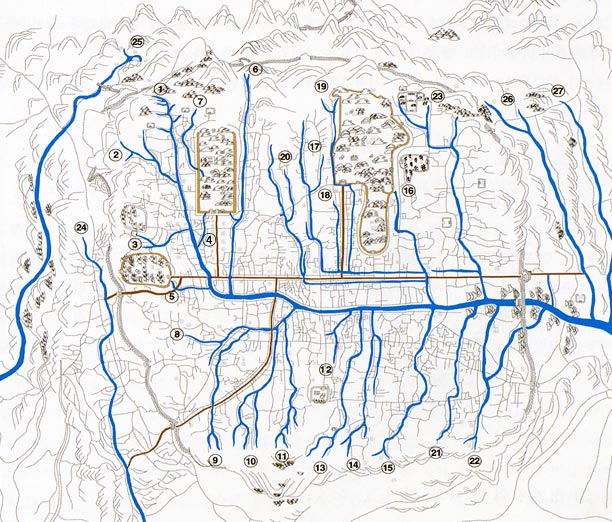
Seoul has always been defined by its most valuable environmental assets: its countless waterways, and the mountains that feed them. 

From the start, the capital revolved around Cheonggyecheon and its network of streamlets:
Nowadays, the Han River tells what's North and what's South, but waterways still account for 8.1% of Seoul's land (below in 2010):

After pouring concrete all over the place to tame the powerful Hangang and its tributaries, to stabilize unstable riverbanks, and to prevent recurring floods, the city has reopened its heart to its waterways, rediscovered them as leisure paths and environmental treasures. Following the restoration of Cheonggyecheon, the Hangang Renaissance, and the restoration of neighborhood streamlets, masses of humans, birds, and even fishes have flocked back to Seoul's watersides. Yes, more concrete was often poured in the process, but biomass keeps growing, embankments are often doubled with natural fish nurseries, and significant wetlands have been created.


Citizens are already very active along these waterways, thanks to all the infrastructure needed by strollers, cyclists, or workout maniacs:

But water level and street level are seldom seamlessly connected, and for good reasons: flash floods remain a constant threat, and these waterways help the city cope with extreme downpour. On such occasions, riversides must be evacuated immediately. Still, more citizens could spend more leisure time there, particularly when they crave for more free and cool open spaces.

More than a decade after his Hangang Renaissance project, Mayor OH Se-hoon aims at a 'Jicheon Renaissance' leveraging Seoul's 332 km of waterways. Not just with more hardware, but with more content and culture, a better connection to local neighborhoods and markets, More 'emotion', as part of an 'Emotional City' of the future vision.

Starting with 4 pilot projects along three streamlets (Dorimcheon, Jeongneungcheon, and Hongjecheon), with 2 more sites by 2030 (Anyangcheon and Jungnangcheon):

  • Hongjecheon will never fulfill its great potential as long as the Naebu Expressway disgraces it (see "Along Hongjecheon, my way or the highway"), and the pilot will focus on two spots: upstream at Hongjimun and Tangchundaeseong, midway at the artificial waterfall near Seodaemun District Office, with a place to have a drink.


  • Dorimcheon is more about the connection to the neighborhood and its businesses, with decks to make the transition and chill out:


  •  Jeongneungcheon will add a cultural layer through a new media art space:


Of course, all this requires water, particularly since the city intends to make these shallow streamlets a bit deeper (from a very thin 10 cm to a more significant 30 cm). So backstage, there's a lot of work to improve water and waste management. 

Today, 18 streamlets including Cheonggyecheon are actually fed with water recycled from the Han River, and climate change has spectacularly dried up the whole nation. Even if I knew Seoul experienced very few precipitations last Winter, I was stunned to see in a recent treck up Bukhansan, how parched soils were. But the only time water streamed by was magical:

As usual, I guess we'll have more imperfect, odd spaces requiring some improvement in further iterations. But overall, Seoul keeps democratizing access to quality time and nature, even if that's in not so natural spaces.

Seoul Village 2022
Welcome to our Korean Errlines! Follow Seoul Village on Facebook and Twitter, follow me on Instagram.
Download 'Seoul VillageS', the free ebook.
Bookmark and Share


Thursday, March 12, 2015

Burying Seobu Expressway (not all car traffic, though)

Seoul eventually confirmed the completion of the transformation of the 10.33 km section of the Seobu Expressway into a 4-lane underground tunnel by 2019, between Seongsan Bridge (Yangpyeong-dong, Yeongdeungpo-gu) and Geumcheon I.C. (Doksan-dong, Guro-gu)*. 


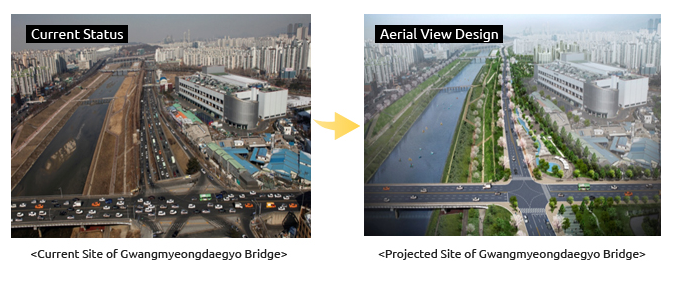
A standard road will double it at ground level, to - hopefully - take care of the local traffic, and to propose a more pleasant experience for residents and visitors: Anyangcheon will at long last be accessible through simple pedestrian crossings (from the Seoul side, Gwangmyeong residents being connected to the eastern side by footbridges), and new parks will be created, including a big one if Seoul manages to move that big, ugly garbage treatment unit. 

Overall, a greener look and feel (particularly with with these before-after pictures comparing winter and summer views!):


This clearly marks an improvement of the cityscape and quality of life in this part of the city, but not a disruption from the car-centric view. And don't expect to totally get rid of traffic noise: "vertical soundproof walls, currently installed between the Seobu Expressway and Gyeongbu Railroad Line, will be replaced with twice the amount of folded soundproof walls to reduce noise levels".

It may look a bit like Yangjaecheon, but a big part of this stretch is occupied by the Guro Digital Complex, not by mid-rise residences. In any case, good news for the district and for people working there. If sure the landowners in front of one of these crossings will find a better use of their ground levels...

Now if your start-up can't afford a Google-size campus for its staff, you can at least offer them a waterfront experience without the disgracious expressway a la Facebook (see "Zee Talk of Zee Town", "Google's Gtown wins over ZeeTown and the Large Apple Collider").


Seoul Village 2015
Welcome to our Korean Errlines! Follow Seoul Village on Facebook and Twitter
Bookmark and Share
Add this page to your favorites

* a Public Private Project on a Build Transfer Operate mode: "Seobu Underground Road To Be Constructed Through Private and Public Joint Agreement".

Tuesday, April 27, 2010

A World Cup Bridge for 2015

Just kicked off : the construction of the World Cup Bridge (월드컵대교) on the Hangang, between Mapo-gu (North) and Yeongdeungpo-gu (South), and between Seongsan Bridge (East) and Gayang Bridge (West).

This 30.7 x 1,980 m shoot will prolong Jeungsanno, a road that cut between World Cup Stadium and World Cup Park, so now you get an idea where the name of the bridge comes from.

The name of Jeungsanno comes from its mountain of origin : Jeungsan, in Jeungsan-dong, Eunpyeong-gu (it continues even further Northwards as Yeonseono). The road follows a stream, Bulgwancheon, and Subway Line 6 until Susaek Station, now the new Digital Media City. A few hectometers were added when the stadium and parc were built, but Jeungsanno stopped right in front of the Han river, waiting for a bridge to come : a big diving board hovering over the main entrance to Seoul from Incheon Airport (Gangbyeonbukno highway), and Nanji-Jigu riverside park.

On the other side, World Cup Bridge will land in Yeongdeungpo-gu in Yanghwa-dong, with a branch stretching Eastwards to Yangpyeong-dong, where traffic will merge with that from Seongsan Bridge on the way to the Seobu / Western Expressway (서부간선도로). Another branch will go Eastwards, cross Anyangcheon, and reach Gangseo-gu at Yeomchang-dong, where it will join another major axis : the road to Gimpo Airport, Gonghangno ("airport road").

If you're lost with all those gus, dongs, and cheons, the big picture :
- the World Cup Bridge will be delivered in 2015, and cost KRW 334.5 bn
- a lot of traffic will be diverted from Seongsan Bridge, easing the way from Gimpo and Incheon to the World Cup Stadium, DMC, and Eunpyeong.
- more asphalt loops and noodles ? you betcha. Cars still rule, but this new bridge does include bike lanes.


Seoul Village 2010

Friday, August 14, 2009

Gocheok-dong baseball stadium will be domed

In the focus on future Dongdaemun Design Plaza, I mentioned the destination for the replacement of the old baseball stadium : Gocheok-dong in Guro-gu.

Seoul just announced that it eventually will seat 22,000 under a dome covering all the stadium, thus delaying the delivery from September 2010 to September 2011 (see "
Korea to Get First Domed Ballpark" - Chosun Ilbo 20090814). A 2 mn promotional video can be viewed on Guro TV (gbsi.guro.go.kr).

Not a giant by all standards, but an interesting infrastructure for indoor entertainment in a rather forsaken "gu", and a major landmark between two outdoor entertainment areas, Anyangcheon and Hangang riversides (ferry connections announced by 2012).

SM2009

books, movies, music