NEW - download 'Seoul VillageS (서울 마을들)', my collection of 12 short fictions now adapted into short films! Get your free copy of the ebook (4 editions: English, French, Korean, Bilingual English-Korean)!

Showing posts with label environment. Show all posts

Wednesday, July 8, 2026

Seoul Summer Beach and Swag

From July 20 to August 9, a giant, free water park will welcome Seoulites on Gwanghwamun Square and Sejongno Park. After drawing about 900k visitors in 2004 and 1.5M last year, Seoul Summer Beach could be even more popular with a 3rd edition featuring pools, slides, and a sand playground. 

Who knows? BTS 'could spend a lifetime watching you swim'

The sandy space will be under a 12 m wide dome that brings more to mind an igloo than a summer beach, and won't allow you to fully enjoy Seoul's most iconic scenery, but sand can be messy, particularly during the rainy season. And hygiene should be less an issue; as a Parisian, I've never dared basking in Paris Plage's sandy stretches. 


I remember chatting with PARK Won-soon about Paris Plage. 
First meant for Parisians who can't afford going on holidays, this yearly festival covers the expressway along the Seine (now reclaimed by pedestrians) with a beach anyone can enjoy for free. The former mayor was toying with the idea of adapting that other Parisian tradition (following Velib, La Nuit Blanche etc), but it wouldn't make much of a splash along the Han River (too wide a river, riversides more disconnected from the rest of the city, Hangang Park already boasting its own water activities...). 

Gwanghwmun Square and Sejongdaero are much more relevant and impactful for this kind of festivities.

Which doesn't mean that the rest of the city will remain dry: we've seen neighborhood parks transformed into water parks during the summer long before Seoul Summer Beach existed, and there are so many ways of having fun while getting soaked, from the Sinchon Water Gun Festival and its giant water slide along Yonsei-ro to PSY's torrential Summer Swag concerts.


My favorite drenched memory in Seoul remains the day I was caught by a sudden downpour in Jongno-gu. The time to run twenty meters to the closest shelter, I was already totally soaked. Because there was no way a bus or a taxi could accept me, I decided to just walk back home peacefully, simply enjoying the shower with a great smile. 

Of course, as Seoul and Korea well know*, too much water can be dangerous. So enjoy responsibly, and have a great summer.


Seoul Village 2026
Welcome to our Korean Errlines! Follow Seoul Village on Facebook, Bluesky, Threads, Substack, and X/Twitter, follow me on Instagram.
Download 'Seoul VillageS', the free ebook.

* and as PSY also knows now: he was once scolded for hosing his fans with 300 tons of water during a concert in the middle of a drought.

Wednesday, March 25, 2026

Vinyl Nation

With 80% of its oil coming from the Strait of Hormuz and a currency crisis that started long before the Iran war, Korea is feeling the pinch at many levels. Beyond the obvious impact at the gas station, possible shortages in secondary products already loom on the horizon. Recently, panic-buying swept the pay+as+you+throw plastic bags issued by Seoul districts, and that's a good occasion to talk about plastic dependence here.

I mean we've seen decent progress regarding single-use plastics, for instance with reusable shopping bags at the supermarkets or reusable cups in fast food restaurants. But the land remains covered with 'vinyl houses', the East Sea the most polluted by microplastics, and the dreaded black 'vinyl bongtu' pervasive.

Black plastic is the most toxic (don't forget plastics are full of chemicals) and the most difficult to recycle. Why on Earth is this increasingly health-conscious country still hooked to that thing? You see it everywhere, and particularly where you should never see it: wrapped around food. 

And of course that black plastic is not even see-through; one of the reasons some people still prefer them to paper bags. The good news is that there are bio-source and bio-degradable alternatives that have become common in Europe, some can break down naturally in non-industrial settings, and leave no harmful waste. 

We could  also write volumes about the deadly combo of over-packaging and plastics here (how many layers of plastic even in Coupang's renewable 'Fresh Bags'?), but getting rid of these little black bags would be a good step forward.


Vinyl houses in Gimjae


Seoul Village 2026
Welcome to our Korean Errlines! Follow Seoul Village on Facebook, Bluesky, Threads, Substack, and X/Twitter, follow me on Instagram.
Download 'Seoul VillageS', the free ebook.

Sunday, July 20, 2025

Summer of Saem

Too much water falling too fast. recent flood episodes claimed 18 lives in Korea, 135 in Texas, and more than 200 in Pakistan. The world over, communities brace for more extreme weather and downpours.  

Too much water staying too long in the air: Korea's dog days are just officially starting, this year's Chobok fell yesterday, so 'Sambok' 2 and 3 are scheduled for July 30 (Jungbok) and August 9 (Malbok).

But how about your own water level? Don't forget to drink a lot, to dress light, to eat light, and if you want to avoid the fate of the narrator of 'Sweat Dream'', to keep cool.

Gapyeong flood damage (News1)

How waterways and floods shaped Seoul: time to re-watch/read my lecture 'Flow and Order: Seoul Waterways: and other Urban Stitches')


Seoul Village 2025
Welcome to our Korean Errlines! Follow Seoul Village on Facebook, Bluesky, Threads, and X/Twitter, follow me on Instagram.
Download 'Seoul VillageS', the free ebook.


Wednesday, August 9, 2023

Seoul waterways and urbanism - the full story

As Typhoon Khanun slashes through Korea, please all be safe.

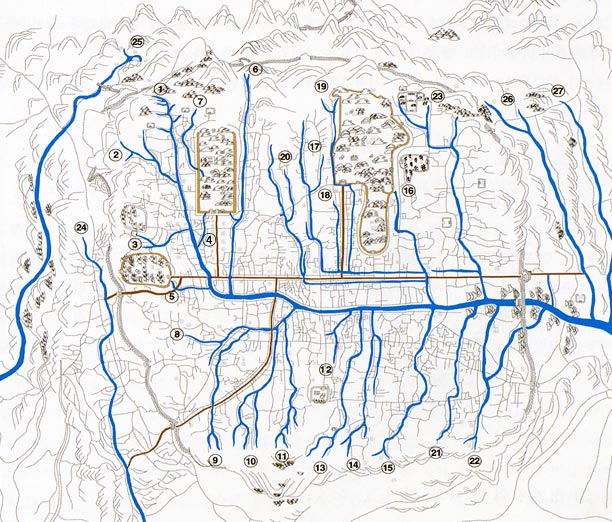
The other day in KOTE, during my lecture "Flow and order - Seoul waterways and other urban stitches", we've seen among other things how Seoul has been struggling from day one with floods, how its waterways play a vital role in managing them, and how this role is bound to become even more critical with climate change, even if the city keeps increasing its natural defenses. 

Again, I thank the Royal Asiatic Society Korea Branch for inviting me, Julie AHN for making the event possible in our beloved KOTE*, and every single member of the audience for coming. Again, sorry to have drowned you all under my overworded slides. RASKB will shortly put the video of the disaster on its YouTube channel**, and I'll add the link here as soon as it is available.

If you really want to take your time and read every line of every slide, the full presentation is here: academia.edu/105436714/Flow_and_Order_Seoul_Waterways_and_other_Urban_Stitches

Shaped by its considerable natural assets, Seoul turned into a major city by negating them in a constant fight to tame a nature capable of major destruction but unable to cope with urban expansion. In this young millennium, this war has evolved into a love story, and Seoulites are reopening an intimate dialog with waterways that even under their concrete prisons kept drawing Seoul's maps, telling the city's history and their own stories. Yet urban planners must avoid overflowing it with storytelling. If Seoul has no future without curated natural spaces, this shapeshifter of a city will always require unscripted parts.

Introduction: The city's lungs and bloodstream
1) The Way of Water vs The Highway of 'Progress'
2) The Way Forward (?) - 'Recreation', 'Renaissance', 'Emotion'
Conclusion: Storytelling vs the Unscripted Seoul


I'll drop below
a few not to wordy samples from this 56-slide trainwreck:


On Seoul's 'dong' / neighborhoods / villages, shared water, time capsules...


Angukdongcheon, the visitor that stopped at KOTE's door the other night 


Seoul choked by concrete (things have improved since, looking forward to fresh data from the Seoul Institute


An extreme climate, major changes and challenges


On the menu: The city's lungs and bloodstream / The Way of Water vs The Highway of 'Progress' / The Way Forward (?) - 'Recreation', 'Renaissance', 'Emotion' / Storytelling vs the Unscripted Seoul


Seoul Village 2023
Welcome to our Korean Errlines! Follow Seoul Village on Facebook and Twitter, follow me on Instagram.
Download 'Seoul VillageS', the free ebook.
Bookmark and Share

* always heartwrenching to see KOTE's old odong namu / princess tree down following that recent storm, but its baby is doing well, and that's a reminder that water brings life, destruction, and communities closer together.

** RASKB YouTube channel: https://www.youtube.com/@raskb1/about
   Video of the disaster: https://www.youtube.com/watch?v=9YMti3ieiHQ


Monday, July 4, 2022

Fire, fury, and de-escalation

As Seoul experiences its first tropical nights of the year, we're all wondering even more acutely how climate change will affect our daily lives in the peninsula.

First, climate change is already happening, and we already know for sure that global temperatures will rise higher than targeted during the Paris Agreement. Key tipping points have already been passed, from the ever-shrinking Amazon rain forest, now emitting more CO2 than it absorbs, to the vanishing glaciers and polar caps, to the geographically closer permafrost collapse.

Permafrost covers a quarter of exposed land surfaces on the Northern Hemisphere, releasing as it melts frightening volumes of methane in our atmosphere already saturated with greenhouse gases. If scientists have already estimated the ginormous volumes to come, it's very hard to predict how, at the local level, they will directly and indirectly disrupt currents that structurally impact (e.g. North Korea's colder seas, the Siberian air masses...). 

After a 20th century where Korea already underwent a rise of +1.8 Celsius in average temperature (more than the rest of the World), this one promises to go medieval: the 2020 South Korea Climate Change Assessment Report (Ministry of Environment and Korea Meteorological Administration) announced that by 2100, the number of heatwave days (over 33 celsius) would more than triple from 10.1 to 35.5 per year. Winters will be shortened by one whole month, and we'll experience more precipitations and extreme episodes.


Rise in numbers of heatwave days (business as usual scenario)

Over the past 30 years, I've seen Winters become not only less cold (e.g. the Han River seldom freezes beyond smaller patches), but also much drier, which probably contributes to wildfires that are more violent and difficult to tame (58% of them happen during the Spring, when the nation is at its driest). Mountain soils get washed away at the first rain, landslides and floods multiply, and as seas rise, whole ecosystems are bound to disappear (tidal flats, wetlands)...

Korea wildfires on March 5, 2022 (NASA)

The social, economic, political impacts of climate change can't be underestimated. Beyond competitiveness, that's a matter of survival, sometimes literally: the number of heat-related fatalities is expected to more than double by the end of the century, and diseases or pests that used to be contained to warmer climates are becoming endemic*.

Food security, highlighted by the war in Ukraine that exposed Korea's over-dependence on China for its sustenance, will become even more critical: by 2100, the production of rice will have dwindled by 25%. The stakes are even higher in North Korea, which relies much more on its own, ailing agricultural sector. In the region, logistics and geopolitics are already impacted by warmer seas (East Russia enjoys its own sea ports that don't freeze during the winters, new arctic routes emerge...). 

Korea destroyed its greenbelts, boosted its coal power, and crippled its nuclear power at the worst moment. In spite of a few significant projects, it's nowhere near it should be in renewables. Logically, the country scores very poorly when it should be setting the example:

Climate Action Tracker, Mars 2022

Water, biomass, and forest management is already a strategic challenge, particularly in a country where a lot of the trees share the same age thanks to the massive tree-planting campaign of the 60s. It would be nice to involve, once again, all the population in a collective effort that would benefit generations to come. 

Big cities, starting with Seoul, are already experimenting and benchmarking best practices, because everybody knows that when cities become the solution, differences can be made much faster. Obviously, a lot remains to be done. Making sure every new project should contribute to improving natural temperature control or water collection / management could help.

Korea tends to forget that its landscapes have been degraded far beyond urban environments, and again (see "From zombie maeul to seed village - from fake startup communities to real Communities-as-a-Startup"), the country must start reconsidering and rethinking its rural world as a key asset for the future.


Seoul Village 2022
Welcome to our Korean Errlines! Follow Seoul Village on Facebook and Twitter, follow me on Instagram.
Download 'Seoul VillageS' (12 fictions, free ebook).
Bookmark and Share

* BTW bad news on the pandemic front: experts expect a second massive wave of coronavirus cases from August as people will gather in confined, air conditioned area, and most of them will have lost a lot of resistance to the virus (most received their last dose of vaccine last year). 


Friday, April 29, 2022

Seoul's Waterfront Renaissance

Seoul has always been defined by its most valuable environmental assets: its countless waterways, and the mountains that feed them. 

From the start, the capital revolved around Cheonggyecheon and its network of streamlets:

Nowadays, the Han River tells what's North and what's South, but waterways still account for 8.1% of Seoul's land (below in 2010):

After pouring concrete all over the place to tame the powerful Hangang and its tributaries, to stabilize unstable riverbanks, and to prevent recurring floods, the city has reopened its heart to its waterways, rediscovered them as leisure paths and environmental treasures. Following the restoration of Cheonggyecheon, the Hangang Renaissance, and the restoration of neighborhood streamlets, masses of humans, birds, and even fishes have flocked back to Seoul's watersides. Yes, more concrete was often poured in the process, but biomass keeps growing, embankments are often doubled with natural fish nurseries, and significant wetlands have been created.


Citizens are already very active along these waterways, thanks to all the infrastructure needed by strollers, cyclists, or workout maniacs:

But water level and street level are seldom seamlessly connected, and for good reasons: flash floods remain a constant threat, and these waterways help the city cope with extreme downpour. On such occasions, riversides must be evacuated immediately. Still, more citizens could spend more leisure time there, particularly when they crave for more free and cool open spaces.

More than a decade after his Hangang Renaissance project, Mayor OH Se-hoon aims at a 'Jicheon Renaissance' leveraging Seoul's 332 km of waterways. Not just with more hardware, but with more content and culture, a better connection to local neighborhoods and markets, More 'emotion', as part of an 'Emotional City' of the future vision.

Starting with 4 pilot projects along three streamlets (Dorimcheon, Jeongneungcheon, and Hongjecheon), with 2 more sites by 2030 (Anyangcheon and Jungnangcheon):

  • Hongjecheon will never fulfill its great potential as long as the Naebu Expressway disgraces it (see "Along Hongjecheon, my way or the highway"), and the pilot will focus on two spots: upstream at Hongjimun and Tangchundaeseong, midway at the artificial waterfall near Seodaemun District Office, with a place to have a drink.


  • Dorimcheon is more about the connection to the neighborhood and its businesses, with decks to make the transition and chill out:


  •  Jeongneungcheon will add a cultural layer through a new media art space:


Of course, all this requires water, particularly since the city intends to make these shallow streamlets a bit deeper (from a very thin 10 cm to a more significant 30 cm). So backstage, there's a lot of work to improve water and waste management. 

Today, 18 streamlets including Cheonggyecheon are actually fed with water recycled from the Han River, and climate change has spectacularly dried up the whole nation. Even if I knew Seoul experienced very few precipitations last Winter, I was stunned to see in a recent treck up Bukhansan, how parched soils were. But the only time water streamed by was magical:

As usual, I guess we'll have more imperfect, odd spaces requiring some improvement in further iterations. But overall, Seoul keeps democratizing access to quality time and nature, even if that's in not so natural spaces.

Seoul Village 2022
Welcome to our Korean Errlines! Follow Seoul Village on Facebook and Twitter, follow me on Instagram.
Download 'Seoul VillageS', the free ebook.
Bookmark and Share


Wednesday, September 22, 2021

Seoul 2030 - a software update

Mayor OH Se-hoon unveiled the 'Seoul Vision 2030' he announced on his inaugural address last April*, an occasion to highlight differences with his 'predesuccessor' PARK Won-soon.

By picking the slogan 'Seoul, a fair city that runs again', ever the ambitious OH delivers two not so subliminal political messages:

  • I want to rally all citizens who want an end to the unfair system that's controlling local and national politics, and 
  • it's not just Seoul that's moving again: I'm running again, with 2027 in sight.

The goal remains the same as a few months before he left office: to lift the capital into the World's top 5 cities. The difference is that since then, under PARK, Seoul has lost its momentum and regressed from 10th in 2010 to 17th last year, which makes the task all the more daunting. To foot the KRW 48 tn bill (USD 41 bn), OH bets on a surge in real estate revenues as well as on undisclosed budget trade-offs. Not sure the equation stands, but Seoul must do something to stop the bleeding as its population shrinks and its businesses struggle.

This 'Seoul Vision 2030' is more about software than about hardware. Typically, it doesn't challenge the urban planning part of 'Seoul Master Plan 2030' laid out in 2015, with its triangle of international hubs (historic center / Yeouido-Yeungdeungpo / Gangnam) and its 7 metropolitan hubs (Yongsan, Sangam-DMC-Susaek, Cheongnyangni-Wangsimni, Jamsil, Magok, Gasan-Daerim, Changdong-Sanggye). Such macro projects are freight trains that can't be rerouted at will. OH can't even stop lighter projects such as the controversial Gwanghwamun Square revamping**; only pause to adjust and adapt in order to limit the negative impacts and to improve urban continuity.

But of course, this being Seoul, a lot of real estate remains on the menu. And hundreds of thousands of new dwellings will be added to the existing oversupply.

The bad news is that redevelopment is unleashed on a large scale, with significant deregulation and the removal of key constraints (F.A.R.), and that a lot of the few remaining Seoul villages could suffer.

"Old #Seoul neighborhoods potentially open for redevelopment jumps from 14 to 50% through #Seoul's new #urbanism guidelines... brace for the worst." (20210527 - twitter.com/theseoulvillage/status/1397728062775513090)

Focusing around certain subway stations may help spare some of them, and result in Hapjeong-izing more neighborhoods (no mentions about new subway projects, but that could come, as usual, closer to next year's elections...):

"#Seoul confirms plan to 'revitalize' #subway station areas (250m radius around stations), starting with 13 pilot projects. Higher rise allowed, mixed uses residential / commercial / offices / services. Will #Hapjeong-style clusters multiply? I'd prefer more stations. #urbanism" (20210705 - twitter.com/theseoulvillage/status/1411963191089721346)
On the upside (literally), new neighborhood parks are planned in proto-urban limbos around Seoul mountains. If done properly (that's a big if), it could paradoxically protect the mountains themselves by creating sanitized but green buffer leisure spaces in stead of unlimited, littered gateways that push unruly crowds deeper into the wild. Most visitors would enjoy a pleasant moment without needing to reach any further, leaving more space to wildlife and respectful mountain lovers.
"#Seoul creates new neighborhood parks in decrepit mountainous areas where development projects have failed for 20 years, starting this year in #Cheonwangsan (#Cheongwandong and #Hangdong, #Gurogu) and #Choasan (#Changdong, #Dobonggu and later #Wolgyedong, #Nowongu). #urbanism"
(@theSeoulVillage 20210910 - twitter.com/theseoulvillage/status/1436132137258795017)

Seoul targets a 40% greenhouse gas reduction by 2030 and carbon neutrality by 2050, but to achieve that, will it continue to outsource part of the dirty job to Gyeonggi-do (see "Seoul Power Play: One Less Nuclear Plant, One More Coal Plant")?

Obsessed with Seoul's business competitiveness, OH Se-hoon wants to seize a momentum and snatch as much of the Hong Kong exodus away from Singapore as possible, and to attract FDIs getting cautious about Korea's neighbors Japan (who wants to be the next Carlos GHOSN?) and China (hard-soft power supremacy challenged worldwide, investors wary of XI Jinping's authoritarian moves). Foreign media were already flocking in before South Korea's government pushed its own laws stiffling press freedom.  In that context, the creation of an agency modeled after Singapore's EDB makes perfect sense. How it articulates with existing entities (SBA etc) remains to be seen.

How Yeouido can turn into an international finance magnet without structural reforms at the national level also puzzles me.

Like during his first mandate, OH wants to boost international tourism, this time up to 20M visitors a year. He insists on culture which is of course essential, but that will take more than a 'Seoul Festa' and kpop events.

I'm more interested in how Seoul intends to nurture and boost the local startup ecosystem, deep and wide. Hosting 40 unicorns by 2030? that's mostly for the show. Building new clusters? as if there weren't enough already... I prefer the concept of mentoring programs for seniors: recent trends already show more 50-year+ executives joining previously almost exclusively young crews, but there's a need for a much broader-reaching, more inclusive approach. 

The 5 pillars of 'Seoul Vision 2030' are "fairness, coexistence, safety***, future sensitivity, global leadership", and 'future sensitivity' is a nice way of saying the whole population should be involved, innovation requires pedagogy and respect for everyone.

"Fairness", and "coexistence" are the most beautiful and difficult challenges. Seoul aims at equal opportunity, fostering women activity and youth employment, seniors access to lifelong learning programs, Seoul Learn online education platform for underprivileged students... Basic income will even be tested. Ending the gender war among younger generations should be added as a core Seoul Development Goal.

By the way, on Thursday, the 3rd SBAU (Seoul Biennale of Architecture and Urbanism) kicked off. An anticlimatic event in a most complex climate, but always the opportunity to connect a few new dots and to confront different visions of different cities:


Seoul Village 2021
Welcome to our Korean Errlines! Follow Seoul Village on Facebook and Twitter, follow me on Instagram.
Download 'Seoul VillageS', the free ebook.
Bookmark and Share

* The launch of a Seoul Vision 2030 Committee was the 5th pledged made by the new Seoul Mayor:

"
The 5 pledges of #Seoul mayor #OhSehoon (NB: good luck with that):" (@theSeoulVillage 20210428 - twitter.com/theseoulvillage/status/1387308187209015300)


** see among others "Gwanghwamun Square 3.0 re-Deep-Surfaces"

*** mostly in a pandemic context.