NEW - download 'Seoul VillageS (서울 마을들)', my collection of 12 short fictions now adapted into short films! Get your free copy of the ebook (4 editions: English, French, Korean, Bilingual English-Korean)!

Showing posts with label Busan. Show all posts

Monday, January 1, 2024

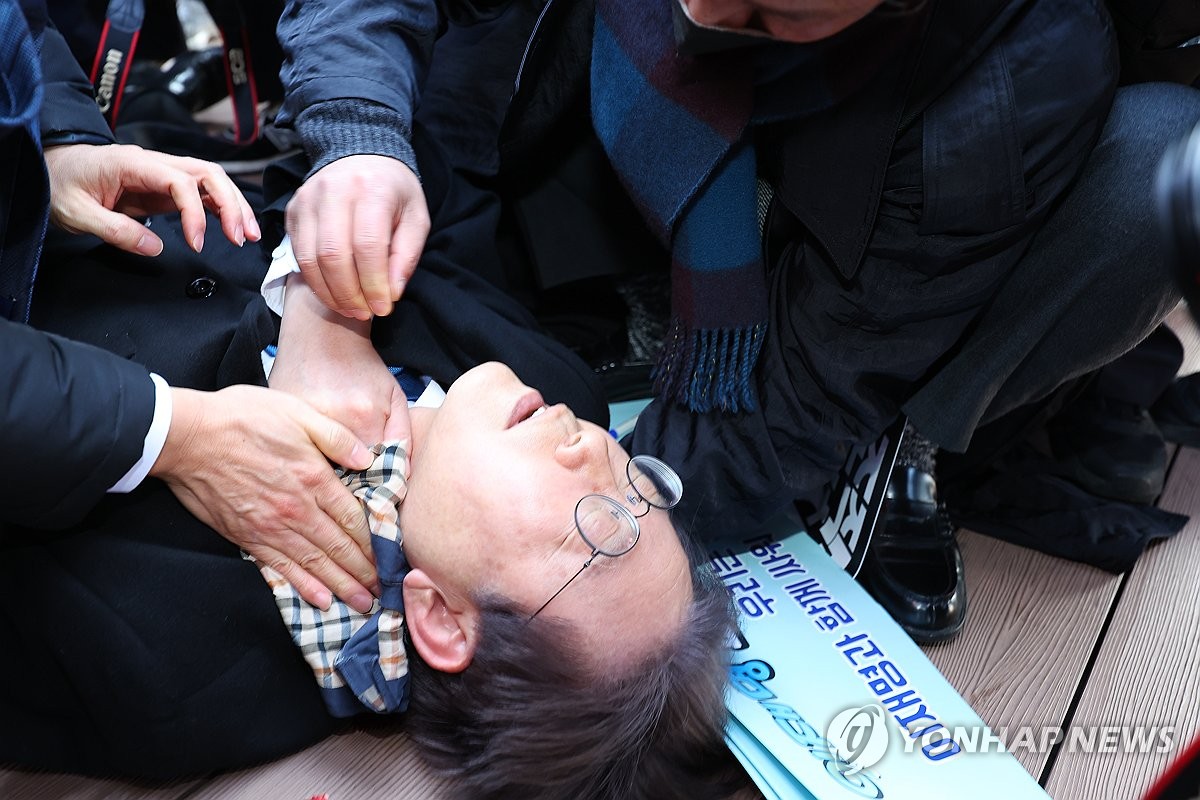
Assassination attempt on LEE Jae-myung in Busan

LEE Jae-myung was stabbed in the neck this morning in Busan on the campaign trail. The 50-year-old culprit was arrested on the spot and LEE rushed to the hospital in critical condition. I wish Korea's opposition leader the soonest recovery.

As much as I dislike the character and the threat he poses to justice and democracy, this is the very negation of democracy and justice, and a very somber day for Korea.

This tragic event echoes the 2006 stabbing of another controversial figure, PARK Geun-hye, also in the neck. PARK went on to become president 6 years later. I wish LEE well, but not that well.


Seoul Village 2024
Welcome to our Korean Errlines! Follow Seoul Village on Facebook and Twitter, follow me on Instagram.
Download 'Seoul VillageS', the free ebook.
Bookmark and Share

Thursday, April 8, 2021

After OH Se-hoon's Hangang Renaissance, Who In 2022?

If both Seoul and Busan delivered landslide victories to PPP candidates, yesterday's by-elections were less a conservative triumph than a crushing defeat for the ruling party, and a double-edged sword win for moderates between two much more consequential votes.

Here's the score:

  • Busan: PARK Hyun-joon (PPP) 63% - KIM Young-choon (DP) 34%
  • Seoul: OH Se-hoon (PPP) 57.5% - PARK Young-sun (DP) 39%
  • Both winners claimed 100% of the districts*.
     

OH Se-hoon campaigning in Sinchon on April 6 (photo S.M.)

PARK and OH offered rather humble acceptance speeches out of respect for the context and the expectations of voters, but also in sharp contrast with the ruling party who, last year, interpreted their landslide win at the 2020 legislative elections as, instead of a referendum on the handling of the pandemic, an absolute mandate for the very reforms that, under normal circumstances, should have led to their defeat:

  • They not only kept undermining the separation of powers in the name of justice reform, but prolonged the CHO Kuk scandals with the CHOO Mi-ae and YOO Mee-yang scandals... They even managed to create, all by themselves, their strongest presidential challenger to date: YOON Suk-yeol.
  • They not only pushed even further suicidal real estate reforms that kept crushing the middle class and leading have-nots to have even less, but also got entangled in the LH scandals.

No wonder even the inept, irrelevant PPP could defeat this embarrassing crew. Yet conservatives shouldn't make the same mistake as the DP, and believe or claim that conservatism won. It's a democratic, centrist alliance that made all the difference. And what Korea wants, what Korea needs now is neither an ideological, stubborn conservative rule, nor a ideological, stubborn left, but a pragmatic, moderate, centrist, uniting leadership**. 

Actually, conservatives lost the PPP primaries when center-right OH Se-hoon defeated NA Kyung-won. And the pact OH cemented with AHN Cheol-soo (who won the centrist primaries against  KEUM Tae-sup) worked perfectly: they wrapped up their poll-based primaries right on time, and campaigned together in a rare display of political fair play.

Centrist leader AHN Cheol-soo and weather vane kingmaker KIM Chong-in on stage in Sinchon, campaigning for OH Se-hoon on the eve of the 4.7 elections (photos S.M.)

When announced the winner yesterday on TV, OH Se-hoon was obviously very moved, and remained seated for a few seconds. Probably thinking about the miscalculation that cost him his job ten years ago, when he put it in the balance for an unnecessary referendum on school lunches (ironically, the left won by campaigning against a measure of social justice usually pushed by socialist parties - only the rich pay for it)***. Maybe remembering his exile in Kingali and Lima, his failed political return five years ago (see "OH Se-hoon returns... but did he ever leave?").  Certainly reflecting about how, just weeks ago, he was still an underdog...

Now OH looks ideally positioned for the 2027 presidential elections, except for the fact that he is once more facing a hostile majority at the Seoul metropolitan council. He only won the job for 15 months (the remainder of PARK Won-soon's mandate), and will have to campaign again next year with little chance to bring significant change in between: even before the elections, LEE Nak-yon let everybody know that his party would obstruct his every move... LEE's dumb statement immediately backfired but anyway, after yesterday's debacle, the ruling party's former front-runner doesn't stand any chance for 2022's main prize: Cheong Wa Dae.

Who will win next year's presidential elections? 

If the PPP learns the lessons from Seoul, they will try to further evolve, and build a big tent reaching for the center and YOON Suk-yeol, whom AHN Cheol-soo has already been rooting for. A PPP momentum means less room for a fully independent candidate. I'm not sure the former top prosecutor will want to run, but this liberal certainly won't do it under a very conservative banner.

The ruling party will probably try to perform some cosmetic changes and bring new faces, but they have to abandon the anti-democracy path they've chosen recently, and preferably with a better candidate than a Trump-style populist like LEE Jae-myung. He could win, but then Korea would lose.

Whatever The Future brings, this being Korea, we shall be hearing some more about real estate during the campaign...

'WTF. Seoul election results by... subway lines and stations!!! Actually quite entertaining. Oh Se-hoon. Park Young-sun' (@theSeoulVillage - 20210407 - twitter.com/theseoulvillage/status/1379795550023774213)


Seoul Village 2021
Welcome to our Korean Errlines! Follow Seoul Village on Facebook and Twitter, follow me on Instagram.
Download 'Seoul VillageS', the free ebook.
Bookmark and Share

* Beyond Seoul's 25 'gu', OH even won every single 'dong' / neighborhood, except 3:

  • Seongsan 1-dong (Mapo-gu) by 168 votes
  • Hwagok 8-dong (Gangseo-gu) by 309 votes
  • Guro 3-dong (Guro-gu) by 863 votes. 

** I should add 'inclusive', because that's also what Korea needs. But not yet what Korea wants. OH Tae-yang, the first openly LGBT candidate for Seoul mayor, finished 9th out of 12 with 6,483 votes (0.13%). That's a first step, but Korean politics remain overwhelmingly homophobic.

*** In case you forgot, the referendum that caused OH Se-hoon his job, and the scandal that hit his rival KWAK No-hyun right afterwards, opening a path for a very lucky PARK Won-soon: "Seoul free school lunch referendum (continued)" (20110612), "In memoriam OH Se-hoon" (20110824), "Kwak's "gros couac" (20110830)

Thursday, April 10, 2014

Redrawing Korean Maps - Innovation Clusters

Maps time!

More than ever, the NW-SE axis forms the industrial backbone of South Korea. Since 2010, the regions of Yeongnam (Busan-Gyeongbuk-Gyeongnam-Ulsan-Daegu) and Hoeseo (Chungnam-Chungbuk-Daejeon-Sejong) have boomed much more spectacularly than Sudogwon (Seoul-Incheon-Gyeonggi):


Korea's main industrial regions in 1980 and now - the purple dots mark sites added after 2010 (Yeongnam clearly ahead of Hoseo and Sudogwon)
The recent adoption of a system of innovation clusters certainly contributed to a phenomenon facilitated by improved infrastructures, particularly in transports. Each region has now clear "verticals", knowing that, of course, not all regions and clusters are not created equal:


Clear "verticals" for each region

Zooming in, the regional hubs and their interfaces (simplified maps):


Sudogwon (Seoul-Incheon-Gyeonggi) - Paju among the missing hubs
Chungcheong, where Samsung invests massively in displays for instance in displays
Yeongnam Daegyeong (North) - NB: I'm glad nothing is planned around Andong
Yeongnam Dongnam (South) - Busan the natural magnet
Honam - a less dense network
Gangwon - new infrastructures (e.g. railways) shall help this laggard of a region catch up. As long as they don't spoil Seoraksan..
On the Korea Industrial Complex Corporation's e-cluster.net website, you can also get all details at the mini-cluster level. Here, Seoul, where the DMC and the G-Valley (around Guro) play key roles:


The Korea Industrial Complex Corporation promotes a global vision and consistency in a complex system where some major industrial parks are directly under the authority of the government, while many are attached to local authorities**. Launched in 1997 to replace a system of regional management corporations, the KICOX started the following year with the Paju publishing hub, and led the shift towards innovation clusters in 2004.

Naturally, only a few clusters may become international leaders, and there's always a rob Peter to pay Paul effect, not to mention environmental impacts. But as we speak, Korea's map keeps being redrawn.

And such clusterfucks as Saemangeum will probably keep popping up: in Korea like anywhere else, you'll never prevent all politicians from nurturing pharaonic pet projects.


Seoul Village 2014
Welcome to our Korean Errlines! Follow Seoul Village on Facebook and Twitter
Bookmark and Share
Add this page to your favorites

* "4곳뿐이던 산업단지가 30년만에 131곳 `진격의 충청`" (MK News 20140410)
** just like with the special zones (FEZ - Free Economic Zone / FIZ - Foreign Investment Zone / FTZ - Free Trade Zone...)

Monday, February 10, 2014

Pilgrimage

I haven't posted anything over the past weeks: I was on a pilgrimage in Indonesia, my first return since 1989, when the nation was still under Suharto's yoke, and I an ESSEC student. 

For my first experience in Asia, I worked as an intern for a French bank in Jakarta. In the evening and on week-ends, I would often bajaj my way across parts of the capital I wouldn't have the opportunity to discover otherwise, and sometimes reach by car into Jawa Barat (Cirebon, Pelabuhan Ratu...). To go to Yogyakarta, I took the old Dutch train that basically never stopped between both cities, the mechanics taking only a few minutes to oil the rusty antique after each 12 hour journey... which left me 24 hours to visit the city, Borobudur, and Prambanan. And to celebrate the end of the intership, I indulged in a week in Bali, with a jeep to explore every hill and village.

This pilgrimage started in Bali and ended in Jakarta, with a big chunk devoted to Jogja. And for the final leg of the trip, I took once more the train from Tugu to Gambir, an 'express' (only 7h18!) that lacked the quaint charm of its green ancestor, but compensated with a much higher level of comfort, and even allowed me to say a brief hello to Cirebon*. From the train windows, rural Jawa looked relatively unchanged, the suburbs significantly extended, and the recent floods still visible.

Of course, Jakarta is dotted with much more high rise buildings than a quarter of century ago, but it didn't change as radically as Seoul over the past decades. This may not last long, with these steady 5%+ GDP growth rates and FDI billions pouring into Indonesia. I already saw a couple of scary round blocks towering over whole neighborhoods, as if some mad urbanist had used a giant round hole punch and left the 50 m thick disc standing out, then built newtownish apartment towers over it.

By the way... hard to escape Korea in 2014 Indonesia. In Yogyakarta city, posters advertize a K-pop festival, and in the countryside, jobs in Busan - here, near a lovely, remote, and warmly welcoming hamlet in Argomulyo district (Kecamatan Cangkringan, Kabupaten Sleman, Daerah Istimewa Yogyakarta):

Ad to recruit workers for Busan, in Indonesia countryside near Merapi volcano (wage USD 800 to 2 K)
twitter.com/theseoulvillage/status/431403149207674880


Seoul Village 2014
Welcome to our Korean Errlines! Follow Seoul Village on Facebook and Twitter
Bookmark and Share
Add this page to your favorites
.
* on my previous trip I passed by Bandung - the French program "Des Trains Pas Comme Les Autres" later (1993) made a focus on that cult line

Sunday, November 11, 2012

From urban mirages to urban decay

The KRIHS (Korea Research Institute for Human Settlements - 국토연구원 - krihs.re.kr) delivered last week a grim portrait of Korean rust belts: of the 144 industrialized zones it surveyed, 23 would show early signs of urban decay, and 44 would be seriously emptying themselves. Some counties have never recovered from the collapse of the textile industry, but I'm more interested in the stories of urban centers.

Over the past few days, the Korean press buzzed about the findings, and I'm not surprised to see the Korean JoongAng Daily focus today* on the example of Incheon's Nam-gu, and the failures of short sighted urban development. I precisely took downtown Incheon as the textbook case of downtown sacrificed by Korea's suicidal urban planning in a recent focus ("Wet eyes for wetlands and urban mirages"), from which I reproduce here the 'About New Towns and the laws of gravitation' part:

"New cities must always be conceived with a long term vision that encompasses the past as well as the future. And one of the great tragedies in Korean urbanism is the fact that developpers prefer to build from scratch a new city instead of improving existing ones, even if it means the eventual failure of both. I understand the short term economics, but that's simply not sustainable.

That's true for both "Urban New Towns" and "Greenfield New Towns". The first expression may sound like a tautology, but that's how I define New Towns replacing partly or totally an already urbanized area. I often lament about how, in Seoul, New Towns tend to obliterate all reference to the past. There's a quantum leap between improving a city and negating it, and that's exactly what happened when whole neighborhoods vanished, replaced by over-sanitized and over-standardized blocks of tombstone "apateu". If the spirit of Seoul villages could somewhat survive in certain complexes, the city may face new challenges as the generation that ignited the baby boom passes away.

Moving on to "Greenfield New Towns", now. If you want to evaluate their impacts, don't just consider their direct environment. Take Incheon, for instance: even if you remain within Incheon territory, Songdo is only part of a gigantic scheme that involves other greenfield projects (eg Cheongna), and partial redevelopments of existing neighborhoods. But at the heart of the city, many places have regressed over the past decade, surviving in some kind of limbo. In other countries they would have been priorities for improvement, but they don't stand a chance when money talks first in urban planning. What may seem good for business in the short term may prove to be socially, politically, and economically counter-productive in the medium to long term.

In countless places across the country, some cities are already schizophrenic entities with brand new districts totally disconnected from former city centers stuck in the wrong side of the eighties, and if authorities don't invest now to fix the balance, the mess will only get worse (note that the winners of today may not be the winners of tomorrow considering the end of the universal "apateu" model, the relatively low cost of land downtown...).

If you can try to pass the buck to the next administration, you simply can't escape demographics."

In the US, downtown Pittsburgh somehow manages to bounce back after lost decades, but only after land value dived to the point whole parts could be redrawn with a sounder environmental approach. Downtown Incheon remains far from that stage, and will need to find its own model for revival.

The KRIHS found similar patterns in most cities, but I note a clear difference between Seoul and all others. If you take Incheon, Busan, Daegu, Gwangju, or Daejeon, cities are hit in their historic centers, generally in their "Jung-Buk-Nam-Dong-Seo-gu" (Center, N-S-E-W districts). In Seoul, it's more in the periphery, with Eunpyeong-gu, Nowon-gu, and Gwanak-gu in the 'early decaying' stage, and Gangbuk-gu and Jungnang-gu in the 'hollowing out' stage.

Of course, it's not that simple. The survey is based on demographic trends and proportions of old buildings which could also become opportunities, and situations may differ spectacularly at the micro level. Eunpyeong-gu, for instance, exposes spectacular disparities between its new town areas, the Tongil-ro axis, and more withdrawn neighborhoods. Some projects are already under way: Gangbuk might bet a needed boost from the future Ui-Sincheol LRT (Light Rail Transit) line, Nowon from the renovations around its center (see "Nowon confirmed as Seoul's northeast hub"), and Seoul can play on more levers than other cities... but the lack of strategic vision remains embarrassing.

Even with their significant cultural assets, it's hard to tell how Gwanak or Jungnang are defining themselves, let alone where they're heading for. Excluded from major projects, they are more considered as transitional spaces than well defined urban entities, and the only literature I can find about them recycles the usual cliches. Both have the opportunity to build themselves a more balanced future than their neighbors, but for that to happen, they need to solve their own identity crisis, and to stand for something.

And of course, Seoul has the mission to make sure no one is left behind, that each and every one belongs, and at the same time to respect and nurture the originality and diversity that make metropolises sustainable. It's like a soccer team: it's not just about star power, and you can tell the strongest ones by their weakest points.


Seoul Village 2012
Welcome to our Korean Errlines! Follow Seoul Village on Facebook and Twitter

* "Old downtowns in Korea’s cities are hollowing out" (20121112 Korea JoongAng Daily)

Saturday, April 21, 2012

Busan Corner on Taxi-daero


Each time I ride my bicycle from Yeonhui-dong to Hongdae, I follow the same Yeonhuimat-ro / Donggyo-ro line. And each time, I make a couple of mental notes along the way: I must come back for this and that eatery, I haven't visited them in a long time.


The first section is called Yeonhui's street of flavors (Yeonhuimat-ro, formerly Yeonhuimat-gil) for a reason: people come from far away for the food, even for a dish as simple as Yeonhui-dong Kalguksu.


The second section is far less inviting: basically an apartment block (Imgwang Apartment) stuck between two disgracious elevated infrastructures (Seongsan-ro and the Gyeongui Line). But even there you can find a couple of restaurants.


The next stretch is a paradise for authentic Chinese cuisine lovers (see for instance Hong Bok or Ha Ha). That's also where you'll find the very Chinese-friendly Yeonhui-Yeonnam Global Village (Seoul Global Center).


Further afield, Donggyo-ro shifts by 45 degree from Southwest to South, until it reaches the new park. I knicknamed that 100% restaurant section "Taxi-daero" because both sides of the street are always fully packed with diagonally parked cabs (a good sign if you believe in Word Of Mouthwatering, that Great Tradition among Taxi Drivers).


Soon after the park, Donggyo-ro meets with Yeonnam-ro and takes you to Hongik University Station and Seogyo-dong, drawing a big smile north of Yanghwa-ro (there again, countless places to take a snack, including Charles Sutbul Gimbap).


I've already mentioned this new park, a potential game-changer for a neighborhood that badly needed one. Bonus: the best configuration possible for cafes and terraces. They only reopened the section between Donggyo-ro and Yanghwa-ro, but right now, this 30 meter wide band covering the AREX looks very promising, even if Mapo-gu didn't invest a lot in the trees, rather rachitic. Speculators have started raiding the spot a couple of years ago, and many buildings have already being remodeled. I sincerely hope they won't let them grow taller than 2-3 levels because that would totally ruin the area, as is already the case for the section North of Donggyo-ro (on this picture, along Kolon Apartment):


I'm also worried about Taxi-daero because if this neighborhood becomes too successful, more shops shall move from Hongdae, and I wouldn't want the place to look like yet another Garosu-gil.

What I fear most is the disparition of unspectacular landmarks that make this place so special and particularly Busan Corner, a delicious and cute eatery ideally located at the Southernmost end of Taxi-daero, with a view on the garden, or rather on this catwalk for anorexic plants. The owner is a very kind lady from Busan, who cooks simple and delicious local snacks (부산먹거리) for a song:


Bibim dangmyeon (비빔당면)


Homemade odeng soup (수제오뎅탕)


Busan Gimbap (부산김밥)


Busan Corner  / 부산코너 (snacks)
At the corner of Donggyo-ro and AREX park, Mapo-gu
Tel +82.322.9242

Seoul Village 2012
NEW : follow Seoul Village on Facebook and Twitter


* Note that the garden will continue on the other side of Yanghwa-ro, but for the moment that's just a barricaded working site from which only the new AREX exit emerge. When they connected the Incheon-Gimpo Airport line to Hongdae station they changed the numbering system for all subway exits, and I once sent by mistake a friend to that no man's land - not the best first impression for Hongik University area.

Tuesday, March 13, 2012

Twelve Minutes in Bballi-Bballiland

Between 8:34 and 8:46 on February 9, 2012, the Gori-1 reactor of KEPCO's Kori Nuclear Plant lost power, a first for the national nuclear industry (operational since 1978). More embarrassing: it took 12 minutes to realize that the back-up system didn't work either, the kind of details that could lead to a meltdown. And the reactor was under a safety inspection, which theoretically means under close scrutiny...

Twelve minutes, that's about the time it took for South Korean guns to retaliate following the shelling of Yeonpyeong-do by North Korea, in late 2010, because they were pointing in the wrong direction during ROK navy drills*.

I've already mentioned the unpreparedness of South Korea regarding blitz attacks from the North**, but the Kori incident confirms serious risk management issues in strategic fields. In the land of 'bballi bballi', some long term vision might also help.

Kori, or Gori, or more accurately Go-ri, Jangan-eup, Gijang-gun, lies within Busan Gwangyeoksi limits, a.k.a. Busan Metropolitan City, 3 million souls. You lucky you, here's the map***:


View Seoul Village in a larger map

Seoul Village 2012
NEW : follow Seoul Village on Facebook and Twitter

* see "We need to talk about KIM". Note that the Obama administration dissuaded SK from carrying a larger counter-attack. Considering the precision of the shots, that was probably a sound call.
** see "
Korean blitz : all bases loaded"
*** on the Eastern shores, as usual (see my post-fukushimesque "
Shaken and stirred")

Monday, September 20, 2010

Chuseok dreams : tunnels between Korea, China, and Japan

I remember, before the construction of the Channel Tunnel between France and England, how images of earlier projects would resurface, including those from Napoleon era (early 1800s), where horse coaches would travel on paved road under the sea, tall brick chimneys reaching for the surface every mile or so to help people and animals breathe... The 50.45 km long "Chunnel" is now a reality, changing forever the face of European transports, London becoming almost a suburb of Paris*.

On this Chuseok day, the Chosun Ilbo mentions* 3 undersea railway projects under investigation between Korea and its neighbors. It's not the first time we hear about them, but things seem to be getting more serious.

The shortest project is 3 times longer than the Chunnel : it would connect Jeju-do with the mainland at Mokpo, putting Jeju only 2:26 hours away from Seoul by KTX. Sounds great but a bit disproportionate : I like Jeju very much, but the island only boasts half a million inhabitants. Even boosting the traffic (already millions of tourists every year) wouldn't make the concept viable.

Linking Korea with Japan makes much more sense, Busan-Fukuoka remaining the most likely axis (1 hour and 222.6 km according to the plan). But the connection should then continue across the archipelago far beyond Kyushu, and I wonder if it could be seismically sustainable.

What to say of the third project, a 341 km / 95 mn link between Incheon and Weihai (Shandong), with an artificial island in the middle ? A very ambitious project, but the shortest way if you put North Korea out of the equation, which is precisely the aim of the game : China would easily control major entry points to the peninsula for people and freight, and make reunification less a necessity.
Seoul Village 2010


* those darn Brits would turn the sentence around - after all, they dared chose Waterloo, the symbol of Napoleon's fall, as their main station for the Eurostar bullet train ! Mercifully, the new St Pancras Station is less an embarrassment for French visitors.

** see "
개통땐 서울~제주 KTX로 2시간 26분… 국토해양부 "타당성 조사중"

Monday, September 6, 2010

KIAF, Busan Biennale, and Gwangju Biennale

Every other year, contemporary art hunters hop across Korea. Among other stops, a trio of now established events :


KIAF 2010 : after
really claiming international recognition in 2008, the Korea International Art Fair pushes harder into the global stage. Names ? I could mention Damien HIRST because Britannia is ruling this year and this show has a lot to do with hype and money, but since art is involved, I picked this "Untitled" by Jean-Michel BASQUIAT.
- what : 5,000 works exhibited, 1,500 artists, 193 galleries from 16 countries (guest country UK with 15 galleries, Japan 16, Germany 13...), special exhibition "Creative Present: Korea Media Art"...
- when : 2010/09/09-13 (vernissage Sept 8th)
- where : 1F Hall A&B, COEX, Seoul
- more :
kiaf.org


2010 Busan Biennale : more compact than the previous edition, this biennale isn't as much a pan-Asian mecca as the PIFF for the movie industry.
- what : theme "Living in Evolution", Special Exhibition "Now, Asian Art". Artistic director Azumaya Takashi. 75 artists, 135 works.
- when : 2010/09/11-11/20
- where : Busan Museum of Art, Busan Yacht Center, Gwangalli Beach, Busan Cultural Center, Busan City Hall... (main exhibition and side events)
- more :
busanbiennale.org


8th Gwangju Biennale : A mix of new commissions and older works is supposed to give a temporary museum touch to this emotional edition themed after Ko Un's poem "Maninbo" ("10,000 Lives"), itself a tribute to the 1980 Gwangju uprising. 30 years after the massacre, visitors will meet completely different faces in a completely different environment.
- what : theme "10,000 Lives", 134 works stretching over the last century. Curated by young artistic director Massimiliano Gioni.
- when : 2010/09/03-11/07
- where : Gwangju Biennale Hall, Gwangju Museum of Art, Gwangju Folk Museum
- more :
gb.or.kr


Seoul Village 2010

Monday, July 19, 2010

Online sales become the first distribution channel in Korea - or is door-to-door back ?

When I first came to Korea 20 years ago, Department Stores were becoming the main distribution channel for many consumer goods, taking over traditional door-to-door sales.

Convenience stores (FamilyMart, LG25 - now GS25 -, BuyTheWay, 7Eleven...) were also gaining ground. Then came the hypermarkets (eMart, Carrefour at one moment, Samsung / Tesco HomePlus, Lotte Mart...), and the SSMs / SuperSuperMarkets (Lotte mySuper, HomePlus Express, eMart Everyday...).

One by one, small groceries / mom & pop stores closed, and traditional markets plummeted, killed by discount shopping (or supposedly "discount" shopping : a recent survey pointed out that for many food items, traditional markets are actually cheaper). Survivors could count on a system that protected both food majors and small distributors : product packaging including the price tag regardless of the sales channel guaranteed the same price for such basic items as instant noodles or ice creams. But this system is about to be abandoned and anyway, it didn't mean much anymore : big discounters sell their own brands of instant noodles, and my local SSM offers a year-round 50% discount on all ice creams.

Even as competition raged between discount shops, many opening 24/7/365, Department Stores (Lotte DS, Shinsegae DS, Hyundai DS, Galleria DS...), sometimes growing into ambitious complexes (ie Shinsegae Centum City in Busan) remained ahead for many consumer goods and fashion.

Until now : online sales have just become Korea's first distribution channel.

This doesn't come as a surprise for anyone living in "ubiquitous" Korea : beyond pure players (ie Auction), even brick and mortar leaders are pushing ecommerce very hard, prefering cannibalization to the loss of a customer.

Somehow, we're back to square one and door-to-door sales. The first door is your mobile, PC or TV screen, but everything is done to deliver it wherever you live (home deliveries keep booming), wherever you work (Seoul would collapse without cheap express deliveries), and even wherever you go (ie location based services and mobile couponing).

Like for ADSL or FTTH, Korea's economy of access is unbeatable. Because of urban density, because major players are ready to offer what comes as a premium anywhere else, and furthermore because in many cases for smaller fish, the last mile is provided by people working under the legal hourly wage, ready to make a buck even if it doesn't make any sense if you simply take into account transportation costs. When you see a truck carrying about five hundred eggs on a highway, you know something is wrong. And when you order a book online, the delivery person is rarely twice the same plain-clothes individual.

I guess that's one of the reasons why Amazon is not in Korea. The retailer tried to do some business via Samsung / SIMS more than ten years ago but failed. So Amazon ships from other countries to international customers while Kim & Chang law firm securely protects Amazon.co.kr URL.

Of course, Amazon would face pure players in cultural goods, such as Aladdin (now Aladin.co.kr), or Kyobo Book Center (very ambitious in the ebook ecosystem), but I don't think it's about competition : players differenciating themselves on logistic platforms tend to struggle here. Carrefour left the country in spite of commercial success for regulatory reasons : it couldn't operate with its usual purchasing power model. I think the logistics equation could be very tricky for Amazon.

eBay is faring much better in Korea (as Auction.co.kr) - it even wolfed down G-market, snatching it away from Inter Park... but eBay is more into auctions and C2C than into retailing and B2C. And when it advertised massively on internet shopping, big retailers pushed the pedal to the metal.

But the biggest revolution for e-commerce in Korea this year is the end of Microsoft Explorer's de facto monopoly since July 1st : since 1999, all online shopping and banking services had to use ActiveX systems, but the Financial Services Commission put an end to it following the recent boom in smartphones.


Seoul Village 2010

Monday, February 23, 2009

Pierre Gagnaire a Seoul

I don't know whether "Pierre Gagnaire à Séoul" can help revive the very corny Lotte Hotel or not, but it had been ages since I last pushed its doors... and I guess I'm not the only customer to experience this weird feeling on his way to the 35th floor and to the first restaurant by a 3 Michelin Star Chef in Korea.

After Paris, Tokyo, Hong-Kong, and Dubai, the Pierre Gagnaire franchise opened shop in Seoul.

The timing couldn't be worse... or better for the Lotte Group : all luxury restaurants are struggling, but this chaebol is on an aggressive investing drive (purchasing food and beverage companies, building a new 555 m high Lotte World II...), and intends to gain ground as rivals struggle (most rivals : fellow retailer Shinsegae just opened a giant new complex in Busan, and purchased at a bargain price a key building near its headquarters in downtown Seoul).

Enough biz talk. And let's not waste time describing the curvy decor creating two niches with a view on the city center, enhanced by a smart system of mirrors.

Food, now. For this first encounter of the third kind in Seoul and after experiencing some overacted cuisine extravaganzas at "Gaya par Pierre Gagnaire" in Paris, I didn't dare taking too risky a path on the rather stimulating menu, and went for a simple and classic course. No surprise there (ie veal with eel and boletus), except for a few successful innovations maintained on the side (ie amuses-gueule and dessert), and at the right level.

My first impression : not a major disruption, but the possibility for Seoulites to enjoy the real Parisian-style, 3-star thing.

This fills a competitive gap with rival Asian neighbors, and could spark some positive competition at the national level. Eventually. And if Lotte can sustain the "caprice" until better times come.

Knowing that a much quicker and more positive way of putting definitely Seoul on the global culinar map would be to promote high end Korean restaurants : this courageous opening doesn't make for last year's tragic loss (see "Annus Horribilis").

Pierre Gagnaire à Séoul
Lotte Hotel Seoul 35F New Wing, Sogong-dong, Jung-gu, SEOUL, ROK
Tel +82.2.317.7181, 7182

Seoul Village 2009

see other restaurants in Seoul and Korea.

Sunday, May 25, 2008

Beefing up Korea

Red carpet to Middle Eastern and other Arab nations : one month ahead of the KAS (The Korea-Arab Society), 22 Arab countries are attending a conference in Seoul today.

Cultural issues will be mentioned, and Seoulites are already invited to enjoy local delicacies at the Arab Cultural Festival*, but the menu clearly highlights energy and oil supplies as the main dish. I guess we'll also get a slice of real estate and finance : LEE Myung-bak never made a mystery of his intentions to see more petrodollars reaching the Korean shores.

Korea will definitely need some help in the months to come (inflation, weaker won, commodity and food prices, slower growth...). The real estate sector faces gloomy times : more constructors are going bankrupt, some banks may fall, and more than a few individuals as well (non-fixed rates are favored here as well / bad).


And the MBtious President needs to deliver some good news for his own good : he had to apologize last week for not warning the public about the resumption of US beef imports**.

In spite of LEE's affection, US is not exactly the most popular flavor around Gwanghwamun these days***, and building partnerships with new players should pay in the long term as well : France secured many important deals in times of trouble thanks to similar ties with Arab countries.


* this should go beyond the usual spots near Itaewon's Mosque. See Arab Cultural Festival website : arabculturalfest.com. (June 6 to 8, 2008)
** mad cow disease is a relevant issue, but Korea should also cope with other food related health hazards, not to mention asbestos in the subway, cancerous materials used in interiors... a specific agency seems long overdue.
*** unless Obama wins - Barack asked the Government to give up Korean - US FTA

---
update 20080527 - Al Ahli Group and Busan city teaming up to make a Marvel Entertainment theme park by H1 2013... this is not exactly the kind of cultural outcome one could have expected from this conference... nevermind. The best sashimis on Haeundae courtesy Wolverine ?

Thursday, May 8, 2008

7 zones

LEE Myung-bak's government is facing big hurdles these days but at least something seems relevant : grouping provinces and big cities around 7 economic zones, and accelerating bullet train projects at the national level. I hope this won't alter the "cluster" approach but boost each region.

The 5 major zones will be :

- Central metro : Seoul + Incheon + Gyeonggi-do - major : finance & hi tech
- South East : Busan + Ulsan + Gyeongsangnam-do - major : heavy industries
- Daegu / Gyeongbuk : Daegu + Gyeongsangbuk-do - major : electronics, textile, energy
- Chungcheong : Daejeon + Chungcheongnam-do + Chungcheongbuk-do - major : science, R&D, education
- Gwangju / Jeolla : Gwangju + Jeollabuk-do + Jeollanam-do - major : tourism

Two provinces remain on their own :

- North East : Gangwon-do - major : tourism and medical
- Jeju : Jeju-do - major : tourism

Not a dramatic change for Jeju but some hope for Gangwon, now a segment of one potentially more advertized overseas. Splitting Gyeongsang is an even smarter move. Jeolla remains untouched and focused on tourism, but a "Sun Belt" Economic Zone is also planned from Mokpo to Busan along the South Coast in order to rival Seoul and accelerate the demographic and economic development of Mokpo area. Top chaebols will be invited to open vice-national HQs in the new zone. Preferably not in the Busan area, already a major hub by itself.

If new administrative levels could limit the intranational competition between self proclaimed Asian hubs, they are not necessarily good news - poorly handled they would even destroy value everywhere. I also suspect some potential cannibalization / coopetition with Korea's existing cluster strategy.

Sunday, January 13, 2008

The Bulldozer Canal

President-elect-and-under-judicial-threat LEE Myung-bak confirmed his ambition to build a canal joining the Han and the Nakdong rivers during his first (and theorically only, unless he also manages to remodel the constitution) mandate.

One more project on the Seoul - Busan axis ? I'd rather see Korea build a circular bullet train line to balance the country's infrastructures with a milder impact on the environment. Or even better, invest in the much needed restoration of Seoul's subway stations, many of which are plagued with asbestos dust falls (30% of Seoul Metro's employees are rumored to be suffering from this cancerous material).

As the name of his Cyworld blog shows*, "Bulldozer" LEE is ambitious : one year to plan, three years to build (2009-2011), and one year to campaign for a second term. Not much time to think and plenty of time to sink ?

The former CEO of Hyundai Engineering and Construction wants his pharaonic project to be 100% financed by private companies. All chaebols have already been invited to a roundtable, and Middle East investors are likely to pour the bulk of the $15 bn announced.

A quick reality check already showed the actual number would be triple that... and a tedious real estaty check would probably multiply it tenfold.

A streamlet as a Mayor, a canal as a President... should LEE become the next BAN Ki-moon, he'd probably dig a new ocean or at least an Asian equivalent to the Mediterranean sea.


* http://mbtious.cyworld.com/