NEW - download 'Seoul VillageS (서울 마을들)', my collection of 12 short fictions now adapted into short films! Get your free copy of the ebook (4 editions: English, French, Korean, Bilingual English-Korean)!

Showing posts with label Junghakcheon. Show all posts

Wednesday, January 26, 2022

More Gwanghwamun Square previews

Seoul revealed new visuals of Gwanghwamun Square 3.0, which shall be inaugurated in July.
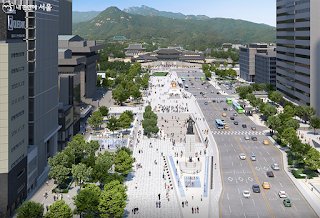
They prolong the last major iteration presented in 2019 ("Gwanghwamun Square 3.0 re-Deep-Surfaces"), which corrected one of the worst urbanistic blunders  of the initial version ("Gwanghwamun Square Enters Third Dimension"). PARK Won-soon's team rushed the construction a few months before the elections without conducting any decent impact survey, and work started late 2020. As soon as OH Se-hoon returned as mayor, he paused the site to assess the situation, but the changes could only be cosmetic.

The Woldae extension in front of the palace gate will only be created next year, so we have yet to see how vehicles flow around Yulgok-ro's future curve. Adjusting to the modifications already in place is not always easy. As expected, the intersection in front of Sajik-dan helps reconnect both sides of Sajik-dong, but the impossible new U-turn just North of the Government building stops functioning as soon as traffic slows down (too close before a major traffic light, unlike the old one heading for Sajik tunnel).

Most important, Seoul's defining axis is preserved, with its iconic Gwanghwamun-Gyeongbokgung-Bugaksan perspective, and pedestrians will enjoy a 20 m-wide park with a vast selection of tree species, guaranteeing natural shade and oxygen as they grow. That's where most of the extension (from 18 to 40,000 square meters) comes from. People will be able to sit on benches and along the Haechi Madang ramp, where street animations may bloom next to the new media wall.

Sejong-daero's pedestrian and cycling experience has already been improved with the new green walks and bike lanes added on the way to Namdaemun (see "Lower Sejongdaero's turn"). With its fountain tunnel and pavement fountain, the 'Gwanghwamun' Lounge section is likely to welcome kids and keep them fresh during the Summer. If some artifacts found during the renovation shall be on display in the cultural section, most of the Joseon era infrastructures (see timeline*) shall be covered again. I hope the tribute to Yukjo street will not look to corny. 


On the Eastern side, Junghak-dong will not host a simple reconstitution of the old Uijeongbu site, but a fusion hanok exhibition space. I wish there were more trees in that section, but that can (and probably will, if they want the spot to be successful) be fixed later.

This Uijeongbu project was on display at the Seoul Hall Of Urbanism (see again timeline below*) during the low key, pandemic-plagued 3rd edition of the Seoul Biennale of Architecture and Urbanism. SBAU will return in September 2023, with CHO Byung-soo (BCHO Architects) as its Director. This architects knows a bit about dao, and Seoul could do with some more harmony...

Ganghwamun Square reopening in the heat of the Summer will be a perfect crash test. I'm pretty sure Seoulites will quickly make it their own. At least during the evenings. And as much as that damned coronavirus will allow.


Seoul Village 2022
Welcome to our Korean Errlines! Follow Seoul Village on Facebook and Twitter, follow me on Instagram.
Download 'Seoul VillageS', the free ebook.
Bookmark and Share


* From @theSeoulVillage timeline: 


"Gwanghwamun Square last week. Seoul started controversial revamping without a proper impact survey..." (20201220 - twitter.com/theseoulvillage/status/1336888158437265408)


"The few changes since the initial plan won't prevent the expected traffic pandemonium. Tragic lack of urban planning, urbanism vision from Seoul... Sejong-daero Gwanghwamun" (20210221 - twitter.com/theseoulvillage/status/1364019424752115720)


"Western side of Sejong-daero / Gwanghwamun Square to close tomorrow for the controversial revamping (future Jeokseon-dong loop in the foreground)" (20210305 - twitter.com/theseoulvillage/status/1367760419218018306)

"As expected, works on the Western side of Gwanghwamun Square for its extension reveal Joseon time artifacts and structures related to former ministries. Here, a waterway in Jeokseon-dong (between Baekundongcheon & Junghakcheon - see seoulvillage.blogspot.com/2009/08/baekun #urbanism)." (20210319 - twitter.com/theseoulvillage/status/1372721209939431427)

"I guess mainly to evacuate overflows towards Baekundongcheon, to contain water damage in case of heavy rains. Gwanghwamun Square urbanism Jeokseon-dong Photo Chosun Ilbo" (20210319 - twitter.com/theseoulvillage/status/1372721211789037583)
"OH Se-hoon hits pause button on controversial Gwanghwamun Square revamping. Also asks AHN Cheol-soo to suggest talents for Seoul." (20210410 - twitter.com/theseoulvillage/status/1380664510638264322)


"Seoul's unearthed Yukjogeori during Gwanghwamun Square revamping:" (20210511 - twitter.com/theseoulvillage/status/1391895161337090049)


"Gwanghwamun's future Uijeongbu site at Seoul HOUR (Seoul Biennale / SBAU):" (20211028 - twitter.com/theseoulvillage/status/1453500318226935809)


Sunday, July 15, 2012

Suseongdong Valley


This valley depicted by landscape artist "Gyeomjae" Jeong Seon in his "Eight Scenes of Jang-dong" (early 18th century) has been officially restored last week.


Suseongdong Valley (수성동계곡) is located in Seochon, west of Jahamun-ro, and more precisely in Ogin-dong, Jongno-gu, just north of Baehwa school system. In the area, the main landmark used to be Ogin Apartment, a very ugly green structure reclaimed by the city a couple of years ago (when you walk up Inwangsan you can't miss it).


The program, initiated by Seoul city in May last year*, differs from the previous streamlet restorations because it involves natural rocks instead of concrete, so the result looks less artificial.

The waterway used to join Baekundongcheon, whose restoration may take more time than expected. Reminder**: Baekundongcheon followed nowaday's diagonal streets that go all the way down to Gwanghwamun Station, where the streamlet met Junghakcheon and turned into Cheonggyecheon.


Seoul Village 2012
Welcome to our Korean Errlines! Follow Seoul Village on Facebook and Twitter


* "서울시, 인왕산 수성동계곡 복원공사 30일 본격 착수"


** "Baekundongcheon / Gwanghwamun-gil - A River Runs Through It"

Saturday, June 26, 2010

Jongno-gu renovation (continued)

Seoul is a permanent working site and even downtown, countless buildings are under construction. Some positive work is also under way for the preservation of Jongno heritages and even if I've been watching them every day it's hard to keep track of everything. A few updates :

- Gwanghwamun : after spreading its wings (lateral walls) over the past few weeks, the gate has just grown feathers (splendid dark tiles) and shedding duvet (the multicolor silhouette of Gwanghwamun was removed from the metal structure covering the renovation site). Inauguration day is definitely approaching, and I'm quite excited : I was glad to see the old Japanese government building disappear, and I can't wait to see the royal Sejongno-Gwanghwamun-Bugaksan-Bukansan perspective fully restored.

- To the East - Yulgokno tunnel (see "
Jongmyo-Changdeokgung reunited") : here is what the 275 m long structure will look like around Donhwamun - Wonnam-dong. Constructors are being selected until September, work will start in October, and inauguration is scheduled for EOY 2012. As I mentioned before, I very much like the ideas of reconnecting Changdeok palace with Jongmyo, and of burying traffic underground, but the cultural alibi doesn't excuse the 50% increase in traffic (from 4 to 6 lanes, even if - or so do I hope at least - two are reserved for buses and public transportation). Traffic must be diverted from downtown instead of increased, and what Seoul needs is an underground circular bypass to aleviate traffic (ie beween East, Northeast, West, Northwest, without passing by city center). Furthermore, this is not a tunnel but a hill built over a road, with the risk of pulling further apart two neighborhoods.

- To the West - sidewalk renovations West of Gwanghwamun towards Sajik-dan (see "
Sajik-dan enshrined, Naeja-dong revived ?") are well advanced now on both sides of Sajikno, and the Gyeongbokgung Station exits far more welcoming. Note that Seoul is getting serious about the look of its streets : you've already noticed the nice grey booths for street vendors, and the elegant black signs mentioning touristic landmarks. Jongno-gu voted stricter guidelines for outdoor advertising, particularly on commercial buildings. This revolution will not happen overnight, but change seems on the way.

- To the South : Junghakcheon restoration (see "Pimatgol, a streamlet runs through it") is advancing as well in a post-war landscape : many buildings have been removed around Gwanghwamun Square and Jongro, most lately on Doryeom-dong-gil, where I wouldn't be surprised to see archeologists find interesting vestiges under the rubbles from very ugly commercial buildings from the late 60s - early 70s. The atmosphere is really strange, particularly in Cheongjin-dong (former Pimatgol and future KT headquarters). On Shinmunro, two new pedestrian crossings have been created. One goes from the Seoul Museum of History to the new building about to be completed next to Citibank. Between both buildings, the Russian Legation (previously hidden by nondescript horrors) is now clearly visible to all visitors to the museum or to Gyeonghui Palace. The other pedestrian crossing is next to the Gangbuk Samsung Hospital, surprisingly close to the existing crossing joining Jeongdong... but not that surprising if you remember that other renovation project : Donuimun gate should be reconstructed precisely between both pedestrian crossings (see "
Donuimun restoration and Sadaemun resurrection")... so I guess construction could be starting pretty soon.Seoul Village 2010

Tuesday, March 30, 2010

Pimatgol - a streamlet runs through it

On my way to Kyobo Bookstore (scavenging for bargains : the institution will close on April 1st for renovation (see "Kyobo Bookstore V2"), I observed the new construction site just across the main entrance, where the book center usually displays books on promotion outdoors.

Workers were building a stone sidewalk including what appears to be the future bed of Junghakcheon (중학천), the streamlet which used to run towards Cheonggyecheon* along the Eastern side of Gyeongbokgung and this very street, named after it : Junghakcheon-gil (in Cheongjin-dong, parallel to Sejongno and behind Kyobo Building, KT Art Hall, the US Embassy...).

The restored streamlet will reach Jongno Fire Station up the street, next to Jongno-gu Office and 340 m from Cheonggyecheon. But that's only the first step of the project, which will follow Samcheongdong-gil, the street bordering the Gyeongbokgung and leading so Seongbuk-dong :
. A second section of 1,020 m will connect the fire station to Jeongdok Public Library, or rather the intersection with Bukchon-gil, which also happens to be the entrance of the old Defense Security Command, now an art museum. Note that the library itself is not on this street bordering the Gyeongbokgung but in Hwa-dong, opposite Artsonje Center.
. A third section (1,040 m) will go from there to the end of Samcheongdong-gil. Actually, Junghakcheon was also known as Samcheongdongcheon (삼청동천).

In the first section or at least at this stage of construction, the renovation seems to be focusing more on "history / prestige" than on "wellbeing / ecosystem" : the waterway's bed is made of stone and in a straight line, not with rocks and plants** and following a curvy path.

Again, this is only the beginning, but we can already make out a small bridge which could be the future entrance of a Pimatgol 2.0, even if the bridge looks closer to main street (Jongro) than the old Pimatgol entrance (most recently signaled by a rotten wooden post and various bodily fluids). Anyway, right now, this bridge is a bridge to nowhere or rather a bridge to a vast wasteland : Pimatgol's last houses and restaurants have finally been erased (my bindaetteok place lasted much more than expected***).

Seoul Village 2010
see also "Baekundongcheon / Gwanghwamun-gil - A River Runs Through It"

* Reminder : technically, Junghakcheon connects with Baekundongcheon (백운동천) to create Cheonggyecheon. Next comes Namsandongcheon (남산동천), from the South and Namsan. The three waterways are either under restoration or about to be reopened.
** while I'm at it, when you see people pick up herbs along Seoul riversides, tell them not to eat them : many varieties can be used in traditional recipes, but those collected in such areas have been proven totally unfit for consumption and utterly "unwell being".
*** see "
Welcome to Pimatgol"

Friday, August 14, 2009

Baekundongcheon / Gwanghwamun-gil - A River Runs Through It

Gwanghwamun-gil is the small diagonal street between exits 7 and 4 of Gwanghwamun Station*. This traditionally messy area full of snacks**, restaurants, small shops, and office clerks flocking from Gwanghwamun Station to their towers, is evolving very quickly : buildings under renovation or destruction, old eateries giving way to modern franchises and new restaurants... another consequence of the Gwanghwamun revival.

Gwanghwamun-gil's unusual angle betrays an old age and indeed, on all ancient city maps, it literally jumps at your face as the beginning of the biggest road West of the Gyeongbok palace.

If you take a map of today's Seoul, you can easily retrace its path : you only have to remove Sejong Cultural Center, which was constructed over 30 years ago, to see the diagonal continue Northeastwards all the way to Inwangsan's old fortress.

The Northern section of the old road (about 1.7 km between Gyeongbokgung Station and Jahamun Tunnel / Buam-dong) is still clearly visible : that's Jahamun-gil, Seochon's main vertical road.

Back to the Southern, 800 m long "Gwanghwamun" section now : between Sejong Cultural Center and Jahamun-gil, the street splits into twin alleys named after local dongs (Dohyeon-dong-gil and Naesu-dong-gil) until it meets with Naejadong-gil. It then becomes a narrow path surrounded by office buildings, and reaches Sajikno between Gyeongbokgung Station exits 6 and 7.

This diagonal looks quite thin nowadays compared to the horizontal lines of Sajikno or even Naejadong-gil, but these two roads were considerably smaller before the opening of Sajik Tunnel (the first tunnel ever built in Seoul was inaugurated on May 30th, 1967). Of great historical significance, the link between Gyeongbokgung and Sajik-dan stopped at the shrine : a founding street for the future capital city, but not exactly today's six lanes of traffic.

Why was this diagonal so important then ? The biggest axis West of Sejongno simply follows Baekundongcheon (백운동천), the stream that becomes Cheonggyecheon when it meets Junghakcheon (중학천), exactly under today's Cheonggyecheon Square.

More vertical, Junghakcheon flows down from Bugaksan, through Samcheong-dong, following the Eaestern walls of Gyeongbokgung. This stream left its name to Junghakcheon-gil, the street behind US Embassy, KTF and Kyobo buildings, parallel to Sejongno.

Now let's take a 1946 map : Junghakcheon is still totally uncovered, but Baekundongcheon already hidden on its Southern section. Yet, the map shows 9 torrents joining it from Inwangsan :
- 3 at its root in Singyo-dong,
- 3 at Ogin-dong (still visible as Ogin-gil and other oblique Seochon streets),
- 2 from Sajik-dong (the street that is now between Space Bon and the KFA Building corresponds more or less to Sajikdongcheon or 사직동천, and when I walk there on a rainy day, I can this cub roar under my feet)
- plus the small one coming from Gyeonghuigung, Gyeonghuigungnaesucheon (경희궁내수천). A bridge has symbolically been rebuilt in front of the Seoul Museum of History.

All the waterway names have disappeared, but they sometimes pop up in ancient literature : Okryudongcheon (옥류동천), Daeunamcheon (대은암천), Malliroe rapids (만리뢰)... They might reemerge someday, just like the restoration of Cheonggyecheon marked the revival of ancient bridges.

Because if both affluents are totally covered now, they may see the light again, like Cheonggyecheon itself. Seoul City already plans to reopen Junghakcheon, and Baekundongcheon should come next. Unfortunately, the first thing they will see is 'Spring' : the most regrettable 20 meter-tall seashell / DNA structure erected by Coosje van Bruggen and Claes Oldenburg... part of Cheonggyecheon Restoration's collateral damage.

Imagine downtown after the restoration of its main streams and Seochon's revival... I hope it will be made with taste and consideration for yesterday's as well as tomorrow's Seoul : Seochon should remain alive, not turn into another Bukchon-style open air museum.

Seoul Village 2009

* from Sejongno Sageori to Sejong Cultural Center crossroads, where Sejongmunha-gil (perpendicular to Gwanghwamun Square) cuts Sejonggwandeuit-gil (which becomes Hyojaro to the North, the road to Cheonghwadae following Gyeongbokgung walls).
** including Gwanghwamun Jip, the best kimchi jjigae in town and Seoul's other Blue House. The main Blue House, of course, being a little bit up North, in the heart of Seochon : the very cute bookstore Daehoseojeom. Yet, I also heard of a third Blue House, a certain Cheongwadae, even further Northwards...

Friday, November 14, 2008

Gwanghwamun Square

The new Gwanghwamun Square (광화문 광장) will be inaugurated in June 2009.

Actually, the square is a rectangle stretching over 740 m all along Sejongno, from Gwanghwamun itself (still under renovation in its original location) to the Statue of Admiral Yi Sun-shin at the cross with Jongro and Shinmunro.

Until now, eight lanes of traffic were separated by a thin green band hosting old gingko trees. The idea is to develop the central section, open it to the public, and turn the whole street into a large plaza for special occasions. So this rectangle will be 10 to 34 m wide depending on the days, and much bigger if you include the large pavements on both sides.


The street itself will be fully paved to turn the landscape into a continuous plane of mineral and water. Forget about natural shade in the central part... I gather authorities wanted to make sure they could easily monitor crowds in such a strategic space. A reminder ? Within a few hundred meters : Korea's Presidential Grounds (Cheonghwadae) and Central Government buildings, Seoul Metropolitan Police Agency, the US Embassy...

People will access this new cultural hub via lateral pedestrial crossings, and a gentle slope starting from Gwanghwamun Station, under Yi's feet. The Admiral will have some company : a statue of King Sejong himself, a little higher on the strip. After all, this road is named after him, not the great commander. Besides, two Haechi statues are to be installed on each side of Gwanghwamun. And not just to celebrate the new symbol of Seoul (see "Goodbye HiSeoul, hello Haechi") : you can see the stone lions on almost every old picture of Gwanghwamun.

On certain pictures, a streamlet appears in front of the gate. The Junghakcheon, which connected to Cheonggyecheon, will be restored on the Eastern side of the Square, but symbolically : in this one meter wide and five centimeter deep Amazon, even maemis should be safe from drowning (remember "Save Korean Maemis" ?). More spectacular waterworks shall animate Gwanghwamun Square around Yi Sun-shin.

The concept ? 600 hundred years of history celebrated in thematic sections, with a central section devoted to "Art" which, thanks to the new pedestrian crossings, almost draws a bridge between two local cultural spots : the Sejong Cultural Center and the less famous KT Building, a cool place where I like to have a drink while listening to decent jazz (friendly live concerts).

Overall, it will reinstate downtown's traditional center and shorten distances between major cultural places. Passers-by will again own the heart of the city, and enjoy a better view on its most prestigious and beautiful perspective : Yi, Gwanghwamun, Gyeongbokgung, Cheonghwadae, Bukhansan.


---

A movie on the restoration :


---
ADDENDUM 20090730 and 20090811

see updates right before the inauguration ("Gwanghwamun Square - Preview") and a few days after ("Gwanghwamun Plaza - The Aftermath").