NEW - download 'Seoul VillageS (서울 마을들)', my collection of 12 short fictions now adapted into short films! Get your free copy of the ebook (4 editions: English, French, Korean, Bilingual English-Korean)!

Showing posts with label UK. Show all posts

Monday, December 25, 2017

Care - Right Now!

A few days before that holiday celebrating a Jewish Palestinian son born to a refugee couple, this Seochon hanok resonated with touching stories of refugees and carpenters.

From Lesvos to Izmir to the Calais Jungle to a Seochon hanok - With Robert Mull and Hahm Donkyoon for Citizen Planet Right Now! School Of Politics - Duty of care, #socialresponsibility and the refugees crises
시민행성 당장!정치학교
(  - instagram.com/p/Bc5pX-pFjuA/)
For the launch of Citizen Planet's 'Right Now! School of Politics', Robert Mull was giving a lecture on 'Care - Architecture, Education, and Social Responsibility' that encompassed decades of involvement, from one Thatcher to another - from the Iron Lady era to Alpha Diagne, that Mauritanian refugee / artist who built and thatched with his own hands the Calais Jungle's iconic Blue House.

'We've dignified this bottom-up city with the care one would look at Florence or Seoul' (Robert Mull on Calais Jungle exhibitions at Barbican, SouthBank)

Robert Mull is a citizen of our planet, an educator, and a double agent in the field of architecture:
  • On the Dr Jekyll side, Robert has taught all over the globe, and headed prestigious institutions. He is currently Professor of Architecture and Design and Head of School at the University of Brighton, a Visiting Professor at the University of Umea, a partner in Beevor Mull Architects, and Director of Innovation at Publica.
  • On the Mr Hyde side, Robert is a relentless activist, and a thorn in the side of an architectural microcosm that too often indulges in navel gazing or disconnected extravaganzas. From his students, he expects bravery, passion with compassion, and an engagement in politics in the noble sense of the term. Even the initials of his Free Unit initiative (now a Global F.U.) send an irreverent message to a trade he often invites to humility (if not self-derision - in the Turncoats series, architects convene to expose their own vanities and impostures).
So here we were, citizens, architects, and citizen architects, cramming Citizen Planet's hanok in its Changseong-dong alleyway, just hectometers away from Korea's own Blue House.

For five years now, Citizen Planet has called social responsibility to mind. Its new Right Now! School of Politics doesn't have any political agenda, and isn't about ideology or idealism - it simply invites all citizens to embrace their responsibilities and to contribute to a better society. Right Now, because this is an urgent necessity. 

Yours truly, with HAHM Donkyoon (Head of Citizen Planet), and Robert MULL
Like caring for refugees.

Which may seem a distant priority for South Korea, a country posting embarrassing low recognition rates for refugees. Well, we do care for defectors trickling down from North Korea, but could we cope with another major flow? Today? At the very moment China builds massive refugee camps at its border? At a time when, for all we know, Seoulites themselves could be one tweet away from becoming refugees?

Yes, Seoul, the very city that makes refugees of its own citizens, barring them from returning to their childhood's neighborhood...
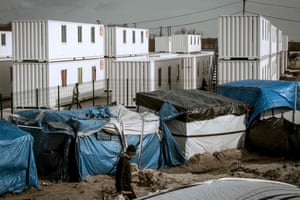
The official shipping container shelters stand in stark contrast to the self-built shelters of the camp.
The contrast between the anonymous containers erected by the French government, and the vibrant 'jungle' (photo Philippe Huguen - AFP/Getty Image) reminded me of familiar Seoul cityscapes ('apateu' v. 'daldongnae').

Refugee crises expose the best and the worst in all of us, providing Robert Mull with powerful examples of ethical approaches, how architects can fulfill what he calls their 'duty of care'.

We truly must care - starting with the words we use, and the way we look at each other, fellow citizens on our only planet.
 

'On the day Calais is demolished the media only mention migrants all reference to refugees has been dropped' (Calais Jungle map - Robert Mull on Twitter - 20161025)


Seoul Village 2017
Welcome to our Korean Errlines! Follow Seoul Village on Facebook and Twitter

Bookmark and Share
Add this page to your favorites

Monday, November 18, 2013

No cablecars in Bukhansan, please

The old Eunpyeong New Town cable car project that raised many critics from environmentalists in the late noughties has been revived yesterday by Seoul Mayor Park Won-soon as a cheap quick fix for recurrent traffic jams between the new town and downtown*. Traffic jams that (sorry for repeating always the same things) should have been avoided in the first place, and public transit solutions considered as core elements of the said new town (an obviousness for any urban planner except - it seems - in this part of the world).

I can't deny the fact that cable cars are cheaper than, say, a railway extension such as the one the same Mayor promised last summer in his initial Seoul Metropolitan Rapid Transit Master Plan, a very ambitious wish list where the Sinbundang Line was supposed to be prolonged to Pyongchang-dong, the infinity and beyond (see "If you ain't broke, fix it: Seoul, Welfare and Railways Deficits). Cable cars are even cheaper than the already environment-unfriendly Eunpyeong-Seochon tunnel considered two years ago, a car-centric nonsense that triggered the following rant from this excuse for a blogger (see "2 more tunnels up North"):
"Eunpyeong-gu definitely needs more connections with the rest of the city, but the priority for a forward looking city should be to develop public transportation, and deter people from using their cars in already saturated areas. 
I mean come on : Seoul is digging tunnels #10 and #11, and not one of them has ever been for a subway or a railway! It's as if the mind frame was set on 1960s and 1970s instead of the new millenium: more people? build more roads, sell more cars! and don't bother with medium / long term consequences! 
This totally contradicts Seoul's efforts to develop tourism and international attractiveness: downtown is not supposed to become again an environmental nightmare and a communication failure."
But Seoul is not Santiago do Chile, where funicular railways made perfect sense to connect higher neighborhoods with the rest of the city. Here, cable cars would follow a roller coaster from ground level to ground level in an endless, preventable eyesore that would totally ruin Bukhansan (via Samgaksan, Bugaksan, Inwangsan), one of the capital's most valuable assets - not to mention, of course, Seoul fortress... and downtown Seoul as a whole, because this monster would go all the way from Gupabal Station to City Hall (either in a straight line of 9.6 km, or in a 11 km course that would pass over Tongil-ro via Yeonsinnae and Dongnimun)! All this to shrink to 20 mn a journey that takes 40-50 mn by car or 30-35 mn by subway!

And they have the gall to sell it as a potential tourist asset as great as the London Cable Car, an urban abomination only topped by the ArcelorMittal Orbit as the most embarrassing erection of the 2012 Olympics (in a city with a recent history already rich in urban disasters). 

Of course the view could be interesting from above, but that's what you'd see from under:

The Emirates Air Line, a.k.a. the London Cable Car, a low cost bridge over River Thames. Now picture that as you stroll around Sejongno, Seochon, or Jeong-dong... "touristic", isn't it?

Brits can do whatever they want over this part of the Thames, I won't let downtown Seoul welcome a new elevated wart, not even a decade after the restoration of Cheonggyecheon.

This project insults the city's past, present and future. Seoul can't fix Eunpyeong New Town's failure by making it even worse and more visible. 

So back to the drawing board, and I'm begging you, next time, please try to look for more sustainable ways.

Seoul Village 2013
Welcome to our Korean Errlines! Follow Seoul Village on Facebook and Twitter
Bookmark and Share
Add this page to your favorites

* see "서울시, 은평뉴타운~서울 도심 케이블카 건설 검토 논란" (Chosun Ilbo 20131118)

NO WAY! Park Won-soon considering cablecar connections between Eunpyeong new town and downtown Seoul! Save Bukhansan from this madness!
twitter.com/theseoulvillage/status/402245416474800128

Wednesday, June 22, 2011

Seoul-upon-Han and Yeongguk-dong

Brittons will always excel in at least two areas : humor and gardening. The other evening, during a charming Garden Party at the British Embassy in Jeong-dong, I was admiring the flower beds facing the late XIXth Century residence of the Ambassador, when I noticed two almost identical signs at the feet of a young tree.

On the left one : "this tree was planted by Queen Elizabeth II in 1999". On the right one : "this tree was replanted by Hong X-X, head gardener, 1986-2011". What could pass for lese majeste (a Korean commoner correcting a Queen's mistake !) is actually a very smart way of honoring the host country and Embassy staff.

Another smart citizen of the United Kingdom was Mr William George Aston, the British Consul-General who purchased in 1884 for a song but with his own money the land where the Embassy would be erected. And with less secular British powers headquartered next door (Bishop John Corfe bought the land six years later for the Anglican church), the whole neighborhood could be named Yeongguk-dong (영국동).

Technically part of Jeong-dong, Jung-gu, this lovely and peaceful spot can be reached from Taepyeongno, through a short street facing the Western side of City Hall, between Deoksugung and Seoul City Council.

The area comprises a rather few but remarkable buildings. If the Ambassador's Residence is hidden by the concrete bulk of the Embassy's main building (there had to be an architectural faux pas somewhere), the Bishop's residence exposes to the public its unique facade : three sections blending British and Korean architectures, surrounding a massive tree and facing the Seoul Anglican Cathedral, a striking display of romanesque style. As a transition between the Bishop's residence and Deoksugung walls, a large hanok, formerly part of the palace, hosts the Anglican church offices. Note that the Cathedral adds, beyond its definitely Mediterranean touch, yet another fusion element to the mix with the almost Byzantine mosaic illuminating its altar.


Few foreign communities contributed so positively to Seoul's skyline : I'd give an A to the Russian Legation (
more than ever an undisputed cultural and historical asset), a D- to the US Embassy (they can't do much worse when they move to Yongsan), and a C+ to the Ambassade de France (where Korean architect Kim Chung-up erected an ambitious yet indigestible Corbusieresque hanok-bunker).

Of course, the longest lasting footprints are the ones Seoul is leaving on us.

But even there, Brits had a head start : the Royal Asiatic Society Korea Branch (RASKB) has been promoting Korean culture since 1900.

Seoul Village 2011
NEW : follow Seoul Village on
Facebook and Twitter

Picture : the Cathedral, inaugurated in 1926 by Reverend Mark Napier Trollope (his tomb lies in the middle of the crypt)

books, movies, music