*
From SIBAU to the Seoul BiennaleEver since the event was announced, I expected something special. If you remember the context well, it was supposed to crown the presidential campaign of Mayor PARK Won-soon ahead of the November elections, by showcasing his vision and realizations, starting with the Seoullo 7017 inaugurated only months before**. PARK Geun-hye's impeachment and the mayor's failed campaign purged the biennale from that noise, making it all the more interesting.
To me, this inaugural biennale really started in October 2015, with a symposium opening up the debate about what (yet) a(nother) biennale should be, how to make it relevant in an already crowded calendar.
 |
| 'City architect of Seoul SEUNG Hyo-sang at 2015 SIBAU - new keywords for architecture and urbanism' (20171026 - twitter.com/theseoulvillage/status/658455212521197568) |
Announced last year, the theme, 'Imminent Commons', conveys a sense of emergency in troubled times. Nine commons were selected along ecology (earth, wind, water, fire), and technology (Making, Moving, Communicating, Sensing, Recycling) lines.
On Friday, for the V.I.P. preview day, PAI Hyungmin (co-director with Alejandro Zaera-Polo) launched the first edition with a tour of the cities exhibition at the DDP, followed by the opening forum featuring Ricky BURDETT, and a presentation of the festivities planned across the capital.
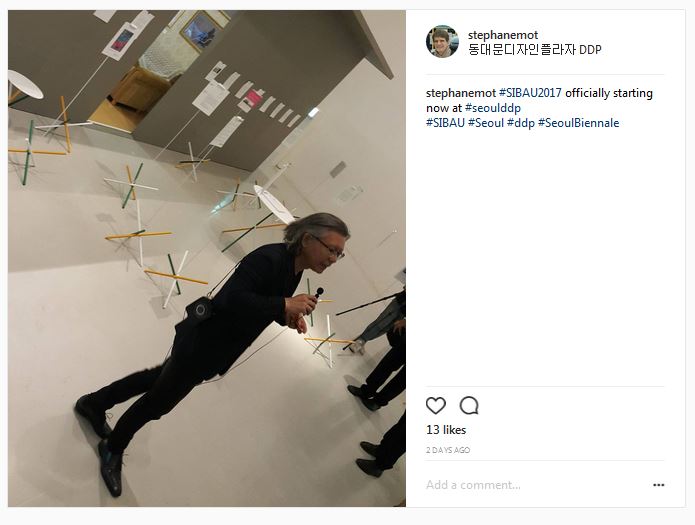 |
| www.instagram.com/p/BYesjexllHS |
 |
| Pyongyang interior at SIBAU 2017 City Expo. Soundtrack HWANG Jin-yong (20170831 twitter.com/theseoulvillage/status/903464391495917568) |
Of course, Le Corbusier chimed in again*** to reunite both Korean capitals in the most urbanistically dystopian way:
 |
| Pyongyang 2015, Le Corbusier 1935, Seoul 1970... Corbu wins, urbanism loses (20170831 www.instagram.com/p/BYeutqWFZUO) |
Among the more formally invited cities, Oslo proposed a bucolic catalogue of its edible natural assets, and Paris prolonged its presentation at the Pavillon de l'Arsenal.
So come visit the DDP for this expo, but don't forget to enjoy the 'off' parts of the festival, and side venues that deserve more attention than Zaha's last gasp. Again, to me, this complex is more sculptural than architectural, and a perfect example of the very negation of urbanism. It totally ignored the urban context, and would rather suit Dubai than the center of Seoul...
That (re)said, I'll focus on three of the seven other venues (I'll save Changsin-dong for other occasions).
*
Urban regeneration - 3 works in progressSo let's return to Seun Sangga, Mapo Depot / Oil Tank Culture Park, and Donuimun Museum Village (you can also check "Urban Regeneration: 27 Projects For Seoul" to refresh your memory).
SEUN SANGGA is still undergoing the first phase of its revamping (see previous episodes). The priority was to improve connectivity across the neighborhoods, and you can see a great deal of new staircases and escalators all over the place. As demanded in the competition brief, the Northern and Southern halves of KIM Swoo-geun's cruise ship are being reconnected. And like most projects, this one added new neighborhood / urban regeneration exhibition spaces.
The main problem with this new and improved Seun? It somehow spoils key assets of the old one, particularly the view on Cheonggyecheon (there were probably more discreet ways to connect the deck and the stream than this bulky staircase), and the feeling of space when you walk the deck (I love Seoul alleyways, but adding new structures all along the way was a mistake). But this was a very challenging project, and if Seun's fragile ecosystem and spirit subsists, this will be a victory.
 |
| 'Seun Sangga recovered its arms, with a massive staircase obliterating the best view over Cheonggyecheon' (20170831 - www.instagram.com/p/BYf512xlAvb) |
 |
| "Sneak peek from #Seun Electronic Museum / #세운전자박물관, which opens tomorrow" (20170831 - www.instagram.com/p/BYfQ1_mFAD0) |
MAPO DEPOT (now Oil Tank Culture Park) also lost some of its charm. Even the creative squatters who occupied the abandoned site have joined the main stream by optimizing their FAR with new containers, and surrounding their now legalized lot with a classic fence and hedge. I understand that you couldn't keep the tanks 'in their juice', but there's a bit too much concrete for my taste, and the cathedral-like volumes have shrunk too dramatically. Tank #3 has been spared, so you still can have a gist of what it used to be, but you can't get inside that one. Nevertheless a spectacular site, with rocks carved to prevent neighboring parts of the city from suffering in case of explosion, and a fun walk particularly during the Seoul Architecture Festival, with plenty of talks and exhibitions to enjoy.
 |
| 'At the former #MapoOilDepot for the #SeoulArchitectureFestival. Only the ghosts of the tanks subsist. They lost their inner volumes, shells, souls.' (20170831 - www.instagram.com/p/BYiJ3y5l-uM/?taken-by=stephanemot) |
I'll give DONUIMUN MUSEUM VILLAGE a similarly unfairly lukewarm review. Mind you, I'm more than ever glad that this section of Gyonam New Town has not been transformed into Gyeonguigung Xii's park (see the Gyonam saga), I was ready for significant changes towards gentrification, and I guess it has become a very pleasant spot for visitors, but. If you knew the place as it used to be, it feels like a caricatural movie set of it, without its main roles. Between the messy old place and this sanitized, manucured village, I wish the cursor had been placed a little more towards the past. I'm really okay with a new central place that transforms the dense eating/drinking cluster into a more open village, but the hanok alleyway where I used to eat has been destroyed and rebuilt, recycling only a few beams, and replacing the most charming curves with anonymous straight lines. And why not keep more vintage bits of walls, the tree that made that eatery's madang so cute, or the wooden windows that made that two story Japanese house so special? I had so much hope when the project started...
It's a bit like Sissel Tolaas' exciting Seoul smellscape (in one of the tallest buildings of that low rise neighborhood), where you can sniff scents captured across the city center, between the DDP and this DMV: smells are synthetized and amplified, not like the original, but a distant echo.
 |
| 'Sissel Tolaas and her Seoul smellscape in the new Donuimun Museum Village' (20170831 - twitter.com/theseoulvillage/status/903556640154173441) |
Seoul shall use the space as a guest house hub after the biennale, but I hope it will host future editions as well.
Meanwhile, enjoy this first edition, and this ever changing city of ours!
*
 Seoul Biennale of Architecture and Urbanism 2017 (20170901-1105): seoulbiennale.org
Seoul Village 2017
Welcome to our Korean Errlines! Follow Seoul Village on Facebook and Twitter

Add this page to your favorites
* see among others "Urban Regeneration: 27 Projects For Seoul"
** see "Seoullo 7017, and more roads to Seoul"
*** see "Don't miss Le Corbusier in Seoul... The artist, not the urban planner!"


 Visitors (