NEW - download 'Seoul VillageS (서울 마을들)', my collection of 12 short fictions now adapted into short films! Get your free copy of the ebook (4 editions: English, French, Korean, Bilingual English-Korean)!

Showing posts with label transports. Show all posts

Thursday, December 19, 2024

On Seoul Station and Seoullo Station, covered and uncovered railways...

Over a year ago, Seoul initiated an overhaul of Seoul Station area that left all options on the table, including covering railways and removing the Seoullo eyesore ('Tear down that Seoullo?'). Here's what they came up with for 2028.

The good news? 

  • As expected, goodbye ugly tracks, hello street level vegetation and pedestrian-friendlier infrastructures.
  • The original Seoul Station, now Culture Station Seoul 284, recovers its majesty (don't get me wrong, not talking about its Imperial Japan era origin - besides, the architect was inspired by the Lucerne Station in Switzerland).
  • At least one traffic lane seems to have been removed on the Tongil-ro / Hangang-daero side, at least in front of the old station.
  • In the same green vein as the Gyeongui Line Forest Park, railways shall be replaced by a linear park that will go all the way to Hangang. 

The usual caveats? High rise multipurpose buildings that will coopete with other hubs. 

On the northen section: a cluster of towers between Seosomun Park and... Seoullo?

Now something puzzles me: Seoullo 7117 is still there. Which means that the project was not fully thought through.

At least, this micro heliotropolis connected to all major means of transportation including Incheon Airport looks more integrated to its surrounding neighborhoods than all previous avatars of this decades-old project. 

***

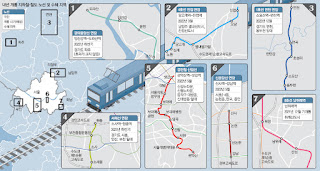
Speaking of public transportation, another update: the elusive Seobu Line could be back on track. This key vertical LRT axis passed an important hurdle at the Ministry of Finance, but the consortium has to be reactivated. Other more or less new projects are in some kind of pipe (a few of them are familiar):

Like Goyang earlier to the north, Anyang city declared its intention to extend it to the south, along with the Wirye Line, from SNU to Anyang Sports Complex and Pyeongchon New Town. It certainly would help Anyang, but could further delay the Northern side of the Seobu Line, which remains with Pyeongchang-dong the biggest hole in Seoul's grid.

The 6 'new' lines in red on the big map above:

  • Seobu Line (Saejeol - Seoul National University Entrance) - see previous posts related to it. Note two extensions (in green on the full map) to the existing network: on the Seobu Line from SNU Entrance to SNU, and on the Shillim Line from Saetgang Station to Seobu's third and easternmost station on Yeouido.

  • Gangbuk Hoengdang Line (Mok-dong - Cheongnyangni horizontal) - 25.72km, 20 stations that would connect Pyeongchang-dong to the grid.

  • Ui Line extension (Ui-dong - Banghak-dong) - 4.13km, 6 stations


  • Myeonmok Line (Cheongnyangni - Sinnae-dong) - 9.05km, 12 stations


  • Nangok Line (Boramae Park - Nangyang-dong)


  • Mok-dong Line (Sinwol-dong - Dangsan Station) 


Besides, 2 existing lines are upgraded (in blue on the map):

  • Line 4 (Danggogae - Namtaeryeong): express
  • Line 5 (Dongducheon-dong - Gupundari)


See all posts related to Seoul Station, transports, and subways.


Seoul Village 2024
Welcome to our Korean Errlines! Follow Seoul Village on Facebook, Bluesky, and X/Twitter, follow me on Instagram.
Download 'Seoul VillageS', the free ebook (12 fictions, now adapted into short films).


Sunday, June 23, 2024

On Korea's Jigsaw, Urban Footprint, and Urban Replanning

If you're a frequent flyer on my Korean errlines, you've had your fill of rants about recurring blunders in urban planning, the persistence of obsolete visions of urbanism, or (re)development equations that totally ignore plummeting demographics.

Well criticizing is easy. Urban harmony is like life or democracy: a very delicate, dynamic balance of power, a complex, evolutive system of checks and balances. No one will ever achieve perfection, and that's the beauty of it.

Besides, I see some glimmers of hope. Korea has eventually started worrying seriously about its shrinking population, seeking more inter-regional solidarity and cooperation, thinking about reviving ailing city centers in smarter ways... 

Korea is starting to realize that the real estate paradigm it's been addicted to for decades has become a Ponzi scheme, a sub-zero sum game where eventually everybody loses, even the wealthy ones who won't be able to resell their 'luxury condos' with a profit after paying much more for them than they would have for the most outrageous Manhattan penthouses.

Korea is starting to realize that it can't afford 'affordable housing' if that means building apartment blocks in greenbelt areas, that when a 'new town' succeeds somewhere, it means that somewhere else, an older town in depleting.

Korea is starting to realize that it can't keep adding new non-matching pieces to an ever growing jigsaw puzzle on an ever shrinking table, that these absurd urban footprint dynamics can't be sustained any longer.

The 5th Comprehensive National Territorial Plan, which covers the most critical 2020-2040 period, already mentions sustainability and other sound principles, but all is not set in marble and a lot has happened since it was released 5 years ago: rural desertification and fertility rate diminution accelerated dramatically, the GTX and other projects reshuffled whole decks... So a revised version is expected next year, for the 2026-2040 period.

Improving inter-regional solidarity and cooperation remains a key goal, particularly where they prove already challenging at the intra-regional level because of political divisions or fierce city rivalries. 

In addition to their autonomy, such special self-governing provinces as Jeollabuk-do or the recently upgraded 'Gangwon State' don't have to deal with special cities punching holes in their maps. In comparison, Gyeonggi-do must cope not only with giant neighbors nesting in its midst (Seoul and Incheon*), but also with a complex history of city creation explaining odd administrative shapes, or new towns stretching over different cities (e.g. Dongtan).

Granting a special status to a local government was generally done without much concern for the impacts around, which prevented all parties from reaching their full potential.

Wherever you stand on the fierce political fight over the creation of Sejong City (the left wanted to move the capital city to a new, central location to balance development across South Korea - the right refused to undermine Seoul and maintained part of the government there), you have to admit that from an urbanism point of view, things could have been done a bit better.

We're not talking Brasilia or Nusantara, a new capital erected far away from existing hubs: Sejong City seats right* next to the metropolitan city of Daejeon, South Korea's 5th largest cit, its central hub, and already the seat of several  central administrations, and right next to Cheongju, Chungcheongnam-do's capital.

Daejeon lies less than one hour away from Seoul via KTX but no, Sejong City must not enjoy express connectivity with the 'old' capital because then civil servants would commute instead of moving to Sejong**. And no, Daejeon's subway shouldn't come all the way to Sejong's vital parts. At its inception, it's almost as if Sejong City was designed as a local competitor instead of a national facilitator.

17 years after its creation, Sejong claims 400k souls, Daejeon remains around 1.5M, and Cheongju inched up from 650 to 720k. Common sense would have led to something more  rational, even simply two cities instead of three: the regional capital Cheongju and a-name-it-whatever-you-fancy-as-long-as-you-spare-local-susceptibilities national capital bis. If arranged harmoniously, I bet the latter would be today a thriving 2.5-3M strong metropolis.

Mind you, both Daejeon and Sejong are faring relatively well nowadays, but I'm not surprised to see the Sejong City - Daejeon - Chungnam - Chungbuk ensemble included in the potential revisions to Korea's 5th CNTP. Some consistency would clearly make the meta-region more competitive internationally - with the caveat that it wouldn't present an official one-stop front. 

Same with 'sudogwon', the capital region (Seoul-Incheon-Gyeonggi-do): unlike say the Ile de France region that encompasses Paris and its surroundings, it doesn't really exist as an official entity with representatives. It does make sense for the national government to be directly involved in an area representing half the nation's population and GDP, but the World's 4th metropolitan bloc can't fully leverage its potential. Of course, adding another administrative layer and the tensions that go with them, particularly with dwindling resources, may not necessarily be the panacea. Some even envision Daejeon + Sejong + Chungnam + Chungbuk as an 'ultra-wide megacity' - at least that would avoid the ego problem of who gets to be granted the regional capital status...

The debates promise to be complex and animated, but it's important to get every stakeholder involved, to identify all the impacts of each option, to learn from past mistakes, to minimize / optimize the urban footprint, to think urbanism beyond cities, towns, and other labels, wherever humans decided to settle or to build (be it a road, a remote factory, a farm, or even a field), and not to build for builders' sake.


Seoul Village 2024
Welcome to our Korean Errlines! Follow Seoul Village on Facebook and Twitter, follow me on Instagram.
Download 'Seoul VillageS' (free ebook - short fictions now adapted into short films)
Bookmark and Share


* If the cities are administratively continuous, there's no actual urban continuum... but then again, few cities in Korea excel at urban continuity.

** Likewise, I still can't stomach the fact that the railway from Seoul to Incheon Airport was deliberately delayed until a few years after inauguration because that would have hurt taxi businesses. Or that Songdo didn't have a subway from day one (hello? a ginormous polder built from scratch?). At least nowadays, if new big fat greenfield 'new towns' keep popping up, most of them include a railway connection.

Wednesday, March 27, 2024

GTXtension(s) - fast transit rather than mass commuting?

In case you missed it, three new projects of GTX (Great Train eXpress) lines were announced earlier this year. Since we're getting closer to the inauguration of the first section on March 30 (GTX-A from Suseo to Dongtan), but also to key elections on April 10, I'll spare you all the wonderful urban development pledges that have popped up from all sides (I guess merging Gimpo with Seoul was one of the most radical), and talk a bit more about these Great Train extensions and GTX-tensions.

By stretching ABC and adding DEF, the network reaches further North, South, West, and East, and draws a first ring around Seoul and across Gyeonggi-do (GTX-F):

If GTX clearly brings places closer together, dividing by 3 the time to join Suseo and Dongtan, and if it reaches relatively fast speeds (105 km/h in its inaugural section, with peaks at 180 km/h), the system is 'express' in the sense that it makes few stops. And so far, it has more or less managed to resist intense pressure to add intermediary stations, particularly within Seoul. 

Which makes the success of seamless multimodal transport hubs even more critical, and I'm not sure that will be the case from day one. 'Luckily', the traffic shall not be too massive, because as it is conceived now, GTX can't really handle mass commuting. 

Beyond the limited number of trains per hour, their shortness is an issue, and commuters may struggle to find a spot to hop in, particularly in intermediary stations. I've experienced rush hour on Paris region's RER, with its long, double-decker trains, and that's not always pleasant... We may not see scenes similar to Line 9 saturation on steroids, but expect at least significant frustration from a lot of people who were expecting GTX as the instant panacea.

GTX provides fast transit before mass transit, it shortens connections before coping with mass commuting, and that's already something big. Even if you won't commute to work there, simply knowing that you can go to Seoul very quickly for lunch, dinner, or on a weekend can make moving far away less alienating. 

These massive and costly extensions do add Gangwon-do (Chuncheon and Wonju) and Chungcheongnam-do (Cheonan) to the equation, but also risk of further widening the gaps between sudogwon (Seoul-Incheon-Gyeonggi) and the rest of Korea as well as within the capital region and within the capital itself. With its relatively cheap fees (KRW 3.2K + 250 per 5 km), GTX may even cannibalize such alternatives as KTX.

The choices of routes and stations is always debatable and many areas within and beyond Seoul will remain underserved, but I always welcome transversal approaches in transport, and cooperation within the capital region. Nowadays, Seoul is collaborating much closer with Gyeonggi-do, including for its Climate Card now, and a ring bringing Gyeonggi closer together and bypassing the capital altogether marks a significant step.

Somehow, GTX is forcing the emergenceof  the grand vision, the great debate that's always been lacking. The way this whole region keeps developing remains a litany of missed opportunities, particularly since most of this urban and transport development (or lack of) relied on new towns built from scratch. And you know how often I complain about so much urban planning without urbanism or planning.

Now we're hearing about covering the Gyeongin Expressway and the rift between the Eastern and Western sides of Dongtan new town, and both will cost a fortune, but the Seoul-Inchon axis dates from ages ago, and that rift should have been solved from Dongtan's very conception. As demographics plummet and finances shrink, Korea can't afford not to get it right from the beginning. 

This nation is so great at alphabets, it should contemplate beyond ABCDEF.


Seoul Village 2024
Welcome to our Korean Errlines! Follow Seoul Village on Facebook and Twitter, follow me on Instagram.
Download 'Seoul VillageS', the free ebook.
Bookmark and Share

Thursday, August 24, 2023

Tear down that Seoullo?

On Tuesday, Seoul announced that a MOU shall be signed on September 11 (!) between the city, the Ministry of Land, Infrastructure, and Transport, and the National Architecture Policy Committee to elevate certain areas as 'national symbolic spaces'*. Among them, Seoul Station area. The Seoul Institute will complete a master plan for this problematic hub by October, and the removal of the highly controversial Seoullo 7017 is officially on the table.

I hope that will be the outcome, but more fundamentally, I hope that this time, the underlying problems will not be eluded but tackled, and I hope that this time, we will have a proper process with adequate consultation, consensus, and impact surveys (remember how PARK Won-soon rushed ahead of the elections, ignoring all red flags?).

If you follow this excuse for a blog, you already know that I'm not a fan of this urban and environmental nonsense (yes, environmental too: Seoul needs more natural biomass continuity and rich, water absorbing soils, not more thirsty plants isolated in flower pots... and certainly not sorted in alphabetical order, like in MRVDV's winning project).

You already know that the comparison with NYC's highline (itself inspired by Paris' Promenade Plantee) was a fallacy, that Seoullo should rather be compared to Cheonggye Highway, and that it chose not to solve the key issues (street level, railways...). 

You already know that maintenance costs were not sustainable, that visitor numbers started plummeting from the beginning, even before the pandemic, and that they keep decreasing. The expected failure is total.

But you also know that removing Seoullo 7017 will not solve anything by itself, that pedestrians need a safer way of crossing this sea of roads and railways, and that this concrete, steal, and asphalt sea can't remain a sea for much longer:


Seoul Station area and Seoullo 7017 (Naver Maps)

To say the least, Seoul Station's multimodal hub is very dense and messy. Tongil-ro, Sejong-daero, and Toegye-ro merge into Hangang-daero, with the Gyeongui Line and its sisters on one side, Huam-ro, and countless car and bus lanes on the other. Dedicated bus lanes have considerably facilitated pedestrian circulation on street level, and this thick ribbon may be further reduced into narrower, crossable axes. 

If going above ground failed and if the underground is saturated, there are possibilities.

Covering the railways remains high on the city's wish list, but this takes a lot of time and money. Seoul is considering moving bus transfers to the back of the station (which will have big impacts as well), and to extend walkways to prolong Sejong-daero's green promenade - I suppose with the necessary bicycle lanes - ultimately all the way from Gwanghwamun to the Han River (7 km).

Improving alternatives may reduce the flow of cars, and not just alternative routes beyond this area; alternatives that reduce the use of cars altogether. Quite a challenge in a multimodal hub already subject to bottlenecks at many levels...

What a fascinating urban challenge! One that calls for innovation instead of band-aids.

In any case, expect more Monday quarterbacking from yours truly.


Seoul Village 2023
Welcome to our Korean Errlines! Follow Seoul Village on Facebook and Twitter, follow me on Instagram.
Download 'Seoul VillageS', the free ebook.
Bookmark and Share

* I won't elaborate on this 'national symbolic space' concept, but Seoul Station clearly remains a cultural icon for the nation (entry point for many to the capital city, Gyeongui Line between Seoul and Sinuiju, Tongil-ro, KTX, Culture Station Seoul 284...).  


Sunday, December 26, 2021

7 Seoul subway / railway updates

MK published yesterday an interesting article* on the impact of 7 recent or upcoming subway / railway developments on real estate, which allows us to see of these old friends have fared since their announcements**.

The Maeil Kyeongje's 7 projects (NB our focus below doesn't follow these numbers)

 . Line 1 extension Northwards from Soyosan Station (3 new stations - Choseong-ri, Jeongok, and Yeoncheon): 

Since this extension mostly doubles an existing train, the article logically mentions a low impact on real estate. but it does make commuting more seamless for densely inhabited parts of Yeoncheon-gun, and allows Seoulites to venture further up the Dongducheon valley (not necessarily closer to the DMZ, though: it follows the same axis in this area).

 . Line 4 extension Eastwards from Danggogae Station (3 new stations - Byeollae Byeolgaram, Onam, and Jinjeop):

To be inaugurated next March, this 14.9 km extension is a game changer for this section of Namyangju dotted with major new towns (Byeollae and Jinjeop-eup). But as usual, what a shame that such major clusters were not connected to the grid from day one. 

Of course, this means more commuter traffic for a line already supporting older generation bed towns, but it will also help one of them, Nowon, grow as a cultural hub in Northeast Seoul. Furthermore, the article reminds us of two other projects that will help cope with the flow:

  • Seoul considers doubling Line 4 with an express service for the 31.7 km section within city limits, between Danggogae and Namtaeryeong, with potentially 12 more stations concerned (all the ones connected to other lines). That would leave 12 stations with only the standard service, along with the ones in Gyeonggi-do.
  • The extension of Line 8 Northwards from Amsa Station to Byeollae Station (Gyeongchun Line) by the end of 2023 could later be prolonged to Byeollae Byeolgaram Station via a new station, Byeollae Jungang, further anchoring Byeollae to the South, and making it a transport hub east of Seoul around a decent 'Byeollae Line' backbone.

 . Inauguration of Namwirye Station (Line 8):

Located between Bokjeong and Sanseong Stations in Seongnam, Namwirye doesn't really support Wirye New Town which, as the author mentions, would have much more impact. But he's not taking into account a tramway bound to deliver the goods: the construction of the Wirye Line is just starting these days.

'#Seoul about to start the construction of its first #tramway in decades (#WiryeLine - 12 stations, 5.4 km - to open i 2025). Line announced 8 years ago (http://seoulvillage.blogspot.com/2013/08/seoul-lrt-projects-update-part-22.html) #transports' (20211220 - @theseoulvillage)


 . Gyeongui Jungang Line extension Northeastwards from Imjingang Station to Dorasan Station

In this part of Paju, as the article confirms, 'nothing to do with real estate'. This line is simply inching further towards Kaesong, now a reasonable walk away... provided of course you've got all the papers to enter the DMZ at that most strategic point. For the moment, you're mostly connecting Seoul to a giant, empty parking lot: doesn't look like many workers will commute any time soon to the Kaesong Industrial Complex... Let's hope that some day, this dead end will be prolonged into a friendlier North Korea.


 . Seohae Line extension Northwards from Sosa Station to Wonjong Station (via Bucheon Stadium Station)

As we've already seen (in "Twice upon a time in the West"), there's a lot going on around Bucheon. This vertical will split much earlier the traffic to/from Seoul between the North (Line 1) and the South (Line 7). And it will later be prolonged not only to Gimpo Airport, but also across the river, to Line 3 (Daegok Station, after a stop in Neunggok Station).

If Daegok seems a bit isolated between Goyang's 'old and new' New Towns (Ilsan to the West, Hwajeong to the East), Line 3 leads to more glamorous sites: downtown Seoul and Gangnam. And I wouldn't be surprised to see this new, vertical airport line that will go from Goyang to Hwaseong (for now, Ansan remains the Southern limit) venture further to the North-Northeast and connect to more New Towns.


 . Sillim Line inauguration (from Gwanaksan Station to Saetgang Station)

Thanks to this precious new vertical connected to Line 9 (Saetbang), Line 1 (Daebang), Line 7 (Boramae), Line 2 (Sillim), 'I live in Bongcheon-dong' will sound a lot more uplifting. But in parallel to this LRT,  Western Seoul needs more verticals (Gangnam-gu already getting it's fourth!), starting with Seobu Line...


 . Shinbundang Line Northwards extension from Gangnam Station to Sinsa Station:  

The article made its headline on the star extension because it's about real estate and money, and we're talking expensive real estate (Gangnam-daero), and expensive stations: Gangnam on Line 2, Sinnonhyeon on Line 9, Nonhyeon on Line 7, and Sinsa-dong on Line 3. No new stations, but hopefully fewer cars on the Hannam Bridge once Sinbundang's next profitable extension to the North will lead across the river and Yongsan, all the way to Yongsan Station.

*

Beyond railway and subway projects, Maeil Kyeongje also mentioned work on more sections of the capital region's Second Ring Expressway, which will definitely have some impact. But what the region needs is more public transportation, and a better dialog within Gyeonggi-do, beyond the usual Seoul-suburbs dialog.

It's always good to connect existing dots, and the Ansan-Bucheon-Goyang axis is very welcome, but no new major urban projects should be allowed without a direct connection to the network.

The problem is that Gyeonggi-do is poorly managed, and this has something to do with the way big cities compete with each other without a real regional authority. Only the State has the potential to force some collaboration, or at least more coopetition and less competition within Gyeonggi-do. The lack of political will and strategic vision results in the multiplication of projects cannibalizing each other, a suicidal rat race as the population ages and declines. Clearly, there are countless ways of spending less, better, and still generating much more value for everyone.

 
Seoul Village 2021
Welcome to our Korean Errlines! Follow Seoul Village on Facebook and Twitter, follow me on Instagram.
Download 'Seoul VillageS', the free ebook.
Bookmark and Share

* ""딱 역 3개인데, 폭발력 엄청나다"…판교 분당 부동산 난리난 이유" (Maeil Business Newspaper 20211226)
** see "Seoul subway to gain 89 km by 2025" (June 2015), "Seoul LRT Projects Update (Part 1/2)" and "Seoul LRT Projects Update (Part 2/2)" (August 2013, following "If you ain't broke, fix it: Seoul, Welfare and Railways Deficits" - July 2013). See also all subway related posts.

Monday, November 23, 2020

Korean Errlines

The Korean Air - Asiana Airlines merger would face severe antitrust backlash anywhere, but Korea doesn't seem ready to welcome a foreign full-service carrier, and this is 2020. Yes, the new giant will lose many international routes, since Asiana competed with KAL on almost half of its overseas destinations, but it will also become a big player among Asia's low cost carriers after combining Jin Air, Air Seoul, and Air Busan (probably under the Asiana Airlines brand). Skyteam scores a major win against Star Alliance, and even slightly diluted as a KAL shareholder, Delta Airlines reinforces a key position in the region.


Needless to say, the pandemic spiced up this Korean drama where both Asiana suitors flew away: 

  • the preferred consortium (Hyundai Development Company - Mirae Asset - Daewoo) looked for every possible loophole to take off between the engagement and the wedding, 
  • Aekyung landed on a much smaller prey, beefing up its Jeju Air with Eastar Jet
  • in the end, Kumho Asiana will have to lead their daughter to their main rival

The Hanjin KAL holding company will be able to advance the funds thanks to KDB, who will get a bit more than 10% of the merged carrier. So indirectly, the government foots the bill. In spite of the chaebol family scandals (from the nutrage to its many sequels), the Cho must go on...

Earlier this year, Korean Air fared much better than its global rivals, mainly thanks to freight traffic. And these days, the most popular domestic route in the World happens to be between Seoul and Jeju, the nation's preferred holiday destination benefiting from the lack of overseas alternatives. 


(source "These Are the World’s Busiest Airline Routes During Covid Times" - Bloomberg 20201117)

After inventing flights to nowhere (take off and landing in the same airport), Korea opened its skies to international fly-over travels. So there's always a quick fix if you miss international travels. Even for those who miss Jin Air's inflight meals (this is 2020, you are entitled to miss anything), there's a solution - low cost, of course:

'Travel withdrawal syndrome? Jin Air proposes inflight meals at home (today's KJD). For this plastic frenzy to make perfect sense, they should add a hundred gallons of kerozene to burn in your living room' (@theseoulvillage - 20201024)

But for cheap and easy escapes, nothing beats a travel book:

'Lonely Planet' indeed (they forgot 'Glamping on the balcony') (@theseoulvillage - 20201023)


Hep, taxi!


Seoul Village 2020
Welcome to our Korean Errlines! Follow Seoul Village on Facebook and Twitter, follow me on Instagram.
Download 'Seoul VillageS', the free ebook.
Bookmark and Share


Sunday, April 26, 2020

Lower Sejongdaero's turn

Seoul's most defining avenue, Sejongdaero, is getting all the attention it deserves from the municipal government. After the highly controversial plans to revamp its upper half (see "Gwanghwamun Square 3.0 re-Deep-Surfaces"), the focus seems to be on the lower half, between Sejongno sageori and Seoul Station. This includes cosmetic changes in adjacent neighborhoods, most recently in Jeong-dong (see "Jeong-dong forever"), or around Sungnyemun (Jung-gu decided to harmonize signage for 80 stores between Seoullo 7017 and the gate*), but now a more ambitious program will help pedestrians, cyclists, and tree huggers reclaim a space almost as car-centric as the upper section before Gwanghwamun Square.


Sejong-daero towards Gwanghwamun, viewed from the Deoksugung-Seoul Plaza crossing

The main changes (drawn here by Kim Yeong-eun for Yonhap News Agency**), expected by the end of the year, consist in reducing the number of traffic lanes (from 12 to 7-9; at least that's consistent with the new bottlenecks conceived further North around the avenue), and improve the pedestrian experience, particularly around Deoksugung and Sungnyemun / Namdaemun Market:


A lot of trees shall be added to widened sidewalks, with some species diversity which is really positive. Even if naming this "Sejong Forest" (세종숲) sounds a bit over the top (at least the Gyeongui Line Forest Park was more honest with its "숲길", which could be translated into 'Forest walk / way / street').


A plaza and a tree trail shall improve the barren entrance to Namdaemun Market from Sungnyemun


I'm looking forward to the new bicycle lane all along the 1.5km stretch (I criticized the city for not adding some on day one when they renovated the Northern section of Sejongdaero for Gwanghwamun Square), and the eased pedestrian circulation around Sungnyemun, which even after the changes will remain basically a peninsula in a sea of cars:


A better experience for pedestrians and cyclists, but still car centric

Moving back to Deoksugung and Jeong-dong, this close up of Daehanmun shows that, beyond the extension of the plaza and sidewalks, Deoksugung-gil is likely to become car-free, at least partly (and I presume at least on weekends and holidays, like Insadong-gil):


Overall, nothing revolutionary, but significant improvements for Sejong-daero. Needless to say, Mayor Park Won-soon would love to see part of downtown's growing - at least B.C. / Before Coronavirus - tourist traffic walk closer to his pet project Seoullo 7017. before the 2022 presidential elections.
 Again, I can't stress enough the importance of Sejong-daero, the spine of downtown Seoul, at its original core. We're talking urban stem cells here. ICYMI here's the short video I made to explain the dynamic map of Seoul intra muros a.k.a. Sadeaemun (fortress walls, main gates, mountains and streams, key landmarks, vertical and horizontal axes...):


Seoul Village 2020
Welcome to our Korean Errlines! Follow Seoul Village on Facebook and Twitter, follow me on Instagram.
Bookmark and Share


* "서울 중구, 세종대로 등 145개 점포 간판 정비" (Yonhap News 20200420).
** "세종대로 1.5km 구간 보행로 대폭 확장…차로 12개→9개 축소" (Yonhap News 20020426)


Monday, May 6, 2019

Twice upon a time in the West

The Minister of Land, Transport and Tourism came up with a new batch of developments for the capital region*, including new public transport projects, and unfortunately more instances of Korea's failed 'New Town' model, at the very moment the country experiences a slump in housing prices, and an oversupply of dwellings. The aim is actually to make sure the prices remain low for a while, which doesn't seem a bad idea, except that in Korea's speculative zero sum game, this necessarily means more losers, and more dead neighborhoods in the short, medium, and long term.

2 'New Towns', 26 small-to-medium-sized developments, 1 BRT, 1 subway line:

Following the first three announced last year (Incheon Gyeyang, Namyangju Wangsuk, Hanam Gyosan - in blue on the map below, which also shows future GTX lines), two more 'Greenfield New Towns'** will be created one kilometer West of Seoul, one on each side of the Han River (in red):
  • Goyang Changneung: 38,000 households in Deokyang-gu, Goyang (Yongdu-dong, Hwajeon-dong)
  • Bucheon Daejang: 20,000 households in Ojeong-gu, Bucheon (Daejang-dong, Wonjong-dong)

In a more acupunctural approach, 26 small and medium-sized residential projects shall add 51,517 households in already developed neighborhoods:


Transports-wise, the government's package proposes two new public transport lines, and road extensions:
  • a 17.3 km-long "S-BRT" line (NB does 'Super - Bus Rapid Transit' mean super dedicated infrastructures for buses?) between Gimpo Airport Station and Bucheon Sports Complex Station, around Gimpo Airport, with connections to subway lines 5, 9, and even 7 (Bucheon Stadium Station). It will also reach Cheongna BRT.
  • a new subway line will connect Goyang City Hall to Saejeol Station (Line 6), and intersect with Line 3, GTX-A, and Gyeongui Line at Daegok Station.
  • A new motorway will connect Baekseok-dong (Ilsan) to the Seoul - Munsan expressway (Gogang, Seoun interchanges).
  • Susaek-ro (already hosting 3 of the new housing projects judging by the map), and Worldcup-ro shall gain layers to cope with a growing traffic towards downtown Seoul as well as towards Yeouido and Gangnam.
Bucheon's new S-BRT line around Gimpo Airport
Goyang's new subway line


The good, the bad, and the ugly:


Overall, if you consider the three announcements made since last December, the State plans to sell 73,000 homes by 2022, 67,000 in 2023, 58,000 in 2024, 61,000 in 2025, and 44,000 in 2026, which may provide more options for affordable housing, but also amplify Korea's oversupply of dwellings. The only clear winner seems to be IKEA Goyang, today an outpost, but tomorrow ideally located to serve the new town.

At least, for a change,...:
  • ... Seoul intra-muros is spared from more of the large-scale New Towns that destroyed so many of its neighborhoods (including the seven buried under Gyonam New Town). 
  • ... a 'Greenfield New Town'** adds some urban continuity instead of pushing urban sprawl further afield: on paper, Goyang Changneung shall better tie Ilsan to the capital.
  • ... transports, including public ones, are better phased and synced with new major developments (new subway, BRT, GTX lines around Goyang and Bucheon new towns, respectively top and bottom):


This remains an absurd case where we add commuting traffic before solving existing problems upstream and downstream. Yes, commuters from the latest new town will reach Seoul faster, but they will slow down commuters from Ilsan's 'older new town', and more cars will flock into Seoul's Western bottlenecks, even if some cosmetic touches are added along Susaek-ro. Urban planners went as far in the irony as to name their concrete monstruosity after the Joseon Royal Tomb*** it will deface.

In this young millenium, any new project should aim at the very least at zero emission and zero increase in car traffic, and this is obviously not the case. I nonetheless appreciate the new public transport lines: the BRT will add some verticality and fluidity across Bucheon, and Goyang will better split its commuters between line 3 and 6.

All this also means that the construction of Seobu Line / Seobuseon becomes even more urgent (see "Seobu Line confirmed as Seoul's LRT top priority"). Just months ago, the project was delayed because SNU wanted to prolong the line further into its campus, and now a boost comes from the other end of the line, the national government speeding up the agenda, and footing the bill for the first 7 stations. Because actually, this new Goyang line constitutes the new beginning of the most defining project for the Western half of Seoul's subway network. Now hopefully, the whole line should be completed by 2026.

On the other side of the Han River, Bucheon will clearly benefit from a denser public transportation network. How the new town will coopete with Magok District or Gyeyang Techno Valley remains to be seen....


Seoul Village 2019
Welcome to our Korean Errlines! Follow Seoul Village on Facebook and Twitter, follow me on Instagram.
Bookmark and Share
Add this page to your favorites

* see for instance in Today's Chosun Ilbo: "3기신도시 고양 창릉·부천 대장동 등에 11만가구 공급", "새절역~고양시청 철도, 김포공항역~부천종합운동장역 BRT 신설", or in Today's Joongang Ilbo: "집값 다시 뛸라...집값 약세 둔화에 3기 신도시 '기습 발표'" (UPDATE 20190508 "To cool real estate, gov’t plans two new towns")
** as defined in "Wet eyes for wetlands and urban mirages"
*** see "Royal Joseon Tombs Become UNESCO World Heritage Properties
**** and by the way, these latest developments make even more irrelevant the Gangbuk Line project drafted a couple of months ago - see "Gangbuk LRT - Naebu v. Seobu, or PARK v. OH?")