NEW - download 'Seoul VillageS (서울 마을들)', my collection of 12 short fictions now adapted into short films! Get your free copy of the ebook (4 editions: English, French, Korean, Bilingual English-Korean)!

Showing posts with label technology. Show all posts

Sunday, December 25, 2022

Seoul Innovation Park on steroids

We've already seen Eunpyeong-gu's former KCDC site mutate into a makers' hub*, a vibrant Nokbeon-dong neighborhood park, and a cultural crossroads** in an underprivileged part of Seoul. Now the city wants to turn this low rise oasis into its gazillionth high rise utopia.

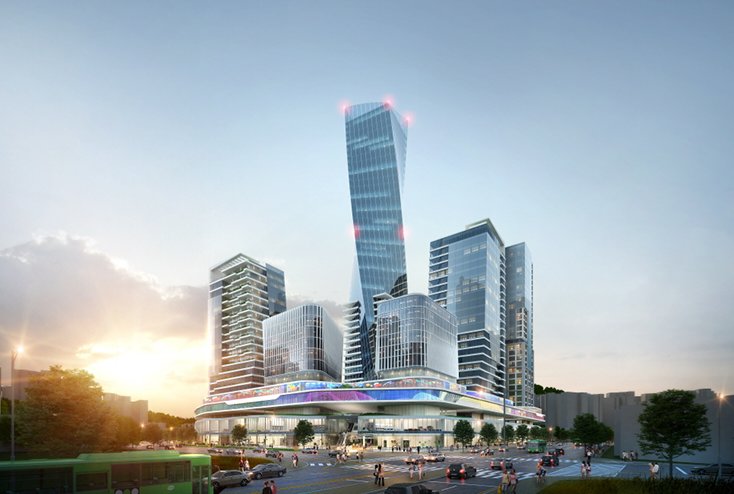
Meet the new and improved Seoul Innovation Park:


Quite a change from nowadays:

"Vegan Festival in Seoul Innovation Park, Eunpyeong-gu." (@theSeoulVillage 20170511- twitter.com/theseoulvillage/status/866195549707358208)

Okay, all cars shall be parked underground instead of these traditional outdoor sprawls, plus there's also going to be this manicured 'Seoul UIC Campus' (University of Seoul Industry Cooperation), but that's not the same as a laid-back park full of happy families:

As you well know, I'm all for fixing the capital city's unbalances, and Northeast Seoul clearly deserves a boost. Besides, the city already owns this 110,000 sqm site, and it's next to a subway station (Bulgwang Station), close to the Yeonsinnae transport hub (Subway Lines 3 and 6, GTX-A - see "GTX, meet Sinbundang Line"). 

But not exactly there. And we've already seen this not so disruptive concept of futuristic, buzzword-friendly city within the city, with its iconic landmark tower - here, 60 more floors to be filled in a market already suffering from oversupply. Yet another empty alibi for yet another real estate nonsense (many 'apateu' have already risen nearby)? And of all models, why pick the COEX as a symbol of success? 


Needless to say, the grove with its old trees at the entrance, under which kids would play and seek fresh shelter in the Summer, is gone. From the outside, this could be any mall:


This time, it's different, they say. We go 'beyond zoning', we're truly mixing commercial, residential, and business. And this time, promise, we'll build and startups will come. SH Corporation will make sure a diversity of people build a genuine community, a 'Golden Village' where elderlies, newlyweds, single households share the same spaces with all facilities required in changing times.

Sincerely hope that flies but frankly, Seoul, you can do better.


"Seoul's project for Seoul Innovation Park (Nokbeon-dong, Eunpyeong-gu)? A coex-ish hub, very Oh Sehoon-ish urbanism:" (@theSeoulVillage 20221220 - https://twitter.com/theseoulvillage/status/1605025577102032896)


Seoul Village 2022
Welcome to our Korean Errlines! Follow Seoul Village on Facebook and Twitter, follow me on Instagram.
Download 'Seoul VillageS', the free ebook.
Bookmark and Share

* starting with Seoul Creative Lab and Hyebin's FabLab:

"Always nice to visit Seoul Innovation Park's FabLab! Eunpyeong-gu, Seoul." (@theSeoulVillage 20161207 - https://twitter.com/theseoulvillage/status/806453941252673536)

** including, most recently, SEMA Storage in a former KCDC warehouse (see "Nine new museums in Seoul by 2023")

Wednesday, September 22, 2021

Seoul 2030 - a software update

Mayor OH Se-hoon unveiled the 'Seoul Vision 2030' he announced on his inaugural address last April*, an occasion to highlight differences with his 'predesuccessor' PARK Won-soon.

By picking the slogan 'Seoul, a fair city that runs again', ever the ambitious OH delivers two not so subliminal political messages:

  • I want to rally all citizens who want an end to the unfair system that's controlling local and national politics, and 
  • it's not just Seoul that's moving again: I'm running again, with 2027 in sight.

The goal remains the same as a few months before he left office: to lift the capital into the World's top 5 cities. The difference is that since then, under PARK, Seoul has lost its momentum and regressed from 10th in 2010 to 17th last year, which makes the task all the more daunting. To foot the KRW 48 tn bill (USD 41 bn), OH bets on a surge in real estate revenues as well as on undisclosed budget trade-offs. Not sure the equation stands, but Seoul must do something to stop the bleeding as its population shrinks and its businesses struggle.

This 'Seoul Vision 2030' is more about software than about hardware. Typically, it doesn't challenge the urban planning part of 'Seoul Master Plan 2030' laid out in 2015, with its triangle of international hubs (historic center / Yeouido-Yeungdeungpo / Gangnam) and its 7 metropolitan hubs (Yongsan, Sangam-DMC-Susaek, Cheongnyangni-Wangsimni, Jamsil, Magok, Gasan-Daerim, Changdong-Sanggye). Such macro projects are freight trains that can't be rerouted at will. OH can't even stop lighter projects such as the controversial Gwanghwamun Square revamping**; only pause to adjust and adapt in order to limit the negative impacts and to improve urban continuity.

But of course, this being Seoul, a lot of real estate remains on the menu. And hundreds of thousands of new dwellings will be added to the existing oversupply.

The bad news is that redevelopment is unleashed on a large scale, with significant deregulation and the removal of key constraints (F.A.R.), and that a lot of the few remaining Seoul villages could suffer.

"Old #Seoul neighborhoods potentially open for redevelopment jumps from 14 to 50% through #Seoul's new #urbanism guidelines... brace for the worst." (20210527 - twitter.com/theseoulvillage/status/1397728062775513090)

Focusing around certain subway stations may help spare some of them, and result in Hapjeong-izing more neighborhoods (no mentions about new subway projects, but that could come, as usual, closer to next year's elections...):

"#Seoul confirms plan to 'revitalize' #subway station areas (250m radius around stations), starting with 13 pilot projects. Higher rise allowed, mixed uses residential / commercial / offices / services. Will #Hapjeong-style clusters multiply? I'd prefer more stations. #urbanism" (20210705 - twitter.com/theseoulvillage/status/1411963191089721346)
On the upside (literally), new neighborhood parks are planned in proto-urban limbos around Seoul mountains. If done properly (that's a big if), it could paradoxically protect the mountains themselves by creating sanitized but green buffer leisure spaces in stead of unlimited, littered gateways that push unruly crowds deeper into the wild. Most visitors would enjoy a pleasant moment without needing to reach any further, leaving more space to wildlife and respectful mountain lovers.
"#Seoul creates new neighborhood parks in decrepit mountainous areas where development projects have failed for 20 years, starting this year in #Cheonwangsan (#Cheongwandong and #Hangdong, #Gurogu) and #Choasan (#Changdong, #Dobonggu and later #Wolgyedong, #Nowongu). #urbanism"
(@theSeoulVillage 20210910 - twitter.com/theseoulvillage/status/1436132137258795017)

Seoul targets a 40% greenhouse gas reduction by 2030 and carbon neutrality by 2050, but to achieve that, will it continue to outsource part of the dirty job to Gyeonggi-do (see "Seoul Power Play: One Less Nuclear Plant, One More Coal Plant")?

Obsessed with Seoul's business competitiveness, OH Se-hoon wants to seize a momentum and snatch as much of the Hong Kong exodus away from Singapore as possible, and to attract FDIs getting cautious about Korea's neighbors Japan (who wants to be the next Carlos GHOSN?) and China (hard-soft power supremacy challenged worldwide, investors wary of XI Jinping's authoritarian moves). Foreign media were already flocking in before South Korea's government pushed its own laws stiffling press freedom.  In that context, the creation of an agency modeled after Singapore's EDB makes perfect sense. How it articulates with existing entities (SBA etc) remains to be seen.

How Yeouido can turn into an international finance magnet without structural reforms at the national level also puzzles me.

Like during his first mandate, OH wants to boost international tourism, this time up to 20M visitors a year. He insists on culture which is of course essential, but that will take more than a 'Seoul Festa' and kpop events.

I'm more interested in how Seoul intends to nurture and boost the local startup ecosystem, deep and wide. Hosting 40 unicorns by 2030? that's mostly for the show. Building new clusters? as if there weren't enough already... I prefer the concept of mentoring programs for seniors: recent trends already show more 50-year+ executives joining previously almost exclusively young crews, but there's a need for a much broader-reaching, more inclusive approach. 

The 5 pillars of 'Seoul Vision 2030' are "fairness, coexistence, safety***, future sensitivity, global leadership", and 'future sensitivity' is a nice way of saying the whole population should be involved, innovation requires pedagogy and respect for everyone.

"Fairness", and "coexistence" are the most beautiful and difficult challenges. Seoul aims at equal opportunity, fostering women activity and youth employment, seniors access to lifelong learning programs, Seoul Learn online education platform for underprivileged students... Basic income will even be tested. Ending the gender war among younger generations should be added as a core Seoul Development Goal.

By the way, on Thursday, the 3rd SBAU (Seoul Biennale of Architecture and Urbanism) kicked off. An anticlimatic event in a most complex climate, but always the opportunity to connect a few new dots and to confront different visions of different cities:


Seoul Village 2021
Welcome to our Korean Errlines! Follow Seoul Village on Facebook and Twitter, follow me on Instagram.
Download 'Seoul VillageS', the free ebook.
Bookmark and Share

* The launch of a Seoul Vision 2030 Committee was the 5th pledged made by the new Seoul Mayor:

"
The 5 pledges of #Seoul mayor #OhSehoon (NB: good luck with that):" (@theSeoulVillage 20210428 - twitter.com/theseoulvillage/status/1387308187209015300)


** see among others "Gwanghwamun Square 3.0 re-Deep-Surfaces"

*** mostly in a pandemic context.

Tuesday, April 20, 2021

From zombie maeul to seed village - from fake startup communities to real Communities-as-a-Startup

As far as train wrecks go, the demographic ones are the easiest to predict. And Korea's bullet train is not exactly slowing down.

Last year, the nation officially posted its first negative growth on record, but COVID-19 had little to do with it. Yes, the pandemic claimed over one thousand lives and that's far too many, but that's also only a fraction of what most countries experienced. Yes, it hindered Foreign influx, but it also drew many members of the Korean diaspora back to the motherland. Yes, it will also impact future births, but last year only prolonged distressing trends: 2020's record low fertility rate (0.84) was preceded by an already scary one (0.92 in 2019).

If you think 2020 was bad, 2021 starts even worse...

... and the previous years already showed how bballi bballi Korea was aging even before the pandemic

In this sub-zero-sum game, the only regions that progressed spectacularly, Sejong and Gyeonggi-do, did it often at the expense of Seoul: the former benefiting from the transfer of governmental administrations, the latter from suicidal real estate policies that further accelerated the capital's decline (now well below the 10 M threshold it passed for the first time in 1988). Yet in March 2021, even Gyeonggi-do posted its first population decrease since the 1980s.

All over the nation, more rural localities are facing extinction*, and Korea continues its urbanistic nonsense, adding more dwellings to an already overflowing market because decision makers don't know any other translation of 'make homes more affordable' (what it needs) than 'build new homes' (which it doesn't need). I'll just repost below part of the rant I wrote five years ago (see "Seoul summerscapes: death, taxes, and budongsan" - 20160917, and all previous posts related to demography):

Now, the pandemic did act a bit like a catalyst at some level. If, so far, the nation hasn't implemented a real lockdown (except for Daegu), many have experienced remote working or remote learning at home in confined conditions. Like everywhere, many are dreaming of individual homes, more private space, a greener environment, many are reassessing their priorities, the rat race. And like everywhere, more city dwellers are considering rural lives. 

Of course, if there's always been a market for the Larzac / flower power fringes, most people wouldn't give up a certain level of services. And the 'winning' regions end up losing their souls when they pour concrete over their pristine shores to lure more city slickers (e.g. Jeju).

Can and should all rural communities be saved? I don't think so. But rural desertification can and should be prevented where it makes sense in a sustainable way.

Spontaneous grassroots initiatives can work, but local authorities can also play a role. What matters is that no one should play it selfishly, or with a short-term vision. Regional and national authorities an also help, particularly in order to mutualize and share resources and to make sure that as few people as possible fall out of the grid on key services and infrastructures.

Take the digital divide, for instance. Broadband coverage being strategic, it has become rather common for regulators and local authorities to push for network sharing schemes between operators, just like SK Telecom, KT Mobile, and LG U+ did last week: the government selected 131 rural and coastal areas which will then be covered by all 3 players, even if it wouldn't have made economic sense for any of them otherwise.

That's a good example on how a macro approach can help prioritize and focus the efforts. Local authorities should also pool to help prevent the closure of such essential infrastructures as hospitals or schools, which often accelerate the down spiral and seal the fate of several localities.

Education is paramount, and recent innovations and changes of habits could help change the equation for endangered institutions. We know that remote learning can become part of the mix, but also that some level of physical presence is essential for pupils. In order to maintain schools with a good level of education, why not have for instance confirmed teachers teach in parallel in different classrooms, with a junior assistant in each? 

Some worry about the absence of cultural life, but in Korea, I've already seen artists move their studios to very rural settings, or an old, remote industrial site converted into an art residence. And more fundamentally, there is no such thing as a cultural desert where a community is alive. Involving existing communities guarantees a cultural continuum, a transmission of the knowledge of the land and its history, but this is the ideal opportunity to bring more diversity. In Europe, quite a few rural communities have been revived by Foreigners who came to love them, and felt the love in return. A dying Italian village was repopulated with refugees and there as well, essential services could reopen. 

To help tilt the balance in the right direction, authorities can subsidize essential services. It's good to make sure that within a certain radius there's at least one store that can also provide basic postal / logistical services (not just a mini local platform for the pervasive delivery services). Once you enter a virtuous cycle of organic revival, other infrastructures can be envisioned - e.v. charging station, mini shuttle operations...

You don't want to build something as artificial as these cult-like life-on-Mars simulator bubbles, but grow reasonably ambitious, sustainable, local, impact projects. Transform zombie villages into seed villages where you want to enjoy life and why not, have kids. 

I realize that the concept of 'seed village' is already used for something very different, less inclusive. I was also into startup references. When I observe Korea's and not just Seoul's startup ecosystem, I see a lot of zombie startups that don't make sense, have no business model or future, and only exist and survive because they know how to milk the blind cows of public subsidies (and more than a few private funds, mind you).

I strongly believe that every region claiming to be the next startup magnet (in other words, this being Korea, all regions) should devote a portion of its startup budget to not-necessarily-tech, communities-as-startups approaches. If they manage to build clusters that's great, but in parallel it would be nice for Korea to build a grid of such CaaS (not Containers as a Service but Communities as a Startup). A human network, a community of communities sharing best practices instead of local authorities competing with each others.

It shouldn't be just a Bring-your-own-job party for young entrepreneurs, but an attractive alternative for people of all backgrounds and vocations. And the perfect occasion to fulfill overlooked yet strategic land-oriented missions: for instance, Korea needs to improve its forest maintenance, and to reduce its agricultural goods / food dependency through a more sustainable farming.

Now seems the time to seriously give it a try.


Seoul Village 2021
Welcome to our Korean Errlines! Follow Seoul Village on Facebook and Twitter, follow me on Instagram.
Download 'Seoul VillageS', the free ebook.
Bookmark and Share

* see interesting data about the local extinction risk index in "Korea Is Aging Rapidly" (The Dongguk Post 20210412)

Thursday, June 27, 2019

Magok updates

Last month, ULI organized a presentation of Magok District, starting with an update by SH Corporation, and a visit of the recently inaugurated Seoul Botanic Park, the most significant addition to the puzzle since our 3-part, May 2018 focus (Framing Magok (Part I - Location) / Magok's horizontal verticals (Part II - Cluster) / Magok's lifespace (Part III - Environment)).

'Definitely a greenhouse, and the effect that comes with one. Inside Seoul Botanic Park / 서울식물원. Magok District Seoul' (20190528 - https://twitter.com/theseoulvillage/status/1133291466761969665)
As expected (see the second part of that focus), bringing big players in innovation proved much easier than building a diverse and open startup ecosystem, which requires among other things a vision, planning, and free urban spaces for creativity to bloom. SH decided to devote a stretch along the waterway to a more open neighborhood (명소화거리). Let's hope it will remain low rise, not overly scripted, and free from the usual storytelling and franchises. 

Like the MICE strategy, this happens very late in the process. I couldn't help but think about Canal Walk. Cornerstone hot spots like this new street or the Magok Square should be ready from day one, with the rest of the city revolving around them, not a just final touch supposed to add some sort of soul to a big development.

As I put it in the DMC-Songdo parallel, particularly for a New Town, 'sequence is of the essence'.


'Urban planning sans urban planning. This is where Magok District's 명소화거리 will rise. A potential cornerstone for the whole neighborhood, unfortunately added very late in the project, like Sondo's CanalWalk. Hope it will be low rise, not flashy, but sustainable' (20190528 - https://twitter.com/theseoulvillage/status/1133291466279702528)


Seoul Village 2019
Welcome to our Korean Errlines! Follow Seoul Village on Facebook and Twitter, follow me on Instagram.
Bookmark and Share
Add this page to your favorites
.

Monday, May 21, 2018

Riding along 'horizontal verticals' in Magok District (Part II)

This is the second part of my focus on Magok District:
    1. Framing Magok (Part I - Location)
    2. Magok's horizontal verticals (Part II - Cluster)
    3. Magok's lifespace (Part III - Environment)


***


2) Magok's horizontal verticals

In the first part we saw how, by its simple location and connectivity, Magok District enjoyed key assets for a business hub. In the third one, we'll see if its environment can, as advertised, attract researchers and creative minds. Here, we'll focus on the innovation cluster promise.

The signature used in recent advertorials sounds familiar, and as usual with previous Korean projects sharing similar ambitions in the past, 'Korean Silicon Valley Magok' ("한국의 실리콘밸리 마곡") is supposed to create a haven where big fish and small fry cohabit. But as usual, chaebol struggle to envision innovation clusters beyond proprietary ecosystems, which can become a major hurdle for diversity and creativity (see "Redrawing Korean Maps - Innovation Clusters").

Magok doesn't aim at aggregating value around business 'verticals' like the Sangam DMC, conceived as the name suggests for media and entertainment, or even Songdo, when it was desperately looking for a way to reboot and better market itself. Here, we're into 'convergence and fusion technology', more in the Pangyo Techno Valley vein, but with a stronger industrial - manufacturing touch.

As the first big fish to sign for this former swampy rice paddy area, LG Group set the tone for 'convergence and fusion', pooling Research and Development teams from key subsidiaries (LG Electronics, LG Chem, LG Display...) in its LG Science Park complex (18 buildings, capacity of 25,000 employees) to better tackle such challenges as robotics or A.I.. Similarly, Lotte Group is looking for new synergies between Lotte Food, Lotte Confectionery, Lotte Chilsung Beverage, and Lotteria...

Should we dub this higher stage of chaebolism 'horizontal verticals'?


Clockwise, the site of Tadao Ando's future LG Art Center / LG Science Hall, LG Science Park's ISC (Integrated Support Center), Kolon One and Only Tower.
LG Science Park Integrated Support Center (www.instagram.com/p/Bi8rK-slfWJ)

LG also provides the neighborhood with a cultural venue designed by Tadao Ando. The new LG Art Center will open in 2020 on Magokjungang 10-gil, across the LG Science Park and next to the park itself. The group will operate the theater for thirty years before offering it to Seoul city.


It's way too early to judge this new ecosystem, particularly since, like in the DMC, small players are supposed to join after the big ones. Urbanism and architecture can give us clues about the potential, though. For instance, LG Science Park can look like series of containers from a distance, but many buildings are porous, with atria and green walkways, giving the ensemble a campus-like touch, more open to its surroundings than other, more monolithic centers.

Unlike the actual Silicon Valley, where most companies of all sizes and shapes settled in existing urban or peri-urban environments, this research complex consists of contiguous lots, most of which will be developed by one powerful player. So if you're having a coffee in the Eastern half of Magok District, chances are it will be in a building owned by one of those, which may alter the way you pitch your startup over a cup of java.


***

If Magok District will welcome garage startups, they are not its main target. The aim is to boost innovative research in industries that do have fuzzy edges, but also complex cores and cycles, and it already signed enough significant players to succeed. More will want to join in a site ideally located for logistics and within the capital city, but quality of life will also be a factor. Ideally, Magok's environment must stimulate creativity, but in not necessarily too 'speedy' and disruptive ways. 

Is it likely to deliver? That's what we'll check in our last part of this focus.

 
Seoul Village 2018
Welcome to our Korean Errlines! Follow Seoul Village on Facebook and Twitter
Bookmark and Share
Add this page to your favorites
.

Sunday, May 20, 2018

Riding along 'horizontal verticals' in Magok District (Part I)

As we've seen before*, Magok District deserves specific attention as Seoul's last big chunk of undeveloped land (until they decide to chop off all remaining mountains), and one of Korea's ambitious innovation clusters.

If new pieces keep being added every now and then to this urban jigsaw puzzle, recent weeks have seen major developments and PR operations, particularly with the inauguration of LG Science Park by MOON Jae-in, two years after PARK Geun-hye's speech at its groundbreaking ceremony. Of course, since many initiatives in Korea boil down to real estate, a lot of this PR aims at promoting new residences in a neighborhood that's been rather overperforming the market.

Time seems ripe for an update on Magok's narrative, reality, and fundamentals. Could it mark an evolution in Seoul's postwar urbanism (for the big picture, see 'Inhuman, all too human Seoul')? Certainly not a real disruption, since in many ways it remains a classic, zoned Korean 'New Town'. And the focus being on business, let's see how this 'swamp thing' can compares to - or coopetes with? - neighborhoods I've seen rise from a landfill (Digital Media City), the sea (Songdo), or a valley (Pangyo).

Like my 2013 focus on the DMC and Songdo***, I'll slice this one into 3 pieces:
    1. Framing Magok (Part I - Location)
    2. Magok's horizontal verticals (Part II - Cluster)
    3. Magok's lifespace (Part III - Environment)


'Magok's future Seoul Botanic Park' (20180518 - www.instagram.com/p/Bi6Wi5illxo)


***

1) Framing Magok

What better image to help you grasp the scale and level of completion of the 3.6 M square meter Magok District than this recent aerial view?


Magok District from above in 2017 (Seoul Metropolitan Government)

Stretching over Magok-dong and Gayang-dong, Magok District lies at the very heart of Gangseo-gu, which badly needed a center to make better sense. It's articulated around the gu's backbone: its road to Gimpo Airport, Gonghang-daero.
  • To the West: Banghwa-daero, Banghwa New Town, and Gonghang-dong which hosts the airport. 
  • To the North: Olympic Expressway and the Han River
  • To the East: Gangseo-ro (East), and Deungchon-dong. 
  • To the South: the new Balsan District and Gangseo Agricultural and Marine Products Market.


Actually, only a tendril of Seoul Botanic Park - but a most essential one - reaches the Han River. Most of the district remains under Yangcheon-ro, blocked to the West by the Seonam Water Recycling Center, and to the East by Gungsan, a cute hill which I hope will be preserved, along with the village at its feet.

Magok's four defining dimensions were 'industrial', 'business and commercial', 'residential', 'parks and green', with zones clearly visible from the initial masterplan:


Within the district, three main axes have been created to border its 503,000 sqm park:
  • Magokjungang-ro to the West, with Magok Station (Line 5) at the intersection with Gonghangdaero, and Magongnaru Station (Line 9, and soon AREX) to split what's North of it into two even parts. If Gongangdaero is as wide as a highway, Magongnaru area is booming around the relatively narrow winding road leading to previously developed Banghwa-dong. 
  • The much quieter Magokdong-ro to the East separates for the moment two LG research blocks, with Kolon's spectacular One and Only Tower (!) at the interection with the third axis.
  • Magokjungang 10-gil marks the park's Southern border, with LG Science Park on the frontline (obviously, LG's L still stands for Lucky; the early bird did catch the worm).
So this is basically the frame being filled step by step...
' map keeps filling up (ad in my mailbox)' (20141207 - twitter.com/theseoulvillage/status/541499306344448000)
 ... its central park still missing, but continuously advertised as a key asset:


***


Keep in mind this brief framing of Magok District when we move on to its business purpose (Part II) and living environment (Part III). It already reveals precious advantages:
  • a simple, compact, and flat map
  • seamlessly integrated to its urban vicinity, unlike Songdo, or even Pangyo (highway) and the DMC (railway). As you know, I value "urban continuity" as a key factor of success.
  • even if it's located in the capital's far west, Magok District is very close to the airport (a clear advantage over Pangyo for instance), but also directly connected to the historic center (Gwanghwamun via Line 5), and to key business hubs (e.g. Yeouido, Yeongdongdaero via Bongeunsa Line 9). When AREX opens at Magongnaru Station, the synergies with DMC and Guro Digital Complex, both one stop away, will be even easier.
  • in spite of the Olympic Expressway, Magok provides a unique corridor to the Han River, and its park enjoys relatively little competition in a wide radius. Can it bring Gangseo-gu's half million inhabitants closer together, and reach beyond?

Seoul Village 2018
Welcome to our Korean Errlines! Follow Seoul Village on Facebook and Twitter
Bookmark and Share
Add this page to your favorites

* e.g. "Magok District on cruise mode", "Magok District: SIM City as in "Seoul Intra Muros"? Alleyways as in "Seoul Inter Muros"?", all posts related to Magok District.
** "Songdo, DMC: sequence is of the essence (Part I)", "Part II", "Part III"