NEW - download 'Seoul VillageS (서울 마을들)', my collection of 12 short fictions now adapted into short films! Get your free copy of the ebook (4 editions: English, French, Korean, Bilingual English-Korean)!

Showing posts with label TPP. Show all posts

Wednesday, April 29, 2015

"History is harsh" and other sick jokes

As expected (see "Sweeping History Under The Red Carpet"), Shinzo Abe delivered, under one of his trademark smokescreens, an unapologetic speech to the joint session of the US Congress.

The controversial Japanese PM took no chances ahead of the event:
- press muzzled at home (e.g. "Effort by Japan to Stifle News Media Is Working" by Martin Fackler - NYT 20150426)
- USA bribed with sweeteners (no to AIIB, yes to TPP), and of course the promise to D.C. hawks that the region will be over-militarized for the decades to come (Collective Self Defense)
- public opinion fooled with symbolic visits (ah, the irony of watching a war crime negationist visit a Holocaust museum, a sex slavery denier tour the Lincoln Memorial...)
- ...

So let's listen to his messages.
Video and transcript of Shinzo Abe's speech in US Congress. Needed big font to deliver his fine print revisionism (twitter.com/theseoulvillage/status/593598281965441024)
Following his new mantra, Abe repeats that he "will uphold the views expressed by the previous prime ministers", but he never voices them, precisely because they include the closest thing to personal apologies ever uttered by past Japanese leaders.

Typically, where Murayama stated his personal remorse and apology ("my feelings of deep remorse and state my heartfelt apology"*) over 'tremendous damage and suffering' caused to many nations by Japan's 'mistaken national policy', 'colonial rule and aggression', Abe keeps his distances and discards the key words 'apology', 'colonial rule' or 'aggression', and of course 'irrefutable facts of history' (see transcript). Even the 'human trafficking' tested on the way to D.C. disappeared. 

Fundamentally, Abe only refers to standard war casualties and collateral damage that occur in any kind of conflict: "History is harsh", people died on both sides, and Japan has not done anything worse than other belligerents. Again, you couldn't expect formal apologies from a man who devoted his whole life to the negation of war crimes and the destruction of post-war Japan (see Nippon Kaigi agenda). 

Abe can allow himself to get personal for the US victims of WWII ("with deep repentance in my heart"), but always remains distant from past embryos of apologies ("Post-war, we started out on our path bearing in mind feelings of deep remorse over the war") that are now restricted to the paragraph on Asian nations.

Abe's difference in treatment between the US and Asian nations reaches deeper than the need to tailor his speech for the US Congress: Abe clearly poses at the same level as the former (we fought each other, we're now friends, it was a good game, fair play, all is well), and leagues over the latter (the condescending "We must all the more contribute in every respect to the development of Asia. We must spare no effort in working for the peace and prosperity of the region").

In his speech, Abe mentions a couple of people present in the gallery, but of course not LEE Yong-soo halmoni, one of the last survivors of Imperial Japan's sexual slavery system. She came with Mike HONDA, who along with Steve Israel, Bill Pascrell, and Charles Rangell, took yet another stand at the Congress ahead of Abe's visit. GOP lawmakers were M.I.A. except Marco Rubio, who asked Shinzo Abe to cope with the issue... two days before licking his boots in a Wall Street Journal oped**. Some hawks / lobbyists / fundraisers must have reminded him that he could not say whatever he wanted during his presidential campaign.

Speaking of hawks: Shinzo Abe mentioned at least 3 fellow Nippon Kaigi followers in his speech: Yoshitaka Shindo, Fumio Kishida, and Gen Nakatani. The last two worked with John Kerry and Ashton Carter on a framework to push Abe and Nippon Kaigi's key reform, deliciously hyped as "a sweeping one in our post-war history".

If "the darkest night fell upon Japan" on March 11, 2011, history will also remember as a national tragedy the date Abe starts his destruction of post-war Japan by tearing down its peaceful constitution. A national tragedy except of course in the textbooks monitored by this jaded revisionist...

Gladly hiding behind Abe's smokescreen to push their own, more short-sighted agenda, the US clearly don't end up looking like the world's only hyperpower. And even if Abe didn't expose the triumphant body language of Netanyahu on the same soapbox a few weeks earlier, he clearly looks closer to his lifetime dream (Japan's nightmare) than ever.

Yesterday, at the Asan Plenum, Alexis Dudden distributed this Asahi Shimbun cartoon showing the leaders of the trilateral alliance (then LBJ, Park Chung-hee, Eisatu Sako) two days after the June 22, 1965 pact between Japan and Korea. Carrying the diminutive Park on his back, a towering Johnson says 'now I can rest easy, too' while his Asian partners shake hands:


twitter.com/theseoulvillage/status/593276051041554432

The day after Shinzo Abe's speech in Congress, I guess it could show the US thanking Japan before leaving: 'thanks for taking care of the region, they need me somewhere else'. As they shake hands, the US and Japan seem to be of the same height, because the latter is standing on Korea's corpse.


Seoul Village 2015
Welcome to our Korean Errlines! Follow Seoul Village on Facebook and Twitter
Bookmark and Share
Add this page to your favorites

* key paragraph in Tomiichi Murayama's 1995 statement: "During a certain period in the not too distant past, Japan, following a mistaken national policy, advanced along the road to war, only to ensnare the Japanese people in a fateful crisis, and, through its colonial rule and aggression, caused tremendous damage and suffering to the people of many countries, particularly to those of Asian nations. In the hope that no such mistake be made in the future, I regard, in a spirit of humility, these irrefutable facts of history, and express here once again my feelings of deep remorse and state my heartfelt apology. Allow me also to express my feelings of profound mourning for all victims, both at home and abroad, of that history"

** "Sen. Marco Rubio takes on Japanese prime minister over 'comfort women'" (L.A. Times 20150428) followed by "Asia Needs a Strong U.S.-Japan Alliance" (WSJ 20150430)


Sunday, March 29, 2015

Sweeping History Under The Red Carpet

Shinzo Abe recorded his most significant diplomatic victory ever by receiving an invitation to give a speech to a joint session of the US Congress (probably on April 29, following a stop at the White House on April 28), a honor never given to any Japanese leader. Not even to his war criminal of a grandfather Nobusuke Kishi, who didn't have the full audience in 1957. Not even the poor Junichiro Koizumi, who was denied the prestigious soapbox in 2006, just because he refused to stop visiting Yasukuni.

No such guarantees were required from a Prime Minister who not only advocates visits to the controversial shrine and refuses to denounce Imperial Japan abuses, but also wrote a letter of support to a ceremony honoring war criminals. 

It seems that all Abe had to do was to deliver yet another one of his trademark elusive and deceptive smokescreens.

The Washington Post published last Thursday an interview hyped as groundbreaking because Shinzo Abe said that among 'Comfort Women' were people 'victimized by human trafficking', and because he said that 'women’s human rights were violated', but if you read the full text (see below*), his Nippon Kaigi - friendly positions have not changed a bit:
  • First, regarding the key question 'are you a revisionist?', Abe doesn't answer, saying that only historians can judge.
  • Second, about the Murayama, Kono, or Koizumi statements: as usual, Abe never says that he personally agrees with them. He uses 'I' only to make clear that 'we' / 'Abe cabinet' 'upholds' them so far, and 'is not reviewing' them right now. What 'I' want, what 'I' / my future cabinets will do in the future? You know the answer, because I've already used similar wordings before trying to do something different afterwards. Unfortunately, the WaPo didn't ask the most important question regarding his own August 15 statement for the 70th anniversary of the end of WWII, the one everybody's asking across the region: will he dump the key references to 'aggression' and 'colonization'? I can't see how such a hardcore revisionist could say unequivocally that the Empire of Japan was an aggressor. Abe renouncing his lifetime goal? Simply impossible.
Minutes of Abe Statement advisory panel confirm debate over 'aggression' mention - 20150325 twitter.com/theseoulvillage/status/580625172849410048
  • Third, about Imperial Japan's sexual slavery system ('Comfort Women'), Abe's crocodile tears ('immeasurable pain and suffering beyond description, my heart aches') cannot hide the naked truth: he still refuses to name the culprits and to say that the Empire and its military were involved in the 'trafficking', and he still maintains that if there were violations, they were common to many wars (in his verbiose smokescreen lingua: "Hitherto in history, many wars have been waged. In this context, women’s human rights were violated"). That's the classic Nippon Kaigi's imposture: these women were willing prostitutes, if a few bad guys organized any traffic to recruit unwilling victims, they were local thugs (e.g. Korean, Chinese people selling their own), and Japanese authorities were never involved, and that's the kind of things that, alas, happen in every conflict.
You can trust Shinzo Abe on one thing: he has never changed his core positions and ambitions, and this interview only confirms how cunning he can be. 

You can trust him: he wants to make the most of this 2015 moments on stage at the US Congress and on August 15.

The US have not only their say, but the historic duty to prevent that. 
=> "The USA And Shinzo Abe: From Ostrich Policy To Complicity?"

How much #ABEIGNomics US Congress will swallow from Shinzo Abe an indicator of how far this negationist will go in Aug. 15 #AbeStatement - 20150321 twitter.com/theseoulvillage/status/579158050835013633


Seoul Village 2015
Welcome to our Korean Errlines! Follow Seoul Village on Facebook and Twitter
Bookmark and Share
Add this page to your favorites

* See "David Ignatius’s full interview with Japanese Prime Minister Shinzo Abe".
David Igniatius:
"Is it accurate to say that you are a revisionist–that you would like to revise the picture of Japan so that it is, in your view, more accurate?"
Shinzo Abe:
"My opinion is that politicians should be humble in the face of history. And whenever history is a matter of debate, it should be left in the hands of historians and experts. First of all, I would like to state very clearly that the Abe cabinet upholds the position on the recognition of history of the previous administrations, in its entirety, including the Murayama Statement [apologizing in 1995 for the damage and suffering caused by Japan to its Asian neighbors] and the Koizumi Statement [in 2005, stating that Japan must never again take the path to war]. I have made this position very clearly, on many occasions, and we still uphold this position. Also we have made it very clear that the Abe cabinet is not reviewing the Kono Statement [in 1993, in which the Government of Japan extended its sincere apologies and remorse to all those who suffered as comfort women]
On the question of comfort women, when my thought goes to these people, who have been victimized by human trafficking and gone through immeasurable pain and suffering beyond description, my heart aches. And on this point, my thought has not changed at all from previous prime ministers. Hitherto in history, many wars have been waged. In this context, women’s human rights were violated. My hope is that the 21st century will be the first century where there will be no violation of human rights, and to that end, Japan would like to do our outmost."

Thursday, November 13, 2014

China Dependence

If XI Jinping doesn't eat himself to death, he'll be leading China well into the next decade. And as he hosted the APEC meeting, he already tried to pose as a new breed of World leader, some kind of a super-blob absorbing every disturbance:
- Airpocalypse? Suspended for the occasion. It came back with a vengeance afterwards, and Seoul got a mean whiff of it for Suneung.
- Democracy? Distant umbrella clicking sounds muffled by thick red padded walls. Even the World's supposedly ultimate Democratic leader came bruised up (a red-painted America for Obama's last Midterm Elections).
- TPP? Sorry to hear about your China-free Trans-Pacific Partnership struggle. Here's our China-led Free Trade Area of the Asia Pacific (FTAAP). And Vladimir? I'm not forgetting our Shanghai Cooperation Organisation, we'll invite Modi and India soon. Meanwhile, here's another big contract for you...
- Shinzo Abe? The Imperial Japan revivalist thought their handshake would mark a diplomatic victory for him, Xi turned it into a public humiliation (a red face as visible as the dot on the flag for Abe, once again shaming the nation).

Meanwhile, South Korea and Park Geun-hye confirmed their honeymoon with China and Xi Jinping by concluding their FTA deal, a few days after the official launch of clearinghouse services by China’s Bank of Communications branch in Seoul (November 6).


I need a pull
We got a deal
Do you think Vlad the Impaler is coming our way?
Asia Pacific leaders beamed down to the size of blue cells.
If you remember the survey recently led by the Asan Institute on "South Korean Attitudes on China" (20140703) and "South Korean Attitudes on the Korea-US Alliance and Northeast Asia" (20140424), Koreans seem to consider their growing dependence on China as ineluctable, and they don't feel so comfortable about it.

But Koreans are not so comfortable with their economic situation and gloomy demographics either, and many are ready to make a quick buck, whatever the long term consequences. 

Jeju illustrates perfectly the double-edged sword of Korea's growing dependence on China. Local authorities opened Pandora's box in February 2010 by offering F-2 visas to anyone who invests at least KRW 500 m in real estate, and the Chinese jumped in. Mind you: not just as political risk management tools or evasion tactics. As of June 2014, they owned 5.92 million sqm of land worth KRW 580.7 bn, up from 20,000 sqm worth KRW 0.4 bn in 2009. Over the same period, US citizens gained only 4% more land, and Japanese citizens even lost 2% of their total.*

This year, Jeju will welcome over 5M visitors from China. But beyond the construction of hotels and resorts, China doesn't boost local jobs or consumption**. And at this pace, the island could become a Costa del Sol - style environmental + real estate mess. Local authorities are starting to realize the unsoundness of the equation, but Korea opens other regions to similar schemes, to the risk of creating bubbles, and of sucking much needed steam out of nearby projects that are already struggling.

Otherwise, for places like Songdo, bringing China in the equation helps fill existing towers. And speaking of Incheon: look how the city revived its Chinese heritage over the past decades, from one extreme (a community below the radar) to another (a brand new, colorful Chinatown).

In Seoul, Yeonnam-dong (the southern half of Yeonhui-dong until it joined Mapo-gu) enjoys a long history with China too, and it still shows in the architecture, even if you have to dig deeper and deeper to find one of these 'fusion hanok':
Yeonnam-dong hanok tended to have higher ceilings. Fusion architecture for people from Taiwan. (@theseoulvillage 20140815) - twitter.com/theseoulvillage/status/500156842874380288
Restaurant-wise, there are still a few great Chinese institutions in the neighborhood, but for how long? If flocks of Chinese tourists have recently started pouring in, that's to visit the new duty free shops operated by their compatriots in closed touristic circuits that obviously generate a lot of business, but not much for the local economy. Seoulites won't keep coming if they see Yeonnam-dong's charming streets packed with jay-parked tourist buses. Next thing you know, these closed circuits will include big buffets that will further degrade the neighborhood.

Don't get me wrong: of course China is a chance for Korea at all levels, I'm really happy to see two countries I love develop friendly and fruitful relations, and that's perfectly normal that a big chunk of China's touristic bonanza ends up in Chinese hands. 

I'm just worried about the pace and reach of change, and its impacts on Korea's economy, society, and politics.

Not because China's influence is bad in itself, but because massive and rapid changes could trigger anti-Chinese reactions which could not only damage the relations between both nations, but the multicultural fabric of Korea itself.

Likewise, when I mention political issues, that's not only at the national level (typically: okay for outsourcing part of  North Korea control, not okay to subscribe to the Northeast Project's 'Hanschluss' agenda): who and what will certain local authorities ultimately run for?

We're probably not at that stage yet, but I believe that Korean leaders should keep these risks in mind to work on a sustainable partnership. And that since this partnership cannot be balanced, to strengthen other partnerships in parallel.

*
See also:

Seoul Village 2014
Welcome to our Korean Errlines! Follow Seoul Village on Facebook and Twitter
Bookmark and Share
Add this page to your favorites
.
* "Chinese snap up real estate on Jeju" (Korea JoongAng Daily - 20141103), "Surge in Chinese investors in South Korea’s Jeju Island since 2009 may be to secure residency" (South China Morning Post - 20140903), "Chinese investment is taking over Jeju Island" (The Hankyoreh - 20141004)
** "Chinese Investment in Jeju Not Bringing Consumption, Employment to Region" (Business Korea - 20140829)

Thursday, March 27, 2014

The Tripartite Summitulacra

This trilateral meeting never happened:


All smiles: POTROK Park Geun-hye, POTUS Barack Obama, PMOJ Shinzo Abe

POTROK Park Geun-hye, POTUS Barack Obama, and PMOJ Shinzo Abe did shake hands, seat at the same table, and trade speeches at NSS 2014*, but that was only one notch higher on the below zero thermometer of KOR-JAP relations compared to the previous informal exchanges between Park and Abe.

This picture captures more clearly the tension and forced smiles (even the candle holder, in the background, fearfully expects sparks to fly):


The few words in Korean Shinzo prepared for Geun-hye fell flat (see twitter timeline below)
Of course, we'd love to believe in the first picture, that vintage, Oslo-1993-spirit, with Bill Obama, Yasser Park, and Yitzhak Abe working together to end the mess. But we're more in the Camp David 2000 body language, with Ehud refusing to enter when Yasser opens the door for him.

Park Geun-hye had the most to lose in a photo op that definitely allows Barack Obama the Peacemaker and Shinzo Abe the Pariah to score very useful points. North Korea and the Nuclear Security Summit 2014 provided the ideal alibi, but in order for something to happen, Shinzo Abe had to play to the gallery.

Japan's controversial Prime Minister did pledge not to touch to the Kono and Murayama Statements, but he already did that in the past, and there's no change whatsoever in his government's revisionist stance: the very day following this Tripartite Summitulacra, Education Minister Hakubun Shimomura confirmed his own rejection of the said statements**, and we know for sure these guys share the same views - Abe has always been an outspoken advocate of textbook revisionism.

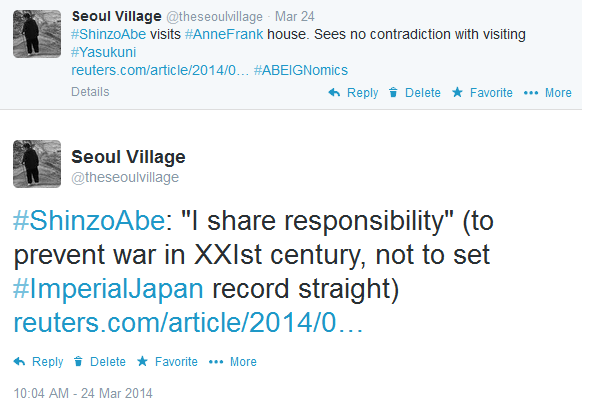
For good measure, Abe visited before the meeting Anne Frank's house, where he said "I share responsibility"... but in yet another one of his trademark, nose-thumbing references to history (see twitter timeline below). That visit happened a few weeks after hundreds of copies of Anne Frank's Diary were vandalized in bookstores and libraries across Tokyo Prefecture - a form of textbook revisionism as shocking as but more mediatized than the institutional one.

If the Tripartite Summitulacra resonates like a diplomatic victory for Abe, it must have come at a price. The one he's paid since his latest Yasukuni visit has already been already quite heavy for a nation where face-saving is paramount: first the US expressed their "disappointment", then Ambassador Caroline Kennedy canceled her NHK interview (following outrageous remarks from its governor), and then a Seoul stop was added to Obama's trip to Asia, conveniently shrinking the first three-day State Visit of a POTUS to Japan since Clinton into a less significant stay.

If historic issues were neatly put aside for the Summitulacra, they are at the center of the discussions held between Korea and Japan ahead of that trip - obviously a prerequisite for Korea to accept the Hague meeting. Korea focuses on "Comfort Women", Japan tries to throw in territorial disputes for confusion. Of course, the former issue is the priority because of its universal reach. Furthermore, it's not about Japan v. Korea, and not even about Japan v. all the nations victims to that institutionalized sexual slavery system, but it's about post-war, democratic and peaceful Japan v. Imperial Japan.

I cannot imagine one second Obama avoiding historic issues altogether, and I'd be more than "disappointed" if he didn't devote a highly meaningful moment to this particular issue.

I wish this trip could also solve the North Korea conundrum, but I wouldn't bet a Won on it. TPP, OPCON transfer, Okinawa moves? Technical details. If this man has a chance to deliver one speech for the ages in the region in 2014, that's it.


Seoul Village 2014
Welcome to our Korean Errlines! Follow Seoul Village on Facebook and Twitter
Bookmark and Share
Add this page to your favorites

* see "Remarks by President Obama, President Park of the Republic of Korea, and Prime Minister Abe of Japan" (US Embassy Seoul - 20140325)
** see "Japan’s rhetoric gets surly again" (Korea JoongAng Ilbo 20140328)

The twitter timeline around the Tripartite Summitulacra (excerpt):


Where we left things last time (see "KORUS chorus" - 20140318)
Now it's up to Park Geun-hye to accept summit with Obama and Shinzo Abe. Will she accept to put history issues aside? #ABEIGNomics (20140320)
twitter.com/theseoulvillage/status/446493174525984770


Japan and Korea discussing talks about Imperial Japan #sexslavery (NB: a condition for KOR-JAP-USA summit?) - 20140321
twitter.com/theseoulvillage/status/446940385177120768


First #ParkGeunhye-#ShinzoAbe meeting confirmed for The Hague next week. #Obama will hold the candle (20140321)
twitter.com/theseoulvillage/status/446803200482344960


#ShinzoAbe: "I share responsibility" (to prevent war in XXIst century, not to set #ImperialJapan record straight) - 20140324
twitter.com/theseoulvillage/status/447901746245816320


Even harder for #Obama to have #ParkGeunhye and #ShinzoAbe meet than to have #Israel and #Palestine meet. + the rockets are fired from #DPRK! (20140324)
twitter.com/theseoulvillage/status/448072415478697984
Historic handshake between war criminal grandson and dictator daughter (Nobel Prize winner observing) - 20140326
twitter.com/theseoulvillage/status/448630575683751937

#ParkGeunhye turned a deaf ear to #ShinzoAbe's "만나서 반갑습니다" ("nice to meet you") - 20140327
twitter.com/theseoulvillage/status/449049540348239872


Ahead of Obama's visit to Tokyo and Seoul, Japan and Korea to hold high level meetings in Washington next month
twitter.com/theseoulvillage/status/449377577962971136