NEW - download 'Seoul VillageS (서울 마을들)', my collection of 12 short fictions now adapted into short films! Get your free copy of the ebook (4 editions: English, French, Korean, Bilingual English-Korean)!

Showing posts with label architecture. Show all posts

Sunday, April 26, 2026

SeMA's saemaeuldeul

SeMA's latest branch was inaugurated on March 12 in Siheung-dong, Geumcheon-gu. Between an elementary school, big apateu blocks, the huge district office and its namesake subway station, this long, low rise structure designed by KIM Chan-joong sits in a small park and dons a headband reflecting light like a screen, probably an echo to its dedication to new media art.

The new ship is docked to its neighborhood through an anchor outdoor installation (Yaloo's Shininho Landing), and an inaugural exhibition ('Mneme topos') honoring its own construction. Nothing revolutionary or pretentious; visitors are even entertained with fun signage from the parking lot to various outdoor spots. The idea seems to make families and newbies comfortable, contemporary art accessible to everyone. 

Seo-Seoul Museum of Art fills a cultural gap in southwest Seoul, and somehow combines Siheung-dong's nature dimension with Doksan-dong's industrial culture. Going to Geumnarae Central Park with the kids or to the district office for some administrative stuff? You can seize the opportunity and take a short cultural break. 

#SeoSeoulMuseumofArt in #Geumcheongu, #Seoul.#culture #architecture pic.twitter.com/DsmrQsiSbu

— Seoul Village 🇺🇦 (@theseoulvillage) April 24, 2026

Previously, SeMA only had one site south of the Hangang, in Gwanak-gu: the Nam-Seoul Museum of Art inaugurated in September 2004 in the former Belgian Consulate building relocated to Namhyeon-dong 21 years earlier.

Before Seo-Seoul, SeMA's last inauguration (in May 2025) was at the diagonal opposite in Chang-dong, Dobong-gu. A sliced dark cube - or should I say a camera obscura? - The Photography Seoul Museum of Art is a more daunting beast, with an edgier inaugural program featuring familiar names, but also experimental artists I'd never knew graced the Park Chung-hee era.


As it opens, step by step, new Seoul villages to art, SeMA welcomes as always visitors for free. In case you missed any, here are the other venues:

  • Seosomun Main Building: SeMA's Main Branch is located in Seosomun-dong, Jung-gu, in the original Supreme Court (built in 1928). Inaugurated in 1988, it moved in 2002 from Sinmunno-2-ga, Jongno-gu, within Gyeonghuigung grounds (now the site of the Seoul Museum of History).

  • Buk-Seoul Museum of Art: inaugurated in September 2013 in Junggye-dong, Nowon-gu, SeMA's second biggest branch filled a regional void and often proposes interesting exhibitions


  • Also:
    • Archives, Seoul Museum of Art (inaugurated in April 2023 on the main axis of Pyeongchang-dong, Jongno-gu).
    •  SeMA Storage (inaugurated in 2016 in the former Innovation Park in Nokbeon-dong, Eunpyeong-gu )
    • SeMA Bunker (inaugurated in October 2017 under the Yeouido park and former runway - in Yeouido-dong, Yeongdeungpo-gu)
    • Nanji Residency SeMA  (in Sangam-dong, Mapo-gu)
    • Paik Ground (formerly Nam Jun Paik memorial house, inaugurated on March 10, 2017 in Changsin-dong, Jeongno-gu)


Seoul Village 2026
Welcome to our Korean Errlines! Follow Seoul Village on Facebook, Bluesky, Threads, Substack, and X/Twitter, follow me on Instagram.
Download 'Seoul VillageS', the free ebook.


Sunday, December 3, 2023

Seoul Twin Eye - A Ferris Wheel With A Twist

Remember 'Seoul Ring', the tolkienesque totem that was supposed to overlook the Han River from the top of Haneul Park? Well it's back, but with a couple of twists.

'Seoul Twin Eye'

'Seoul Ring'

First, the wheel is not on top of the hill, but at its feet, in the World Cup Park, by the Nanji Lake and Peace Park, mounted on a 40 m pedestal to compensate for the altitude loss. Still, we're talking about something gigantic: 180 m wheels, 64 capsules, 1,440 people at a time...

Second, that's a double wheel, with intertwined rings. So you will move sideways as well as vertically, which can be a bit disturbing if not for sensitive stomachs, at least for your sense of balance. A bit like the Las Vegas Luxor's 'inclinator', but in a loop. Thankfully, the pace is slow, so that you can enjoy the view instead.


Third, there's a whole Barnum around it, with a zip line,  performance and exhibition halls, a fountain show on the lake, and many other facilities, almost Lotte World style. 


A monorail to the subway (World Cup Stadium Station Line 6) will add more infrastructure to what was supposed to be a park, but also draw much more visitors on very cold or very hot days.

This KRW 910 bn extravaganza may not be the final concept. At this stage, Seoul city just gave the best score to the Seoul Twin Eye Consortium featuring SH Corporation, with SK Ecoplant leading the construction. Should its preferred bidder position be confirmed, this consortium will enjoy a 30-year concession.

Note that the company in charge of guaranteeing the structure, ARUP, already worked on the giant ferris wheel by the Thames, but at least Seoul decided to do something different from London. So as the name (which may not be final) suggests: 'Seoul Twin Eye' vs 'London Eye', rather a me-two than a me-too project?


Seoul Village 2023
Welcome to our Korean Errlines! Follow Seoul Village on Facebook and Twitter, follow me on Instagram.
Download 'Seoul VillageS', the free ebook.
Bookmark and Share


Thursday, August 24, 2023

Tear down that Seoullo?

On Tuesday, Seoul announced that a MOU shall be signed on September 11 (!) between the city, the Ministry of Land, Infrastructure, and Transport, and the National Architecture Policy Committee to elevate certain areas as 'national symbolic spaces'*. Among them, Seoul Station area. The Seoul Institute will complete a master plan for this problematic hub by October, and the removal of the highly controversial Seoullo 7017 is officially on the table.

I hope that will be the outcome, but more fundamentally, I hope that this time, the underlying problems will not be eluded but tackled, and I hope that this time, we will have a proper process with adequate consultation, consensus, and impact surveys (remember how PARK Won-soon rushed ahead of the elections, ignoring all red flags?).

If you follow this excuse for a blog, you already know that I'm not a fan of this urban and environmental nonsense (yes, environmental too: Seoul needs more natural biomass continuity and rich, water absorbing soils, not more thirsty plants isolated in flower pots... and certainly not sorted in alphabetical order, like in MRVDV's winning project).

You already know that the comparison with NYC's highline (itself inspired by Paris' Promenade Plantee) was a fallacy, that Seoullo should rather be compared to Cheonggye Highway, and that it chose not to solve the key issues (street level, railways...). 

You already know that maintenance costs were not sustainable, that visitor numbers started plummeting from the beginning, even before the pandemic, and that they keep decreasing. The expected failure is total.

But you also know that removing Seoullo 7017 will not solve anything by itself, that pedestrians need a safer way of crossing this sea of roads and railways, and that this concrete, steal, and asphalt sea can't remain a sea for much longer:


Seoul Station area and Seoullo 7017 (Naver Maps)

To say the least, Seoul Station's multimodal hub is very dense and messy. Tongil-ro, Sejong-daero, and Toegye-ro merge into Hangang-daero, with the Gyeongui Line and its sisters on one side, Huam-ro, and countless car and bus lanes on the other. Dedicated bus lanes have considerably facilitated pedestrian circulation on street level, and this thick ribbon may be further reduced into narrower, crossable axes. 

If going above ground failed and if the underground is saturated, there are possibilities.

Covering the railways remains high on the city's wish list, but this takes a lot of time and money. Seoul is considering moving bus transfers to the back of the station (which will have big impacts as well), and to extend walkways to prolong Sejong-daero's green promenade - I suppose with the necessary bicycle lanes - ultimately all the way from Gwanghwamun to the Han River (7 km).

Improving alternatives may reduce the flow of cars, and not just alternative routes beyond this area; alternatives that reduce the use of cars altogether. Quite a challenge in a multimodal hub already subject to bottlenecks at many levels...

What a fascinating urban challenge! One that calls for innovation instead of band-aids.

In any case, expect more Monday quarterbacking from yours truly.


Seoul Village 2023
Welcome to our Korean Errlines! Follow Seoul Village on Facebook and Twitter, follow me on Instagram.
Download 'Seoul VillageS', the free ebook.
Bookmark and Share

* I won't elaborate on this 'national symbolic space' concept, but Seoul Station clearly remains a cultural icon for the nation (entry point for many to the capital city, Gyeongui Line between Seoul and Sinuiju, Tongil-ro, KTX, Culture Station Seoul 284...).  


Sunday, January 16, 2022

From Human Town to Gather Town

Interesting to draw a parallel between OH Se-hoon's last two urban concepts: 'Human Town', which he didn't have time to fully roll out and scale up before the abrupt end of his previous mandate (see " OH Se-hoon launches the "Seoul Human Town" concept"), and 'Gather Town' ('Moa Town'), which has just been announced, less than a year after his return to office.

Both concepts rely on a common goal: revitalizing neighborhoods without destroying them with the usual 'New Town' model, offering community services usually found in big projects while preserving a nuclear, lower rise structure.

Seoul notes that 87% of low-rise neighborhoods don't meet requirements for redevelopment, often because they are not derelict or old enough. Yet many are poorly maintained because they stretch without a common purpose, and their dwellers already struggle to maintain shared spaces within their own buildings.

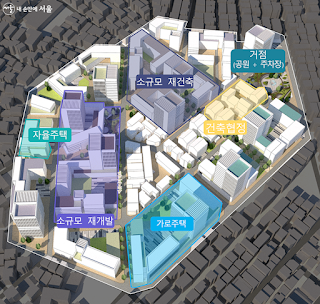
Where Human Town proposed a smart and light cosmetic revamping, Gather Town hybrid formula includes partial redevelopment to replace shared houses and 'villas' with low-to-mid-rise apartments, while preserving the street structure. Key regulations will be eased, for example the threshold for the proportion of deteriorated units, the type of buildings included. Where big projects cover over 100k square meters and take 8 to 10 years to complete, Moa Towns will start from 1,500m2 and only require 2 to 4 years. Seoul aims at 20 projects every year, and 2,404 units by 2025.

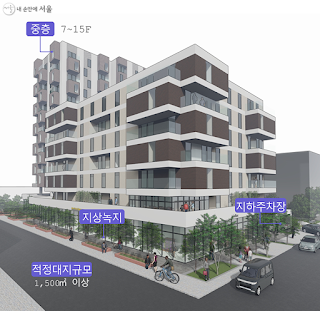
So unlike with Human Town, where individual units keep evolving at their own pace, it won't really the same neighborhood. But shared infrastructures can go much further, for instance a big underground parking that will fully liberate street level, and allow the removal of all these ugly ground floors on pilotis in favor of actual life spaces (shops, terraces, plants and parks, community services like libraries or day care centers...). 

Provided the design is up to the ambition, lively pockets can emerge in the middle of forsaken neighborhoods, and radiate across them.

I like the notion that pragmatism allows the combination of several techniques (certain sections can be redeveloped, other maintained, see schema below), but I wouldn't want it to become just a shortcut to build quickly something that lacks consistence and soul. You want a village where citizens breathe and enjoy walking.

If this rendering of a street (below) doesn't seem very exotic to Western eyes, 80s zoning sure beats the 50s Grands Ensembles that have kept popping up across Seoul ever since the sixties. And this looks much more welcoming than dense, tree-less 'villa' clusters. Provided of course these mid-rise sections conveniently hidden in the background remain a tiny part of the program. Note the post-covid architecture with individual balconies and on the second floor a shared outdoor space running along what must be community services or shops.

The first two projects mentioned on January 13th are Myeonmok-dong, Jungnang-gu, a vast low-rise neighborhood at the feet of Achasan, and Beon-dong in Gangbuk-gu, around Dream Forest and Odong Park, between Suyu-dong, Mia-dong, and Chang-dong, close to the Ssangmun-dong of Seong Gi-hun and Cho Sang-woo (both fictional characters sharing a lot with their author HWANG Dong-hyuk, a true local*).

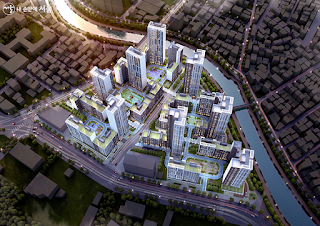
The Beon-dong project is not small at all (50,000 m2), and the one in Myeonmok-dong is almost twice bigger (97,000 m2). Sorry, but to me, this looks much more like a mini-New Town that to an improved old-town:

Beon-dong's 'Gather Town'
 

Obviously, 'Gather Town'  is less human centric than 'Human Town'. More top down than bottom up, with a top that rises a bit too high above 'low rise' levels... 

Seoul Village 2022
Welcome to our Korean Errlines! Follow Seoul Village on Facebook and Twitter, follow me on Instagram.
Download 'Seoul VillageS', the free ebook.
Bookmark and Share

* BTW ICYMI I was mentioned in Charlie Usher's article on not so glamorous Seoul neighborhoods ("The heart of Seoul – the working-class neighbourhoods captured by Squid Game and Parasite"). Of course, less glamorous doesn't mean less valuable, to the contrary. And if you haven't watched it yet, go binge "Squid Game - an addictive slap in the face".

Thursday, October 24, 2019

Seoul Biennale of Architecture and Urbanism 2019 - Collective City (also resilient and walkable)

Seoul is infinitely more walkable and pedestrian friendly than a few decades ago, but during the Seoul Biennale of Architecture and Urbanism, you can even hop from one World capital to the other* without leaving its center. For this second edition, two main venues have been added to the Biennale's horizontal axis, Seoul HOUR and the Seoul Museum of History joining the DDP, Sewoon Sangga, and Donuimun Museum Village.

Six months after the pre-biennale symposium and the Seoul HOUR inauguration (see "Seoul Hall of Urbanism and Architecture, Seoul Biennale 2019 Symposium"), the usual suspects showed up on opening day at Dongdaemun Design Plaza:


"Seoul Biennale of Architecture and Urbanism opening ceremony @ DDP Seoul.
Park Won-soon, Dominique Perrault, Seung Hyosang, Francisco Sanin" (@theseoulvillage - 20190907 - https://twitter.com/theseoulvillage/status/1170224195533279232)
The whole Barnum was supposed to move a few hours later to Donuimun Museum Village, but a last minute guest star crashed the party: because of Typhoon Lingling, all opening day festivities were eventually held in Zaha's landmark. Still, I decided to visit the Cities Exhibition on the same day, even as Lingling kept clearing her throat:


I had a great time exploring the whole show without the crowd, and intended to finish with Ulaanbaatar, a city that moved me so much three years ago (see "Welcome to Ulaanbaatar Village"). Unfortunately, when I arrived, its 'ger' was being dismantled at the last moment: located on the main building's rooftop, it could have been blown away. If this precaution turned out to be unnecessary, it somehow hammered down even harder (without any nails) the core messages from a city facing tremendous challenges, but at the same time able to leverage the amazing flexibility of its architecture. This could well be the poster image of a resilient city:

"Ulanbaatar's ger at Seoul Biennale Cities Exhibition unfortunately had to be temporarily folded yesterday because of Typhoon Lingling. If the typhoon failed to deliver its expected punches, this episode illustrates at the same time the flexibility of Mongolia's iconic architecture marvel, and urbanism challenges faced by its sprawling capital.
#SBAU #DonuimunMuseumVillage #gerhub" (@stephanemot 20190908 - https://www.instagram.com/p/B2I17q3p6qi/)
Go enjoy the countless shows, conferences, and other events (including the parallel ones) across the capital, and don't forget to pass by Seoul Museum of History, with its excellent 'Collective Market City' exhibition highlighting the key role markets played in the city's evolution from its very beginning:

"Collective Market City exhibition at Seoul Museum Of History. SBAU Live Projects with Jang Youngchul, Tomaz Hipolito, Young Wookoh, 000간, Roh Kyung, Oh Jaewon, Bang Jeongin" (@stephanemot - 20190909 - https://www.instagram.com/p/B2MBHqYJYS0)

Hurry up - you only have a couple of weeks left to enjoy SBAU 2019 (until November 10):

SBAU 2019: seoulbiennale.org


Seoul Village 2019
Welcome to our Korean Errlines! Follow Seoul Village on Facebook and Twitter, follow me on Instagram.
Bookmark and Share

* yes, like last time, Pyongyang is there (this time at the Seoul Hall Of Urbanism and Architecture):

"North Korea meets South Korea at Seoul Biennale Pyongyang expo. Seoul Madang, Seoul HOUR. SBAU" (20190910 - https://twitter.com/theseoulvillage/status/1171319358485712896)

Thursday, May 16, 2019

Switzerland v. Gyonam-dong Alps

Nevermind that dull tower rising over Pyeong-dong, down the hill; the new Swiss Embassy truly was the last missing piece in Gyonam-dong's jigsaw puzzle. How does it fit? Can it add some soul to a lobotomized neighborhood? First impressions after a visit organized on May 15, just days before its inauguration.

***
In 1974, to build its Embassy, the Confederation purchased a land enjoying a spectacular view over the valley West of Sadaemun's fortress walls, all the way from Namsan to Inwangsan. Over the decades that followed, and particularly the past fifteen years, high rise buildings and apartment blocks have claimed big chunks of it, and 6 years ago the neighborhood was almost totally wiped out to make room for Gyonam / Donuimun New Town and its anonymous towers, destroying priceless wonders in the process (see "In memoriam Samdong Samgeori, Gyonam-dong" ).

The Swiss could have looked for another location, and maybe join such Embassy clusters as Seongbuk-dong or Itaewon / Hannam-dong, but they courageously decided to stay. Well they did move to Hannam-dong though, but only the time to avoid that apocalyptic mutation, and to replace their nondescript red brick lair with something new. Here it is, now facing Gyeonam-dong alps instead of Geumhwasan and Tongil-ro valley:

Photo Erae Architects - Swiss Embassy website

Halfway between Hong Lampa house in Hongpa-dong, and the sanitized* Donuimun Museum Village in Sinumunro 2-ga, the new landmark confirms this section of Songwol-gil as some kind of green and architecturally diverse oasis.

One roof, continuous wings, a central madang... the 2019 Swiss Embassy clearly honors the hanok style, but with a modern, deconstructed twist, and a broken version of the traditional 'ㅁ' or 'ㄷ' shapes:

The open spiral from above (mockup - Burckhardt Partner website)
Logo created for the Embassy inauguration
More an open keyring than a locked up Swiss bank vault, this Embassy wraps you up without cutting you from its environment, providing at the same time intimacy and transparency. The wide windowpanes facing the courtyard enable a dialog between the four wings (multipurpose, chancery, representation space, residence of Ambassador Linus von Castelmur), but the building is also open to its surrounding. Even the metal fence lets you see through. And if some semi-private spaces (cafeteria, living room) display some sort of ceramic moucharabieh, their lace is very wide. The biggest windows point to the sky or surrounding gardens, others direct your gaze to the greenest spots of the New Town, so that you never quite face its dead monoliths.

The outer concrete walls echo modern Swiss heritage, but wood is omnipresent, with epicea ceilings, staircases, slabs, and pilars. The lightness of the roof and structure, boosted by a gigantic sail cast over half the courtyard, could be achieved by the burial of most technical machinery in dedicated basement corridors. We also visited the nuclear shelter, compulsory for public structures of a certain size in Switzerland, but maybe not that irrelevant this side of the DMZ.


This environment-friendly building collects heat from the underground (30+ geothermal pumps), power from the sun, and water from the skies, sometimes in an artistic way, thanks to Lena Maria Thuring's 'Water connections' installation, where metal chains direct part of the flow from the rooftop to hanging stones and surface channels:


The visit was led by architects Nicolas Vaucher (Burckhardt Partner), and Lee In-ho (Erae Architects). Obviously, I followed the former:


Nicolas Vaucher in the madang, the staircase, the cafeteria, the nuclear shelter, the machinery, the residence's garden, the representation's dining room, the cultural section, the entrance.

Six years ago, I thought that all of Gyonam-dong's seven neighborhoods would disappear for good. They will never be brought back, but at least, somehow, part of Songwol-dong continues to exist under a new form.


Seoul Village 2019
Welcome to our Korean Errlines! Follow Seoul Village on Facebook and Twitter, follow me on Instagram.
Bookmark and Share
Add this page to your favorites

* see my lukewarm review in the "Seoul Biennale of Architecture and Urbanism 2017" focus

Monday, April 15, 2019

Notre Drame bringing back the Namdaemonium trauma

I woke up this morning to the terrifying sight of Notre Dame engulfed in flames by night. It instantly brought back the Namdaemonium trauma, when Sungnyemun burned down (11 years ago, see "Namdaemunium").

Notre Drame 2019 (left), Namdaemonium 2008 (right)

As a Parisian walking by the monument every day when in my hometown, I feared for the worst, but hopefully the cathedral shall not collapse entirely, as Seoul's last original gate did. The damage remains considerable, starting with that amazing 'foret' of original giant beams, gone for good.

Both 'Namdaemun' and Notre Dame had survived centuries, and wars, both were somehow victims of negligence. If an arsonist did ignite Sungnyemun, the site had recently been deprived of human surveillance in favor of CCTVs. We can't tell yet what caused the fire in Paris, it has probably something to do with the restoration under way around the spire (a XIXth century add on). Walking by the scaffolding on the northern side last month, I was surprised to see how vulnerable the working site looked, but how to keep such an architectural marvel behind wraps? 

Ever since the foiled terror attempt to destroy the Eiffel Tower in 1994 (the one that inspired 9/11), I don't look the same way at landmarks I used to take for granted.

More than in our cityscapes, some landmarks are true anchors in our hearts. You know it when they beat faster each time you see them.


Caught in the Seoul traffic with Sungnyemun. That's not a k-pop star: she's much cuter, has better conversation  - twitter.com/theseoulvillage/status/329023620355596289


Seoul Village 2019
Welcome to our Korean Errlines! Follow Seoul Village on Facebook and Twitter, follow me on Instagram.
Bookmark and Share
Add this page to your favorites
.

Sunday, April 14, 2019

Seoul Hall of Urbanism and Architecture, Seoul Biennale 2019 Symposium

The day before Mayor PARK Won-soon cut the ribbon with a dozen VIPs (see below), the new Seoul Hall Of URbanism and Architecture hosted a pre-Seoul Biennale Symposium. A perfect occasion to roam the venue, to the notable exception of the exhibition spaces, and key connections to the neighborhood's underground system, which only opened for the official inauguration.

Yes, I'm talking about the 'Sejongdaero' project we followed from its earliest stages, back in 2015, where the old Japanese tax office used to stand:
. "Tear down that tax office" (20150506)
. "Sejongdaero" competition officially started' (20150727)
. "Sejong-daero winner announced" (20151012)

But before exploring this Seoul HOUR, how about a focus on the Biennale and its symposium?


***

2019 Seoul Biennale and Pre-Biennale Symposium

If the first symposium, held at the Seoul Museum of History in October 2015, questioned even the principle of a biennale (why not a triennale?), this one went as far as presenting the material used to build the stands. A sharp contrast between an exploratory discussion two years before a first edition, and an operational briefing six months ahead of the second.

", , , , , on stage of Symposium " (20151027 - https://twitter.com/theseoulvillage/status/658845140505653248)

A new tandem, LIM Jaeyong and Francisco SANIN, replaced PAI Hyungmin and Alejandro ZAERA-POLO at the heads of the bicephale biennale, knowing that, of course, SEUNG H. Sang remains close by, even if this time, he didn't take the mike (cameo apparitions on a few slides, though).

"#Seoul Biennale 2019 Symposium 20190327.
Between #Francisco Sanin and #Lim Jaeyong: #Cho Minsuk, #Armando Hashimoto, #Peter Wilson, #Noura Al Sayeh, #Chon Jaesun, #Alicia Lazzaroni... #Seoul Biennale of Architecture and Urbanism #architecture #urbanism #seoulhour" (20190412 - https://www.instagram.com/p/BwI7PM9JFsL/)

After 'Imminent Commons', Seoul went for the theme 'Collective City' (announced last December), around the same 4 main axes:
  • Thematic exhibition (curator Beth Hugues): research and propositions around the 'collective city' notion, held in the DDP (Design Exhibition Hall, Design Pathway). Let's see what comes up from the various topics (typology, post-domestic city, mediation, heritage, infrastructures, ecology...).
  • Cities exhibition (curators YIM Dongwoo, Rafael LUNA): I'm excited by the choice of Donuimun Museum Village and its Seoul Center for Architecture and Urbanism for the venue instead of the DDP, where the first edition took place. Mind you, that was a terrific exhibition, and they managed to make it not look like a fair, in spite of the site, but Sinmunno provides the perfect - if challenging - backdrop for a genuine global village, with actual alleyways. Dongwoo already researched innovative mapping axes for the 80 cities.
  • Global studio (curator CHOE Sanki): note the semantic shift from the 'international studios' of the first edition (curated by John HONG, who presented his return on experience). All events shall be concentrated around Seun Sangga (Sewoon Plaza, Sewoon Hall).
  • Live Projects (curator JANG Young-chul): articulated around the concept of market, very relevant in the context of a collective city, particularly since, as JANG reminded us, the '시' in '도시' (city) means 'market'. Two venues: Seun Sangga (Sewoon Plaza, Daelim Sangga), and the Seoul Museum of History.

I presume Seoul HOUR shall also serve as a venue, if not a hub. Anyway, Sadaemun's Jong-ro - Saemunan-ro horizontal remains the biennale's urban backbone. And if you forgot what I'm referring to, I shalt forgive thee, but here's the animated map:


If I'm looking forward this second biennale (September 7 - November 10), this symposium was already worth attending, with stimulating presentations, moments and chats. Special mentions to:
  • Jae-sung CHON's ode to the collective mess (he had me from the start by mentioning Kowloon Walled City and Seoul markets), and his fake news journal to project the reader in the future... that's my vision of urbanism, where you shouldn't sanitize everything, but leave room for organisms to evolve, grow, mutate by themselves. 
  • Peter Ferretto's respect for China's threatened wonders (beautiful project in Gao Bu, Hunan). 
  • CHO Minsuk's updates on Danginri and Bamseom, the rooftop theater of his Seoul Cinematheque. 
  • Alicia Lazzaroni's 'vulnerability as a design' 
  • KIM So-young's 'negociated city' 
  • Erik L'Heureux's lyricism about HCMC's forgotten gems. He saw no connections to Seoul, but I couldn't stop thinking about my dear "Hoehyeon Apt, Chungjeong Apt, Dongdaemun Apt, Ogin Apt..." 
  • John HONG reclaiming preservation as radical, 'Citizen Jane'-style, and LIM Jaeyong musing 'but if it's us vs them, who are we, who are they?'


On the eve of its inauguration, at the new #Seoul Hall Of Urbanism And Architecture for the Pre-Biennale Symposium
Workshop featuring (left to right): #Peter Tagiuri #Alicia Lazzaroni #Klaas Kresse #Kim Soy-oung #Patrick Weber #John Hong #Choe Sanki #Erik L'Heureux #Chon Jaesung #Peter Ferretto #Rafael Luna #Yim Dongwoo
#Seoul Biennale #Seoul Biennale of Architecture and Urbanism #서울도시건축프리비엔날레 #SBAU
#서울도시건축전시관 #seoulhour
(SeoulVillage Facebook page - 20190327)


***

Seoul Hall of Urbanism and Architecture


So we now know how this 'Seoul Chronicle' works, and what its purpose is. From the beginning, I liked the minimalist approach with a focus on connectivity over and underground, the new building subliming surrounding structures: Deoksugung walls, the Seoul Anglican Cathedral, and even the less gracious Seoul Metropolitan Council, whose campanile almost ends up making sense. 


You can reach Seoul HOUR's rooftop from all sides, and face the stream of Sejongdaero as if from a non-scary diving board, with the bulging side of Seoul City Hall in front of you, Gwanghwamun to your left, and Seoul Plaza to your right. If you return to street level, you can also enjoy a panoramic view while sipping a cup of - what else* - coffee.


"Of course, also has a cafe (ground level), and a rooftop view on and (just-above-ground-level rooftop) " (201903 https://twitter.com/theseoulvillage/status/1110894852370161664)

Now in this kind of iceberg structures, you need to dive well below the surface, through 3 underground levels with relatively low ceilings, except in strategic places, and of course for 'VIUM Hall', the huge parallepiped going through all four levels. Frankly, the first impression of this main exhibition space is a bit disappointing: you can reach it directly through a central, monumental staircase that feels somehow like a Seoul subway entrance (yes, as advertised, Seoul HOUR is connected to the Sejongno underground network, which means among others City Hall, and the subway). Furthermore, halfway down, your first glance at the inaugural exhibition (about Vienna public housing) is from above, which makes it look smaller and weaker behind its scaffoldings. Video projections on the wall to your right don't quite make for the big dark void in front of you. I understand the architectural logic to prolong Deoksugung's walls, but from this angle, this corner is really too dark, and not exactly awe inspiring.

But that can be fixed easily; a towering exhibit, or why not an ethereal SUH Do-ho fabric house?

To truly appreciate the hall's volume, this is the best angle, facing lighter structures, the glass connections to the other floors and exhibition spaces, the window towards the street:

" Inauguration with mayor :" (20190328 https://twitter.com/theseoulvillage/status/1111134424853184514)

Here are the 4 inaugural exhibitions: 
  • 'Vienna Model - the past, present, and future of public housing', with a resolutely no-frills museography
  • 'The social role of architecture' (starting with Seoullo 7017, just to make the mayor happy, I presume)
  • 'An-other Seoul', with a 3D map of the capital city reminiscent of the bigger one at the Seoul Museum of History, and an interesting scenario: what if, instead of reducing every year greenbelt areas (see "Land mining Seoul"), urban planners made better use of the sites related to infrastructure, which represent almost two thirds of Seoul's total surfce?
  • 'Documenting the city', curated by LEE Sang-koo, with a focus on familiar lost villages (Sinwol-dong, Sanggye-dong, Geoyeo-dong).


" at () one day before its inauguration, for Symposium. Expo on in , (reminiscent of )... " (20190327 https://twitter.com/theseoulvillage/status/1110892328120508416)


Seoul Village 2019
Welcome to our Korean Errlines! Follow Seoul Village on Facebook and Twitter
Bookmark and Share
Add this page to your favorites

* for instance City Hall in 2012 ("Seoul Tsunami City Hall, The Other Korean Wave"), the DDP in 2013 (see "Sneak peek inside Dongdaemun Design Plaza & Park")
** see "500 m, 80%, 100% urban crappuccino"