Seoul as it was, Seoul as it "is being", ever-changing. Welcome to my Korean Errlines! Get your free copy of my 'Seoul VillageS' (12 fictions) - Join Seoul Village on Facebook and Twitter.
Seoul website posted today* about a UN report on Smart City Seoul, actually a case study published last February by the ITU (International Telecommunication Union), the UN agency in charge of ICT standardization, and co-written by Jong-Sung Hwang (Assistant Mayor for IT, Seoul Metropolitan Government) and Young Han Choe (ITU Telecommunication Standardization Bureau).
In the perspective of Seoul Smart City 2015, that's an interesting overview and update at all levels: policies, organizations, infrastructures, plaftorms, applications, user interfaces and usages... even private initiatives, like the virtual store that made a splash a couple of years ago (see "HomePlus virtual stores in Seoul subway : from your smartphone to Cannes festival screens"). Random examples:
u-Seoul Net - The backbone has been extended to 192 km to enable further integration and convergence across the capital. At the other end of the network, Seoul can leverage a world class broadband coverage (4G, wifi, FTTH, even in subways), but it keeps investing in free wifi hotspots (eg in public areas and parks), and even in device donations to democratize usages.
Smart Work Centers: 10 "u-Work Center" allow civil servants to work closer to home, reduce stress, and carbon footprints... without going all the way to working from home.
Yeyak, the one-stop, integrated reservation system for all public services: yeyak.seoul.go.kr/english/main.web. NB: databases not yet operational**. Seoulites already enjoy great services for free (eg 120 Dasan Center, Seoul Global Center, real time info on traffic and public transports...), and a new mobile app specially designed for foreigners will be launched next month. A leader in e-government, Seoul plans to disclose 100 databases to the public by the end of 2013 (150 by the end of next year).
Yes, there's the security issue any CCTV-laden smart city faces, but this "Big Brother" is rather here to help.
Overall, an interesting read, not too technical for an ITU paper (I remember eating a few of those back in the nineties, when I worked on 3G and beyond). Not all dimensions are covered, and I think it could have been interesting to add something about broadband penetration and usages in the capital. The number of LTE subscribers recently passed the 20 M mark in Korea, where the economy of the "last mile" is very competitive for operators compared to their European counterparts.
... reminds me I've got to finish my latest update on the "ubiquitous" but not yet "all over the place" cities of Songdo and the DMC.
Whether North Korea detonates a fourth nuclear device or not, we'll have other fallouts to worry about. Fukushima keeps making the headlines every now and then (lately, a small leak of contaminated water - barely 120 tons), and Korea has had its share of leathal gas incidents over the past few months, but I'm talking even bigger stuff.
In China alone, air pollution killed more than 1.2 million people in 2010. That's five times as much as Hiroshima and Nagasaki combined. And back in 2010, "airpocalypse" was far from last winter's records in Beijing (40 times the levels considered as dangerous by the WHO)...
Everybody is aware of Beijing's alarming pollution, starting with Chinese authorities, who can't contain anymore its economic, political, and social cost. And at this stage, sweeping the data under the rug is not an option: the US Embassy in Beijing are doing and publishing their own measures, which replaced the official statistics as the reference for Chinese netizens. Bonus, the website of the Institute of Public and Environmental Affairs (IPE) does look less sexy than its American rival:
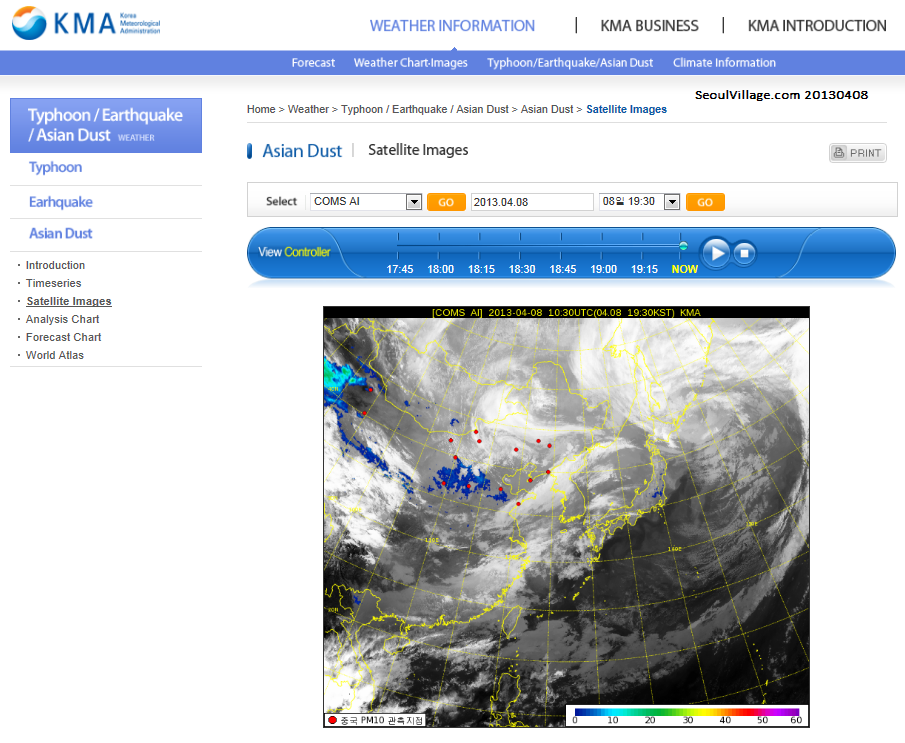
If significant progresses were made at certain levels, and if the country can blame its giant neighbor for recurrent yellow sand and polluted winds (e. g. 30 to 40% of sulfur and nitrogen oxide pollution comes from China*), a lot remains to be done. And the information is - to say the least - not up to the mark.
We do enjoy a relatively good level of information and alert for major yellow sand episodes...
And we're receiving positive signals: - The National Institute of Environmental Research (NIER) will improve its Clean Air Policy MOdeling System (CAPMOS)**, and "the ministry plans to introduce a fine particle warning system for Seoul and the metropolitan area in the first half of this year, and the system will be expanded to ultrafine particles next year"*. NB: that's for the most damaging microparticles, the ones that reach the deepest parts of our lungs (Particle Matter under 2.5 microgram). - Environmental pollution will be more severely fined***
But of course, this accumulation of "measures" shows that there's a sense of emergency. From the start (see "Clean Air @ Seoul"), information websites showed some limits. And "tough penalties" only happen once you've caused three environmental incidents! Imagine the Japanese government telling to TEPCO: "okay, you've been allowed one strike at Fukushima, but two more and you're out"... Wait a sec'... Um, yup, that's exactly what happened... but Korea can do better than that!
Cleaning the air will take time, but transparency will do more good than denial and procrastination, which only make things worse.
Let's make a test: if I tell you "lecture about Korean literature", what do you see? . if you see a yangban scholar watching his pupils silently read in a Andong seowon, you know your classics . if you see a cheering crowd and a Californian guy bringing the house down, you were at last Sunday's 10 Magazine Book Club meeting with Charles Montgomery
Charles Montgomery and the "Explorers Guide to Korean Literature" he prepared for the lecture.
Montgomery, who teaches at Dongguk University's English Interpretation and Translation Division, proves that you can do a lot to promote modern Korean literature without being fluent in Korean. Yes, he relies on translations, and yes, he's very much aware of the gaps they induce with the original works, but precisely: translation being the main channel trough which literature reaches new shores, you want to make sure that foreign readers enjoy to the fullest this wide array of tastes and flavors.
And nowadays, modern Korean literature is reaching new shores and levels of popularity. The literature originating from the peninsula as well as the one originating from the Korean diaspora: long before SHIN Kyung-sook won the 2011 Man Asian Literary Prize for "Please look after mom"* (2009), Chang-rae LEE claimed the 1996 Hemingway Foundation/PEN Award for "Native speaker" (1995), a book written in English.
Let's hope Korean publishers won't feel tempted to follow the suicidal path of a national movie industry that relies almost exclusively on blockbusters, and completely forgets to nurture its diversity**. As long as it respects and feeds the rest of the ecosystem, "commercial" literature shouldn't be despised. Just like with Korean cinema, Korean literature managed to bloom in France without the help of airport novels or bestsellers, but in general, such driving forces do make a difference: Montgomery monitors the sales of a panel of Korean authors on Amazon, and he noticed how, each time a new hit came out, the whole community received a boost beyond the individual who wrote it.
Even if he remains a "paper book" lover, Montgomery knows the importance of ebooks (his wife already owns hundreds of them), and the power of online media. His blog-portal Korea Modern Literature in Translation (ktlit.com***) reviews countless pieces of fictions, sharing bios and links to online resources and texts in the public domain. But that's never a tedious journey for the readers, who are regularly entertained with jokes and anecdotes, and routinely OMGed, LOLed or ^^ed. Montgomery also shares knowledge through Wikipedia, a preferred source that optimizes the chances for web surfers to become acquainted with Korean literature.
When you think that even Korean "airport novels" can't be found in Korean airports! The most obvious entry points for Korean culture are too often overlooked, as is the case with Korean cuisine (e.g. in Seoul, only 2 international 5 star hotels have a Korean restaurant****).
Hopefully, Koreans are reconsidering and reviving their literary heritage, and as we've seen before (in "Seochon's Dead Poets Society (YI Sang, YUN Dong-gu)"), nowhere as strongly as in Seochon area, where it all began. Note that on the Friday preceding this book club meeting, there was a party for a photo expo at YI Sang's former home along Baekundongcheon (now Jahamun-ro 7-gil), and that many came dressed and hair-styled according to the theme: 1930s Seoul. Saved by Arumjigi and renamed "제비다방" / "Jebi Dabang" / "Swallow Teahouse", after the two places the author opened in Seoul, the tiny house was soon completely packed. A perfect alibi to retreat to Aux Petits Verres across the street, and to enjoy nice coffee and cakes while comfortably observing a parade that really looked like 1930s Seoul... except maybe for the fact that rickshaws that probably never set a wheel in the peninsula, and that I rather felt on the "Roaring Myeongdong" than on the "Cultural Resistance Seochon" side of the city.
Anyway, on Sunday, when Roaring Charles encompassed at a fox trot pace centuries of Korean literature, everybody danced along. Of course that didn't leave us much time to discuss the selection of short stories he recommended ahead of the meeting*****, but we came back home with stimulating reading suggestions. Feel free to add your own suggestions to his "All modern Korean literature in translation online" list, and of course to join Barry Welsh's 10 Magazine Book Club (on Facebook: facebook.com/#!/groups/208460045872355).
* not to be confused with LTI Korea, formerly KLIT (Literature Translation Institute of Korea - http://eng.klti.or.kr/). KTLIT on Twitter: @ktlit. ** see "Saving Korean cinema... and even Chaebolplex". BTW if you're more into movies than into books, the Korean Film Archive uploaded a collection of movies dating from the 1940s to the 1990s on its YouTube channel (youtube.com/user/KoreanFilm), where you can watch them for free and with subtitles. *** not to be confused with "Please look after dad's mummy", by KIM Jong-un **** see "Korean Cuisine Aiming At World's Top Five. China is watching." And the Korean education system is also a problem for literature readership, but at least Seoul is creating new libraries (beyond the old City Hall, see "Seoul village libraries"). ***** From the "colonial era" (1905-1945): "A society that drives you to drink" (HYON Chin-gon). From the "separation era" (1945-1965): "The crane" (HWANG Sung-won). From the "miracle on the Han River era": "The city of machines" (CHO Se-hui). From the "post-modern era": "Whatever happened to the guy in the elevator" (KIM Young-ha). NB: I also second Charles's motion when he recommends "The Road to Sampo" HWANG Sok-yong
For its 4th Asian Leadership Conference, Chosun Ilbo gathered an impressive line-up of power hitters around the theme "Asia's Next Challenge: Good Growth and Smart Welfare" (see agenda and program below*).
The simple fact that organizers sped up the process - the previous editions were held in 2005, 2008, and 2012 - tells a lot about the success and the relevance of the event. And this time, there was almost a vintage G8 flavor as a collection of former heads of state joined the usual mix of CEOs, gurus, innovators, and scholars.
But the point was not to impress with hard power. Yes, there was at times testosterone in the air (thank you Jim), but even in this male dominated environment and even in these sabre-rattling times, a clear consensus emerged on the need to emphasize on collaboration vs competition, and on the evidence that empowering women was as the most efficient way of reviving at the same time economies, societies, and politics across the region and beyond.
I couldn't resist, instants before the opening ceremony, taking this "Power to the Women (Fleur Power?)" picture, where even French deputy minister Fleur PELLERIN seems overshadowed in this "man's world":
Random memos 1 - Special mentions and special thanks
Of course, in this kind of events, you can't expect all 150 speakers to deliver life changing speeches, but there were good moments, particularly when heavyweight moderators went out of their way to spur the debate.
So I'll start with a special mention to Sir Martin SORRELL (WPP) and Jim CLANCY (CNN):
Studious Sir Martin
The Ad Man - who proved he could negociate more airtime - forced the former PM of Netherlands to declare his personal views about where the UK should stand vs the EU (better in than out, but only if the UK accepts full membership). I also enjoyed his no-nonsensical lecture later in the day: SORRELL may not be the most inspiring and visionary leader, he may have too financial a focus for my taste, but he has an acute sense of strategy, he always keeps an eye on the big picture, and he knows how to map his environment. The kind of CEOs who won't panic behind the wheel in times of trouble, and who doesn't consider his 165,000 employee company as a supertanker. When I asked him if it the challenge was not greater now that technologies, know-hows, and business models evolve constantly, he answered that it was much easier for a big company.
Battling Jim CLANCY just left the ring: danced like an elephant, stung like a rhino, roared like a lion, won by K.O.
The Anchorman - who proved he could boost an audience - roared like a lion each time a debater tried to dodge certain questions that are not often asked in public in Korea ("So tell me: those Korean chaebols, are they too big to fail or too big to jail?").
I must also give special thanks to Tarja HALONEN and Steve CHEN:
Since we were seating next to each other, I could enjoy a short one-on-one chat with the former President of Finland about European and Asian politics. I wish all top politicians were as kind, modest and straightforward on stage and backstage.
HALONEN was smiling on every other picture I took, but you don't reach 88% approval rates just because you're a nice person: ever the activist, she also knows how to fight for ideals
Note that in general, the atmosphere was very friendly and open, not just thanks to gurus who make a living out of it (Google's very friendly "Jolly Good Fellow" Chade Meng TAN, or the more money-driven coach Marshall GOLDSMITH).
Random memos 2 - To Change? Yes, but you don't kick habits that easily
It was all about the end of ideology, the need for pragmatism, openness, sustainable approaches... and yet a few die-hard ideologues kept playing the same old tunes. The audience didn't seem to mind: judging by their conversations as well as by their votes on the brand new Galaxy tablets offered by the organizers, visitors seemed mainly conservative. Except, at the other end of the spectrum, a male Lee Jung-hee who made everybody laugh with his more than passionate interventions from the floor.
I don't know how many times Adam Smith was quoted over the two days, but even the 2011 Nobel Prize laureate in economics couldn't find a more recent reference to justify his opposition to government intervention in the youth unemployment crisis. At least Thomas SARGENT reminded the audience that Smith himself would have been revolted by the excesses and total lack of ethics in today's capitalism. For SARGENT, unemployment is a natural situation, and regulations artificially pollute this perfect environment that only needs time to adjust. Unfortunately, he was only opposed by Gunther SCHMID, who rolled out without much passion his usual pitch on transitional labor markets. The moderator himself seemed more in a lecturing than an animating mood.
The audience was still recovering from Battling Jim CLANCY's victory by K.O. in the previous bout: "Chaebol: to regulate or not?", featured Raffi AMIT (author of 's WSJ piece "Korea's Costly War on Conglomerates") and JWA Sung-hu (Korea University, author of "The evolution of large corporations in korea") in the "deregulation" team, and JANG Ha-sung (SNU, ever the corporate crusader) and Yishay YAFEH (Hebrew University, author of "Business Groups and Risk Sharing around the World") on the "pro-regulation" side.
AMIT all but disclosed the names of his sponsors in a textbook defense of chaebols started by the usual "don't kill the goose that lays the golden eggs". I do think that Korean conglomerates invested massively in innovation and jobs at the right moment, and that they should be praised for that, but when AMIT noted that chaebols grew more than the rest after the crisis, he forgot to mention that precisely, they sucked way too much value out of the market, phagocytizing new fields they had no business venturing into. Smaller players usually do the bulk of the job in times of crisis, and even in good times, SMEs create 40 jobs with USD 10 M compared to 10 for chaebols.
JWA believes that SMEs have the same chances as chaebols to grow into big fishes, and that the only things that block this perfect system are critics from the outside. He says "we don't need government regulation but stronger competitors", but we can't achieve the latter without the former. In a soft-spoken yet implacable prosecution speech, YAFEH pointed out the fundamental flaws of the system, the collusion, the regulatory capture also achieved by mass hirings of former regulators and judges (at which point CLANCY mentioned the usual "Republic of Samsung" - "chaebols become the government" arguments)... and the indecence of it all: when to intervene?"It's like pornography: you know it when you see it". JANG Ha-sung delivered hard facts, figures, and punches, showing pervasive subsidiary charts. He also drew a comparison with a small village: if a farmer behaved like that, controling the whole value chain from the land and fertilizers to the retailers, what do you believe other villagers would think of him?
NB: images work even better when you actually draw what you're talking about, and Peter SCHREYER did just that during his lecture. Kia-Hyundai's Chief Design Officer drew us a plane, but no lamb. He positions Hyundai as a fluid water drop, and Kia as a more architectural snow flake... which doesn't leave much to competitors (vaporized?).
Random memos 3 - A few pieces of advice to Park Geun-hye
Direct advice to the new president: . From Dominic BARTON: the first year is key, be aggressive, promote vocational jobs like Germany, make them more highly regarded and better paid . From John RICE: focus on infrastructure and immigration to draw foreign investors, promote transnational collaboration. . From Tarja HALONEN: keep your promises, say what your predecessor did well, try to avoir situations where people are unhappy, talk to female students and empower them, strengthten bridges between universities and enterprises, train students for self-entrepreneurship . From Jan Peter BALKENENDE: new deal between chaebols and SMEs, have chaebols be evaluated by their partners like Unilever does, look for values (happiness is not just wellness), work on innovation and trust . From Albert KOCH: go for restructuration, let the private sector take care of business (NB: and if you want a long term vision, don't listen to people like me who make a living out of turnarounds)
Advice to Korean leaders and managers in general: . From Martin SORRELL: don't forget internal communication, explain strategic changes internally, don't let financial procurement claim too much power, doing good is good business. . From Charles DUHIGG: acknowledge complaints, learn from them, teach life skills, turn willpower into training and positive habits . From Peter SCHREYER: no guts no glory, the biggest risk is to take no risks . From Steve CHEN: measure your risks, but if you want to go far, you have to take the plunge, opportunities never last long . From Chade Meng TAN: don't pursuit happiness, it's already there, kindness is powerful. . From Marshall GOLDSMITH: thank people for telling you the truth, don't let other people's craziness become your own, don't say "I'll be happy when" - be happy now . ...
Random memos 4 - The Northeast Asian Reshuffle
This conference wasn't meant as a political tribune, but Michael Powell confirmed the messages he previously delivered to the press. The former Secretary of State hammered that the days the North Korean regime could scare everybody at no cost were over, that THEY should be scared now, and that the time had come to show positive and constructive attitudes. Kevin RUDD, a connoisseur of Chinese arcanes, confirmed that the days China forgave every provocation from the North were over, that the country wanted to be respected as a diplomatic force, and that para-imperialism (ie Northeast Project - "Hanschluss") was putting security at stake. For China, having this unruly regime at the door is much worse than having the US at the door.
It may not show on his face, but former Foreign Minister HAN Sung-joo is very happy that the KOR-US partnership is stronger than ever, that China is evolving in the right direction, and that the rest of the world is unanimously condemning North Korea's dangerous antics.
Yasuo FUKUDA failed as a Prime Minister because he promoted pragmatism, reconciliation in the region, environmental reforms, and "worst of all", because he didn't play the ultra-nationalist game - his surprise resignation, not even one year into the job, happened just weeks after his refusal to visit the infamous Yasukuni shrine. FUKUDA remains the peaceful and soft spoken moderate leader Japan needs right now, and he already succeeded Shinzo ABE once... but this time, he's really too old.
She's the first female president of her country, she's the daughter of a president who ruled with a strong fist, but also carried major reforms... but Megawati SUKARNOPUTRI didn't achieve much else, and at the ALC, she embarrassed the audience by refusing to be treated as a non-keynote speaker, and by reading texts from daddy SUKARNO. Definitely not a model to follow for PARK Geun-hye.
A few portraits to wrap it up:
Chosun Ilbo CEO BANG Sang-hoon, a perfect host
The kind and not so charismatic new Prime Minister, JUNG Hong-won
Fleur PELLERIN again. She may be a fellow French citizen and a fellow ESSEC alumni, I must say I expected something more than her standard sales pitch for FDI in France
Former PM Jan Peter BALKENENDE (Netherlands) has learned the importance of being Ernst and Young, but we did share a laugh after his speech.
Looking forward to the next edition, I presume next year.
Agenda 2: Shaping Asia's New Paradigm - Korea's Case
Agenda 3: Paths To Good Growth
Agenda 4: Future of the Asian Century
The Program:
SESSIONS DAY 1:
Opening Ceremony: . BANG Sang-hoon (Chosun Ilbo CEO) . JUNG Hong-won (Prime Minister of South Korea)
Session 1: Challenges and Tasks of New Asian Leadership Moderator: Martin SORRELL (CEO, WPP Group) . Tarja HALONEN (Former President of Finland) . Fleur PELLERIN (Cabinet Minister of France) . Megawati SOEKARNOPUTRI (Former President of Indonesia) . Yasuo FUKUDA (Former Prime Minister of Japan) . Colin POWELL (Former Secretary of State of the United States) . Jan Peter BALKENENDE (Former Prime Minister of the Netherlands) . Kevin RUDD (Former Prime Minister of Australia)
Session 2: Diplomatic Strategy for Peace and Prosperity in Northeast Asia Moderator: Zeb ECKERT (Reporter, Bloomberg TV) . Colin POWELL (Former Secretary of State of the United States) . Kevin RUDD (Former Prime Minister of Australia) . Sung Joo HAN (Former Foreign Minister of Korea)
Session 3: How to Design Korea’s New Normal Moderator: Jong Nam OH (Professor, Seoul National University) . Tarja HALONEN (Former President of Finland) . Jan Peter BALKENENDE (Former Prime Minister of the Netherlands) . Dominic BARTON (Global Managing Director, McKinsey and Company) . John RICE (Vice Chairman, GE) . Albert KOCH (Vice Chairman and Managing Director, AlixPartners)
Session 4: Chaebol, to Regulate or Not? Moderator: Jim CLANCY (Anchor, CNN) . Raphael AMIT (Professor, Wharton School of Business) . Yishay YAFEH (Dean of School of Business Administration, Hebrew University) . Hasung JANG (Professor, Korea University) . Sung Hee JWA (Former Professor, Seoul National University)
Session 5: Youth Unemployment: Can Government Solve it? Moderator: Dong Sung CHO (Professor, Seoul National University) . Thomas SARGENT (2011 laureate, Nobel Prize in Economics) . Gunther SCHMID (Professor Emeritus, WZB - Wissenschaftszentrum Berlin fur Sozialforschung, Freie Universitat Berlin)
LECTURES DAY 1:
. Steve CHEN (Co-founder, YouTube): chat over lunch . Martin SORRELL (CEO, WPP Group): ‘Global Insights and Branding' . Shigetaka KOMORI (Chairman and CEO, FUJIFILM Holdings Corporation): ‘Winner of the Digital Age’ - moderated by Ji Pyeong LEE (Senior Research Fellow, LG Economic Research Institute) . John RICE (Vice Chairman, GE): ‘The Global Innovator’ - moderated by Sunny YI (Partner, Bain and Company Korea) . Hary TANOESOEDIBJO (President and CEO, MNC Group): ‘The Media Mogul of Indonesia’ . Yigal ERLICH (Founder and Managing Partner, The Yozma Group): ‘Father of the Start-up Nation’
SESSIONS DAY 2:
Special speech: . Jan Peter BALKENENDE (Former Prime Minister of the Netherlands) . Je-yoon SHIN (Chairman of the Financial Services Commission)
Session 6: Finance and the Good Society Moderator: Zeb ECKERT (Reporter, Bloomberg TV) . Douglas FLINT (Group Chairman, HSBC Holdings plc) . David RUBENSTEIN (Co-founder and Co-CEO, Carlyle Group) . Ronald O'HANLEY (President of Asset Mgt. and Corporate Services, Fidelity) . Kwang-woo JUN (Chairman and CEO, National Pension Service of Korea)
Session 7: Job-boosting Entrepreneurship Moderator: Jaeyoung LEE (Congressman of National Assembly, Saenuri Party) . Steve CHEN (Co-founder, YouTube) . Brad HUNSTABLE (Founder and CEO, Ustream) . Suk-Chae LEE (CEO, KT) . Yigal ERLICH (Founder and Managing Partner, The Yozma Group)
Session 8: Economic Cooperation beyond Regional Conflicts Moderator: Yung Chul PARK (Professor, Korea University) . Kiyohiko NISHIMURA (Former Deputy Governor, Bank of Japan) . Fan HE (Deputy Director, IWEP) . Barry BOSWORTH (Senior Fellow, Brookings Institution)
Session 9: The Future of Xi Jinping's Economic Reform Moderator: Duck-Koo CHUNG (Chairman, NEAR Foundation) . Barry EICHENGREEN (Professor of Economics and Political Science, UC Berkeley) . Yongding YU (Former Director-General, IWEP)
Session 10: Smart Ways to Good Growth Moderator: Jihyun Julianne LEE (CEO, Julianne Lee and Company) . Christian LOUCQ (Director General, International Vaccine Institute) . Masahiro KAWAI (Dean and CEO, Asian Development Bank Institute) . Kamal AHMAD (Founder, Asian University for Women) . Ho-Seung YANG (Chairman, World Vision Korea)
LECTURES DAY 2:
. Charles DUHIGG (Reporter, New York Times, Author of ‘The Power of Habit’): 'Habits That Change the World' . Peter SCHREYER (Chief Design Officer, Hyundai Motor Group): 'The Legendary Car Designer' . Chade Meng TAN (Jolly Good Fellow, Google, Author of ‘Search Inside Yourself’): ‘The Most Popular Fellow of Google’ - moderated by Jihyun Julianne LEE (CEO of Julianne Lee and Company) . Bing XIANG (Dean, Cheung Kong Graduate School of Business): 'Mentor of the Chinese CEOs' . Marshall GOLDSMITH (Leadership thinker, Author of ‘Mojo’): 'Guru of the positive attitude' . Albert KOCH (Vice Chairman and Managing Director, AlixPartners): 'The Art of Corporate Turnaround' . Heyi XU (Chairman, Beijing Automotive Group), and Jianwei ZHANG (President, Sinotrans Limited): 'Special Session with Chinese CEOs' - moderated by Sungjoon PARK (Visiting Professor, Incheon National University)
Why do so many Americans feel the need to put everybody in boxes and categories? Mind if I feel less "Caucasian" than "African"? When someone eventually manages to put us in real boxes, it means that we won't be alive to see the result.
Benjamin BARBER, who happens to be American, loves to get rid of the boxes and walls that pollute this world of ours, that artificially prevent us from seeing far, from reaching different people, from growing into citizens without borders. After all, if you want to think out of the box, why not kick away the damn thing in the first place*?
Which Benjamin Barber are we talking about, by the way? The philosopher? The scholar? The political theorist? The playwright? The lyricist? The environmentalist? All of the above, and much more.
This 73 year young man is in Korea for several reasons: Seoul Mayor PARK Won-soon invited Barber the author and researcher to discuss his future book "If Mayors Ruled The World", CITYNET invited Barber the civil society and global governance activist to inaugurate its new Secretariat in Seoul**, and Emanuel PASTREICH (another American with a taste for holistic approaches) invited Barber the multifaceted agent of change and environmentalist to an Asian Institute Seminar ahead of this summer's Global Climate Fund Youth Climate Summit.
There, it was also Barber the father who shared with Korean parents about the future of education in an interdependent world, or the need to see the formidable universality of sports or music among young people find their equivalent in such fields as justice, environment, or citizenship.
"Our children have the global tools - especially the internet - but we have to help them use these tools to solve global problems" (Benjamin Barber, here with Emanuel Pastreich - photo by Arthur E. Michalak)
The word "citizen" comes from the word "city", and even more now that most humans live in them, cities have to stop being the problem and to start being the solution, particularly when states are often crippled by more levels of constraints. "If Mayors Ruled The World", indeed: I liked the way he said that learning about the UN at school was nice, but that along with lessons about failures or cynicism, the youth needed also to hear about the successes of C40 or CITYNET.
Hard to tell how many topics were raised during the lively discussions we all enjoyed over lunch, but among them was the question of university departments. Talking about boxes and the complexity of compartementing in multidimentional, interdependent times... Barber wondered in which box people like Diderot or Voltaire would land today, provided they'd be declared fit for our sometimes over-formatted education systems. I suggested on the campus lawn, discussing with everybody coming from all horizons.
Mercifully, high school students have not yet been put in this kind of boxes, and both the Asia Institute and HOBY (Hugh O’Brian Youth Leadership) Korea believe in the importance of involving them in the global debate for change. That's why they're organizing the 2013 GCF YOUTH CLIMATE SUMMIT for High School Students (July 12-14 in Songdo, see program and details). Students will not only listen to inspiring lectures but share, collaborate on issues and solutions, and hopefully show a leadership that is not meant at overpowering all others, but at lifting up the whole community to new levels.
That's not just wishful thinking from self-declared American optimists: simply the conviction that the solution starts here and now, and that we all have to be part of it.
We the people, we the citizens without borders.
Benjamin Barber between Emanuel Pastreich (Asia Institute) and Hyun Chul Hwang (HOBY Korea)
* mind you: if there are so many innovators in America, that's not because there are more boxes to kick away, to the contrary. ** the organization is moving from Yokohama to Seoul. Another interesting development for the region following the selection of Songdo for GCF HQs (see "Songdo on the world map (Green Climate Fund)"). --- ADDENDUM 20130328: . Dr Barber's website: benjaminbarber.com . Added 2 photos by Arthur E. MICHALAK (Asia Institute) - thank you again Arthur!
Yours truly with Barber the man of wit (photo by Arthur E. Michalak)
French author and conceptor (Fiction and satire - Strategy and innovation). Personal portal: stephanemot.com. Fictions: dragedies. Main blogs: Seoul Village,, mot-bile... Also: LinkedIN profile, FaceBook Page. Visitors profiles: Citizen Came. Mentions, interviews, articles, op eds: Newsweek, International Herald Tribune, Los Angeles Times, Le Figaro, Rue89, Asia Times, Korea Herald, Korea JoongAng Ilbo...