NEW - download 'Seoul VillageS (서울 마을들)', my collection of 12 short fictions now adapted into short films! Get your free copy of the ebook (4 editions: English, French, Korean, Bilingual English-Korean)!

Sunday, April 6, 2014

Heralding cultural diversity - a stronger and more sustainable Korean wave (Part II)

Reminder: this is the second part of my piece for the "First World Congress for Hallyu" (October 2013). It had to be split into 3 parts to fit this blog's format. See Part I for the summary and 1st section, Part III for the 3rd section and final words.
Stephane

Get the PDF on Academia.edu.
 
***
Heralding cultural diversity - a stronger and more sustainable Korean wave:

Summary
  • Understanding wave dynamics – learning from nature
    • Defining waves: always bear in mind that waves are disturbances
    • Defining Hallyu: a simple wave, a current, or a vast ocean?
    • Revealing a vast ocean in movement? Easier than carving every day the perfect wave
  • Respecting cultural diversity – at home and abroad
    • This is not a competition, this is not a “Clash of Cultures”
    • Think nurturing beyond preserving: don’t build seawalls, grow mangroves!
    • Diversity is the key to sustainability, ‘consistent’ doesn’t mean ‘constant’
The spirit of Hallyu
© Stephane MOT - August 2013
***


II) Respecting cultural diversity – at home and abroad


Culture is about identity and community, codes and symbols that are not just meant to be preserved but ‘cultivated’, experienced, transmitted, assimilated, enriched and shared among humans.

A true cultural leader doesn’t destroy nature and its rivals. A true cultural leader is respected because he’s respectful of the whole ecosystem, of all cultures and all stakeholders. A true cultural leader respects cultural diversity at home and abroad, and he makes sure the ecosystem remains ethical, open, and fair.

a) This is not a competition, this is not a “Clash of Cultures”


Moments of contacts between cultures are not supposed to be conflictual. Let’s not transpose the so-called “Clash of Civilizations” imposture into a sterile “Clash of Cultures”, and let’s refer to nowadays intense “competition” in the media between regional or national cultures as a constructive “coopetition”.

This is not about being “the best”. Korean culture is already the best, at the same level as the American, French, or Dogon cultures. When one focuses on delivering the message that one’s the best, one misses the point, and only demonstrates a lack of confidence in their own culture. Being respectful is not a sign of weakness but a sign of confidence. To gain respect from other cultures, one must respect them as much as their own, on equal terms.

This is not about winning “market shares”, claiming new territories. What’s more important: Hangeul becoming the first alphabet to put the Cia-Cia language in written form, or Bau-Bau tribes joining the rest of the Indonesian community, as part of a nation that adopted the Latin alphabet decades ago?

Korea is typically acting as a cultural leader when it promotes young foreign talents along Korean ones for the ASYAAF (Asian Students and Young Artists Art Festival), or when it hosts a Korea-South Asia Culture Ministers meeting (September 6) and encourages international cooperation in Gwangju, site of the future Asia Culture Complex - to the condition of course that this relation doesn’t evolve into condescending patronization. 
Likewise, multiculturalism is a chance for Korean culture. Everything must be made to favor the integration of migrants and the assimilation of mixed kids in the community, but not with the intention to replace one with the other, and always keeping in mind the potential of enriching both cultures with new dimensions.

Opposing different dimensions of culture, for instance tradition and modernity, also undermines the cultural continuum to which they belong. Korea often suffers from what I call the “Wonjo Syndrom”: the original is so much protected that all originality is lost. For example: some great masters are considered as national treasures because they perfected the art of hanji or pansori, and that’s very positive, but they are deterred from trying something new, and sometimes too much protected, as if to prevent contamination from modernism. Yet to the contrary, they have the power to disseminate, to transmit a priceless heritage, to enrich both tradition and modernity. Their role shouldn’t be restricted to maintaining traditions, but extended to inspiring creativity: typically, they should be, from time to time, invited to meet with young designers, who can invent something new from a shared DNA. Korea already proves that it can combine the national/international and tradition/modernity as a cultural leader when it sends young Korean designers to Laos to meet with traditional textile manufacturers who have an original know how, but are not familiar with modern design: each party learns from the other without losing their identities.

Cultural issues can become conflictual, but at different levels, for instance at the commercial level (‘cultural wars’) or at the political level, when ‘Northeast Project’ revisionists claim that parts of the Korean culture (Goguryeo, gimchi…) belong to China. But then, conflicts shouldn’t denature culture itself, and the defense and illustration of the Korean culture should always remain positive, never tainted by nationalism, which opposes people instead of bringing them closer together, and ultimately harms Korean culture.

b) Think nurturing beyond preserving: don’t build seawalls, grow mangroves!


All waves face some resistance and eventually withdraw, sometimes taking more than they give. The negative impacts of aggressive waves are not only measured in terms of public image: fragile ecosystems can be wiped out, and new defenses be erected to protect the shores from the next tsunami.

The short-sighted have the reflex to build seawalls, the wise ones plant mangroves:
  • “Seawalls” are protectionist measures that will stop all waves, but also block evolution (e.g. banning contents from one nation). That’s “tin-can preservation”: you can keep food on a shelf for years, but when you open the can, the food has lost all freshness, and never tastes like the real thing. Preserving identity remains important, but building walls between cultures, or within cultures, as we saw earlier between tradition and modernity, amounts to choking each ecosystem. Korea already knows very well where isolationism leads: Emperor Gojong bitterly regretted his “Soegukjeongchaek” (쇄국정책) policy that precipitated the fall of the Joseon dynasty. 
  • “Mangroves” are natural defenses that also nurture the local ecosystem. They absorb the impact, and the ecosystem grows stronger, more resistant (because the protection comes from within, like an immune defense system), predictive of future changes. 


If Korea’s screen quotas or France’s “exception culturelle” are perceived as protectionist seawalls by the US, they’re actually mangroves guaranteeing diversity and spurring creativity everywhere. Hollywood lobbies against such measures, but ultimately benefits from them as well: without them, ‘Tinseltown’ wouldn’t be able to adapt or remake as many already tested concepts, source as many new talents…, and improve its own capacity to address diverse markets at home or abroad.

NB: Regarding the most particular case of North Korea, South Korea smartly softened its ‘seawal’l: it used to block all image from the North but now, media decrypt the propaganda, South Koreans measure much better the gaps, and they are much better prepared to face any situation in the future. Now if the North could do the same…

Food is typically a cultural domain where Koreans excel at creating new experiences at home and abroad, from street food to fine fusion dining. And even to Nanta, where it becomes a universal language. Inviting foreign chefs to discover Korean food and to adapt it, like in the Seoul Gourmet initiative, shows a willingness to share and to evolve in an open world. If you erect seawalls, your shores can’t be the place where cultures meet, where innovation and creativity blooms. Like in Montparnasse heydays, when artists came from Spain (Picasso, Dali, Miro, Bunuel), USSR (Chagall, Soutine, Zadkine, Orloff), Italy (Modigliani), Romania (Brancusi, Tzara), the Netherlands (Kees van Dongen), the US (Ernest Hemingway, Louis Armstrong, William Faulkner, Man Ray, Gertrude Stein, Ezra Pound), Belgium (Django Reinhardt), Ireland (James Joyce), the UK (D.H. Lawrence), Japan (Foujita)… at the individual, national, and global level, culture progressed everywhere, including of course France (Matisse, Prevert, Cocteau, Poulenc…).

Korea has multiplied the occasions for foreign creators to come and meet, during festivals (e.g. PIFF) as well as for longer periods (e.g. artists in residence at the various Seoul Art Centers). Never have so many young and confirmed talents, Korean and non-Korean, roamed the country. Note that foreign students are another wonderful opportunity for Korean culture: within a decade their number grew from 3,000 to 100,000, many start their career or spend their most creative years in Korea, and all have the potential to remain ambassadors of Korean culture when they come back home or move to another country.

If creativity is infinite, our world is finite. All seas are connected, cross-fertilizing each other. They’re all part of a vast water cycle that sources and reaches everywhere. Just consider the epitome of Italian food, tomato pasta and expresso: tomato came from the Americas, noodles from Asia, coffee from the horn of Africa! Italians welcomed these ingredients to enrich their own culture, and to share with the rest of the World.

An exemplary nature is expected from Korea as it emerges as a cultural leader embracing diversity  and welcoming other cultures. We can be ambitious and confident, but never arrogant, and always respectful – typically, are we respecting multicultural Koreans as well as we should? And as a general “global warming” for Korean contents raises sea levels everywhere, it minimizes the efforts needed to promote them, but also increases the necessity for Korea to act responsibly.
c) Diversity is the key to sustainability, ‘consistent’ doesn’t mean ‘constant’


Like the wind for sea waves, media are the key factor for projecting to distant shores. Many nations are intensively promoting their culture and tourism, particularly across Asia (e.g. China, Japan, India, Korea, Malaysia…), and beyond classic advertising, they leverage pervasively on viral marketing innovations and social networks. But being ‘always on’ and consistent doesn’t mean being invariable and constant.

The capacity to sustain the effort in time and space is an advantage, but not a guarantee for sustainability: a seascape where all waves would always have the same amplitude and frequency would look not only fake, but also boring. People enjoy staying by the sea because it’s at the same time consistent and never quite the same, never fully predictable. Cyclical events of bigger amplitude help forge habits and nurture specific expectations, for instance when surfers anticipate the nth wave, or when tourists flock for events associated to high and low tides. Beyond that, each sea must have the power to surprise you sometimes. But if it surprises you all the time, only a minority of fans will keep coming. It can be useful to have a beach or two like that on your shores, but not all over your country if you aim at mass tourism.

Likewise, when all events and festivals enjoy the same level of hype and promotion, they all become non-events, and the noise breaks promising waves before they have time to grow. Proven successes and truly exceptional events need to be distinguished from the mass to help potential attendees take decisions. And in order to give a chance to every event, specific editorial lines must be developed for specific audiences.

An ocean cannot be carried by a single wave, even a popular one (and it shouldn’t, for the ecosystem’s sake). For instance, using K-pop stars to promote K-food might help K-pop fans get interested in K-food, but also make people who dislike K-pop despise K-food, if they happen to receive the message on mainstream media. Besides, Korean food has the potential to reach much further by itself, starting with food lovers who are generally not in the same demographics as K-pop fans.

Furthermore, audiences evolve. After years of TV domination, Hollywood managed to bounce back during the seventies thanks to blockbusters turning new generations into avid moviegoers. But the young Americans who came for E.T. or Star Wars grew up, and the industry had to design relatively more mature movies, sometimes coupling young stars with confirmed superstars, for instance Tom Cruise with Paul Newman or Dustin Hoffman (“The color of money”, “Rain Man”). Disco or Star Wars enjoyed another ‘mainstream’ period decades later but in between, only hardcore fans remained loyal all the way.

The Korean wave will grow much wider if it taps deeper into Korea’s rich and diverse cultural assets, not as one generic wave, but as thousands of messages of all shapes and sizes under a common umbrella, each one touching a relevant shore with the relevant impact. Exposure to the sun, the air, and new shores will also stimulate content creation in layers that didn’t have that chance previously, but may prove powerful.

Of course, the Great ‘Gangnam Style’ Tsunami of 2012 splashed across continents and demographics, and what started as a shallow parody made millions want to venture into deeper parts of Korean culture. But such ‘monster waves’ can never be repeated, and certainly not guaranteed on demand, when and where you need them. If PSY didn’t take the risk of going for something different, the risk he took was even greater: forcing direct comparisons at all levels with a phenomenon of unique proportions, that couldn’t be reproduced in a laboratory (let alone across the globe): ‘Gentleman’ did pass the 500 M views mark on YouTube – a remarkable success –, but also for a ‘mini-Gangnam Style’. Each new wave can strengthen the continuum if it is distinct from the previous ones, if it presents a different facet of the ocean.

A long but shallow horizontal wave is often less efficient than shorter but more focused slices that cut through deeper layers and target segments. “Verticals” can help specific audiences grow interest in Korean culture through relevant entry points. Beyond market verticals (e.g. teens, seniors, business travelers, honeymooners…) and content verticals (e.g. music, literature, movies, sports, food, tourism…), transversal themes are often used to pool all contents and options in order to better address specific needs, interests, or tastes (e.g. nature, adventure, party, culture and history, romance, health…).

Even when promoting one dimension of Korean culture, it is essential to display variations in rhythm, contents, to leverage all dimensions of that dimension... Again, this is a vast and diverse ocean in motion. And at the same time, you should always respect its identity, its soul. For instance, Korea shouldn’t been ashamed of its shamanic traditions, but accept them as highly valuable and differenciating assets, identity markers. Refusing diversity, showing only the polished and glamorous sides of a culture, that’s negating it and ultimately destroying it. An ocean without biodiversity is a dead ocean.


*
See also Part I and Part III.
 
*


Seoul Village 2014
Welcome to our Korean Errlines! Follow Seoul Village on Facebook and Twitter
Bookmark and Share
Add this page to your favorites


* see "Heralding cultural diversity: a stronger and more sustainable Korean wave (1st Congress - WAHS)"

Saturday, April 5, 2014

Heralding cultural diversity - a stronger and more sustainable Korean wave (Part I)

I've been receiving a couple of requests every week about my piece for the "First World Congress for Hallyu" (October 2013) ever since I mentioned it* last year. I might as well post it here.

I'd been asked a paper on Hallyu and ethics, and seized the opportunity to raise the alarm on a few abuses, and to call for a better respect of cultural diversity. Clearly, as it is defined and marketed now, Hallyu can't survive long. And it shouldn't without a complete overhaul, because Korean culture as a whole can be hit as collateral damage.

There was so much more to say, but I was not going to write a whole book on this topic (well maybe I should, it would most certainly outsell my absurdist fiction).


Stephane


PS: it had to be split into 3 parts to fit this blog's format. See also Part II and Part III. Get the PDF on Academia.edu.


***


Heralding cultural diversity - a stronger and more sustainable Korean wave:

Summary
  • Understanding wave dynamics – learning from nature
    • Defining waves: always bear in mind that waves are disturbances
    • Defining Hallyu: a simple wave, a current, or a vast ocean?
    • Revealing a vast ocean in movement? Easier than carving every day the perfect wave
  • Respecting cultural diversity – at home and abroad
    • This is not a competition, this is not a “Clash of Cultures”
    • Think nurturing beyond preserving: don’t build seawalls, grow mangroves!
    • Diversity is the key to sustainability, ‘consistent’ doesn’t mean ‘constant’
The spirit of Hallyu
© Stephane MOT - August 2013
***

Heralding cultural diversity: a stronger and more sustainable Korean wave

Summary

Korea can fulfill its potential as a cultural leader, become a positive role model, and ensure durable success beyond short-lived fads. And because true leaders cannot be respected if they are not respectful, this cannot happen without understanding how wave dynamics work in nature, without a resolute ethical and sustainable approach of the ecosystem at home and abroad, and without embracing cultural diversity. Making more room for smaller players and indie creations, developing fairer revenue sharing models will not only ensure sustainability and benefit all players, but also help raise the nation’s image overseas.

I) Understanding wave dynamics – learning from nature

When you’re looking for ways to make a wave stronger and more sustainable, the natural place to start is nature itself.

Let us not venture into electromagnetic fields today: even if we’re living in a wireless and digital age, sea waves are much more familiar than sound or radio waves, and most people know what they look like, how they feel like.

a) Defining waves: always bear in mind that waves are disturbances


The first lesson nature teaches us, is that all waves are about energy that travels, actual disturbances, so it’s very important to keep in mind that even the most discreet wavelet can have both positive and negative effects, that respect is of the essence. Yes, waves do carry life and beauty, but as recent history reminded us, they can also bring destruction. And if tsunamis remain rare events, aren’t all shores being reshaped every day by simple, recurrent tides?

b) Defining Hallyu: a simple wave, a current, or a vast ocean?


How do we want Hallyu to be remembered: as a wave, as a current, or as an ocean? As an entertainment fad from the early 2010s essentially targeting younger generations (which can revive later and permeate popular culture, like disco for music, for example), as a special Korean way or flavor for a specific dimension of culture (like Bollywood for cinema, for example), or is Hallyu a generic term to define the whole Korean culture in motion?

The third proposition is not only the most ambitious, but also the most sustainable. And even the easiest to grow and maintain. More than a Korean wave that quickly rises and breaks, more than series of waves, people must realize that Korean culture is a vast and deep ocean, that each time they look at it, they only see the surface. A little bit like the tip of an iceberg, except nothing is frozen here. Everything is always moving, moving meaning perpetual movement as well as a wide range of emotions, strong as well as subtle. Waves are projected to help audiences see more of what’s inside, to help them crave for more, want to explore this vast but welcoming ocean by themselves.

Wave dynamics are as complex and unpredictable as success, but major waves always require large bodies of water. And parallels in factors of success can be drawn between sea waves and promotion / advertising campaigns, which also often come in waves (actually, marketing executive often use similar terms):


c) Revealing a vast ocean in movement? Easier than carving every day the perfect wave


Waves are not the purpose, but only means, elements of proof, each message revealing one facet of the same ocean. The challenge is to do justice at the same time to Korean culture’s vast diversity, and to its unique character.

Of course, no culture can be summed up in a few words: each culture encompasses countless dimensions (e.g. music, literature, language, arts, architecture, games, etiquette, sports, cityscapes, entertainment, tourism, fashion,…), and each dimension encompasses very wide spectrums (e.g. tradition and modernity, mainstream and underground, popular and elitist, slow and “bballi-bballi”, beautiful and ugly, made in Korea or overseas, made by Koreans, non-Koreans, mixed citizens…). And of course, no culture can be summed up in terms of products or marketing, no ocean can be branded. But somehow, you need to feed an umbrella brand, to highlight content verticals, and you can’t pretend to go far, let alone start any relevant campaign, without a clear and consistent strategic vision.

Diversity being a perquisite for all cultures, differenciating requires specific characters that makes this Korean ocean Korean. Is that “Jeong”? is that “Intensity”? Anyway that’s something as universal, timeless and far reaching as an ocean, not just some “segmenting” speciality which only will have a limited reach in terms of audience, time, or diversity, like K-pop (a wave, like disco) or K-drama (a current, like telenovela). But you don’t need to word these “characters” out: that’s neither branding, nor a slogan you dump after a few campaigns, and what matters is that the audience knows which ocean you’re talking about.

Again, the aim is not to design each time the perfect wave, but to reveal an ocean’s potential, from different angles. You can’t paint an ocean in motion by nailing reality at each stroke, and you feel much more comfortable when you keep the big picture in mind. The public doesn’t need to see everything, just to know that there is a lot to see, to crave for discovering more by themselves.
*
See also Part II and Part III.
 
*


Seoul Village 2014
Welcome to our Korean Errlines! Follow Seoul Village on Facebook and Twitter
Bookmark and Share
Add this page to your favorites


* see "Heralding cultural diversity: a stronger and more sustainable Korean wave (1st Congress - WAHS)"

Thursday, April 3, 2014

Assessing China's (hard? soft? normative? discursive? pervasive? comprehensive? blocking?...) Power

After "ping-pong diplomacy", China could be associated with "ping-pong academics": on Wednesday, I attended a nice game at the Asan Institute - or rather a whole marathon, featuring CHUNG Jae-ho as The Middle Umpire.

Asan China Conference 2014 aims at producing another stellar scholar bestseller next year, this time under the theme "Assessing China's Power" (14 chapters covering economy and soft power, military power, global, regional, and Chinese perspectives), with a focus on a comparison with the US, and projections for 2025.

Each contributor was asked to present their work (in various stages of progress) and to review / challenge a colleague's chapter, some shots landing on the referee's lap. As the editor, CHUNG Jae-ho welcomed all constructive remarks, but quite rightly declined the suggestion to set common key definitions because precisely, differences in definitions are essential when you want to grasp China's complexity.

This starts, of course, with the definition of "power". We've heard all the classic debates about hard, soft, normative, or comprehensive power, but I liked CHEN Zhimin's reference to a "blocking" power, which could also echo the technical yet crucial veto right at the UN, go game strategies (where blocking paths is as important as crossing bridges), or even inertia inherent to a continent-country where maintaining unity and a pyramidal power in highly evolutive times and networked societies remains a daunting challenge.

In general, CHEN's inputs were among the most stimulating at the strategic level, and like Evelyn GOH, I wish he shared more of his own views. An unleashed Shaun BRESLIN could venture much further into the wilderness, adding a fun factor to the journey (and along with Francois GODEMENT, potential new catchphrases). 

As a 3G War Veteran, I was very interested in Scott KENNEDY's focus on standardization, and I'd like to hear about his predictions for 5G, where I expect China to play a potentially disruptive mode. To remain in go game territories, I don't expect Chinese players to win, but at least to position more than a few stones here and there. And to prevent single rivals from ruling, even if that means destroying the whole revenue model. Which doesn't mean that China can't work hand in hand with the US, particularly within the Internet Engineering Task Force (IETF) - thank Snowden for small mercies?

And beyond standards, I'd like to read more about challenges in Research and Development: China's rise is truly impressive, but many foreign companies are reluctant to build centers there (an opportunity such neighbors are Korea keep leveraging). Right now, China is still more trusted as a collaborator or a competitor than as a coopetitor.

If by (chapter) construction, we lingered more on Northeast Asia and Southeast Asia (or even the Arctic), India was mentioned a couple of times. Yet not necessarily about the potential wake up of that other sleeping beauty. By 2025, China shall remain more populated, but I'm curious to see how both giants will cope with a different, 250 M strong Pakistan. And I'm not just talking about Afghanistan or Jammu and Kashmir...

Naturally, there are no definite answers, and predictions remain very tricky in this transitional period. So making sure that all the right questions are being asked is probably the book's greatest challenge. In any case, CHUNG pledged to avoid the half-full half-empty glass trap, and judging by the work in progress and the remarks raised by reviewers, it will be a very interesting read.

As far as China's own ideation dynamics are concerned, I'm still torn between the opportunities borne by the combination of the end of ideology / rise of pragmatism with China's love for strategy and long term vision, and the risks of the losing nationalism-materialism game.


Around CHUNG Jae-ho: KIM Hankwon, Scott KENNEDY, Francois GODEMENT, Shaun BRESLIN, ZHAO Suisheng, CHEN Zhimin - twitter.com/theseoulvillage/status/451162295398182914


Assessing no China's military capabilities: Andrew ERICKSON, Michael CHASE, Kevin POLLETER - twitter.com/theseoulvillage/status/451209570883338240


Perception of China power at Asan China Conference with Evelyn GOH, David KANG, Shaun BRESLIN - twitter.com/theseoulvillage/status/451242682065514496


Seoul Village 2014
Welcome to our Korean Errlines! Follow Seoul Village on Facebook and Twitter
Bookmark and Share
Add this page to your favorites

Asan China Conference 2014 - “Assessing China's Power”:
  • 09:45 - 10:00 Welcoming Remarks (Hahm Chaibong, The Asan Institute for Policy Studies), Introductory Remarks (Chung Jae-Ho, Seoul National University)
  • 10:00 - 11:40 Session I - China's Economic/Soft Power:
    • Presenters: Francois Godement (European Council on Foreign Relations), Scott Kennedy (Indiana University), Kim Hankwon (The Asan Institute for Policy Studies)
    • Discussants: Shaun Breslin (University of Warwick), Zhao Suisheng (University of Denver), Chen Zhimin (Fudan University)
  • 13:00 - 14:40 Session II - China's Military Capabilities:
    • Presenters: Andrew Erickson (US Naval War College), Michael Chase (RAND Corporation), Kevin Pollpeter (University of California, San Diego)
    • Discussants: Linda Jakobson (University of Sydney), You Ji (East Asian Institute, Singapore)
  • 15:00 - 18:00 Session III - Global, Regional and Chinese Perspectives on China's Power:
    • Session III-1 (15:00-16:35) Global and Regional Contexts: 
      • Presenters: Shaun Breslin (University of Warwick), David Kang (University of Southern California), Evelyn Goh (Australian National University)
      • Discussants: Francois Godement (European Council on Foreign Relations), Scott Kennedy (Indiana University)
    • Session III-2 (16:35-18:00) Chinese Perspectives:
      • Presenters: Zhao Suisheng (University of Denver), Chen Zhimin (Fudan University)
      • Discussants: David Kang (University of Southern California), Evelyn Goh (Australian National University)
  • 18:00 - 18:10 Concluding Remarks (Chung Jae-Ho Seoul National University)

Thursday, March 27, 2014

The Tripartite Summitulacra

This trilateral meeting never happened:


All smiles: POTROK Park Geun-hye, POTUS Barack Obama, PMOJ Shinzo Abe

POTROK Park Geun-hye, POTUS Barack Obama, and PMOJ Shinzo Abe did shake hands, seat at the same table, and trade speeches at NSS 2014*, but that was only one notch higher on the below zero thermometer of KOR-JAP relations compared to the previous informal exchanges between Park and Abe.

This picture captures more clearly the tension and forced smiles (even the candle holder, in the background, fearfully expects sparks to fly):


The few words in Korean Shinzo prepared for Geun-hye fell flat (see twitter timeline below)
Of course, we'd love to believe in the first picture, that vintage, Oslo-1993-spirit, with Bill Obama, Yasser Park, and Yitzhak Abe working together to end the mess. But we're more in the Camp David 2000 body language, with Ehud refusing to enter when Yasser opens the door for him.

Park Geun-hye had the most to lose in a photo op that definitely allows Barack Obama the Peacemaker and Shinzo Abe the Pariah to score very useful points. North Korea and the Nuclear Security Summit 2014 provided the ideal alibi, but in order for something to happen, Shinzo Abe had to play to the gallery.

Japan's controversial Prime Minister did pledge not to touch to the Kono and Murayama Statements, but he already did that in the past, and there's no change whatsoever in his government's revisionist stance: the very day following this Tripartite Summitulacra, Education Minister Hakubun Shimomura confirmed his own rejection of the said statements**, and we know for sure these guys share the same views - Abe has always been an outspoken advocate of textbook revisionism.

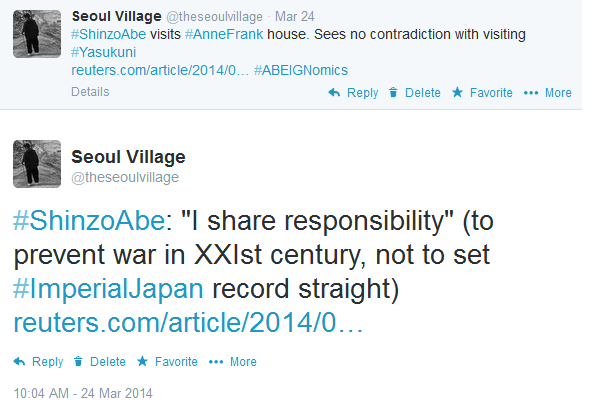
For good measure, Abe visited before the meeting Anne Frank's house, where he said "I share responsibility"... but in yet another one of his trademark, nose-thumbing references to history (see twitter timeline below). That visit happened a few weeks after hundreds of copies of Anne Frank's Diary were vandalized in bookstores and libraries across Tokyo Prefecture - a form of textbook revisionism as shocking as but more mediatized than the institutional one.

If the Tripartite Summitulacra resonates like a diplomatic victory for Abe, it must have come at a price. The one he's paid since his latest Yasukuni visit has already been already quite heavy for a nation where face-saving is paramount: first the US expressed their "disappointment", then Ambassador Caroline Kennedy canceled her NHK interview (following outrageous remarks from its governor), and then a Seoul stop was added to Obama's trip to Asia, conveniently shrinking the first three-day State Visit of a POTUS to Japan since Clinton into a less significant stay.

If historic issues were neatly put aside for the Summitulacra, they are at the center of the discussions held between Korea and Japan ahead of that trip - obviously a prerequisite for Korea to accept the Hague meeting. Korea focuses on "Comfort Women", Japan tries to throw in territorial disputes for confusion. Of course, the former issue is the priority because of its universal reach. Furthermore, it's not about Japan v. Korea, and not even about Japan v. all the nations victims to that institutionalized sexual slavery system, but it's about post-war, democratic and peaceful Japan v. Imperial Japan.

I cannot imagine one second Obama avoiding historic issues altogether, and I'd be more than "disappointed" if he didn't devote a highly meaningful moment to this particular issue.

I wish this trip could also solve the North Korea conundrum, but I wouldn't bet a Won on it. TPP, OPCON transfer, Okinawa moves? Technical details. If this man has a chance to deliver one speech for the ages in the region in 2014, that's it.


Seoul Village 2014
Welcome to our Korean Errlines! Follow Seoul Village on Facebook and Twitter
Bookmark and Share
Add this page to your favorites

* see "Remarks by President Obama, President Park of the Republic of Korea, and Prime Minister Abe of Japan" (US Embassy Seoul - 20140325)
** see "Japan’s rhetoric gets surly again" (Korea JoongAng Ilbo 20140328)

The twitter timeline around the Tripartite Summitulacra (excerpt):


Where we left things last time (see "KORUS chorus" - 20140318)
Now it's up to Park Geun-hye to accept summit with Obama and Shinzo Abe. Will she accept to put history issues aside? #ABEIGNomics (20140320)
twitter.com/theseoulvillage/status/446493174525984770


Japan and Korea discussing talks about Imperial Japan #sexslavery (NB: a condition for KOR-JAP-USA summit?) - 20140321
twitter.com/theseoulvillage/status/446940385177120768


First #ParkGeunhye-#ShinzoAbe meeting confirmed for The Hague next week. #Obama will hold the candle (20140321)
twitter.com/theseoulvillage/status/446803200482344960


#ShinzoAbe: "I share responsibility" (to prevent war in XXIst century, not to set #ImperialJapan record straight) - 20140324
twitter.com/theseoulvillage/status/447901746245816320


Even harder for #Obama to have #ParkGeunhye and #ShinzoAbe meet than to have #Israel and #Palestine meet. + the rockets are fired from #DPRK! (20140324)
twitter.com/theseoulvillage/status/448072415478697984
Historic handshake between war criminal grandson and dictator daughter (Nobel Prize winner observing) - 20140326
twitter.com/theseoulvillage/status/448630575683751937

#ParkGeunhye turned a deaf ear to #ShinzoAbe's "만나서 반갑습니다" ("nice to meet you") - 20140327
twitter.com/theseoulvillage/status/449049540348239872


Ahead of Obama's visit to Tokyo and Seoul, Japan and Korea to hold high level meetings in Washington next month
twitter.com/theseoulvillage/status/449377577962971136
  

Saturday, March 22, 2014

What part of "Operator" don't you understand?

In case you didn't follow Korea's latest hacking scandals, the personal data of 9.81 million KT customers have recently been leaked. For the operator, that's a significant improvement since the previous failure (only 8.7 million victims in 2012).

Imagine receiving this charming letter: oops, we did it again. We just found out that we let a few pieces of information reach the wrong hands. No biggie: just your name, your resident number, your phone number, the number and validity date of the credit card with which you pay your bills, your address, your customer number, your subscription information, your subscribed plan, you know, that kind of boring details. Any call from telemarketers lately?


We do apologize. Really.
KT risks a KRW 100 M fine, which may sound impressive if you're not familiar with local currencies, but amounts to a slaponthewristic USD 92,600 nowadays. Furthermore, as a government official quoted by Yonhap deplores*, "unlike credit card-related rules, the country's telecom law does not acknowledge that data leakage is a financial mishap that causes damage to customers' personal assets (...) - a business suspension is not an option unless KT has collected personal data without users' consent." Needless to say customer associations have gone nuclear, tens of groups considering class actions**.

SK Telecom, the undisputed market leader (including in terms of hacking with 35 million victims in August 2011), frugally celebrated its main rival's predicament by crashing its own network for only 5.6 million customers on Thursday***.

I may sound like I'm making fun of Korea's #1 and #2 operators (well maybe I am), but that's to exorcise my fears. Deep down I'm in a cold sweat. As a customer, but also - in a former life - as a former executive for a leading operator: that's the kind of business where security is paramount, and an obligation if you want to get or to keep a license. And in big data times, you want even less the gimchi to hit the fan..


Seoul Village 2014
Welcome to our Korean Errlines! Follow Seoul Village on Facebook and Twitter
Bookmark and Share
Add this page to your favorites


* see "Gov't mulls fines on KT for data leak, consumers say punishment too weak" (Yonhap News 20140317)
** among which CCEJ, see "KT sued over data leaking" (Korea JoongAng Daily 20140319)
*** "SK mobile network crashes, 5.6 million affected" (Korea JoongAng Daily 20140322)

Wednesday, March 19, 2014

The Republic of Apartments

Even as the "apateu" model is coming to an end (see "Inhuman, all too human Seoul"), Korea remains "The Republic of Apartments" as much as "The Republic of Samsung". But beyond hardware or software, humans always take center stage in Seoul Museum of History's exhibitions, and the original title of this one ("아파트 인생") could be translated as "Apartment life", or maybe even an attenboroughesque "Life in apartments".


"The Republic of Apartments", another great (and moving) @SeoulMuseum show. Gyonam-dong a special guest
twitter.com/theseoulvillage/status/446085171901521920


*

As is often the case in my favorite Seoul museum, you can enjoy two exhibitions for the price of one (anyway, bonus: the entrance is always free!). And as an appetizer to the main dish, I started with the art gallery curated around a theme that, logically, permeates Korean culture.

Note this installation recounting decades of standardization (what I dubbed "the industrial revolution of housing") by timelapsing apartment maps, sizes and prices:


I browsed so many hundreds of "apateu" brochures and ads that I feel like I recognize them all!

More classic, AHN Sekwon's "Lights of Weolgok-dong" triptych, shot between 2005 and 2007, tells the sad and classic story of a charming Seoul neighborhood replaced by a dull new town scenery (as it happens, probably the Wolgok Samsung Raemian or the Wolgok Doosan We've):


Weolgok-dong series by AHN Sekwon (2005-2007)

Come to think of it, Hawolgok-dong is very close to Jongam-dong, also in Seongbuk-gu, where the first apartment blocks were erected in 1958 (Jongam Apartment)*.

*

Which leads us to the main show, a retrospective on the apartment phenomenon focusing on socio-cultural dimensions. Like often here (e.g. Jongno, Gwanghwamun, "Made in Changsin-dong" expos), it features a real interior that was still inhabited a few months earlier. The pensioner who lived in this one had to move because of the redevelopment:


At least, this time, the victim sacrificed on the altar of this urban nonsense was an "apateu" block, not an architectural wonder.

As expected, a lot of tributes were paid to one of the latest victims of Seoul's caricature of urbanism: Gyonam-dong lies (lied) just hectometers away, on the other side of Gyeonghuigung and the fortress walls. There's even a picture of our "Samdong Samgeori"! (by the way, I was very pleased to learn the other day from Robert J. Fouser that this amazing curved-roofed hanok has been, after all, protected and saved for good). 

Scenes of devastation and gutted hanok are nothing new, as this 1966 bird's eye view of demolished shacks in Inhyeon-dong reminds us.

And a whole section is devoted to the people displaced by evictions, including naturally the familiar images of Kim Dong-won's cult documentary "Sanggye-dong Olympic".

But as always, you're not in for a pure tearjerker. First, there's a lot of hope, love, and happiness - it's about humanity and humanness, life spaces rich in personal histories, with fair testimonies from ordinary citizens and middle class Seoulites. Second, the aim is to share with the visitors the experiences of insiders, help them understand the context and accept all sides of the past, reconciling citizens with their city and history.


*


*


Seoul Village 2014
Welcome to our Korean Errlines! Follow Seoul Village on Facebook and Twitter

Bookmark and Share
Add this page to your favorites

* special mention to Haengchon Apartment (1969)!


Tuesday, March 18, 2014

KORUS chorus

The official launch of "Korea matters for America / America matters for Korea", a East West Center - ASAN Institute co-production, was the perfect occasion to celebrate 60+ years of friendship between Korea and the US.

Actually, an earlier launch event titled "Korea and the United States: 60 Years of Partnership Going Forward" took place on the other side of the big pond on December 11th last year, at the Capitol Visitor Center.

Along with the Ambassador of the ROK to the US AHN Ho-young, five Congresspeople attended the Washington, DC launch: Colleen HANABUSA (R-HI), Mike HONDA (D-CA - we already mentioned this great man in "Silver lining, darker clouds"), Mike KELLY (R-PA), David REICHERT (R-WA), Peter ROSKAM (R-IL). East Coast, West Coast, Midwest, Hawaii... you name it!

This morning at the ASAN Institute Seoul HQ, Dr. HAHM Chaibong* welcomed among other dignitaries the US Ambassador to Korea Sung KIM, and two influent members of the National Assembly: HWANG Jin-ha (Vice-Chairman of the Korea-US Inter-Parliamentary Council), and KIM Jong-hoon (Mr KORUS FTA in the eyes of many Koreans - whatever love/hatred they put in the label).


No need to convince Seoul-born US Ambassador to Korea Sung KIM that Korea matters for America and vice versa
twitter.com/theseoulvillage/status/446110479497195520


General KIM Jae-chang (Ret. ROKA, Chairman of the Council on ROK-US Security Studies), Ambassador KIM in the foreground. Among the other speakers, AMCHAM President Amy Jackson.


KIM Jong-hoon (here at the roundtable with Dr. CHOI Kang, Ambassador CHUN Yung-woo, and Dr. Satu LIMAYE) lamented over free trade's loss of momentum globally, and more locally for the Korea-Japan-China FTA (particularly thanks to Shinzo ABE**)
twitter.com/theseoulvillage/status/446139588919033856

Congratulatory speeches set aside, what's "Korea matters for America / America matters for Korea"? A brochure and a platform, part of the "Asia matters for America" initiative created by Dr. Satu LIMAYE, the Director of the East-West Center in Washington. Note that EWC's HQ are truly between continental US and Asia, in the very Korean friendly State of Hawaii.

The bilingual, 34-page brochure co-produced by the two think tanks is a perfect tool to convince any reader of the trueness of its title. Yes, Korea matters for America and America matters for Korea, and at all levels - particularly the four that matter to Ambassador KIM: security, politics and diplomacy, personal and cultural relations, economy.


As a bonus to a brochure mixing perfectly graphics, maps, and statistics, we received a map of the US exports to Korea at the US congressional district level, which is much more precise than the State level. For instance, you can spot Mike HONDA's District, CA-17, the biggest exporter to Korea with $892M in 2012, and a key part of the Sillicon Valley (any famous company from Cupertino in mind, starting with App and ending in le(gal)?).

Beyond the brochure, the platform (where, of course, you can download the brochure). AsiaMattersForAmerica.org/korea is the US-Korea part of the Asia matters for America portal that also covers bilateral relations with China, Japan, India & Co:


In this trove of knowledge, any representative, constituent, businessman or decision maker can measure the value of Asian countries in each congressional district. 

Take for instance Texas 32, another key exporter to Korea - that's NE Dallas around Highland Park, Mesquite, University Park, Garland... and of course Richardson's telecom corridor, home to Samsung Telecommunications America, Inc. You learn that semiconductors and components represent half of the exports to Asia, but also that Asian Americans make up 6% of the population (with more Vietnamese than Koreans), that visitors from Asia bring $120 M to the travel and tourism industry, that Dallas has sister city relationships with Tianjin....


AsiaMattersForAmerica.org/korea

Today, we heard a lot about security, politics, and economy, but of course, it's always about the people. At the top leadership as well as the citizens level, what matters most is the people, and it's no wonder these two think tanks collaborated on this project.


Seoul Village 2014
Welcome to our Korean Errlines! Follow Seoul Village on Facebook and Twitter
Bookmark and Share
Add this page to your favorites


* whom we last saw chatting on stage with a POTUS (see "W. at The Shilla for Chosun")

** BTW Leif-Eric, I might eat my hat after all: a PARK Geun-hye - ABE Shinzo does seem more likely than I thought in the short term!