NEW - download 'Seoul VillageS (서울 마을들)', my collection of 12 short fictions now adapted into short films! Get your free copy of the ebook (4 editions: English, French, Korean, Bilingual English-Korean)!

Showing posts with label Pyongyang. Show all posts

Monday, September 24, 2018

Land mining Seoul

Seoul is once again* about to lose more of its ever shrinking greenbelt area. The main difference with last time? Mayor PARK Won-soon is opposing the move, because it might hurt his presidential ambitions: even if acted now, the move wouldn't translate into new dwellings before 6 to 7 years, and trees would be torn down too close to the 2022 elections.

'Shame on 's Ministry of Land and Territory, which is considering reducing even more 's protected greenbelt areas to provide more . When there's already oversupply, and fewer people living in the capital!' (20180921 - twitter.com/theseoulvillage/status/1042933809820446720)

'This time, mayor is opposing the move, which may backfire for his presidential bid' (20180921 - twitter.com/theseoulvillage/status/1042948381071630338)
Seoul does want to add 62,000 dwellings, by using idle land and relaxing FAR rules. The Ministry of Land, Transport, and Maritime Affairs targets 50,000, but to achieve that goal, intends to tear down greenbelt areas (300,000 sqm).

This good-cop-bad-cop routine between the government and PARK Won-soon doesn't fool anyone. Particularly the week MOON Jae-in all but knighted him as first in line of succession by inviting him (along with his Gangwon-do rival) to Pyongyang for his third summit with KIM Jong-un, pretexting their first-in-line-when-the-gimchi-hits-the-fan-ness (nevermind Gyeonggi-do).

Anyway, MOON's government doesn't have much to lose in taking the blame for destroying Seoul's last lungs: they're not running in 2022, and they are already under fire for their miserable handling of real estate bubbles: everything they try is fueling them now, in anticipation of their downfall. The intentions are good, but like Paris with environment, they leave it up to an ideological ayatollah with little understanding of environmental and economical collateral damage.

Anyway, speculation keeps ruining Seoul. To the point that in some instances, pools of homeowners bully, boycott, and force into bankruptcy realtors who dare post prices too low for their taste.

One thing is sure: there is already an oversupply of dwellings, and Seoul's population has shrunk under PARK Won-soon's watch. Gaping inequalities remain, and heavy regulation is required, but adding further artificial and counterproductive distortions won't help. New social housing projects should propose prices that are fair and affordable, not cowardly indexed at bubble-level-minus-20%.

An opening of North Korea would definitely change the equation. Co-organizing Olympics with North Korea in 2032? Not so much. And where would they be held, without abandoning the one-city rule? Seoul-Pyongyang? Kaesong? Panmunjom?

Seoul Village 2018
Welcome to our Korean Errlines! Follow Seoul Village on Facebook and Twitter

Bookmark and Share
Add this page to your favorites

* see "We reject as false the choice between our welfare and our well being", "Tighten your greenbelt"... 
** "풀어도 문제, 놔둬도 고민"…서울 그린벨트 '딜레마' (Chosun Ilbo 20180919)

Saturday, September 2, 2017

Seoul Biennale of Architecture and Urbanism 2017

Good to see the first Seoul Biennale of Architecture and Urbanism come to life two years after that kick-off symposium at the Seoul Museum of History! Roaming its venues is also the opportunity to see how the city's urban regeneration programs* advance, particularly in Seun Sangga, Mapo Depot / Oil Tank Culture Park, and Donuimun Museum Village.

*
From SIBAU to the Seoul Biennale

Ever since the event was announced, I expected something special. If you remember the context well, it was supposed to crown the presidential campaign of Mayor PARK Won-soon ahead of the November elections, by showcasing his vision and realizations, starting with the Seoullo 7017 inaugurated only months before**. PARK Geun-hye's impeachment and the mayor's failed campaign purged the biennale from that noise, making it all the more interesting.

To me, this inaugural biennale really started in October 2015, with a symposium opening up the debate about what (yet) a(nother) biennale should be, how to make it relevant in an already crowded calendar.
'City architect of Seoul SEUNG Hyo-sang at 2015 SIBAU - new keywords for architecture and urbanism' (20171026 - twitter.com/theseoulvillage/status/658455212521197568)
Back then, the project was known as SIBAU (Seoul International Biennale of Architecture and Urbanism), which almost resonated like a tribute to Walter Gropius. The 'I', and the acronym altogether, were later discarded, probably because a Seoul biennale can only be international, and because there can only be one Seoul Biennale.

Announced last year, the theme, 'Imminent Commons', conveys a sense of emergency in troubled times. Nine commons were selected along ecology (earth, wind, water, fire), and technology (Making, Moving, Communicating, Sensing, Recycling) lines.

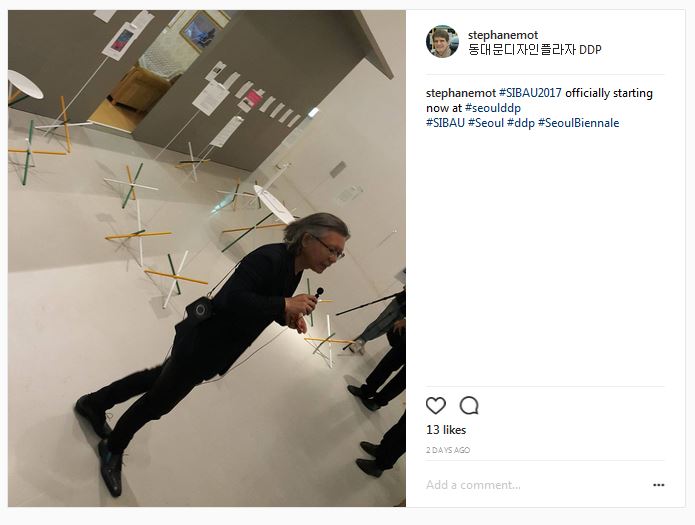
On Friday, for the V.I.P. preview day, PAI Hyungmin (co-director with Alejandro Zaera-Polo) launched the first edition with a tour of the cities exhibition at the DDP, followed by the opening forum featuring Ricky BURDETT, and a presentation of the festivities planned across the capital.

www.instagram.com/p/BYesjexllHS
Pyongyang opens the show with a cosy interior filled with HWANG Jin-yong songs, but lacking the portraits of KIM I and KIM II, masked on the wall to comply with anti-propaganda laws.

Pyongyang interior at SIBAU 2017 City Expo. Soundtrack HWANG Jin-yong (20170831 twitter.com/theseoulvillage/status/903464391495917568)

Of course, Le Corbusier chimed in again*** to reunite both Korean capitals in the most urbanistically dystopian way:

Pyongyang 2015, Le Corbusier 1935, Seoul 1970... Corbu wins, urbanism loses (20170831 www.instagram.com/p/BYeutqWFZUO)

Among the more formally invited cities, Oslo proposed a bucolic catalogue of its edible natural assets, and Paris prolonged its presentation at the Pavillon de l'Arsenal.

So come visit the DDP for this expo, but don't forget to enjoy the 'off' parts of the festival, and side venues that deserve more attention than Zaha's last gasp. Again, to me, this complex is more sculptural than architectural, and a perfect example of the very negation of urbanism. It totally ignored the urban context, and would rather suit Dubai than the center of Seoul...

That (re)said, I'll focus on three of the seven other venues (I'll save Changsin-dong for other occasions).

*
Urban regeneration - 3 works in progress

So let's return to Seun Sangga, Mapo Depot / Oil Tank Culture Park, and Donuimun Museum Village (you can also check "Urban Regeneration: 27 Projects For Seoul" to refresh your memory).

SEUN SANGGA is still undergoing the first phase of its revamping (see previous episodes). The priority was to improve connectivity across the neighborhoods, and you can see a great deal of  new staircases and escalators all over the place. As demanded in the competition brief, the Northern and Southern halves of KIM Swoo-geun's cruise ship are being reconnected. And like most projects, this one added new neighborhood / urban regeneration exhibition spaces.

The main problem with this new and improved Seun? It somehow spoils key assets of the old one, particularly the view on Cheonggyecheon (there were probably more discreet ways to connect the deck and the stream than this bulky staircase), and the feeling of space when you walk the deck (I love Seoul alleyways, but adding new structures all along the way was a mistake). But this was a very challenging project, and if Seun's fragile ecosystem and spirit subsists, this will be a victory.

'Seun Sangga recovered its arms, with a massive staircase obliterating the best view over Cheonggyecheon' (20170831 - www.instagram.com/p/BYf512xlAvb)
"Sneak peek from #Seun Electronic Museum / #세운전자박물관, which opens tomorrow" (20170831 - www.instagram.com/p/BYfQ1_mFAD0)

MAPO DEPOT (now Oil Tank Culture Park) also lost some of its charm. Even the creative squatters who occupied the abandoned site have joined the main stream by optimizing their FAR with new containers, and surrounding their now legalized lot with a classic fence and hedge. I understand that you couldn't keep the tanks 'in their juice', but there's a bit too much concrete for my taste, and the cathedral-like volumes have shrunk too dramatically. Tank #3 has been spared, so you still can have a gist of what it used to be, but you can't get inside that one. Nevertheless a spectacular site, with rocks carved to prevent neighboring parts of the city from suffering in case of explosion, and a fun walk particularly during the Seoul Architecture Festival, with plenty of talks and exhibitions to enjoy.

'At the former #MapoOilDepot for the #SeoulArchitectureFestival. Only the ghosts of the tanks subsist. They lost their inner volumes, shells, souls.' (20170831 - www.instagram.com/p/BYiJ3y5l-uM/?taken-by=stephanemot)

I'll give DONUIMUN MUSEUM VILLAGE a similarly unfairly lukewarm review. Mind you, I'm more than ever glad that this section of Gyonam New Town has not been transformed into Gyeonguigung Xii's park (see the Gyonam saga), I was ready for significant changes towards gentrification, and I guess it has become a very pleasant spot for visitors, but. If you knew the place as it used to be, it feels like a caricatural movie set of it, without its main roles. Between the messy old place and this sanitized, manucured village, I wish the cursor had been placed a little more towards the past. I'm really okay with a new central place that transforms the dense eating/drinking cluster into a more open village, but the hanok alleyway where I used to eat has been destroyed and rebuilt, recycling only a few beams, and replacing the most charming curves with anonymous straight lines. And why not keep more vintage bits of walls, the tree that made that eatery's madang so cute, or the wooden windows that made that two story Japanese house so special? I had so much hope when the project started...

It's a bit like Sissel Tolaas' exciting Seoul smellscape (in one of the tallest buildings of that low rise neighborhood), where you can sniff scents captured across the city center, between the DDP and this DMV: smells are synthetized and amplified, not like the original, but a distant echo.

'Sissel Tolaas and her Seoul smellscape in the new Donuimun Museum Village' (20170831 - twitter.com/theseoulvillage/status/903556640154173441)
Anyway, the site and its expos are definitely worth visiting.
 
Seoul shall use the space as a guest house hub after the biennale, but I hope it will host future editions as well.

Meanwhile, enjoy this first edition, and this ever changing city of ours!

*


Seoul Biennale of Architecture and Urbanism 2017 (20170901-1105): seoulbiennale.org


Seoul Village 2017
Welcome to our Korean Errlines! Follow Seoul Village on Facebook and Twitter
Bookmark and Share
Add this page to your favorites


* see among others "Urban Regeneration: 27 Projects For Seoul"
** see "Seoullo 7017, and more roads to Seoul"
*** see "Don't miss Le Corbusier in Seoul... The artist, not the urban planner!"

Monday, April 7, 2014

China reaches high speed into North Korea... and post-Juche East Asia

KBS detailed yesterday* a high speed line to be built by China across North Korea. It would follow the Pyongui Line (Pyongyang-Dandong), and furthermore the Gyeongui Line that connected Seoul with Pyongyang.

According to KBS, the DPRK Economic Development Commission confirmed in February a December 2013 agreement that would change the whole region, even if in the short to medium term only a minority were to use the infrastructure.

If the line falls short of reaching into China and the DMZ by stopping at Sinuiju and Kaesong, it gives a clear advantage for China and its technology in post-Juche Korea. South Korea will have little choice but to connect - or to try the alternate Rason route with Russia.

Construction would last 6 years, with two waves that have not been fully detailed yet:
  • 1st stretches: 80 km
    • From the North: Sinuiju Station - Tongrim Station (Sinuiju-Dongnim, 40 km)
    • From the South: Kaesong - Yonan (Gaesong-Yeonan, 40 km)
  • 2nd stretches: 296 km
    • From the North: Tongrim - Chongju - Sinanju - Pyongyang (Dongnim-Jeongju-Sinanju-Pyongyang, 147 km)
    • From the South: Yonan - Haeju - Sariwon - Pyongyang (Yeonan-Haeju-Sariwon-Pyongyang, 149 km)


It also mean that Chinese executives and engineers will roam the country for a long while, including at the doorsteps of Kaesong Industrial Complex. China will operate for 30 years on a BOT basis (Build Operate Transfer), likely into post-Juche DPRK. 

Note that this agreement happened around the JANG Sung-taek purge, and that over the past few months, China also gained long term concessions to use North Korean land.

The silent "Hanschluss"* seems well under way. And this Northeast Project of a railway doesn't even need to rewrite history: it's the economy, stupid.

Seoul Village 2014
Welcome to our Korean Errlines! Follow Seoul Village on Facebook and Twitter
Bookmark and Share
Add this page to your favorites


*  "개성~신의주 고속철 북중 계약 체결" (KBS News 20140407) - NB: thanks Nikola "Kojects" Medimorec for the link!
** see "Game over for the 'Hanschluss' scenario?", "Re-engaging North Korea - A Four Party Talk"(on blogules: "China-North Korea : the Great Hanschluss still the base case scenario")... 

20140409 addendum (remarks and reminders):
. This KBS story has not yet been confirmed by any other media, and a MOU is by no means the final deal. We learn how long the construction would take (6 years), but not when it would start, if it does. What matters here is the nature of the concessions made by the DPRK as they (re)negociate with China.
. Note that the Shenyang-Dandong high speed section will be inaugurated in 2015 ("China to open high speed rail link to North Korean border in 2015"). Dandong and Sinuiju are separated by the Yalu River, but I don't know if, among the many new bridges planned by China between both nations, some are already planned as rail-friendly. Shenyang shall also be connected with Beijing, Harbin, and Dalian.  

Wednesday, February 26, 2014

Superpower failures

You've probably all seen this updated image of the Korean "peninsula" by night, taken from the International Space Station. It adds colors to previous versions, but the "island of Pyongyang" remains the biggest speck of light in South Korea's "North Sea":


Pyongyang-do by night (the Korean peninsula from the ISS, North Korea still dark)
picture and video link via @northkoreatech
twitter.com/theseoulvillage/status/438127643787927553
(incl. link to the video below)


A closer look reveals that, in spite of global warming, more islets and rocks keep emerging around "Pyongyang-do".
  • According to Seoul (the blinding supernova radiating 120 miles South of Pyongyang), this archipelago officially belongs to the Republic of Korea. 
  • According to China's most radical group of revisionists (Northeast Project), the whole archipelago (which indeed, also includes South Korea) forms a perennial Province of the Middle Kingdom. 
  • According to the guys supposedly in charge of said islets, this archipelago is the only world superpower not only capable of kicking Uncle Sam's ass, but also capable of using nuclear power just to get his attention ("these grotesquely forged satellite pictures may fool you into believing that we're experiencing a power failure but to the contrary, our perfect control of energy consumption demonstrates the sustainability of our Juche regime").
  • According to the international community, this place should indisputably be called the Gulag Archipelago*.


Gravity (not the movie, but the situation in North Korea, not only electricity-wise)
twitter.com/theseoulvillage/status/438482551645028352


Seoul Village 2014
Welcome to our Korean Errlines! Follow Seoul Village on Facebook and Twitter
Bookmark and Share
Add this page to your favorites


*  reminder: "North Korea, Beware - Rest Of The World, Be Aware"

Thursday, August 1, 2013

If you ain't broke, fix it: Seoul, Welfare and Railways Deficits

I wanted to say a thing or two* about welfare and railway projects in Seoul following these two articles in Monday's Korea Herald:

  • In "[Editorial] Seoul’s rail project" (subtitled "Debacles in other cities should serve as lesson"), the editors accuse PARK Won-soon of pushing a pharaonic and ill-financed program of 10 new light railway lines in the capital (including new tributaries to the ones listed earlier this month, see "Seoul Light Rapid Transit Back On Tracks"), which would cost KRW 3.5 tn to a city already KRW 26 tn in the red (the government would foot 1.1 tn of the bill, leaving 3.9 tn to private investors), not counting yearly compensations for the operators. The Seoul Mayor is also suspected of outrageously flip-flopping on the issue in order to boost his ratings ahead of next year's elections: he cancelled 6 of the 7 lines initiated by his predecessor OH Se-hoon, and now he's pushing even further.

  • In "Seoul City may halt free child care", we learn how Seoul Metropolitan City criticizes PARK Geun-hye's government for promoting a non-sustainable free child care program for all kids under 5. PARK Won-soon asks the government to raise its subsidies from 20 to 40% because unlike more demographically challenged regions, his financially challenged city has to cope with 408,000 of these little citizens. If he mentions the fact that 42% of them are raised in wealthy households (top 30% bracket), PARK Won-soon doesn't go all the way and say that 42% of these kids may not necessarily need a $180 check every month, because he himself was elected on a non-sustainable free meal program that contributes to the said deficit (reminder: ironically, OH Se-hoon was the one proposing the "leftist" model where the rich would pay for the poor - see "Welfare in Korea: the debate (or lack of)" 2012 and "Seoul free school lunch referendum (continued)" 2011).

But there's an awful lot to say about Seoul's new railway projects. We're Thursday and, as I just wrote this morning*, I haven't finished yet. So I'll post today the part about the big picture, and the one about the 10 Light Rail Transit projects will follow as soon as I can.

But first, my two cents about welfare.


*

1) On welfare:


Of course, that's just politics as usual. The Saenuri Party wants to claim back Seoul, and this free child care for all almost sounds like an ironic joke ("so you fancy universal freebies, uh?") at the expense of a man who could also become a serious menace for the 2017 presidential elections: elected as an independent, PARK Won-soon is now running for the DP, and leveraging Korea's most powerful local authority to multiply popular/populist initiatives, leaving his only potential rival to date AHN Cheol-soo very much isolated, with little political machinery around him, and little media coverage.

I already made my point about welfare state, the state of welfare, and the state of the debate on welfare in Korea. Again, PARK Won-soon must give up ideology and populism, embrace pragmatism, and among other things stop offering free meals to the wealthiest. And again, Saenuri and the governement must also give up their own ideology, populism and pharaonic pork-barrel projects, and among other things promote a sound and sustainable welfare system, and carry out the structural reforms needed to revive Korean demography (including in the education system...).

Unfortunately, reason remains most of the time a foreign word in Korean politics nowadays.

Significantly, in its revised Seoul Metropolitan Rapid Transit Master Plan**, the city is using the word "welfare" to qualify new railway projects. That's typical PARK Won-soon "human-centric-on-the-fringe-of-populism" lingua, but I do believe in public service, and in public transports as a fundamental right for metropolitan citizens. Besides, "welfare" and "fare well" are akin.

I'm not for or against anyone. I want Seoul, the region, and Korea as a whole to succeed and to invest wisely when it's still possible. And when I say "Korea as a whole", I mean both Koreas: the frontier is very close, and it won't remain closed forever.

At this moment, just like Korea has a welfare deficit, Seoul has a railway deficit, so if you ain't broke, fix it.


*


2) On the revised Seoul Metropolitan Rapid Transit Master Plan: yes, Seoul needs more railways...


10 years from now, all Seoulites shall live within a 10 min walk from a subway station. Or rather the overwhelming majority of Seoul citizens: the most remote parts of this mountainous city are not solely populated with Steve Austins, Jaime Sommerses, and other Usain Bolts.


The biggest gaping holes in the grid shall be significantly reduced (e.g. Seodaemun-gu, Geumcheon-gu, Northeast)

That's the ambitious target fixed in the revised Seoul Metropolitan Rapid Transit Master Plan** expected (in whose dreams?) to be validated next year by the Ministry of Land, Infrastructure and Transport. Seoul will officially submit the plan in September.

Compared to earlier versions, the vision has been a bit simplified at the macro level and complexified at the micro level. I'll get into the details for the suggested improvements to the "broadband" backbone and Light Rail Transit projects, but one thing is sure: Seoul does need more railways.

If I already questioned the economic viability of the new light rail lines, I disagree with those who think that buses will solve everything. Even if the Seoul bus network is very efficient, railways mean high capacity and consistency, and they represent the main backbone for any metropolis, a core element of multimodal transportation systems aiming at reducing the use of cars and promoting public services and greener individual modes (pedestrians, cyclists...).

Clearly, Seoul is still lagging behind key rival capitals. Subways carry only 36% of Seoul passengers (28% take buses / 31% cars or taxis / 5% other), compared to 86% in Tokyo (1 / 11 / 2%), 65% in London (8 / 25 / 2%), and 58% in Paris (9 / 28 / 5%).

By extending its rail network to 441 km, Seoul expects to raise the share of public transport from 64 to 75%. Today, its 327 km-long network is only 15% longer than that of Paris, a city six times smaller:


CityDaily users (M)Tot. rail netwk (km)Subway (km)Light Rail (km)Street-car (km)Mono-rail (km)Netwk per citizen (km / M)
LONDON3.2104644023428-67
PARIS4.180283218-65-43
TOKYO8.50035430616171840
SEOUL7.010327327---31


3) ... but the big picture could be improved


At the macro level, Seoul wants to beef up its "broadband" backbone, and to strengthten the 'Hanyang-Gangnam-Yeouido' triangle. "Hanyang", that's the original name of Seoul, a more poetic word than "downtown", and a wide area encompassing a significant number stations... except the one supposed to be Seoul's main hub: sorry, but Seoul Station is not located within fortress walls!

Anyway, here's the big picture:


This map shows us the three above mentioned hubs, and four colorful axes:

  • The blue axis refers to the future Sinansan Line (Seoul Station-Ansan Jungang): Phase 1 (Yeouido-Gwangmyeong) is expected by 2019, and the rest (Seoul Station-Yeouido + Gwangmyeong-Jungang) by 2022. Seoul city doesn't need to change the program.

  • The purple axis refers to the Sinbundang Line, which Seoul would like to extend all the way to the new Samsong District in Goyang via Gwanghwamun, a project that would also alleviate traffic congestion on Subway Line 3 and Tongil-ro. For the moment, only the Gangnam-Yongsan section of the extension is scheduled (Phase 3 - 2018, via Sinnonhyeon, Nonhyeon, Sinsa, Dongbinggo or Seobinggo, and Ichon). Where would they pass by after that? Seoul mentions a 19.7 km extension between Donbinggo and Samsong, and we've seen similar projects before (see for instance "3 subway lines projects revived ?", 2 years ago), but this time Pyeongchang-dong could be in the loop: both sides of Jahamun tunnel seem to be awarded a dot in the above "before-after" map, and the other day I saw banners urging local authorities to keep their promises and to deliver the long expected subway... Anyway, intense lobbying should rage everywhere and at all levels until the elections.

  • The pink axis refers to the Suseo High Speed Railway (Suseo-Dongtan KTX - see "New KTX vertical to Gangnam by 2015" - NB: Suseo also in a Korea Train eXpress project to Pyeongtaek). Seoul wants a 30.4 km-long extension between Suseo and Uijeongbu via Cheongnyangni to create a Dongtan-Uijeongbu line. Note that this pink axis doesn't pass by any of the three hubs, which proves that the presentation needs some fixing.

  • The green axis refers to the GTX Line B. Expected for September 2016, the Great Train eXpress project consists of 3 lines, each one about 45-50 km-long:
    - GTX Line A is in the general direction of the "purple axis" (Sinbundang): initially from KINTEX (Ilsan/Goyang) to Dongtan New Town (Hwaseong) via Daegok, Yeonsinnae, Seoul Station, Gangnam Station, and Suseo (NB: the Suseo-Dongtan part corresponds to the KTX, stretching the line to 74.8 km overall).
    - GTX Line C is in the general direction of the "pink axis" (KTX): from Geumjeong to Uijeongbu via Gwacheon, Yangjae, Gangnam, Cheongnyangni, and Changdong/Sanggye.
    - Seoul city focuses on the GTX Line B, initially planned from Cheongnyangni to Songdo via Seoul Station, Yongsan, Yeouido, Sindorim, Dangarae, Bupyeong, and Incheon City Hall. But only the Songdo-Dangarae-or-Sindorim section seemed secured. Seoul suggests to change course, and to draw a southern express line across Seoul from Dangarae to Jamsil (30.3 km), via Gangnam of course. Note that GTX is not just 3 times faster than a standard subway, it also has fewer stations, which would shrink a trip from the COEX to Ilsan from 83 to 22 min in case of Line A, or a Songdo-Jamsil from 112 to 39 min according to this newly suggested route.

Frankly, I'd like to see a different presentation. If we want to improve the whole system, we need to understand the situation and the dynamics, the challenges. We need to see several maps of Seoul and its sudogweon region with all existing road and railway networks, all the projects already in the pipe, the ones already in discussion, but also the mountains and valleys, the demographics, the fluxes by transportation modes, the hubs and nodes, the bottlenecks of today and tomorrow (e.g. New Towns)... We need to visualize the present and the future.

Before getting the recos for the rapid transit, we want a big picture of the dynamics, regardless of the transportation networks that enable them. There are too few elements in the document released last month about transports (Vision 2030), and not many maps, let alone relevant ones. If the  previous administration can be blamed for many things, it was much better at communicating a strategic vision and at drawing maps, for instance in this slide from the 2006-2010 plan (Vision 2020):


Of course this map is debatable too. But here, we know much more what's going on, and what the city has in mind. We also know that before thinking Songdo, Dongtan or Uijeongbu, Seoul thinks - as it should - Incheon, Daejeon, Chuncheon, or Pyeongyang (talking about the big picture and tomorrow challenges!). Furthermore, we visualize a much more relevant selection of main hubs: we're neither forgetting Yongsan, nor neglecting the considerable effort around Sangam-Susaek and Cheongnyangni-Wangsimni to boost Northwest and Northwest Seoul and relieve downtown bottlenecks at the same time.

So back to the drawing board. And more maps, please. I love maps.


*

See also the following 2 focus on all LRT projects:
"Seoul LRT Projects Update (Part 1/2)"
(the full list of 7+3+3 projects, the "3-Tailed Dragon")
"Seoul LRT Projects Update (Part 2/2)"
(all other projects)


*


* Well, I already did that Monday on Twitter, but with a constraint of 2x140 characters:


@theseoulvillage tweets 20130729
wants fair free child care (same as what wanted for free meal program ^^!)
(9:55 PM - 29 Jul 13 - twitter.com/theseoulvillage/status/361832451628216321)
mayor also flip-flopping regarding 's railway projects, according to
(9:58 PM - 29 Jul 13 - twitter.com/theseoulvillage/status/361833197744562177)
 

*

Seoul Village 2013
Welcome to our Korean Errlines! Follow Seoul Village on Facebook and Twitter
Bookmark and Share
Add this page to your favorites

* if writing "Yonsei-ro the first street in Seoul to ban cars in its transportation mix" contributed to the delay, it also paved some of the way ahead
** see "'서울 어디서나 도시철도 10분' - 철도 중심시대가 열립니다" (seoul.go.kr 20130725)

Sunday, July 21, 2013

Beyond Containment: Andrei Lankov On Stage (10 Magazine Book Club)

Over the past few months, Andrei Nikolaevich LANKOV has been everywhere, on every network. The Russian expert of North Korea even had to join Twitter under media pressure (yes, the voluble LANKOV restricted to 140 characters, that's possible, and that's on @AndreiLankov).

Granted, for the release of his latest book, "The Real North Korea: Life and Politics in the Failed Stalinist Utopia"*, he did receive the hell of a boost from KIM Jong-un, but LANKOV doesn't need anybody's help to become a media darling: this man doesn't even use kid gloves to handle the most fissile materials, and nuclear countdowns have never been that fun watching ever since Peter Sellers brought the house down in Kubrick's "Dr. Strangelove".

Yesterday, the showman was on stage in Myeong-dong for Barry Welsh's 10 Magazine Book Club, and he tirelessly explored every square inch of it with mickjaggeresque energy - barely pausing for a sip of tea now and then to fuel his own reactor.

Does Andrei Lankov rock & roll? You bet!
twitter.com/theseoulvillage/status/358831263123111936

A pundit of the "pound it" variety, LANKOV can not only dance like a butterfly and sting like a bee, but also crack the audience up with outrageous wit ("Human Rights did improve under KIM Jong-un: from unbelievingly bad to exceptionally bad" / "Most defectors from North Korea are 40-50 year-old ajumma - in the Soviet Union, it used to be young and smart Jewish chess players").

Kim Il-sung trying to stop Andrei Lankov, in vain. Great show at @10MagBookClub todaytwitter.com/theseoulvillage/status/358883923025092608

Impossible to sum up a show that covered a remarquable scope considering the limited time (one hour presentation, one hour Q and A). Just a few insights:
  • It was easier to reduce the military's economic influence than to tame private entrepreneurship. The rising class of private entrepreneurs is seen as a threat by the party nomenklatura, less apt to survive in case of change. At this stage, neither sees their shared interest. LANKOV doesn't believe in a coup. The only underground he sees is the not very impressive Christian one. (NB: beyond the scenario of an organized coup, many things can happen, from an individual going rogue to KJU choking tomorrow on a pretzel.)
  • (About what I called the "Hanschluss scenario") LANKOV does consider the scenario of a puppet regime controled by Beijing, but only a "open" one that would happen after the collapse of the regime and a military intervention of China. Needless to say, that would not be well perceived by North Koreans, who would then blame Beijing for anything going wrong.
  • North Korea remains very rational. LANKOV doesn't think KJU marked a disruption (NB: I agree in substance but not in style - if he does keep both the "Juche Line" and "Beijing Line" parties sweet following his dad's guidelines, he ruined everything with his lack of patience, alienating key supporters in China**)
  • The very existence of a successful South Korea can become a hindrance for evolution. A country like China could carry out significant reforms, but "where is South China?" (NB: AL logically considers Taiwan's impact as limited at the economic level, the difference in wealth being 3 times compared to up to 40 between both Koreas - furthermore Taiwan is relatively tiny. A question from the audience stressed the political importance of even tiny Taiwan as a democratic model)
  • Internet: LANKOV wouldn't be surprised to see the world wide web partially accessible in a near future. The risks are obvious, but control technologies have considerably improved, and the risk of lagging too far behind is even greater.
  • Reunification: many North Koreans see it through rose-colored glasses, thinking South Koreans are eagerly looking forward to it, and that economic problems would be solved within a couple of years.
  • ...


Seoul Village 2013
Welcome to our Korean Errlines! Follow Seoul Village on Facebook and Twitter
Bookmark and Share
Add this page to your favorites

* "The Real North Korea: Life and Politics in the Failed Stalinist Utopia"
Oxford University Press - April 2013
** "This Time Is Different - Six Decades of North Korean Follies (The Umpteenth Final Countdown)"
*** "Game over for the 'Hanschluss' scenario?"