NEW - download 'Seoul VillageS (서울 마을들)', my collection of 12 short fictions now adapted into short films! Get your free copy of the ebook (4 editions: English, French, Korean, Bilingual English-Korean)!

Showing posts with label Space Bon. Show all posts

Tuesday, April 12, 2016

The Yongsan itch and the Sajik balm

One up, one down. Seoul speeds up for the redevelopment of Yongsan 4, and puts the brakes on Sajik 2.

We've known for a while* that the future Yongsan Park would be surrounded by high rise structures. After burning their fingers on the doomed Yongsan IBD project, authorities decided to offer their all-you-can-build gifts to speculators in smaller packages, wrapped in green. Here, at the Hangangdae-ro - Seobinggo-ro interesection (Hangangno-dong), a tentative 'Yongsan Parkway' serves as an environmental alibi for more 30-40+ towers:


In Jongno-gu, a far less popular - and far less tragical** - "drama" has also been running for years: the redevelopment of what I call Sajik Heights, the hilly neighborhood nested between Sajik-ro / Sajik Tunnel, Space Bon, and Gyeonghuigung. I've walked its alleyways countless times, and even wrote a short story about Kim Ki-chan meeting my fictional Kim Mudangnim there (the great photographer also used to live in Sajik-dong).


A pigeon, a hanok, a hilly alleyway, Inwangsan - Sajik Heights in 2009

For a decade, Sajik Heights has been preparing for the transformation, and Lotte Castle eventually won the right to build the New Town.


As far as 'urban continuity' goes, it looked consistent with the Gyeonghuigung Xii (Gyonam New Town) rising from the other side of the tunnel / hill / (now almost totally obliterated) fortress wall... 

But Seoul city seized a debate over modifications to stop the process***. Among the landmarks to be protected (let's hope in a less destructive way than nearby Dilkusha****), the 1906 house where Josephine Eaton Peel Campbell lived. I visited that place at the top of the hill, around the time it was used as an office by local residents. It seems to have never been used for the purpose the Campbell estate sold it, which was to promote the education of young girls, in the tradition of Campbell herself, the founder of Baehwa (girls' schools and women's university in Pirun-dong).

Residents are now wondering what's best for them, particularly after witnessing what happened in the vicinity: Gyonam? newtonized. Seochon? bukchonized. So what for Sajikistan?

Whatever happens in the future, something of the old neighborhood shall survive. Or evolve. 

Anyway, it would be nice to see something decent next to a potential UNESCO Heritage site (Yeol still working hard on the Sajik-dan revival*****).

Seoul Village 2016
Welcome to our Korean Errlines! Follow Seoul Village on Facebook and Twitter

Bookmark and Share
Add this page to your favorites
.
* see for instance "Yongsan park - fake forests and real estates" (Feb. 2011)
** if a person died in Yongsan, no casualties for the only tragedy I witnessed when I lived in Sajik-dong, a hanok fire back in 2009.
*** "사직2구역 재개발 추진 7년…110년 된 캠벨 사택 어쩌나" (JoongAng Ilbo 20160413)
**** less forsaken than 5 year ago (see "Sajik Heights and micro-hanokization"), the building seems to have undergone serious change in the name of 'preservation' 
***** rites have been performed for a long while, and the restoration helped as well (see "Sajik-dan enshrined, Naeja-dong revived ?")

Sunday, March 10, 2013

Build a hanok and they will come - Marketing impostures and genuine slow urbanism

Sorry for posting yet another focus on urban developments - following last Thurday's "Sudogwon New Town Blues" -, but even if you're not among the (more than a few) researchers and experts in urbanism who roam this excuse for a blog, this is about Seoul villages, old and new. Yeah, I also suffer from hypergraphia*, but that's not the issue.

Anyway. Korean "model houses" are always worth visiting for at least three reasons (see "Inhuman, all too human Seoul"): to follow housing market(ing) trends, to measure gaps between different levels of reality and their representations, and to explore ethnological goldmines. 

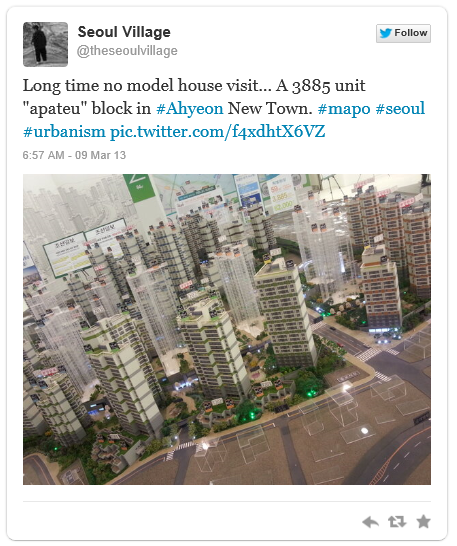
Yesterday, the piece de resistance was a rather classic project, this 3885-unit section of Ahyeon New Town:


see this Tweet on Tweeter

We'll get back to it later. Now check this medium-sized apartment block, also in Mapo-gu, and by the same developers, but this time solo (they partner with another chaebol on the previous project). As you can see, a brand new "hanok guest house" and its "hanok playground" sidekick are highlighted as star assets at the feet of the apartment towers, and in a pop-up that dwarves the rest of the mock-up:

see this Tweet on Tweeter
This "traditional" corner belongs to the condominium: all residents can enjoy the playground anytime, and a preferred rate when they want to rent the guest house, for instance when relatives visit for a special occasion.

If traditional pavillions or walls multiplied in the middle of new apartment complexes well before the real estate crisis**, the 'hanok fad' really caught in major commercial projects at the end of the naughties, from "hanok style interiors" to whole hanok complexes (see "New Towns : hanoks in Eunpyeong, a desert in Wangsimni", "Hanok New Town in Seongbuk-dong").

Most of the time, it's more a "Hanok Alibi": residents still opt for the usual "apateu" experience, and the traditional house only comes as a "feel good" factor, a marketing gimmick, like in a "Hanok Inside" campaign. Yes, we destroyed the old neighborhood but see, we respect traditional architecture. And if we can afford such a costly low rise construction on our very expensive land, it tells a lot about the value or our community and the values of its members. Anyway these days promoters seldom sell all apartments as easily as they used to, and for them cramming as many units as possible is not a winning proposition anymore...

On a more positive note, not so long ago, many prospects and customers would have been revolted by the idea of wasting money and space in this kind of old stuff. The fact that hanoks can "sell" confirms encouraging trends: at long last the general public is reconsidering Korea's architectural heritage, perceiving preservation efforts as positive (as long as they don't hinder your personal real estate projects, of course). And hanoks do sell: their market value has sharply risen in certain neighborhoods, where Seoul promotes and sponsors their creation and renovation.

At the individual level, building or restoring a hanok remains a statement, a long but rewarding process, and a perfect example of slow urbanism in a city where short term rules like a despot.

To a major development project, the "hanok touch" adds sense, anchors with the city's cultural continuum. But it works better when it's heartfelt, sincere, conceived from the start. 

As we saw, the hanok village was only a late addendum to Eunpyeong New Town, but without it, the project wouldn't be much distinguishable from any bedtown. And if it comes more as a transition to Bukhansan national park than to the cityscape, that's because the New Town is not contiguous with the rest of the district, except by the road and rail connections - mainly Tongil-ro, and Subway Line 3 between Yeonsinnae and Gupabal. Even if we are in Seoul, this is more a "greenfield new town", built in a valley of its own: the one carved by Changneungcheon, the stream that marks the Seoul-Goyang border in Jingwan-dong.

If I can't be satisfied with the destruction of part of Seoul's greenbelt for yet another real estate development, this looks much better than your usual tombstone "apateu" towers:

Eunpyeong New Town's hanok village: a new touristic entry point to Bukhansan... 

... but also a new neighborhood with over 200 private residences

Bonus: Eunpyeong Museum, yet another concrete dent into Seoul greenbelt (if you find it ugly, wait until you see the new Eunpyeong-gu office, on the other side of Tongil-ro)

If you prefer more intimate entry points to Bukhansan, you'll have to follow Bukhansan-ro further eastwards: not long after the T intersection with Yeonseo-ro, a streamlet will lead you up to the temple of Baekhwasa.

With its pedestrian highway of a paved road, this new gateway to the mountain is clearly meant for the masses. Environmentally debatable, Eunpyeong's hanok village shall become a touristic asset for the district and draw visitors from far away, among which some who would have never considered Bukhansan otherwise.

Hopefully, Eunpyeong new town shall not be just a residential dead end, or a bedtown lost in the outskirts, but a touristic destination, a neighborhood visitors will cross with a purpose, and - yes - a village with its own cultural life.

Again, time and the way humans behave will tell if this urbanistic and architectural project succeeds. Preferably, Eunpyeong Museum shouldn't be an empty shell, and the hanok village should become a neighborhood where real people live actually, not yet another artificial folk village.

Let's wait and see.

I told you I'd get back to Ahyeon New Town. I did, and here as well, you can find a hanok at the feet of the towers:


Not a part of the development, but a survivor:


Will it be transformed into a restaurant? Will it merge with its neighbors and grow into a five story building with a PC bang in the basement, a convenience store on the ground floor, and scores of non-descript offices or one-room units all the way up?

Let's wait and see.

We can wait as long as we want, we'll never see again some charming places of the old Ahyeon and Bukahyeon-dong.


Seoul Village 2013
Welcome to our Korean Errlines! Follow Seoul Village on Facebook and Twitter
Bookmark and Share
Add this page to your favorites

* and Seoul Village is only the tip of the iceberg ("HGTP (Hypergraphia Transfer Protocol) Turns 10: 03/03/03 - 13/03/03")
** Gwanghwamun Space Bon went as far as to throw in a stone bridge and a mini walled historic site... but they don't compensate for the lost hanok village at the heart of Sajik-dong. Note that the planned redeveloppement of Sajik heights, between the tunnel and Gyeonghuigung, also includes a "traditional" corner.

Monday, September 5, 2011

Sajik Heights and micro-hanokization

My previous post* reminds me I forgot to mention an interesting development over Sajik Tunnel : this new hanok overlooking the traffic.


I waited to have the photo opportunity as a car passenger to show the impact from Sajikno. Of course, what strikes you first is the very ugly Yangeuimun Church, a towering white monster under wraps these days (maybe to transform into a towering colorful monster). The red bar to its right is the Korea Social Science Data Archive (KOSSDA or 한국 사회과학자료원). Further to the right is the Jongno Culture and Sports Center, where I used to go swimming twice a week or so**. And to reach this place from Gwanghwamun Space Bon, I had to pass in front of that hanok spot so I know pretty well every inch along the way.

I could write stories about the alleyway leading up to what I call Sajik Heights from Sajikno, the pawprints left by a dog on the rough concrete staircase, the passage over Sajik Tunnel (now covered with a deck), and the poor white dog who broke my heart each time I passed by her tiny place : either leashed or in her small cage, the poor bitch ruled over a 10 square feet staircase (she managed to get babies once but didn't keep them for long).

Now about this new hanok. There's a bigger one behind, and the owner used to grow an amazing variety veggetables in front of his place, including where this small new extension stands, by the ruins of a house partly serving as a parking lot.

This is a truly minor change, and there are many other hanoks nearby, and more than a few nice "jutaek" on the way to Sajik-dan and Seochon, but this tiny detail could have a lot of significance for the local urban landscape because of its visibility for outsiders at a key location.

I'm not talking about something very spectacular like the restoration of a whole traditional village, but about a small protuberance that catches the corner of your eye and suddenly connects you to a neighborhood, help you reconcile with your city. So many places disappeared over the years, and particularly along major avenues, that it's hard to get a notion of what's been lost without venturing deeper into vernacular Seoul. But from time to time, hope shyly shows its head.

Of course, preserving existing landmarks remains preferable to artificially creating new ones. And right on the other side of the tunnel (in Haengchon-dong, 1-88 beonji), there's an amazing jewel on the verge of collapse : not far from a magnificent gingko tree, this 1923 red brick house is not abandoned but - to say the least - poorly tended. Named Dilkusha ('my heart is happy' in Hindi), it used to be the residence of Albert Taylor, the press correspondant who was jailed for 6 months in Seodaemun Prison - at the 2009 exhibition "Three Foreigners' Reminiscence of Seoul" at Seoul Museum of History two years ago, they mentioned how his wife Mary could see him, from their house, walk the prisoners walk.

At the time of its construction, the view over the valley must have been breathtaking but now, villas almost completely occult it. I hope it can be saved the way a smaller red brick landmark was, just one block away : it is now a mini-museum at the corner of the park recently created at the top of the future Gyonam / Dongnimmun New Town.

We also owe Taylor the
fantastic panorama exhibited on the museum's ground floor (curators had the brilliant idea to match this 90 year old marvel with a contemporary view of downtown Seoul).

Seoul Village 2011
NEW : follow Seoul Village on
Facebook and Twitter

* "
Junggye's "Baeksa Village" shall survive"
** or picknicking higher on Inwangsan (follow the trail on "
Inwangsan's Great Wall and Seoul's Royal "T" Time")

Monday, September 6, 2010

Reconsidering Sejongno Park

After the Eastern side of Sejongno this morning ("Insadong - Bukchon seamless for pedestrians"), some news from the not so far West.

At the intersection between Naejadong-gil* and Sejongno lies a small public park echoing the historical significance of the area, for centuries a cluster of ministries. But Sejongno Park is neither nice nor welcoming, and most visitors are simply on their way in or out the old parking operated underground. I often wonder how Sejongno would look like if it were animated all the way during cultural events, and particularly if this very spot were better designed : here is a very large space, in an ideal location (between Gyeongbokgung, Gwanghwamun Square, and Sejong Cultural Center), but totally wasted.


That could be about to change : the contract with the tenant expires in 2012 and the city intends to revive the area, creating a sunken garden, also history-themed, which (I presume) could be connected to the existing underground walkway across the boulevard, and maybe even to the King Sejong exhibition space inaugurated last year under Gwanghwamun Plaza.

That would make not only perfect sense but confirm the success of the restoration of Seoul's most prestigious axis. Of course, the design had better be right from the start (please not another Haechi Madang, please not another dangerous staircase that visitors discover only a split second before breaking their own necks...).

I reckon authorities will also keep an eye on demonstrators : since Gwanghwamun Square inauguration, small political gatherings have regularly been using the Cultural Center's staircases as a tribune, and this new spot would be almost at the feet of the Central Government Building... Note that further down the boulevard (Taepyeongno will merge with Sejongno), Mayor OH Se-hoon is facing similar threats : the metropolitan assembly, now overwhelmingly progressive, voted in favor of facilitating demonstrations under his very windows on Seoul Plaza.

More animation ahead, then. And many colorful "events" (pronounce "eee-bent").

Seoul Village 2010

* If you're not familiar with Naejadong-gil, that's the street perpendicular to the boulevard, starting between Sejong Cultural Center and the Central Government Building, with a short tunnel connection to the other side of Sejongno (near the US Embassy), and leading to Sajikno in front of Sajik-dan, with Inwangsan in the background. The street progressively evolves from an administrative / office center to a residential hub (Gwanghwamun Space Bon, Gyeonghuigungoe Achim...), with the Seoul Metropolitan Police in the middle and many eateries.

---
UPDATE 20110524 - Sejongno Park under renovation
---

Sunday, January 10, 2010

Let It Snow

I took this small video last Monday, under a bright sun in Gyeonghuigung, downtown Seoul, from the playground right behind the palace :


Unfortunately, the soundtrack is provided by
Haemil, the green glass building coming right after the palace in this amateur 360 panorama (then there's an old villa, Space Bon in the background, and we're back to the woods on the hill separating Sajik-dong from Gyonam-dong).

Chung Mong-joon's think tank recently moved into their new headquarters and as you can hear, the big air-con blocks that spoiled our game* are working fine. As you can see, they eventually decided not to replace the wall, completing the "illusion" that they own the place... to the risk of causing incidents : particularily with this snow, visitors to the palace cannot see the deep gap in front of them (what to say about kids playing nearby...).

Anyway, nothing could ruin this beautiful day, nor the magic of Seoul under the snow. Sounds carry differently too. Yesterday morning, I heard the rooster from my window.

Seoul Village 2010


* see "Haemil construction, continued (game interrupted)"

NB: from now on we'll refer to the building as the ASAN Institute HQ instead of Haemil HQ. The AIPS / ASAN Institute for Policy Studies was named after Chung Ju-yung's nickname and hometown (Mr Chung's father founded the Hyundai Group).

Tuesday, July 28, 2009

The Sandwich

The Space Bon terrace, where Naejadong-gil meets Sajikno, is getting more crowded.

Starbucks Cafe, the small convenience store, and nearby Cafe Mori have been recently joined by new cafes, snacks and restaurants : seafood (Gorebul), Japanese (Koen), tea (Puer)... and my new "cantine" when I need a tasty burger.

"The Sandwich" prepares burgers, salads, soups and (of course) sandwiches with good ingredients, terrific bread, and original sauces. You'll find East Coast classics (BLT, Philly, submarine, French fries, breakfast...), experience some innovations (ie interesting sauce with salmon sandwich), and even eat healthy and tasty veggies... though I must confess I have a weakness for their chilly burger (to die for).

It's a small place with a small kitchen, and they're often full for lunch. Those in a hurry may prefer to avoid rush hours (12 to 1).

If you manage to get a seat on the terrace (each restaurant seems to be allowed only two outdoor tables), it can be an interesting spot for the summer. The block protects you from the sun for lunch, and a small garden provides some fresh air... with the contribution of the mountain : the view on Inwangsan comes as a bonus, with Sajik Park and Hongsalmun at its feet*, and often spectacular summer skies for sunset.

The Sandwich (restaurant)
Gwanghwamun Space Bon 201-107 B
9 Sajik-dong, Jongno-gu, Seoul, ROK 110-054
Tel: +82.2.720.9396


Seoul Village 2009

* see "
Inwangsan's Great Wall". Note that Sajik-dan will be protected by a new traditional wall - old rites are being performed regularly and I suspect authorities to push for a UNESCO heritage listing.

Sunday, June 28, 2009

Rem Koolhaas on Seoul and Prada Transformer (CNN)

Dutch architect Rem Koolhaas was recently Interviewed on CNN Talk Asia in front of his Prada Transformer, an advertocultural event which has at least the advantage to make more people visit Gyeonghuigung. Most Gangnam hypists won't even notice the presence of the royal palace, but many Seoulites will (re)discover the area and who knows, some may even pay a visit to Seoul Museum of History next door (and paying a visit doesn't cost much : you can enjoy many exhibitions for free or just a few hundred wons).

Koolhaas chose the location with taste : Joseon rulers themselves picked a perfect spot with Inwangsan in the background. Note that for his Seoul National University Museum of Art, the Pritzker Prize winner already enjoyed good vibes from Gwanaksan. But if the Leeum Samsung Museum of Art offers an interesting view from Itaewon heights, there's not enough room around the Samsung Child Education & Culture Center Koolhaas designed to appreciate it from a distance. Both buildings are less striking than this Transformer anyway.

What you have here is basically a tetrahedron with one circular face, its metallic structure poking under a light white skin. Not as light as the contents though : an alibi to justify the design and architectural bravado, and to leave some room for the sponsor. Cranes turn the pyramid in various positions, each one hosting a specific event.

The 3 parts of the interview :

Part 1 - "Living differently" (around 1'40" - 2' into the video, the construction of Transformer, with Inwangsan and Gwanghwamun Space Bon in the background)


Part 2 - "Staying relevant"


Part 3 - "Seoul Man" (SNU Museum of Art...) :


Seoul Village 2009

see also OMA's website : oma.eu (Office for Metropolitan Architecture founded by Rem Koolhaas)

Saturday, April 18, 2009

Sabal (Seoul)

The administrative area of Sajik-dong covers West of Sejongno all the way to the fortress (Gyonam-dong on the other side of the hill), and includes 12 smaller neighborhoods or "court dongs"*.

The two "majors" being culture and parks (Gyeonghuigung, Sajik Park, Seoul Museum of History, Sejong Art Center, art galeries, Inwangsan...), and administrations (central government, metropolitan police, offices and officetels...), there is a large offer of restaurants and cafes, all thriving on officeworkers but some batting steady over the average on weekends.

The Gyeonghuigungoe Achim complex stands where Naeja-dong-gil and Jusigyeong-gil meet, across the Seoul Metropolitan Police Headquarters. Its apartment / officetel mix is more residential than Byeoksan Gwanghwamun Sidae or Ssangyeong Platinium (to the East), but less than Space Bon (to the West), so not all its restaurants are deserted on weekends.

"Sabal" and "Market" share the same owners, and both propose an alternative and often innovative take at basics using fresh ingredients : rice for Market and noodles for Sabal.

I have a preference for the latter. Sabal proposes different styles of noodles (janchi guksu - veggies, seafood, gimchi...), with a great variety of tastes and dishes. By "dishes" I mean that not two bowls look the same, which echoes the name of the restaurant (사발 = "bowl").

Rice comes in big portions at Market, so if you want to try both, you'd better go for a massive lunch at Market, and enjoy more refined flavors and a cosier atmosphere for dinner at Sabal.

Sabal / 사발 (restaurant)
Gyeonghuigung Achim ("King's Garden") block #3, 1F (142),
72 beonji, Naesu-dong, Jongno-gu, Seoul, ROK
Tel +82.2.720.4845

Market / 마켓 (restaurant)
same address
Tel +82.2.720.8211

Seoul Village 2008

* see Jongno-gu dongs

see also other restaurants in Seoul and Korea..