NEW - download 'Seoul VillageS (서울 마을들)', my collection of 12 short fictions now adapted into short films! Get your free copy of the ebook (4 editions: English, French, Korean, Bilingual English-Korean)!

Showing posts with label PAI Hyungmin. Show all posts

Sunday, April 14, 2019

Seoul Hall of Urbanism and Architecture, Seoul Biennale 2019 Symposium

The day before Mayor PARK Won-soon cut the ribbon with a dozen VIPs (see below), the new Seoul Hall Of URbanism and Architecture hosted a pre-Seoul Biennale Symposium. A perfect occasion to roam the venue, to the notable exception of the exhibition spaces, and key connections to the neighborhood's underground system, which only opened for the official inauguration.

Yes, I'm talking about the 'Sejongdaero' project we followed from its earliest stages, back in 2015, where the old Japanese tax office used to stand:
. "Tear down that tax office" (20150506)
. "Sejongdaero" competition officially started' (20150727)
. "Sejong-daero winner announced" (20151012)

But before exploring this Seoul HOUR, how about a focus on the Biennale and its symposium?


***

2019 Seoul Biennale and Pre-Biennale Symposium

If the first symposium, held at the Seoul Museum of History in October 2015, questioned even the principle of a biennale (why not a triennale?), this one went as far as presenting the material used to build the stands. A sharp contrast between an exploratory discussion two years before a first edition, and an operational briefing six months ahead of the second.

", , , , , on stage of Symposium " (20151027 - https://twitter.com/theseoulvillage/status/658845140505653248)

A new tandem, LIM Jaeyong and Francisco SANIN, replaced PAI Hyungmin and Alejandro ZAERA-POLO at the heads of the bicephale biennale, knowing that, of course, SEUNG H. Sang remains close by, even if this time, he didn't take the mike (cameo apparitions on a few slides, though).

"#Seoul Biennale 2019 Symposium 20190327.
Between #Francisco Sanin and #Lim Jaeyong: #Cho Minsuk, #Armando Hashimoto, #Peter Wilson, #Noura Al Sayeh, #Chon Jaesun, #Alicia Lazzaroni... #Seoul Biennale of Architecture and Urbanism #architecture #urbanism #seoulhour" (20190412 - https://www.instagram.com/p/BwI7PM9JFsL/)

After 'Imminent Commons', Seoul went for the theme 'Collective City' (announced last December), around the same 4 main axes:
  • Thematic exhibition (curator Beth Hugues): research and propositions around the 'collective city' notion, held in the DDP (Design Exhibition Hall, Design Pathway). Let's see what comes up from the various topics (typology, post-domestic city, mediation, heritage, infrastructures, ecology...).
  • Cities exhibition (curators YIM Dongwoo, Rafael LUNA): I'm excited by the choice of Donuimun Museum Village and its Seoul Center for Architecture and Urbanism for the venue instead of the DDP, where the first edition took place. Mind you, that was a terrific exhibition, and they managed to make it not look like a fair, in spite of the site, but Sinmunno provides the perfect - if challenging - backdrop for a genuine global village, with actual alleyways. Dongwoo already researched innovative mapping axes for the 80 cities.
  • Global studio (curator CHOE Sanki): note the semantic shift from the 'international studios' of the first edition (curated by John HONG, who presented his return on experience). All events shall be concentrated around Seun Sangga (Sewoon Plaza, Sewoon Hall).
  • Live Projects (curator JANG Young-chul): articulated around the concept of market, very relevant in the context of a collective city, particularly since, as JANG reminded us, the '시' in '도시' (city) means 'market'. Two venues: Seun Sangga (Sewoon Plaza, Daelim Sangga), and the Seoul Museum of History.

I presume Seoul HOUR shall also serve as a venue, if not a hub. Anyway, Sadaemun's Jong-ro - Saemunan-ro horizontal remains the biennale's urban backbone. And if you forgot what I'm referring to, I shalt forgive thee, but here's the animated map:


If I'm looking forward this second biennale (September 7 - November 10), this symposium was already worth attending, with stimulating presentations, moments and chats. Special mentions to:
  • Jae-sung CHON's ode to the collective mess (he had me from the start by mentioning Kowloon Walled City and Seoul markets), and his fake news journal to project the reader in the future... that's my vision of urbanism, where you shouldn't sanitize everything, but leave room for organisms to evolve, grow, mutate by themselves. 
  • Peter Ferretto's respect for China's threatened wonders (beautiful project in Gao Bu, Hunan). 
  • CHO Minsuk's updates on Danginri and Bamseom, the rooftop theater of his Seoul Cinematheque. 
  • Alicia Lazzaroni's 'vulnerability as a design' 
  • KIM So-young's 'negociated city' 
  • Erik L'Heureux's lyricism about HCMC's forgotten gems. He saw no connections to Seoul, but I couldn't stop thinking about my dear "Hoehyeon Apt, Chungjeong Apt, Dongdaemun Apt, Ogin Apt..." 
  • John HONG reclaiming preservation as radical, 'Citizen Jane'-style, and LIM Jaeyong musing 'but if it's us vs them, who are we, who are they?'


On the eve of its inauguration, at the new #Seoul Hall Of Urbanism And Architecture for the Pre-Biennale Symposium
Workshop featuring (left to right): #Peter Tagiuri #Alicia Lazzaroni #Klaas Kresse #Kim Soy-oung #Patrick Weber #John Hong #Choe Sanki #Erik L'Heureux #Chon Jaesung #Peter Ferretto #Rafael Luna #Yim Dongwoo
#Seoul Biennale #Seoul Biennale of Architecture and Urbanism #서울도시건축프리비엔날레 #SBAU
#서울도시건축전시관 #seoulhour
(SeoulVillage Facebook page - 20190327)


***

Seoul Hall of Urbanism and Architecture


So we now know how this 'Seoul Chronicle' works, and what its purpose is. From the beginning, I liked the minimalist approach with a focus on connectivity over and underground, the new building subliming surrounding structures: Deoksugung walls, the Seoul Anglican Cathedral, and even the less gracious Seoul Metropolitan Council, whose campanile almost ends up making sense. 


You can reach Seoul HOUR's rooftop from all sides, and face the stream of Sejongdaero as if from a non-scary diving board, with the bulging side of Seoul City Hall in front of you, Gwanghwamun to your left, and Seoul Plaza to your right. If you return to street level, you can also enjoy a panoramic view while sipping a cup of - what else* - coffee.


"Of course, also has a cafe (ground level), and a rooftop view on and (just-above-ground-level rooftop) " (201903 https://twitter.com/theseoulvillage/status/1110894852370161664)

Now in this kind of iceberg structures, you need to dive well below the surface, through 3 underground levels with relatively low ceilings, except in strategic places, and of course for 'VIUM Hall', the huge parallepiped going through all four levels. Frankly, the first impression of this main exhibition space is a bit disappointing: you can reach it directly through a central, monumental staircase that feels somehow like a Seoul subway entrance (yes, as advertised, Seoul HOUR is connected to the Sejongno underground network, which means among others City Hall, and the subway). Furthermore, halfway down, your first glance at the inaugural exhibition (about Vienna public housing) is from above, which makes it look smaller and weaker behind its scaffoldings. Video projections on the wall to your right don't quite make for the big dark void in front of you. I understand the architectural logic to prolong Deoksugung's walls, but from this angle, this corner is really too dark, and not exactly awe inspiring.

But that can be fixed easily; a towering exhibit, or why not an ethereal SUH Do-ho fabric house?

To truly appreciate the hall's volume, this is the best angle, facing lighter structures, the glass connections to the other floors and exhibition spaces, the window towards the street:

" Inauguration with mayor :" (20190328 https://twitter.com/theseoulvillage/status/1111134424853184514)

Here are the 4 inaugural exhibitions: 
  • 'Vienna Model - the past, present, and future of public housing', with a resolutely no-frills museography
  • 'The social role of architecture' (starting with Seoullo 7017, just to make the mayor happy, I presume)
  • 'An-other Seoul', with a 3D map of the capital city reminiscent of the bigger one at the Seoul Museum of History, and an interesting scenario: what if, instead of reducing every year greenbelt areas (see "Land mining Seoul"), urban planners made better use of the sites related to infrastructure, which represent almost two thirds of Seoul's total surfce?
  • 'Documenting the city', curated by LEE Sang-koo, with a focus on familiar lost villages (Sinwol-dong, Sanggye-dong, Geoyeo-dong).


" at () one day before its inauguration, for Symposium. Expo on in , (reminiscent of )... " (20190327 https://twitter.com/theseoulvillage/status/1110892328120508416)


Seoul Village 2019
Welcome to our Korean Errlines! Follow Seoul Village on Facebook and Twitter

Bookmark and Share
Add this page to your favorites

* for instance City Hall in 2012 ("Seoul Tsunami City Hall, The Other Korean Wave"), the DDP in 2013 (see "Sneak peek inside Dongdaemun Design Plaza & Park")
** see "500 m, 80%, 100% urban crappuccino"


Saturday, September 2, 2017

Seoul Biennale of Architecture and Urbanism 2017

Good to see the first Seoul Biennale of Architecture and Urbanism come to life two years after that kick-off symposium at the Seoul Museum of History! Roaming its venues is also the opportunity to see how the city's urban regeneration programs* advance, particularly in Seun Sangga, Mapo Depot / Oil Tank Culture Park, and Donuimun Museum Village.

*
From SIBAU to the Seoul Biennale

Ever since the event was announced, I expected something special. If you remember the context well, it was supposed to crown the presidential campaign of Mayor PARK Won-soon ahead of the November elections, by showcasing his vision and realizations, starting with the Seoullo 7017 inaugurated only months before**. PARK Geun-hye's impeachment and the mayor's failed campaign purged the biennale from that noise, making it all the more interesting.

To me, this inaugural biennale really started in October 2015, with a symposium opening up the debate about what (yet) a(nother) biennale should be, how to make it relevant in an already crowded calendar.
'City architect of Seoul SEUNG Hyo-sang at 2015 SIBAU - new keywords for architecture and urbanism' (20171026 - twitter.com/theseoulvillage/status/658455212521197568)
Back then, the project was known as SIBAU (Seoul International Biennale of Architecture and Urbanism), which almost resonated like a tribute to Walter Gropius. The 'I', and the acronym altogether, were later discarded, probably because a Seoul biennale can only be international, and because there can only be one Seoul Biennale.

Announced last year, the theme, 'Imminent Commons', conveys a sense of emergency in troubled times. Nine commons were selected along ecology (earth, wind, water, fire), and technology (Making, Moving, Communicating, Sensing, Recycling) lines.

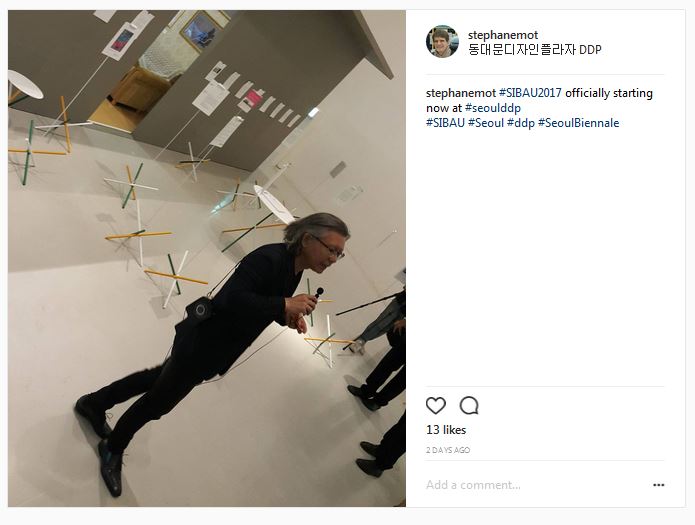
On Friday, for the V.I.P. preview day, PAI Hyungmin (co-director with Alejandro Zaera-Polo) launched the first edition with a tour of the cities exhibition at the DDP, followed by the opening forum featuring Ricky BURDETT, and a presentation of the festivities planned across the capital.

www.instagram.com/p/BYesjexllHS
Pyongyang opens the show with a cosy interior filled with HWANG Jin-yong songs, but lacking the portraits of KIM I and KIM II, masked on the wall to comply with anti-propaganda laws.

Pyongyang interior at SIBAU 2017 City Expo. Soundtrack HWANG Jin-yong (20170831 twitter.com/theseoulvillage/status/903464391495917568)

Of course, Le Corbusier chimed in again*** to reunite both Korean capitals in the most urbanistically dystopian way:

Pyongyang 2015, Le Corbusier 1935, Seoul 1970... Corbu wins, urbanism loses (20170831 www.instagram.com/p/BYeutqWFZUO)

Among the more formally invited cities, Oslo proposed a bucolic catalogue of its edible natural assets, and Paris prolonged its presentation at the Pavillon de l'Arsenal.

So come visit the DDP for this expo, but don't forget to enjoy the 'off' parts of the festival, and side venues that deserve more attention than Zaha's last gasp. Again, to me, this complex is more sculptural than architectural, and a perfect example of the very negation of urbanism. It totally ignored the urban context, and would rather suit Dubai than the center of Seoul...

That (re)said, I'll focus on three of the seven other venues (I'll save Changsin-dong for other occasions).

*
Urban regeneration - 3 works in progress

So let's return to Seun Sangga, Mapo Depot / Oil Tank Culture Park, and Donuimun Museum Village (you can also check "Urban Regeneration: 27 Projects For Seoul" to refresh your memory).

SEUN SANGGA is still undergoing the first phase of its revamping (see previous episodes). The priority was to improve connectivity across the neighborhoods, and you can see a great deal of  new staircases and escalators all over the place. As demanded in the competition brief, the Northern and Southern halves of KIM Swoo-geun's cruise ship are being reconnected. And like most projects, this one added new neighborhood / urban regeneration exhibition spaces.

The main problem with this new and improved Seun? It somehow spoils key assets of the old one, particularly the view on Cheonggyecheon (there were probably more discreet ways to connect the deck and the stream than this bulky staircase), and the feeling of space when you walk the deck (I love Seoul alleyways, but adding new structures all along the way was a mistake). But this was a very challenging project, and if Seun's fragile ecosystem and spirit subsists, this will be a victory.

'Seun Sangga recovered its arms, with a massive staircase obliterating the best view over Cheonggyecheon' (20170831 - www.instagram.com/p/BYf512xlAvb)
"Sneak peek from #Seun Electronic Museum / #세운전자박물관, which opens tomorrow" (20170831 - www.instagram.com/p/BYfQ1_mFAD0)

MAPO DEPOT (now Oil Tank Culture Park) also lost some of its charm. Even the creative squatters who occupied the abandoned site have joined the main stream by optimizing their FAR with new containers, and surrounding their now legalized lot with a classic fence and hedge. I understand that you couldn't keep the tanks 'in their juice', but there's a bit too much concrete for my taste, and the cathedral-like volumes have shrunk too dramatically. Tank #3 has been spared, so you still can have a gist of what it used to be, but you can't get inside that one. Nevertheless a spectacular site, with rocks carved to prevent neighboring parts of the city from suffering in case of explosion, and a fun walk particularly during the Seoul Architecture Festival, with plenty of talks and exhibitions to enjoy.

'At the former #MapoOilDepot for the #SeoulArchitectureFestival. Only the ghosts of the tanks subsist. They lost their inner volumes, shells, souls.' (20170831 - www.instagram.com/p/BYiJ3y5l-uM/?taken-by=stephanemot)

I'll give DONUIMUN MUSEUM VILLAGE a similarly unfairly lukewarm review. Mind you, I'm more than ever glad that this section of Gyonam New Town has not been transformed into Gyeonguigung Xii's park (see the Gyonam saga), I was ready for significant changes towards gentrification, and I guess it has become a very pleasant spot for visitors, but. If you knew the place as it used to be, it feels like a caricatural movie set of it, without its main roles. Between the messy old place and this sanitized, manucured village, I wish the cursor had been placed a little more towards the past. I'm really okay with a new central place that transforms the dense eating/drinking cluster into a more open village, but the hanok alleyway where I used to eat has been destroyed and rebuilt, recycling only a few beams, and replacing the most charming curves with anonymous straight lines. And why not keep more vintage bits of walls, the tree that made that eatery's madang so cute, or the wooden windows that made that two story Japanese house so special? I had so much hope when the project started...

It's a bit like Sissel Tolaas' exciting Seoul smellscape (in one of the tallest buildings of that low rise neighborhood), where you can sniff scents captured across the city center, between the DDP and this DMV: smells are synthetized and amplified, not like the original, but a distant echo.

'Sissel Tolaas and her Seoul smellscape in the new Donuimun Museum Village' (20170831 - twitter.com/theseoulvillage/status/903556640154173441)
Anyway, the site and its expos are definitely worth visiting.
 
Seoul shall use the space as a guest house hub after the biennale, but I hope it will host future editions as well.

Meanwhile, enjoy this first edition, and this ever changing city of ours!

*


Seoul Biennale of Architecture and Urbanism 2017 (20170901-1105): seoulbiennale.org


Seoul Village 2017
Welcome to our Korean Errlines! Follow Seoul Village on Facebook and Twitter
Bookmark and Share
Add this page to your favorites


* see among others "Urban Regeneration: 27 Projects For Seoul"
** see "Seoullo 7017, and more roads to Seoul"
*** see "Don't miss Le Corbusier in Seoul... The artist, not the urban planner!"