NEW - download 'Seoul VillageS (서울 마을들)', my collection of 12 short fictions now adapted into short films! Get your free copy of the ebook (4 editions: English, French, Korean, Bilingual English-Korean)!

Showing posts with label waterways. Show all posts

Sunday, July 20, 2025

Summer of Saem

Too much water falling too fast. recent flood episodes claimed 18 lives in Korea, 135 in Texas, and more than 200 in Pakistan. The world over, communities brace for more extreme weather and downpours.  

Too much water staying too long in the air: Korea's dog days are just officially starting, this year's Chobok fell yesterday, so 'Sambok' 2 and 3 are scheduled for July 30 (Jungbok) and August 9 (Malbok).

But how about your own water level? Don't forget to drink a lot, to dress light, to eat light, and if you want to avoid the fate of the narrator of 'Sweat Dream'', to keep cool.

Gapyeong flood damage (News1)

How waterways and floods shaped Seoul: time to re-watch/read my lecture 'Flow and Order: Seoul Waterways: and other Urban Stitches')


Seoul Village 2025
Welcome to our Korean Errlines! Follow Seoul Village on Facebook, Bluesky, Threads, and X/Twitter, follow me on Instagram.
Download 'Seoul VillageS', the free ebook.


Thursday, September 14, 2023

Seoul center stage

Earlier this month, Seoul became the world capital of art for a week with the conjunction of Seoul Art Week, KIAF + Frieze Seoul, Seoul Biennale of Architecture and Urbanism, Seoul Fashion Week, Crypto Art Seoul / Korea Blockchain Week, and a myriad of events, shows, and gallery openings.

(If you wonder what Mitch McConnell was doing on my Instagram timeline during Frieze Seoul 2023, I found this very realistic statue of him on sale at a discount price at Freeze D.C. 2023) Hopping from Hyoja-dong (Arumjigi) to Samseong-dong (Frieze-KIAF @ COEX) via Huam-dong (M+ and Doryun CHONG's homecoming, Whitestone's opening), Sinsa-dong (White Cube and LEE Jinju), Euljiro (Dan Archer and LG OLED at the DDP, Seongsu-dong (Beeple at The Gateway in S Factory), Songhyeon-dong (Kimchi and Chips' RE:WORLD), Taepyeongno (SBAU in Seoul HOUR)...

A lot of hype of course (boy did that crypto party remind me of internet extravaganza circa 2000), but also genuine gems and emotions. Good to see KIAF alive and kicking, many galleries coming from new horizons (even Accra), Doryun CHONG's emotional return to Seoul, or of course the themes of the (already!) fourth Seoul Biennale (waterways and mountains*, 2123 Seoul).

The return of visitors from China fueled the coopetition between Seoul and Hong Kong, and September here can counterbalance March madness there beyond the Frieze-Art Basel war. Interesting to see how Art Busan, now backed by web3 players, will fare / fair in early November with DEFINE (for DEsign and FINE arts in Seongsu-dong).

Seoul Village 2023
Welcome to our Korean Errlines! Follow Seoul Village on Facebook and Twitter, follow me on Instagram.
Download 'Seoul VillageS', the free ebook.

Bookmark and Share

* ICYMI: "Seoul waterways and urbanism - the full story"

Wednesday, August 9, 2023

Seoul waterways and urbanism - the full story

As Typhoon Khanun slashes through Korea, please all be safe.

The other day in KOTE, during my lecture "Flow and order - Seoul waterways and other urban stitches", we've seen among other things how Seoul has been struggling from day one with floods, how its waterways play a vital role in managing them, and how this role is bound to become even more critical with climate change, even if the city keeps increasing its natural defenses. 

Again, I thank the Royal Asiatic Society Korea Branch for inviting me, Julie AHN for making the event possible in our beloved KOTE*, and every single member of the audience for coming. Again, sorry to have drowned you all under my overworded slides. RASKB will shortly put the video of the disaster on its YouTube channel**, and I'll add the link here as soon as it is available.

If you really want to take your time and read every line of every slide, the full presentation is here: academia.edu/105436714/Flow_and_Order_Seoul_Waterways_and_other_Urban_Stitches

Shaped by its considerable natural assets, Seoul turned into a major city by negating them in a constant fight to tame a nature capable of major destruction but unable to cope with urban expansion. In this young millennium, this war has evolved into a love story, and Seoulites are reopening an intimate dialog with waterways that even under their concrete prisons kept drawing Seoul's maps, telling the city's history and their own stories. Yet urban planners must avoid overflowing it with storytelling. If Seoul has no future without curated natural spaces, this shapeshifter of a city will always require unscripted parts.

Introduction: The city's lungs and bloodstream
1) The Way of Water vs The Highway of 'Progress'
2) The Way Forward (?) - 'Recreation', 'Renaissance', 'Emotion'
Conclusion: Storytelling vs the Unscripted Seoul


I'll drop below
a few not to wordy samples from this 56-slide trainwreck:


On Seoul's 'dong' / neighborhoods / villages, shared water, time capsules...


Angukdongcheon, the visitor that stopped at KOTE's door the other night 


Seoul choked by concrete (things have improved since, looking forward to fresh data from the Seoul Institute


An extreme climate, major changes and challenges


On the menu: The city's lungs and bloodstream / The Way of Water vs The Highway of 'Progress' / The Way Forward (?) - 'Recreation', 'Renaissance', 'Emotion' / Storytelling vs the Unscripted Seoul


Seoul Village 2023
Welcome to our Korean Errlines! Follow Seoul Village on Facebook and Twitter, follow me on Instagram.
Download 'Seoul VillageS', the free ebook.
Bookmark and Share

* always heartwrenching to see KOTE's old odong namu / princess tree down following that recent storm, but its baby is doing well, and that's a reminder that water brings life, destruction, and communities closer together.

** RASKB YouTube channel: https://www.youtube.com/@raskb1/about
   Video of the disaster: https://www.youtube.com/watch?v=9YMti3ieiHQ


Saturday, July 1, 2023

'Flow and order - Seoul waterways and other urban stitches'

Very pleased to announce that on August 8 I'll be giving a lecture to Royal Asiatic Society Korea on Seoul waterways and other 'urban stitches', as I like to call elements that make our city more wholesome and awesome.

Looking forward to seeing you in KOTE next month (see details below)!

----

TITLE: 'Flow and order - Seoul waterways and other urban stitches'

DATE: Tuesday. August 8, 2023. 7:30PM (Seoul)
VENUE: KOTE in Insa-dong (Insadong-gil 7, Jongno-gu, Seoul)

SUMMARY:

If humans have tamed Seoul’s mountains and streams, these natural assets keep acting as great dividers and connectors, at the same time hindering and enabling this shapeshifter of a city. Urban planners have realized how key they are for Seoul’s competitiveness, but each time they decide to put a spotlight on them, whole neighborhoods can be revived or destroyed. As Seoul grows more ambitious visions and narratives around these urban stitches, unscripted parts must be left for the city to breathe and evolve, for new stories to emerge.

BIO:

A French author and conceptor born in Paris in 1967, Stephane Mot first met Seoul in 1991, as a young ESSEC alumn at the French Embassy’s economy section. Without ever disowning fiction, satire, and nonsense, this expert in strategy and innovation (serial startup survivor, strategic advisor…) is naturally drawn to what comes next and often writes about innovation, urbanism, politics, culture, or societal trends.
His fictions include ‘dragedies’ (bittersweet-going-on-pungent fictions) and ‘La Ligue des Oublies’ (The League of The Forgotten, a tribute to soccer legends who never existed). ‘Seoul Villages’, his first collection of short stories in English, is now available in Korean and will be adapted into short films; these Seoul urban legends are also a form of revenge on SeoulVillage.com, his non-fiction blog devoted to a city of which he’s walked through every single neighborhood.
Stephane and Seoul have been haunting each other for over three decades.

To register to the event: 'Flow and order - Seoul waterways and other urban stitches'

 UPDATE: watch the lecture, download the presentation: 'Seoul waterways and urbanism - the full story' 

Seoul Village 2023
Welcome to our Korean Errlines! Follow Seoul Village on Facebook and Twitter, follow me on Instagram.
Download 'Seoul VillageS' (12 fictions, free ebook).
Bookmark and Share

Friday, April 29, 2022

Seoul's Waterfront Renaissance

Seoul has always been defined by its most valuable environmental assets: its countless waterways, and the mountains that feed them. 

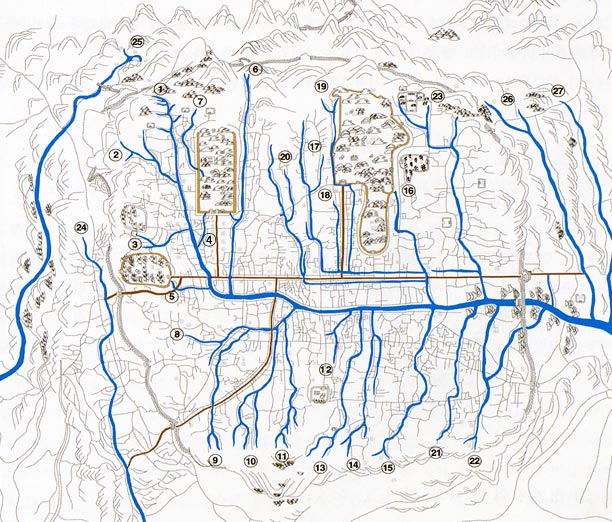
From the start, the capital revolved around Cheonggyecheon and its network of streamlets:

Nowadays, the Han River tells what's North and what's South, but waterways still account for 8.1% of Seoul's land (below in 2010):

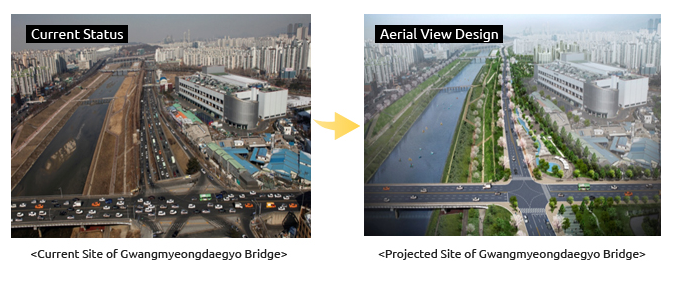
After pouring concrete all over the place to tame the powerful Hangang and its tributaries, to stabilize unstable riverbanks, and to prevent recurring floods, the city has reopened its heart to its waterways, rediscovered them as leisure paths and environmental treasures. Following the restoration of Cheonggyecheon, the Hangang Renaissance, and the restoration of neighborhood streamlets, masses of humans, birds, and even fishes have flocked back to Seoul's watersides. Yes, more concrete was often poured in the process, but biomass keeps growing, embankments are often doubled with natural fish nurseries, and significant wetlands have been created.


Citizens are already very active along these waterways, thanks to all the infrastructure needed by strollers, cyclists, or workout maniacs:

But water level and street level are seldom seamlessly connected, and for good reasons: flash floods remain a constant threat, and these waterways help the city cope with extreme downpour. On such occasions, riversides must be evacuated immediately. Still, more citizens could spend more leisure time there, particularly when they crave for more free and cool open spaces.

More than a decade after his Hangang Renaissance project, Mayor OH Se-hoon aims at a 'Jicheon Renaissance' leveraging Seoul's 332 km of waterways. Not just with more hardware, but with more content and culture, a better connection to local neighborhoods and markets, More 'emotion', as part of an 'Emotional City' of the future vision.

Starting with 4 pilot projects along three streamlets (Dorimcheon, Jeongneungcheon, and Hongjecheon), with 2 more sites by 2030 (Anyangcheon and Jungnangcheon):

  • Hongjecheon will never fulfill its great potential as long as the Naebu Expressway disgraces it (see "Along Hongjecheon, my way or the highway"), and the pilot will focus on two spots: upstream at Hongjimun and Tangchundaeseong, midway at the artificial waterfall near Seodaemun District Office, with a place to have a drink.


  • Dorimcheon is more about the connection to the neighborhood and its businesses, with decks to make the transition and chill out:


  •  Jeongneungcheon will add a cultural layer through a new media art space:


Of course, all this requires water, particularly since the city intends to make these shallow streamlets a bit deeper (from a very thin 10 cm to a more significant 30 cm). So backstage, there's a lot of work to improve water and waste management. 

Today, 18 streamlets including Cheonggyecheon are actually fed with water recycled from the Han River, and climate change has spectacularly dried up the whole nation. Even if I knew Seoul experienced very few precipitations last Winter, I was stunned to see in a recent treck up Bukhansan, how parched soils were. But the only time water streamed by was magical:

As usual, I guess we'll have more imperfect, odd spaces requiring some improvement in further iterations. But overall, Seoul keeps democratizing access to quality time and nature, even if that's in not so natural spaces.

Seoul Village 2022
Welcome to our Korean Errlines! Follow Seoul Village on Facebook and Twitter, follow me on Instagram.
Download 'Seoul VillageS', the free ebook.
Bookmark and Share


Thursday, March 12, 2015

Burying Seobu Expressway (not all car traffic, though)

Seoul eventually confirmed the completion of the transformation of the 10.33 km section of the Seobu Expressway into a 4-lane underground tunnel by 2019, between Seongsan Bridge (Yangpyeong-dong, Yeongdeungpo-gu) and Geumcheon I.C. (Doksan-dong, Guro-gu)*. 


A standard road will double it at ground level, to - hopefully - take care of the local traffic, and to propose a more pleasant experience for residents and visitors: Anyangcheon will at long last be accessible through simple pedestrian crossings (from the Seoul side, Gwangmyeong residents being connected to the eastern side by footbridges), and new parks will be created, including a big one if Seoul manages to move that big, ugly garbage treatment unit. 

Overall, a greener look and feel (particularly with with these before-after pictures comparing winter and summer views!):


This clearly marks an improvement of the cityscape and quality of life in this part of the city, but not a disruption from the car-centric view. And don't expect to totally get rid of traffic noise: "vertical soundproof walls, currently installed between the Seobu Expressway and Gyeongbu Railroad Line, will be replaced with twice the amount of folded soundproof walls to reduce noise levels".

It may look a bit like Yangjaecheon, but a big part of this stretch is occupied by the Guro Digital Complex, not by mid-rise residences. In any case, good news for the district and for people working there. If sure the landowners in front of one of these crossings will find a better use of their ground levels...

Now if your start-up can't afford a Google-size campus for its staff, you can at least offer them a waterfront experience without the disgracious expressway a la Facebook (see "Zee Talk of Zee Town", "Google's Gtown wins over ZeeTown and the Large Apple Collider").


Seoul Village 2015
Welcome to our Korean Errlines! Follow Seoul Village on Facebook and Twitter
Bookmark and Share
Add this page to your favorites

* a Public Private Project on a Build Transfer Operate mode: "Seobu Underground Road To Be Constructed Through Private and Public Joint Agreement".

Thursday, November 15, 2012

Along Hongjecheon, my way or the highway

If Hongjecheon has been renovated a couple of years ago, this lovely stream remains disfigured by one of Seoul's most infamous elevated highways, the Naebu Expressway, here clearly visible behind Yujin Sanga and Inwang market:


I'm afraid Naebu won't be removed anytime soon: inaugurated in 1995, this "inner ring" is a vital rapid transit axis for cars across "gangbuk" Seoul (north of the Han river):


In a city sacrificed on the altar of real estate speculation, building over a waterway turned out to be the cheapest and fastest way to solve chronic traffic congestion, but the costliest in terms of environmental and urban impacts. Seoul's projects being on hold for the "U Smartway" underground expressways as well as for new subway lines in the area, we might have to wait for decades before the Cheonggyecheon scenario is reproduced here. And that's a shame, because Hongjecheon is dotted with absolutely charming sites. But to enjoy them, you have to use your imagination, and to mentally photoshop all this concrete out of your sight.

***

First, the big picture: Hongjecheon crosses Jongno-gu, Seodaemun-gu, and Mapo-gu, drawing a NE-SW diagonal (horizontal on this schema) from Bukhansan to the Han River:


1) Jongno-gu (a 4+ km ride along Pyeongchang-dong, Sinyeong-dong, and Hongji-dong):

Here, the young streamlet has been almost completely obliterated, and only short segments emerge on both sides of Segeomjeong-ro, Pyeongchang-dong's main road, at the bottom of the valley between Seodaemun-gu (West) and Songbuk-gu (East).

Right before the Segeomjeong-ro - Jahamun-ro crossroads, Hongjecheon draws an absolutely ravishing curve, with a small village at its tip. Unfortunately, redevelopment has already spoiled an area which would, in any other city, have remained a very picturesque neighborhood.

Gracefully, the stream then circles the hill crowned by Hongjimun, Seoul fortress's northern gate, while nesting at its feet the pavillion that gave its name to the road, Segeomjeong. But all you see is the big crossroads, where Jahamun-ro stops, at the entrance of Sangmyung University. Starting at Gyeongbokgung Station, the road that splits Seochon in its middle was widened when the Jahamun Tunnel was pierced, and prolonged here, where it looks more like the beginning of a highway.

A hundred meters further to the west, you leave Jongno for Seodaemun. 

2) Seodaemun-gu (a 6+km ride along Hongje-dong, Hongeun-dong, Namgajwa-dong, and Yeonhui-dong):

But you have yet to leave the Pyeongchang valley, and for that, Hongjecheon carved a glorious V-shaped gateway between Bukhansan and Inwangsan, and humans added a cute hamlet. But rushing through this natural bottleneck, the new and improved Segeomjeong-ro destroys all harmony at ground level, and Naebu Expressway takes care of the mountain, suddenly springing out of its Hongjimun Tunnel to expose its obscene mass over your head. To add insult to injury, the six "dong" of Yuwon Hana Apartment complex have been erected right on this spot. I wish I took pictures of this place before the concrete hit the fan...

You have now reached the northernmost part of another valley surrounded by a complex mountain system featuring Inwangsan, Bukhansan, Baekryeonsan, Yeonhuisan and Ansan. Here, separating Hongeun-dong and Hongje-dong, Hongjecheon draws another curve, this time much wider and heading north, as if to contemplate the scenery before dashing towards the Han river. If Naebu Expressway mercifully spared this curve (to gain a few costly hectometers), a couple of appartement blocks have been sprayed over the landscape. There used to be more than a few hanoks in the area, but I don't think many survived.

Soon after the loop, Naebu rides Hongjecheon's back again. Worse: the stream is fully covered by an older concrete monster, Yujin Sanga (유진상가). The long shopping arcade - or rather the Inwang Market it also hides - marks a strategic crossroads: here, Segeomjeong-ro becomes Yeonhui-ro and meets Tongil-ro, northeast Seoul's historic backbone.

You're in Hongje Station neighborhood, an urban question mark subject to countless renovation projects. Four years ago, there was a plan to build 50 story towers and a silver center there, and last time I mentioned this spot, it was to wonder about the future of Inwang Market ("Tongin market opens up to art : adaptation or yet another symptom of Seochon's "Bukchonization"?"). Seodaemun-gu just announced 500 residences for students (one site near the subway station, another in front of the Grand Hilton): there are more than a dozen universities nearby, and it could complete a Sinchon-Hongdae-Hongje triangle.

Anyway, I don't hear much about the stream in any renovation project. As if it didn't exist. And it precisely happens to be one of the few historic, cultural, and natural threads planners can leverage in the area.

Hongjecheon becomes more tourist-friendly when it meets Moraenae-ro: a fake waterfall and a promenade have been arranged in the last curve before the straight line to Hangang, and sport facilities regularly dot the usual bike lanes along the banks. It can't get much kitschier, but it works, and it reconciles whole neigborhoods with the old waterway.

Great risks and opportunities rise with Gajwa New Town / Gajaeul New Town growing up on the northern side (Namgajwa-dong / Moraenae-ro), and the smaller redevelopments planned on the southern side (Yeonhui-dong / Hongjecheon-ro). Again, this area "is expecting redeveloppement like Ellen Ripley her baby alien", and I'm not sure such eateries as Moraeae Seollongtang or Yeonhuigol Gumteo will survive.

Let's hope Seodaemun-gu and Seoul Metropolitan Government will not allow towers to be erected along the stream the way it did almost everywhere else, clogging the city even more instead of leveraging some of its most precious assets. To the contrary, it's a unique opportunity to improve urban and daily life harmony, and the pedestrian and cultural experience along Hongjecheon.

As you follow the current, you walk under the bridges of Hongyeongyo (at Yeonhui-ro), Hongyeon2gyo (at Gajwa-ro), and Hongnamgyo (at Jungga-ro), before reaching another major concrete and steel mess around Sacheongyo, where Hongjaecheon and Naebu Ringways cross a major road (Seongsan-ro/Susaek-ro), and a major railway (the Gyeonghui Line*). At this disgraceful frontier between Seodaemun-gu and Mapo-gu, the stream is a victim among others of urbanism gone wrong.

3) Mapo-gu (a 2+km ride along Yeonnam-dong, Seongsan-dong, Sangam-dong, and Mangwon-dong):

The final stretch now. Before merging with the Han River, Hongjecheon flows east-southeastwards in a sunken straight line, even more overwhelmed by road infrastructures. From above, people riding their bikes or using the free exercise machines almost look like inmates in a high security facility.

Between Mapo-gu City Hall and Seoul World Cup Stadium, just a few hundred meters before Hangang, the stream receives a last minute boost from Bulgwancheon, a lucky rival who saw no elevated highway ride piggyback along its path... Which, of course, doesn't mean urban planners will spare it.

Anyway. In a final concrete spaghetti extravaganza, Naebu Ringway and Seongsan-ro also rush towards the river, splitting into thinner elevated tentacles plungeing towards the riveside highways, or even reaching across the Hangang, as Seongsan-ro turns into Seongsan Bridge.

The general impression? Cars and roads everywhere, the negation of a city, the negation of its citizens, the negation of its natural landscape.

***

I would like to show two films in parallel: the journey we've just made along Hongjecheon, then and now, before and after the urban massacre.

My point is not that everything was better in the past (not always true), but that we must work on a better future. Maybe these two films could help trigger a third, animated one: a collaborative effort showing what could be reasonably done to right some of the wrongest wrongs.


Seoul Village 2012
Welcome to our Korean Errlines! Follow Seoul Village on Facebook and Twitter

* which by the way will be extended all the way to Gongdeok (inauguration by the end of this year).

Sunday, July 15, 2012

Suseongdong Valley


This valley depicted by landscape artist "Gyeomjae" Jeong Seon in his "Eight Scenes of Jang-dong" (early 18th century) has been officially restored last week.


Suseongdong Valley (수성동계곡) is located in Seochon, west of Jahamun-ro, and more precisely in Ogin-dong, Jongno-gu, just north of Baehwa school system. In the area, the main landmark used to be Ogin Apartment, a very ugly green structure reclaimed by the city a couple of years ago (when you walk up Inwangsan you can't miss it).


The program, initiated by Seoul city in May last year*, differs from the previous streamlet restorations because it involves natural rocks instead of concrete, so the result looks less artificial.

The waterway used to join Baekundongcheon, whose restoration may take more time than expected. Reminder**: Baekundongcheon followed nowaday's diagonal streets that go all the way down to Gwanghwamun Station, where the streamlet met Junghakcheon and turned into Cheonggyecheon.


Seoul Village 2012
Welcome to our Korean Errlines! Follow Seoul Village on Facebook and Twitter


* "서울시, 인왕산 수성동계곡 복원공사 30일 본격 착수"


** "Baekundongcheon / Gwanghwamun-gil - A River Runs Through It"

Tuesday, March 30, 2010

Pimatgol - a streamlet runs through it

On my way to Kyobo Bookstore (scavenging for bargains : the institution will close on April 1st for renovation (see "Kyobo Bookstore V2"), I observed the new construction site just across the main entrance, where the book center usually displays books on promotion outdoors.

Workers were building a stone sidewalk including what appears to be the future bed of Junghakcheon (중학천), the streamlet which used to run towards Cheonggyecheon* along the Eastern side of Gyeongbokgung and this very street, named after it : Junghakcheon-gil (in Cheongjin-dong, parallel to Sejongno and behind Kyobo Building, KT Art Hall, the US Embassy...).

The restored streamlet will reach Jongno Fire Station up the street, next to Jongno-gu Office and 340 m from Cheonggyecheon. But that's only the first step of the project, which will follow Samcheongdong-gil, the street bordering the Gyeongbokgung and leading so Seongbuk-dong :
. A second section of 1,020 m will connect the fire station to Jeongdok Public Library, or rather the intersection with Bukchon-gil, which also happens to be the entrance of the old Defense Security Command, now an art museum. Note that the library itself is not on this street bordering the Gyeongbokgung but in Hwa-dong, opposite Artsonje Center.
. A third section (1,040 m) will go from there to the end of Samcheongdong-gil. Actually, Junghakcheon was also known as Samcheongdongcheon (삼청동천).

In the first section or at least at this stage of construction, the renovation seems to be focusing more on "history / prestige" than on "wellbeing / ecosystem" : the waterway's bed is made of stone and in a straight line, not with rocks and plants** and following a curvy path.

Again, this is only the beginning, but we can already make out a small bridge which could be the future entrance of a Pimatgol 2.0, even if the bridge looks closer to main street (Jongro) than the old Pimatgol entrance (most recently signaled by a rotten wooden post and various bodily fluids). Anyway, right now, this bridge is a bridge to nowhere or rather a bridge to a vast wasteland : Pimatgol's last houses and restaurants have finally been erased (my bindaetteok place lasted much more than expected***).

Seoul Village 2010
see also "Baekundongcheon / Gwanghwamun-gil - A River Runs Through It"

* Reminder : technically, Junghakcheon connects with Baekundongcheon (백운동천) to create Cheonggyecheon. Next comes Namsandongcheon (남산동천), from the South and Namsan. The three waterways are either under restoration or about to be reopened.
** while I'm at it, when you see people pick up herbs along Seoul riversides, tell them not to eat them : many varieties can be used in traditional recipes, but those collected in such areas have been proven totally unfit for consumption and utterly "unwell being".
*** see "
Welcome to Pimatgol"